

Authored by the Technical & Engineering Team at Qingdao ACTA Biotechnology Co., Ltd. Experts in Grease Thickener Kinetics | ISO 9001 Certified Manufacturer | Supplying Tribologists and Formulators in 30+ Countries Since 2012
Target Audience: Grease Formulators, Tribology Engineers, Lubricant R&D Directors, and Global Procurement Managers.
If your lubricating grease is failing in the field, drifting in consistency from batch to batch, or bleeding base oil prematurely on the warehouse floor, the root cause is rarely the base oil, nor is it the extreme-pressure (EP) additive package. In the vast majority of cases, the failure originates at the microscopic level—specifically within the Grease Thickener Kinetics that govern the formation and stability of the thickener’s structural fiber network.
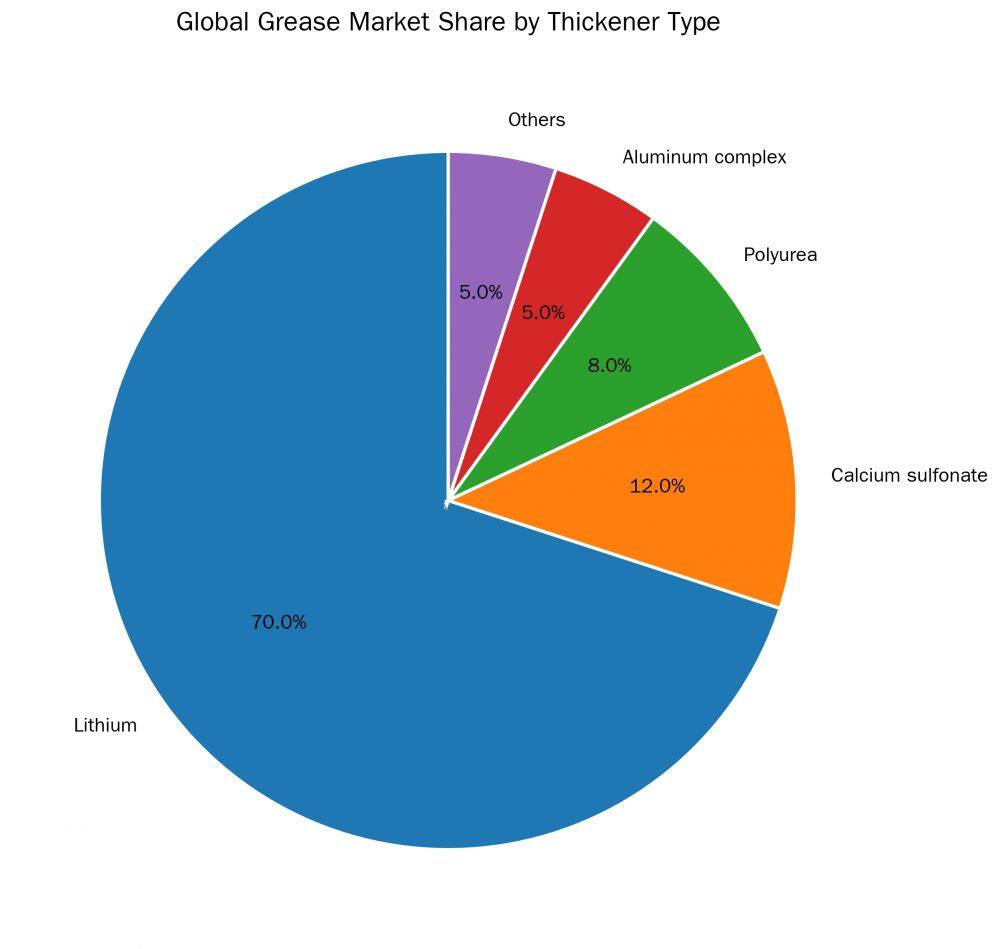
Lithium 12-hydroxystearate (CAS 7620-77-1) is the undisputed champion of grease thickeners. It forms the structural, mechanical, and thermal backbone of over 70% of the world’s lubricating greases. From the ultra-high-speed, low-noise wheel bearings of modern electric vehicles (EVs) to the massive, heavily loaded open gears of mining excavators operating in sub-zero temperatures, this specific chemical dictates how a grease reacts under extreme mechanical shear, thermal stress, and oxidative pressure.
However, a dangerous misconception persists in the global supply chain: the belief that Lithium 12-hydroxystearate is a generic, interchangeable commodity. It is not. It is a highly engineered chemical intermediate. The exact morphology of its crystalline structure, the absolute purity of its hydroxyl groups, the precise stoichiometric balance of its lithium content, and the absence of residual unreacted fatty acids are the hidden variables that separate premium, high-margin lubricants from catastrophic mechanical failures.
This comprehensive, technical-grade guide, developed by the tribology and chemical synthesis experts at Qingdao ACTA Biotechnology Co., Ltd., provides global grease manufacturers with deep engineering insights into the Grease Thickener Kinetics and molecular mechanics of lithium soap, advanced kinetic manufacturing protocols, rigorous quality assurance standards, and strategic procurement frameworks.
To fully comprehend the critical importance of high-purity Lithium 12-hydroxystearate, one must first analyze the macroeconomic landscape and the fundamental Grease Thickener Kinetics of the global lubricants industry. The worldwide lubricating grease market operates on an astronomical scale, exceeding USD 7.5 billion annually, driven by rapid industrial automation and the evolution of automotive drivetrains.
According to comprehensive industry production surveys conducted annually by the National Lubricating Grease Institute (NLGI) and the European Lubricating Grease Institute (ELGI), lithium-based greases account for an overwhelming 70% to 75% of total global grease production.
Despite the aggressive marketing of alternative thickener technologies—such as anhydrous calcium, calcium sulfonate complex, polyurea, and aluminum complex—none have dethroned lithium. The reason lies in its unparalleled, synergistic balance of cost-efficiency and the predictable Grease Thickener Kinetics that allow for multi-purpose performance and massive manufacturing scalability.
Prior to the commercialization of lithium 12-hydroxystearate, formulators relied on highly compromised technologies. Sodium soaps offered high melting points but dissolved instantly in water, while calcium soaps offered water resistance but collapsed at 80°C.
Lithium 12-hydroxystearate revolutionized tribology by optimizing Grease Thickener Kinetics to provide:
While simple lithium 12-hydroxystearate grease handles general needs, extreme environments led to Lithium Complex greases. Crucially, high-purity Lithium 12-hydroxystearate remains the foundational building block. By mastering the Grease Thickener Kinetics involved in reacting the primary lithium soap with a complexing agent (like azelaic or sebacic acid), formulators push dropping points beyond 260°C. However, if the primary base thickener is contaminated, the entire complexing process will yield unpredictable, substandard results.
To engineer a superior grease, one must view the formulation through the lens of a physical chemist. The performance of a grease is entirely dependent on the physical “sponge” created by the thickener.
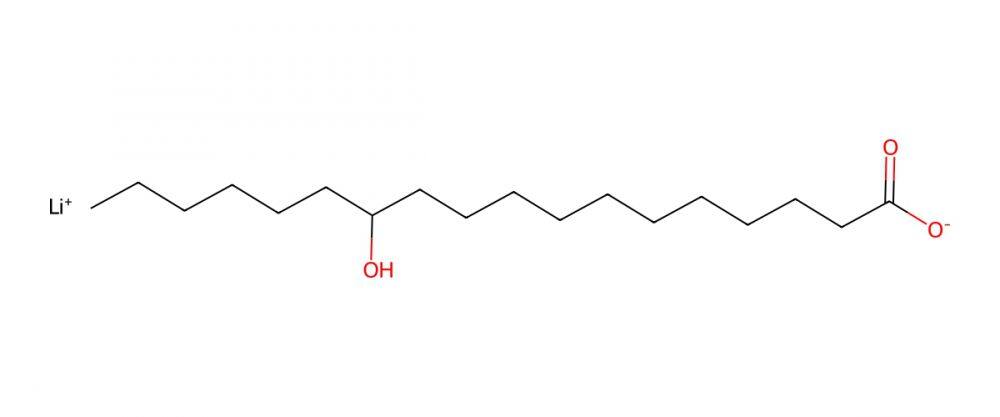
Lithium 12-hydroxystearate is synthesized through a highly controlled saponification reaction between battery-grade Lithium Hydroxide (LiOH) and 12-Hydroxystearic Acid (12-HSA).
The journey of 12-HSA begins with natural castor oil. Unlike standard stearic acid (derived from animal tallow, which is a straight hydrocarbon chain), 12-HSA possesses a critical, defining structural feature: a hydroxyl group (-OH) attached precisely at the 12th carbon atom.
When normal stearic acid is saponified, the soap molecules are held together by weak Van der Waals forces. The resulting grease is soft, lacks memory, and bleeds oil.
Conversely, the highly polar -OH groups in Lithium 12-hydroxystearate interact directly with one another to form strong intermolecular hydrogen bonds. This acts as “molecular Velcro.” The soap molecules twist, stack, and self-assemble into a highly ordered, three-dimensional crystalline lattice, giving the grease its structural rigidity.
Under a Scanning Electron Microscope (SEM), high-quality Lithium 12-hydroxystearate appears as a dense, tangled forest of microscopic twisted fibers. This matrix physically traps base oil through capillary action and surface tension.
Static Phase: Hydrogen-bonded fibers hold the oil tightly in place, preventing leakage.
Dynamic Phase: Mechanical shear aligns the fibers, breaking the physical structure temporarily and allowing the grease to behave like a fluid to lubricate metal asperities.
Recovery Phase: The chemical memory provided by the hydrogen bonds immediately pulls the fibers back into their tangled matrix, returning the grease to its semi-solid state.
This reversible phenomenon is thixotropy. If the thickener contains impurities, hydrogen bonding sites are blocked. Fibers become short and brittle, causing the grease to structurally collapse under pressure.
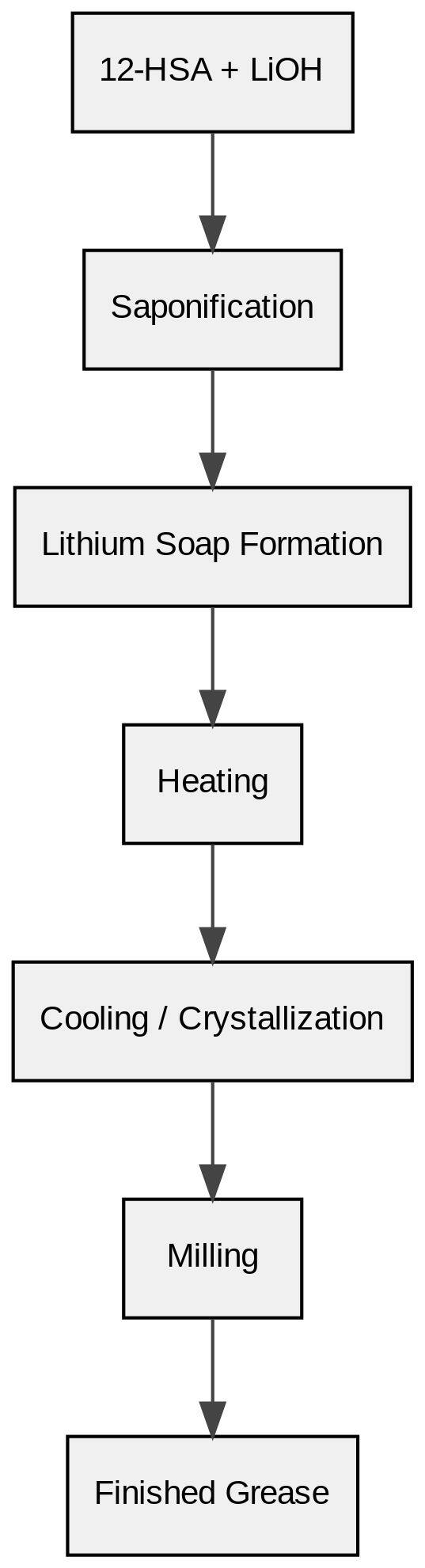
The synthesis of lithium grease is a delicate thermodynamic process. Utilizing a high-quality, pre-formed thickener from Qingdao ACTA Biotechnology drastically simplifies this process for formulators.
The solid Lithium 12-hydroxystearate powder is slowly inducted into a portion of the base oil under agitation.
The ACTA Advantage: Our product is meticulously engineered for optimal particle size distribution. It presents as a fine, free-flowing powder that disperses rapidly without forming “fish-eyes” (impenetrable lumps of dry powder), ensuring a visually appealing and structurally sound grease.
As the kettle reaches 195°C–205°C, the solid crystals dissolve into the base oil, forming a clear liquid solution. This stage is highly sensitive to the Acid Value. High levels of unreacted free fatty acids will violently attack and oxidize the base oil at 200°C. ACTA strictly controls Acid Value to ≤ 4.0 mg KOH/g to act as a shield, protecting your expensive synthetic base oils.
As the solution is strategically cooled, the soap reaches supersaturation and crystallizes out of the oil matrix. The cooling rate dictates fiber structure (fast cooling yields hard grease; slow cooling yields buttery grease). ACTA’s exceptional purity ensures that crystallization kinetics remain identical from batch to batch, eliminating unpredictable NLGI grade shifts.
The remaining oil and additives are folded in, and the grease is pumped under high pressure through a colloid mill. Intense mechanical shear “combs” the soap fibers. A high-quality, flexible thickener like ACTA’s will stretch and align without breaking, whereas cheap thickeners will physically shatter inside the mill.
At Qingdao ACTA Biotechnology, we do not test to “pass” industry minimums; we test to exceed them. Here is how our parameters protect your bottom line.
| Quality Parameter | Definition | Industry Standard | The ACTA Standard | Engineering Impact |
| Hydroxyl Value | Concentration of essential -OH groups for hydrogen bonding. | ≥ 150 mg KOH/g | ≥ 158 mg KOH/g | A low value means weak fiber structure, leading to severe dynamic oil separation and mechanical stability failure. |
| Acid Value | Amount of unreacted, free fatty acids in the powder. | ≤ 5.0 mg KOH/g | ≤ 4.0 mg KOH/g | Acids accelerate oxidative breakdown of base oils and neutralize your expensive performance additives. |
| Lithium Content | Exact mass percentage of elemental lithium bound in the soap. | 2.0% – 2.3% | 2.0% – 2.3% | Unreacted LiOH is highly alkaline and abrasive; it will literally score and destroy high-speed bearings. |
| Dropping Point | Temperature at which the grease matrix collapses into liquid. | N/A | ≥ 195°C (in 10% reference grease) | First metric for high-temp grease. Low dropping point is a direct symptom of thickener impurity. |
| Moisture | Percentage of trapped water within the thickener. | ≤ 1.0% | ≤ 0.5% | Moisture flashes into steam at 200°C, causing explosive foaming in the kettle and severe bearing corrosion. |
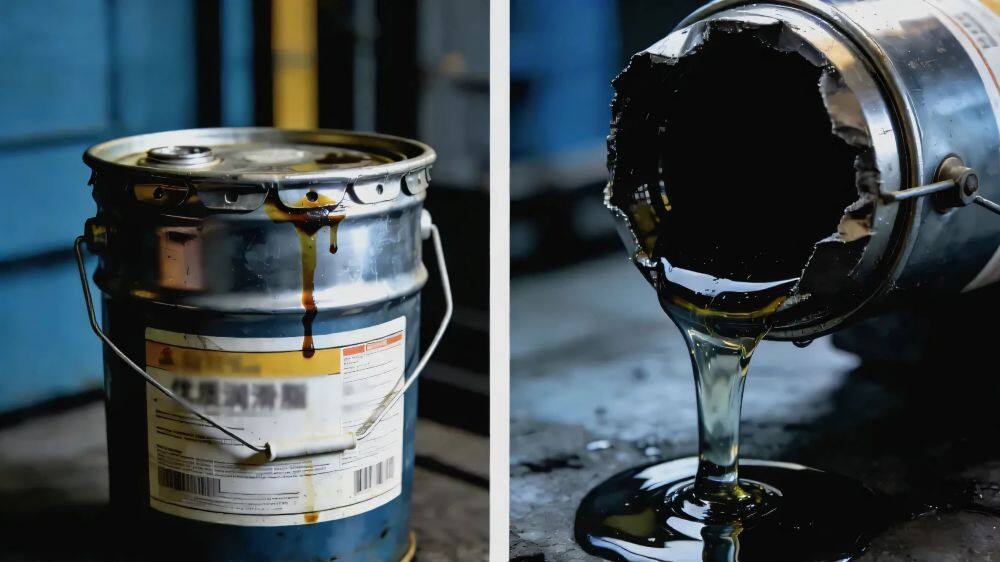
When thousands of liters of grease must be scrapped, the financial loss is staggering. ACTA’s technical team frequently helps clients troubleshoot these six common issues:
Procuring Lithium 12-hydroxystearate is a complex exercise in global risk management. Buying based solely on the lowest price per kilogram is a dangerous illusion.
Over 80% of the world’s castor beans are grown in Gujarat, India. Yields are volatile due to weather and speculation. When castor prices spike, low-tier manufacturers quietly dilute their products with cheaper stearic acid (lowering Hydroxyl Value) to maintain profit margins. This is exactly why formulators suddenly experience massive batch failures when macroeconomic conditions shift.
China is the premier global hub for downstream processing of castor derivatives. Sourcing from a reputable, heavily capitalized manufacturer like ACTA provides:
Smart procurement teams do not buy on invoice price alone; they buy based on mathematical TCO, which is fundamentally driven by the efficiency of Grease Thickener Kinetics. If a generic supplier offers a thickener for $0.15 less per kilogram, the following hidden costs often emerge:
The ACTA ROI: Formulators utilizing ACTA experience optimized Grease Thickener Kinetics, resulting in lower treat rates and zero batch rework. In high-stakes lubrication, superior kinetics are the ultimate cost-reduction strategy.
The Hidden Cost of Treat Rates: If a competitor’s product lacks the high-purity Grease Thickener Kinetics required to form a robust lattice, you may require a 10% treat rate instead of ACTA’s highly efficient 8% rate. Essentially, you are buying more powder to compensate for poor structural kinetics, increasing the total cost per batch.
The Cost of Rework: If inconsistent Grease Thickener Kinetics ruin a 5,000-liter batch, the loss is catastrophic. You lose not only the thickener but also the expensive synthetic base oil, complex additive packages, factory labor, and—most importantly—customer trust.
Since 2012, Qingdao ACTA Biotechnology Co., Ltd. has transitioned from a specialized domestic producer to a globally recognized standard-bearer in grease thickener technology.
Our advanced facility utilizes DCS (Distributed Control Systems) to continuously monitor reactor core temperatures, agitation torque, and reaction kinetics down to the millisecond, eliminating human error from the production floor.
We control the lifecycle of our material through three stringent gates:
For our industrial partners, supply chain traceability is a non-negotiable requirement. Every bag of ACTA Lithium 12-hydroxystearate is stamped with a unique, scannable lot number. Furthermore, we retain physical, sealed samples of every single production batch in our climate-controlled archives for a minimum of 24 months. If a client ever has a question or an audit regarding a formulation a year down the line, we can immediately pull the exact historical sample and run comparative diagnostics.
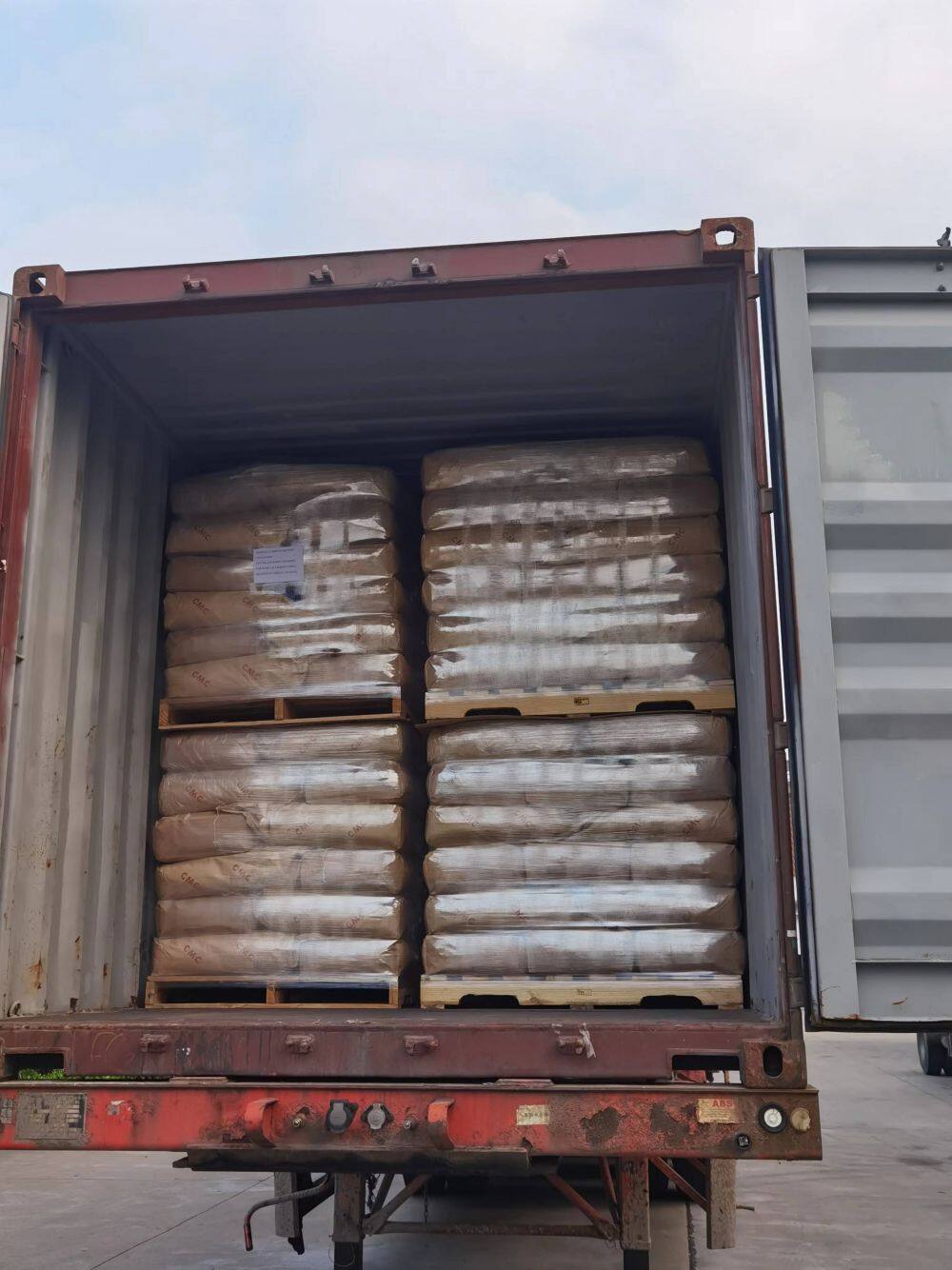
We understand that shipping a highly hygroscopic powder across the ocean requires meticulous care. ACTA abandons cheap woven sacks in favor of heavy-duty, multi-ply kraft paper bags equipped with a dedicated, extra-thick inner moisture-barrier polymer liner. Bags are hermetically sealed, neatly palletized, and secured with heavy-duty stretch wrapping to ensure that the thickener arrives at your facility exactly as dry, pure, and free-flowing as the day it left our reactors.
To move beyond theory and illustrate the tangible, financial impact of upgrading your thickener supply, consider these anonymized case studies from our global portfolio of clients.
The Challenge: A major tier-one lubricant manufacturer in Southeast Asia, producing thousands of tons of heavy-duty automotive chassis grease annually, was experiencing a crippling 15% batch rejection rate due to unstable NLGI penetration values. One batch would pass, the next would be far too soft, requiring extensive, costly rework.
The Diagnosis: ACTA’s technical engineering team audited their formulation and analyzed their previous supplier’s thickener. We discovered massive, hidden fluctuations in the Hydroxyl Value (ranging wildly from 140 to 158 mg KOH/g across different shipments depending on the season).
The ACTA Intervention: The manufacturer transitioned 100% of their purchasing to ACTA Lithium 12-hydroxystearate, with our ironclad guarantee of a Hydroxyl Value ≥158.
The Result: Within the very first month of pilot production, penetration variance dropped to near zero. The manufacturer was able to standardize their heating and cooling profiles entirely, eliminating the 15% batch rejection rate and saving over USD $120,000 annually in energy, labor, and rework costs.
The Challenge: A specialty lubricant blender in the United Arab Emirates (UAE) was attempting to formulate a high-temperature desert mining grease. Their current simple lithium grease was structurally collapsing and melting out of the heavy equipment bearings at 175°C, causing catastrophic, multi-million dollar equipment failures at the mine.
The Diagnosis: Their local thickener supplier was utilizing poorly processed 12-HSA, leaving dangerously high levels of unreacted free fatty acids (Acid Value > 8) in the powder. This excess acid disrupted the crystal lattice and artificially depressed the dropping point of the final grease.
The ACTA Intervention: ACTA supplied our premium grade thickener, featuring an Acid Value strictly controlled to ≤ 4.0 and boasting pristine, long-fiber morphology.
The Result: Without changing a single drop of the base oil or altering the expensive additive package, the dropping point of the customer’s finished grease instantly shot up to 202°C. The grease successfully passed the rigorous high-temperature bearing tests, allowing the client to secure a highly lucrative government mining contract.
The Challenge: A European formulator developing a “fill-for-life” grease for next-generation Electric Vehicle drivetrains was failing the strict NVH (Noise, Vibration, and Harshness) acoustic tests mandated by the automotive OEM. The bearings were running too loud.
The Diagnosis: Standard commercial thickeners contain microscopic hard particles—unreacted lithium carbonate and trace agglomerates—that scratch the ultra-smooth raceways of high-speed EV bearings (operating at 20,000+ RPM), generating unacceptable acoustic noise.
The ACTA Intervention: ACTA deployed our ultra-milled, high-purity variant. By ensuring 100% stoichiometric reaction and utilizing advanced micronization milling prior to packaging, we eliminated all hard particulate contaminants.
The Result: The formulation passed the OEM’s acoustic decibel limits with flying colors. The grease provided a perfectly smooth, silent hydrodynamic film, positioning the client as a leading supplier in the booming European EV sector.
As the world rapidly transitions toward Electric Vehicles (EVs), renewable wind energy, and high-speed industrial robotics, the mechanical and thermal demands placed on lubricating grease are skyrocketing to unprecedented levels.
EV motor bearings operate at incredibly high RPMs and require “fill-for-life” lubrication that cannot bleed under high centrifugal forces, cannot evaporate, and must maintain strict dielectric properties to prevent electrical arcing. Offshore wind turbine main bearings face massive shock loads, salt-water ingress, and impossible maintenance schedules.
To meet these futuristic, high-stakes demands, formulators are relying heavily on advanced Lithium Complex and Lithium-Calcium mixed soap hybrid technologies. However, the foundational law of tribology remains unchanged: You cannot build a skyscraper on a weak, crumbling foundation.
As grease formulations become increasingly sophisticated and additive packages become more sensitive, the absolute purity requirements for the base Lithium 12-hydroxystearate will only increase. Qingdao ACTA Biotechnology is not resting on its laurels. We are already pioneering next-generation synthesis techniques to push hydroxyl values even closer to theoretical maximums and trace impurities closer to absolute zero, ensuring our global partners are fully equipped and ready for the extreme lubrication challenges of the next decade.
Lithium 12-hydroxystearate is vastly more than just a line item on a procurement spreadsheet; it is the structural heart, the molecular skeleton, of your lubricating grease. Settling for cheap, inconsistent, poorly controlled thickeners from unreliable brokers is a guaranteed fast track to operational headaches, ruined factory batches, catastrophic field failures, and the permanent loss of highly valued customers.
At Qingdao ACTA Biotechnology Co., Ltd., we view ourselves not merely as chemical vendors, but as an integrated extension of your R&D, Quality Assurance, and Procurement departments. Our unyielding commitment to ISO 9001 manufacturing excellence, uncompromising feedstock verification, and deep, specialized tribological expertise makes us the safest, most reliable, and most technically proficient choice for grease manufacturers globally.
When you source your thickener from ACTA, you are not just buying a sack of white powder. You are buying formulation stability. You are buying total peace of mind for your engineers. You are buying the ironclad guarantee that your grease will perform exactly as engineered, every single time, in every bearing, all over the world.
Choosing a new thickener supplier or upgrading your current supply chain is a critical engineering and financial decision. We confidently invite R&D directors, formulation chemists, and strategic procurement managers to put our quality to the ultimate test. Our global technical engineering team is ready to support your formulation transition with absolute transparency and zero risk.
Comprehensive Documentation: Full Technical Data Sheets (TDS), Material Safety Data Sheets (MSDS), and REACH compliance information where applicable.
Transparent Quality Proof: Representative, batch-specific Certificates of Analysis (COA) clearly demonstrating our superior analytical metrics against industry norms.
Risk-Free Pilot Trials: Complimentary Laboratory Evaluation Samples (typically 500g to 1kg) shipped directly via DHL/FedEx to your R&D facility for immediate pilot-scale grease cooking trials and physical testing.
Expert Engineering Support: One-on-One Technical Consultation with our in-house tribology experts. Whether you need help optimizing a specific formulation’s treat rate, diagnosing an ongoing phase-separation issue, or developing a new high-temp complex grease, we are here to assist.
Secure Your Global Supply Chain Today: Do not wait for your next 10,000-liter batch to fail before rethinking your thickener supply strategy. Contact the experts at ACTA Biotechnology today and discover the profound financial and operational difference that true manufacturing excellence can make to your lubricants business.
Qingdao ACTA Biotechnology Co., Ltd. — Engineering the Future of Global Lubrication, One Batch at a Time.
https://www.sciencedirect.com/science/article/abs/pii/S1226086X22001423
