

Best MCC Gel to Stop Sedimentation in Plant Milk & Dairy Beverages: Solving Stability Issues with High-Performance Colloidal MCC (2026 Technical Guide)
Improving Mouthfeel and Stability in Dairy & Plant-Based Beverages: The Complete Technical Guide to Microcrystalline Cellulose Gel
Qingdao ACTA Biotechnology Co., Ltd. | MCC Gel Manufacturer & Global Supplier
You’ve spent weeks perfecting your plant-based milk formula. The flavor profile is exactly where you want it, the nutritional panel is locked in — and then, 48 hours after bottling, you open a sample and see it: a dense layer of sediment sitting at the bottom, and thin, watery liquid floating on top.
This isn’t a packaging problem. It’s not a processing problem. It’s a stabilizer problem.
From almond milk producers in California to coconut drink manufacturers in Southeast Asia, suspension instability remains one of the most persistent and costly formulation challenges in the beverage industry. At ACTA’s technical team in Qingdao, we receive variations of the same email from formulators across different countries, describing almost identical scenarios, every single year.
The answer, in nearly every case, comes back to one ingredient: Microcrystalline Cellulose Gel (MCC Gel, also known as Colloidal MCC).
Standard Microcrystalline Cellulose (MCC) is a purified, partially depolymerized cellulose derived from high-quality wood pulp or cotton linter. Most formulators encounter it first as a tablet binder in pharmaceutical manufacturing.
MCC Gel — also searched as Colloidal MCC, MCC Gel Manufacturer, or Microcrystalline Cellulose Gel supplier — is a co-processed form: MCC co-dried with a controlled percentage of sodium carboxymethylcellulose (CMC). During manufacturing, CMC acts as a dispersing aid, coating the cellulose microfibrils and enabling them to re-disperse in water to form a stable, three-dimensional colloidal network.
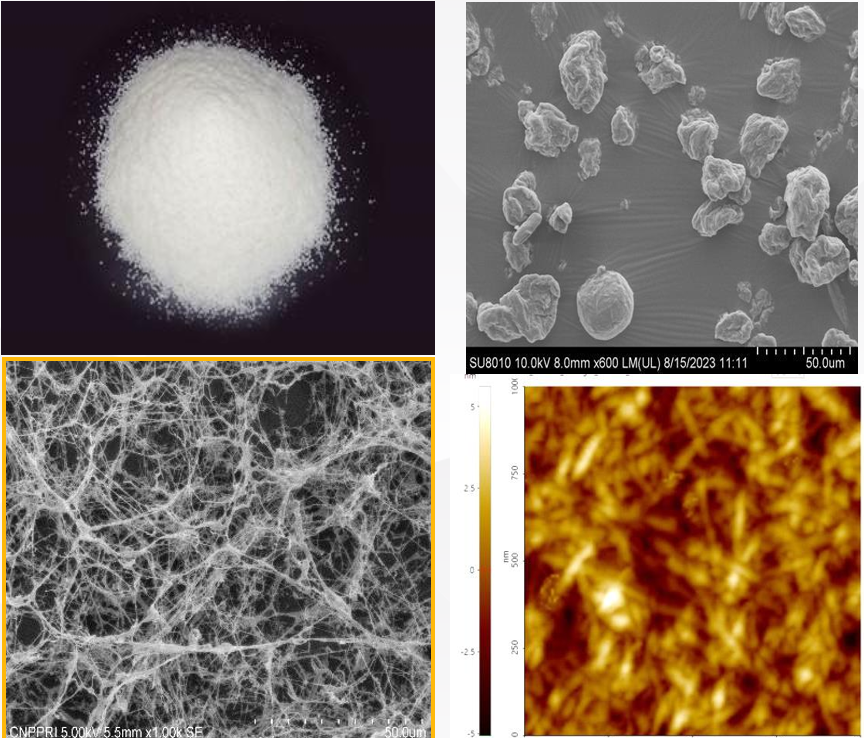
Colloidal Cellulose Product Form
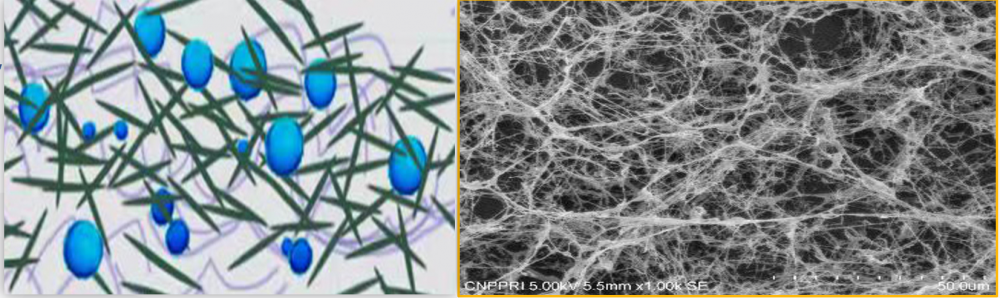
MCC Gel’s 3D network structure — the mechanism behind suspension stability in plant-based beverages.
The resulting material has fundamentally different functional properties from standard MCC powder — and those differences are what solve your sedimentation problem.
At ACTA, every production batch of MCC Gel is tested against the following specifications, with a batch-specific COA issued for every single shipment:
| Parameter | Specification |
| Particle Size (D90) | ≤ 40 μm |
| Moisture Content | ≤ 8.0% |
| pH (2% dispersion) | 5.0 – 7.5 |
| Viscosity (1% dispersion, 25°C) | 25 – 100 mPa·s |
| CMC Content | 8% – 18% |
| Compliance | USP / EP / BP / GB Standard |
This table is not marketing material. It is the core content of the COA that ships with every order. When your goods arrive, your QC team has the actual batch data in hand — not a generic template.
Two rheological concepts explain why MCC Gel consistently outperforms conventional stabilizers in suspension applications:
Shear Thinning Under mechanical stress — pumping, mixing, homogenization — the viscosity of an MCC Gel dispersion drops significantly. The 3D microfibril network temporarily breaks apart under applied force. The result: smoother pumping, consistent filling, lower energy consumption on your production line.
Thixotropy Once shear stress is removed — once the product sits still inside a bottle on a shelf — the 3D network rebuilds itself. Viscosity recovers. Particles, proteins, and fat droplets are held in place.
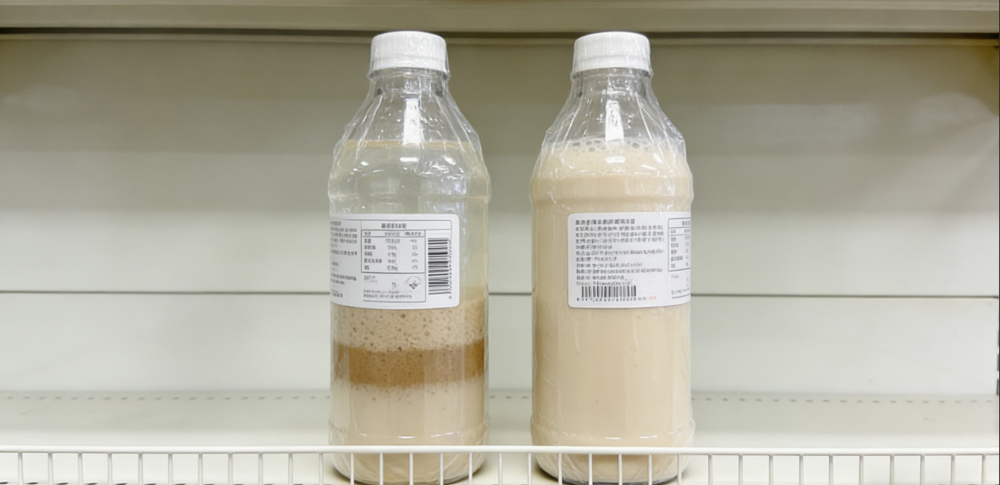
72-hour shelf stability comparison: without MCC Gel (left) vs. with ACTA MCC Gel (right).”]
This combination is what no single hydrocolloid can fully replicate:
| Stabilizer | Adds Viscosity | Builds Structural Memory | Shear-Recoverable |
| Xanthan Gum | ✅ | ❌ | Partial |
| Guar Gum | ✅ | ❌ | ❌ |
| Carrageenan | ✅ | Partial | ❌ |
| MCC Gel (Colloidal MCC) | ✅ | ✅ | ✅ |
Those hydrocolloids add viscosity. MCC Gel builds structural memory. When working with clients on stabilizer reformulation, we rarely recommend replacing MCC Gel’s suspension function with a single hydrocolloid alone — they address fundamentally different dimensions of the same problem.
This is where many MCC Gel suppliers fall short — and where procurement teams need to pay close attention.
In pharmaceutical tablet manufacturing, if your MCC Gel batch drifts just 0.5% above the moisture specification, the following cascade begins:
· ⚠️ Granulation water uptake increases unpredictably
· ⚠️ Granule hardness becomes inconsistent batch to batch
· ⚠️ Tablet compression force must be recalibrated
· ⚠️ Dissolution profiles shift — potentially outside regulatory acceptance criteria
In food applications, excess moisture accelerates microbial risk and destabilizes the colloidal network by disrupting hydrogen bonding between microfibrils.
“Don’t just look at the price per kg. Ask your supplier for the Moisture Stability Report of the last 3 batches. A 1% moisture fluctuation can cost you $10,000 in batch rework. Quality is always cheaper than downtime.”
— Richard, Technical Sales Director, Qingdao ACTA Biotechnology Co., Ltd.
We have worked with customers across Europe, Southeast Asia, and the Middle East who previously sourced MCC Gel from lower-cost suppliers, only to find that batch-to-batch moisture variation exceeded 1%. On paper, they were saving money on raw material. In practice, they were recalibrating granulation parameters every few batches — and the combined cost of downtime, waste, and rework far exceeded the original price difference.
Consistent moisture control is not a premium feature. It is the baseline that makes everything else in your process predictable.
The global plant-based milk market is projected to surpass $21 billion USD by 2030. Formulators working across oat milk, almond milk, rice milk, soy milk, and coconut beverages face a shared set of challenges — and MCC Gel addresses each one directly.
✅ Challenge 1: Particle Sedimentation
Insoluble fiber particles, mineral fortifications (calcium carbonate, iron), and protein aggregates all want to settle. MCC Gel’s thixotropic network suspends them without generating a heavy or gummy mouthfeel.
· ACTA’s MCC Gel maintains D90 below 40μm, ensuring the colloidal network is fine enough to trap the suspended particles typical of plant-based milk formulas
· Recommended usage level: 0.1% – 0.5% w/w in the finished product, adjusted for particle load and target viscosity profile
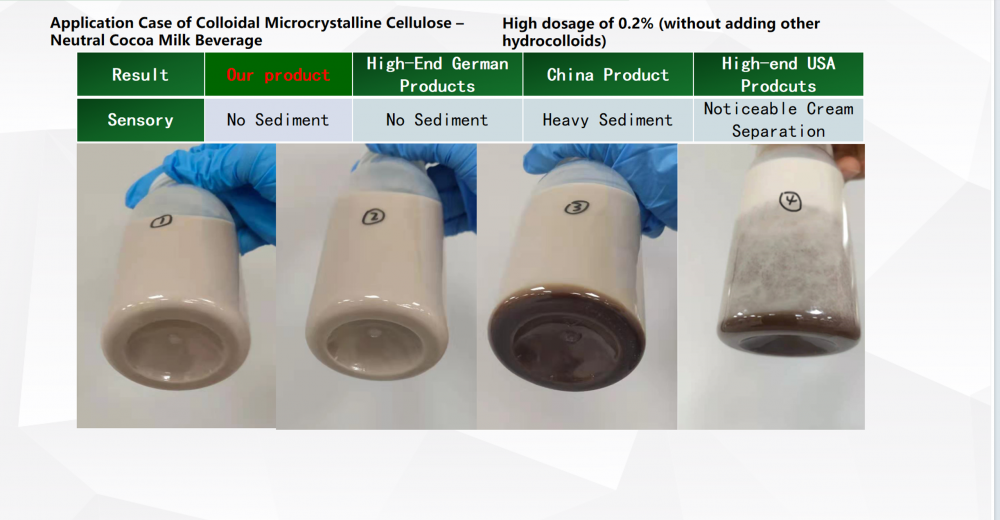
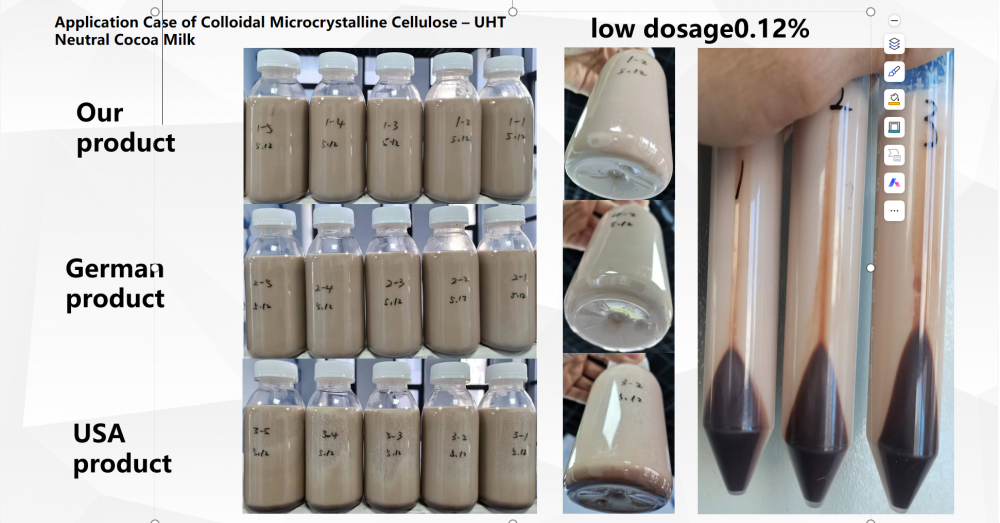
The comparsion between ACTA MCC gel and high-end German,China and High-end USA product,It can be seen that the Neutral Cocoa Milk using our colloidal microcrystalline cellulose has no sediment at all
✅ Challenge 2: Fat Separation and Creaming
Emulsified fat droplets in coconut or nut-based beverages cream upward without structural support. MCC Gel works synergistically with emulsifiers (lecithin, mono/diglycerides) to physically impede droplet coalescence.
· CMC content stability is critical in this application — ACTA controls batch-to-batch CMC variation within ±1%, ensuring emulsification synergy remains consistent across every single delivery
✅ Challenge 3: Heat-Process Stability
Plant-based beverages typically undergo UHT or retort processing. Unlike some hydrocolloids that degrade under prolonged high-temperature exposure, MCC Gel maintains its structural integrity through standard thermal processing cycles.
✅ Challenge 4: Clean Label Compliance
MCC Gel is labeled simply as “microcrystalline cellulose” on ingredient panels — recognized as a clean label ingredient across all major global markets:
· ✅ FDA 21 CFR (USA)
· ✅ EU Regulation (EC) No 1333/2008 (Europe)
· ✅ Chinese GB Standards
For brands selling simultaneously into North American, European, and Asian markets, ACTA’s multi-standard compliance documentation can be used directly for registration submissions across all jurisdictions — eliminating the cost and delay of redundant third-party testing.
· Has your current stabilizer been validated under UHT processing conditions?
· Does your MCC Gel supplier provide full D10 / D50 / D90 particle size data, or just an average figure?
· Can you receive a batch-specific COA within 24 hours of requesting one?
If the answer to any of these is “no” or “I’m not sure” — it may be time to benchmark your current supply against a higher standard.
[Request a Free 500g Lab Sample + Full Batch COA →]
Application Deep Dive: Pharmaceutical Oral Suspensions
Beyond food and beverage, MCC Gel is a critical excipient in pharmaceutical oral suspensions — antacids, pediatric antibiotics, and mineral supplements among them.
| Requirement | What It Means in Practice |
| Redispersibility | Gentle shaking redisperses the settled product cleanly, with no caking |
| Dose Uniformity | Every teaspoon delivers the same API quantity — critical for pediatric dosing accuracy |
| Excipient Compatibility | Chemically inert; no reaction with APIs; stable across a broad pH range |
USP and EP monographs specify full testing requirements for Microcrystalline Cellulose and CMC Sodium — including identification tests, viscosity measurement, and loss on drying. ACTA’s MCC Gel is manufactured and tested in compliance with both USP and EP specifications simultaneously.
In practical terms: the same batch of ACTA MCC Gel can support your FDA submission and your EMA dossier — without requiring separate sourcing or separate validation rounds for each regulatory market.
⚠️ Improper dispersion is the single most common reason MCC Gel underperforms in real production environments. The same material, dispersed incorrectly, can show viscosity and suspension performance that varies by several times.
If you encountered disappointing lab results with MCC Gel in the past, check the dispersion protocol before drawing any conclusions about the material itself.
Follow these four steps:
① Pre-Hydration Add MCC Gel to cold or ambient-temperature water first, before any other ingredients. Minimum water-to-MCC Gel ratio: 10:1.
② High-Shear Mixing Apply high-shear mixing (rotor-stator homogenizer or equivalent) for a minimum of 15–20 minutes. This step activates the colloidal network. Paddle mixers and low-shear agitation will not achieve adequate dispersion — regardless of how long you mix.
③ Rest Period Allow the dispersion to rest for 30 minutes before incorporating it into your main formula. This allows the 3D network to fully rebuild before it encounters other ingredients.
④ Temperature Control MCC Gel disperses optimally below 60°C. If your process requires heating, introduce the MCC Gel dispersion after the hot-fill step, or adjust your ingredient addition sequence accordingly.
Optimal dispersion parameters vary depending on your specific equipment configuration and formula composition. ACTA provides tailored dispersion guidance for each new customer’s process conditions — not as a paid add-on service, but because ensuring the material performs correctly in your system is the only outcome that matters to both sides.
Not all MCC Gel manufacturers and suppliers operate to the same standard. Here is what the real difference looks like:
| Feature | Low-Cost Suppliers | ACTA Biotechnology |
| COA Type | Generic / Template | Batch-Specific & Real-Time |
| Standards Coverage | Local standards only | USP / EP / BP / GB Multi-Compliance |
| Technical Support | Sales follow-up only | Formulation & Dispersion Guidance |
| Moisture Control | Unverified batch variance | Per-batch tested, variance documented |
| Particle Size Data | Average value only | Full D10 / D50 / D90 distribution |
| Large Order Lead Time | Often undisclosed until too late | Confirmed and committed at inquiry stage |
| Reserve Inventory | Not available | Available for forecast-based customers |
| Global Logistics | Standard only | Guaranteed shipping windows + real-time tracking |
The suppliers on the left side of this table are not hard to find. The question is what that choice costs you at the production level — in rework, in regulatory risk, and in the hours your team spends chasing quality issues that should never have arrived at your facility in the first place.
On logistics: We understand the current complexity of global shipping. ACTA provides confirmed shipping windows and real-time cargo tracking for every international order — because your production schedule cannot afford to be built around uncertainty.
MCC Gel is not a standardized commodity. Meaningful differences exist between sources in particle size distribution, CMC content, and colloidal network structure — and those differences show up directly in your finished product quality.
Use this checklist when evaluating any MCC Gel manufacturer or supplier:
· Is the COA batch-specific, or is it a generic template?
· Does particle size data include D10, D50, and D90 — not just an average?
· Can the supplier provide documentation compliant with both USP and EP?
· What is the realistic lead time for orders above 10 metric tons?
· Can the supplier hold reserve inventory against your forecast volume?
· Is technical support provided by formulation specialists, or only by sales staff?
· Does the supplier provide confirmed shipping windows for international orders?
When you ask ACTA these questions, you will get direct answers. These are exactly the questions a serious buyer should be asking — and we would rather have that conversation at the beginning of a relationship than demonstrate the answers under pressure when something goes wrong.
If you are currently assessing MCC Gel supply sources, comparing Colloidal MCC manufacturers, or dealing with active suspension stability challenges in your formulation pipeline — we are glad to help.
ACTA offers 500g free laboratory samples for qualified manufacturers and R&D teams, shipped with the full batch-specific COA. Run your own benchmarks under your own lab conditions. Compare it directly against your current material.
We are not asking for a commitment. We would rather you make the decision based on your own data.
→ [Request Free 500g Lab Sample + Batch COA]
→ [Download Our MCC Gel Technical Data Sheet (PDF)]
→ [Contact Richard — 15-Minute Free Technical Consultation]
Qingdao ACTA Biotechnology Co., Ltd. MCC Gel Manufacturer | Colloidal MCC Supplier | Food & Pharma Grade Excipients
Technical Inquiries & Sample Requests: wangpengfei@actabiotechnology.com https://www.actabiotechnology.com
MOQ: 25kg | Bulk supply available up to full container quantities
International shipping to Europe, Southeast Asia, South Asia, Middle East & Americas
