

Many individuals review the ingredient lists on vitamin bottles. Did you feel confused by a name like “Silicified Microcrystalline Cellulose USP Monograph”? This is a common practice among consumers
That lengthy name belongs to a key helper ensuring your pill is safe and effective. But to understand its role, we must first break down its core component.
The story begins with something incredibly familiar: plants. Cellulose is the strong, fibrous material that makes up tree trunks and cotton.
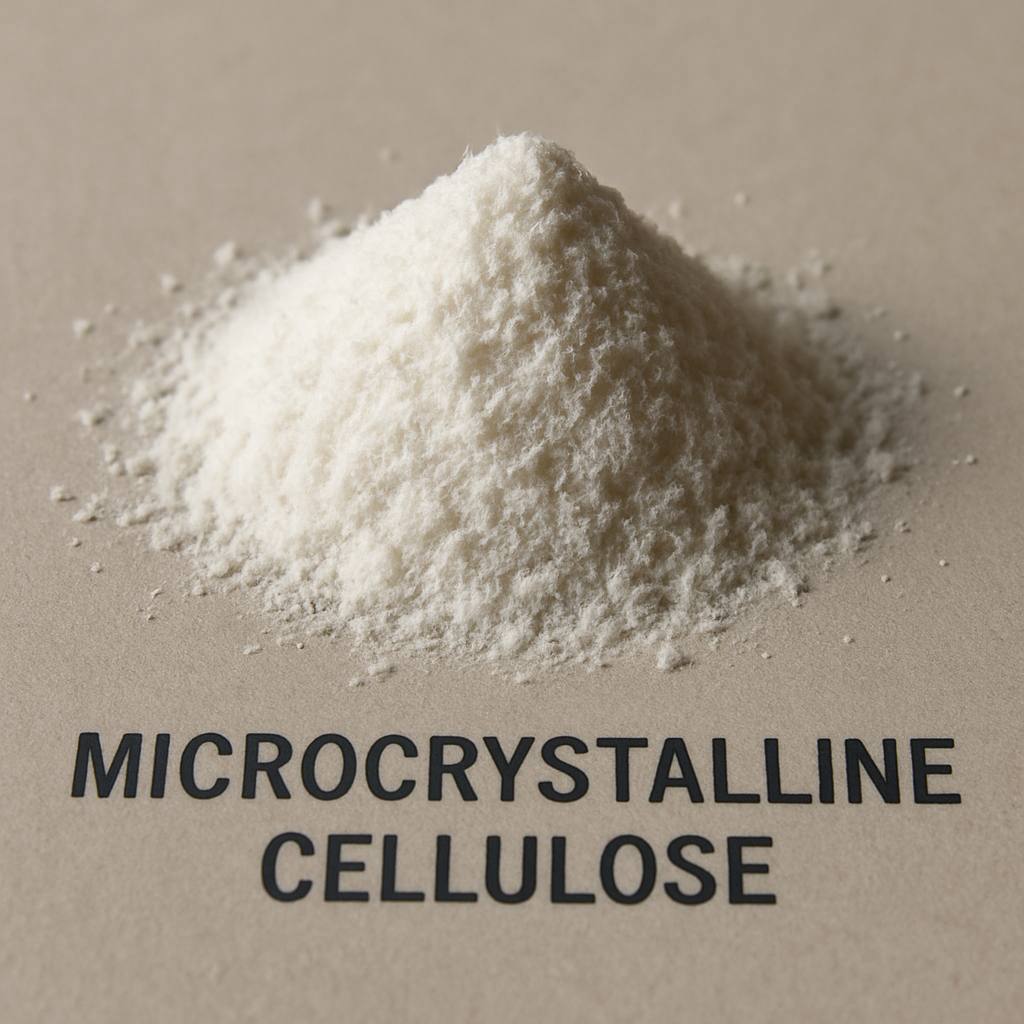
We clean and treat plant fiber with acid to make Microcrystalline Cellulose (MCC).. This process breaks it down.
The result is a purified, partially broke down cellulose that appears as a white or almost white powder. Odorless and tasteless, it serves as an ideal inert carrier for active medicines without affecting their sensory profile.
This powder functions similarly to flour in a baking recipe.. It provides the bulk for a tiny dose of active medicine and binds everything into a solid tablet.
Its does not dissolve is a key reason why MCC performs so effectively.. It won’t mix into or swell in water, alcohol, or common solvents. This chemical stability helps it remain unchanged during manufacturing and storage. This makes it a reliable base for creating consistent pills and tablets.
Even though MCC is great, there’s a common problem: the fine powder can stick and clump in fast-moving machines.
The smart solution is a process called process of adding silica. Scientists don’t just mix MCC with silica (a natural mineral from sand). Instead, they process them together in water before drying. This creates a tightly bonded mixture.
This small change makes a huge difference. The new powder flows freely, like fine sugar, instead of This property represents a major advancement for tablet manufacturing. The powder fills every tablet mold evenly and perfectly every time. This means each pill gets exactly the same amount of medicine.
This innovation not only simplifies manufacturing but also produces a superior tablet for the end user. Tablets become stronger, more stable, and much less likely to break or crumble.
But how is this special ingredient regulated to guarantee its safety, identity, and performance?
An ingredient like “Silicified Microcrystalline Cellulose” on a label need not be a source of uncertainty. Manufacturers deliberately engineer this component.
The next time you pick up a supplement, look for three letters on the ingredient list: USP. Finding them transforms the label from a mystery into a message of assurance. This monograph is the official rulebook for excipient and finished-dosage manufacturers. It helps them qualify each batch of material and support regulatory filings.
You’re not just seeing a list of words; you’re seeing a system of protection. The Silicified Microcrystalline Cellulose USP monograph is proof that behind effective medicine lie strict, enforceable rules for identity, purity, strength, and quality. That label becomes a clear signal, allowing you to read it with confidence.
A Clear Guide to Silicified Microcrystalline Cellulose (SMCC)
To help you understand this important ingredient, we will explain ten key points. We will discuss what it is, the process of ensuring it meets rigorous standards (USP-NF), and the reasons for its effectiveness.
SMCC (Silicified Microcrystalline Cellulose) constitutes a co-processed composite, not a simple mixture.. Manufacturers create it by mixing cellulose and silica in water.
They then dry the mixture, which forms a strong bond. Its typical composition combines approximately 98% cellulose with 2% silica. This exact ratio meets official quality tests.
The final product is a white, odorless, tasteless powder that flows easily. Its porous structure is key—it provides lots of surface area to help bind ingredients and make pills break apart in your body.
Its main job is to act as a binder and filler for making tablets by direct compression. This method is simpler and safer than older ones. The 2% silica makes it flow and compress much better.
A major feature is that it does not dissolve in water, alcohol, acetone, or toluene. It also doesn’t dissolve in most acids or solvents, though it may swell slightly in strong alkali. Because it’s so inert, it doesn’t interfere with the medicine itself; it just provides physical support.
An official rulebook called the USP monograph guarantees its quality. This legally recognized document sets every standard—from how to identify SMCC to how pure it must be. It acts as a quality contract, ensuring every batch performs exactly as needed in your medicine.
SMCC flows much better than regular cellulose powder. Adding 2% nano-silica can improve flow by over 30%.
This characteristic is vital for modern pill presses to produce tablets of identical weight.. In industry, things like Carr’s Index measure flow. SMCC often achieves a Carr’s Index score of ≤20%, which indicates “good” to “excellent” flow.
It compresses more evenly, which solves common pill-making problems. This compression reduces defects.
It decreases issues like “capping,” where the top layer peels off, and “lamination,” which is internal splitting. The reduction is over 50%. This means fewer wasted pills and a stronger, more reliable final product for you.
The USP monograph requires many tests to ensure every batch is reliable:
The monograph also checks for impurities:
Adherence to the USP monograph ensures the high consistency of SMCC. This helps drug makers compress difficult powders directly. This includes high-dose or sticky medicines without needing extra steps. This makes developing new pills more straightforward and cost-effective.
While USP sets the minimum bar, top manufacturers test even more. They tightly control extra factors like powder density, surface area, and precise particle size. This guarantees not just minimum quality, but outstanding and consistent performance in high-speed production.
Beyond its main job, SMCC’s properties let it do other tasks, which can simplify pill recipes:
In short, “Silicified Microcrystalline Cellulose USP” is far from just a complicated name. Strict quality rules support this highly engineered, multi-purpose solution. This process shows how science and strict rules turn simple plant fiber into a pill ingredient you can trust. The USP monograph is what builds that trust.
References & Further Reading on the USP Monograph:
