Pharmaceutical Tableting Excipient: A Technical Masterclass for R&D and Quality Assurance Professionals
Authored by: The Global Technical Division, Qingdao ACTA Biotechnology CO., LTD
1.Introduction: Redefining the Role of the Pharmaceutical Tableting Excipient
In the traditional pharmaceutical nomenclature, Microcrystalline Cellulose (MCC) is often relegated to the status of an “excipient” or “filler.” However, in the high-stakes environment of modern, high-speed tableting—where machines operate at velocities exceeding 200,000 units per hour—MCC is far from inactive. It is the mechanical engine of the solid dosage form.
1.1 The Forensic Case Study: The 500mg Paracetamol Crisis (Expanded)
A mid-sized manufacturer in Southeast Asia recently reported a catastrophic failure in their paracetamol line. Paracetamol is notoriously difficult to compress due to its elastic nature and poor bonding properties.
The Baseline: For years, they used a standard Direct Compression (DC) blend with a 30% MCC loading.
The Incident: During a peak monsoon season, tablet friability jumped from 0.4% to 1.8%. Hardness dropped from 15kp to 8kp.
The Investigation: ACTA’s technical team conducted a root cause analysis. While the API purity was within 99.9%, the MCC’s Loss on Drying (LoD) had drifted to 5.8%. Although this was below the USP limit of 7.0%, the “Free Water” at the particle surface was acting as a molecular lubricant, preventing the formation of the critical hydrogen-bonding network.
The Lesson: Precision in MCC selection isn’t about meeting the pharmacopoeia—it’s about mastering the process window.
2. Molecular Architecture of a Superior Pharmaceutical Tableting Excipient
MCC (CAS 9004-34-6) is not a simple ground-up wood product. It is a product of sophisticated chemical engineering.
2.1 The Acid Hydrolysis Kinetics
The production of ACTA MCC begins with high-purity, specialty wood pulp. We subject this pulp to Controlled Mineral Acid Hydrolysis.
The Target: The acid selectively attacks the Amorphous Regions (the disordered, flexible parts of the cellulose chain) while leaving the Crystalline Domains intact.
The LODP (Level-Off Degree of Polymerization): Raw cellulose has a DP of over 10,000. Through our proprietary hydrolysis time-temperature profile, we reduce this to an LODP of 150–350. This specific range is the “Sweet Spot” for mechanical strength; too low, and the particles become brittle; too high, and they become fibrous and lose flowability.
2.2 Crystallinity Index (CI) and its Impact on Tensile Strength
ACTA MCC maintains a CI of 55%–80% (measured via X-ray Diffraction). A high CI provides:
Rigidity: The ability to withstand high compression forces without fracturing into dust.
Bonding Potential: Maximizing the number of exposed hydroxyl (–OH) groups available for hydrogen bonding.
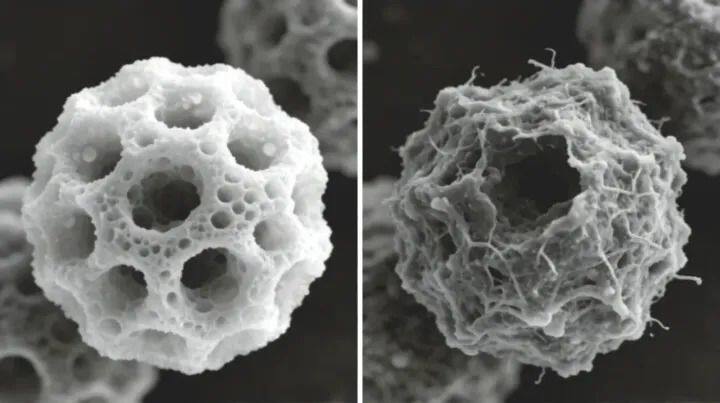
Scanning Electron Microscopy (SEM) analysis at 500x magnification. Left: ACTA PH-102 exhibiting a superior porous, sponge-like morphology optimized for API nesting. Right: Standard fibrous MCC showing limited surface area, which leads to poor bonding and potential segregation
3.Mechanics of Compression: How This Pharmaceutical Tableting Excipient Acts as “Molecular Velcro
Why can you make a tablet with MCC but not with plain starch? The answer lies in Deformation Mechanics.
3.1 Elastic vs. Plastic Deformation
Most excipients are either brittle (they fracture) or elastic (they spring back). MCC is uniquely Plastically Deforming.
The Process: When the punch applies pressure, the porous MCC particles flatten permanently. This increases the True Contact Area between particles.
The “Velcro” Effect: As particles flatten, the hydroxyl groups on adjacent surfaces come within 3 Ångströms of each other. At this distance, hydrogen bonds form spontaneously. This is “Molecular Velcro”—no liquid binder required.
3.2 Porosity and Specific Surface Area
Under Scanning Electron Microscopy (SEM), ACTA MCC reveals a sponge-like morphology. Our PH-102 grade has a specific surface area optimized for API Nesting. The porous structure allows fine API particles to “hide” within the MCC matrix, which significantly reduces Radial Segregation in the tablet press feed frame.
4. The Spray-Drying Revolution in Pharmaceutical Tableting Excipient Manufacturing
Traditional MCC is often tray-dried, leading to “Case Hardening.” ACTA utilizes Advanced Atomization Spray-Drying.
4.1 Particle Engineering in the Drying Chamber
Instantaneous Drying: The cellulose slurry is atomized into droplets and dried in seconds. This prevents the degradation of surface hydroxyl groups.
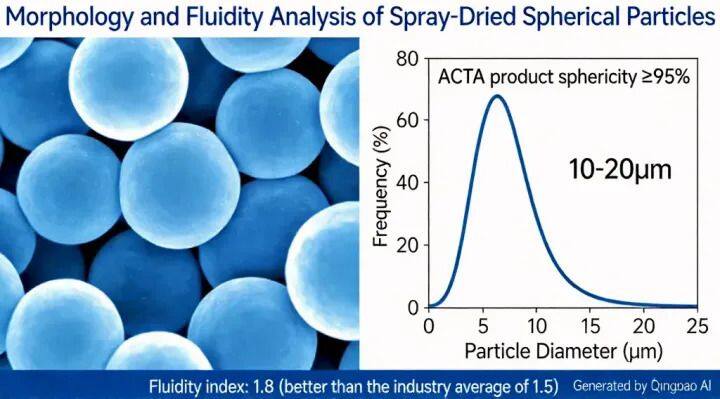
Morphology Control: Spray-drying produces more Isometric (Spherical) Particles. This is reflected in our superior Hausner Ratio (typically 1.15–1.25 for PH-102), indicating excellent flow even in humid conditions.
Thermal Purity: By minimizing heat residence time, we eliminate the formation of furfural and other thermal degradation byproducts that can cause “Yellowing” of tablets over time.
5. The Comprehensive Grade Compendium: A Detailed Framework
5.1 PH-101: The Wet Granulation Specialist
Mean Particle Size D50: 50 μm.
Bulk Density: 0.26–0.31 g/cm³.
Mechanics: High surface area makes it a superior “sponge” for aqueous binder solutions. It ensures that granules are dense and have high internal bond strength.
Application Note: Use PH-101 when your formulation requires high-shear granulation to prevent API oxidation.
5.2 PH-102: The Direct Compression Gold Standard
Mean Particle Size D50: 100 μm.
Flowability: Angle of Repose<35°.
Mechanics: This grade is engineered for high-speed rotary presses. Its particle size distribution (PSD) is tightly controlled to ensure that there are enough fines for bonding, but enough large particles for flow.
5.3 PH-301 & PH-302: High-Density and Content Uniformity (CU)
The Physics: Standard MCC is light (approx. 0.30 g/cm³). Many APIs are heavy (0.50+ g/cm³). This density gap causes Segregation.
The ACTA Solution: PH-302 has a bulk density of 0.35–0.46 g/cm³. By narrowing the density gap between excipient and API, we ensure that every tablet in a 1-million-unit batch has the exact same dose.
5.4 PH-105: The “Smooth-Melt” ODT Specialist
Mean Particle Size D50: 20 μm.
Sensory Science: The human tongue can detect particles > 50 μm as “gritty.” PH-105 is invisible to the palate.
Capillary Disintegration: The ultra-fine pores create massive capillary pressure. When the tablet touches saliva, water is “wicked” into the core, causing it to melt in seconds without a chalky aftertaste.
6. Moisture Dynamics: The “0.5% Rule” and Water Activity Aw
This is where ACTA differentiates itself from low-cost commodity suppliers.
6.1 The Destructive Power of “Free Water”
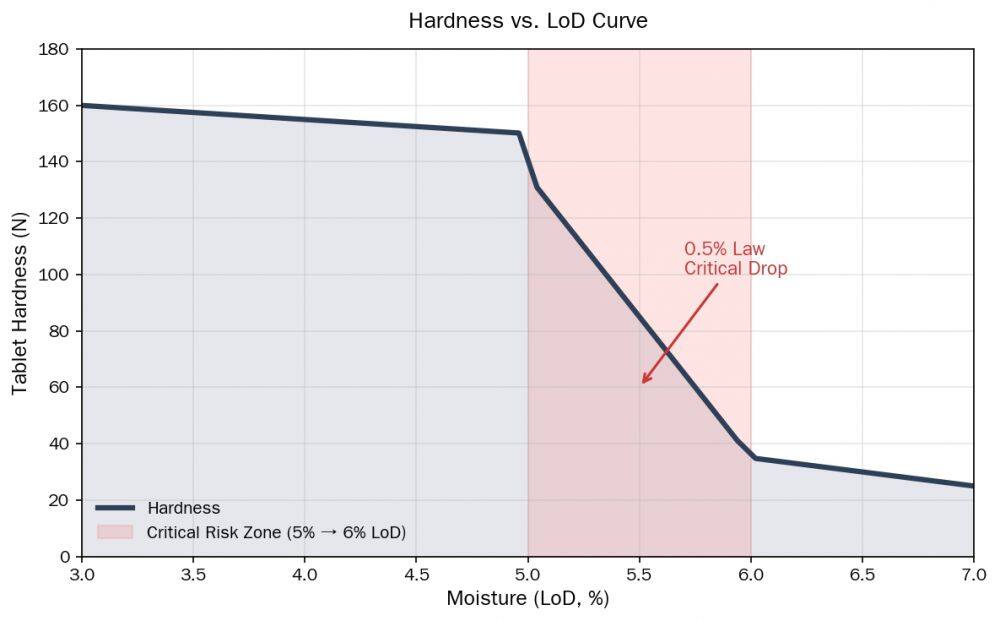
The USP/EP limit is 7.0%. However, our research shows that for every 1% increase in moisture above 3.5%, tablet tensile strength can drop by 10%–15%.
The Mechanism: Excessive water molecules occupy the hydroxyl bonding sites. Instead of a Cellulose-Cellulose bond, you get a Cellulose-Water-Cellulose bond, which is significantly weaker.
The ACTA Internal Spec: We maintain a tighter LoD (typically ≤ 5.0%) to provide our customers with a Safety Buffer against environmental humidity.
The “0.5% Rule” Impact Study. Experimental data showing the inverse correlation between Loss on Drying (LoD) and tablet tensile strength. Maintaining LoD below 5.0% provides a critical safety margin for maintaining structural integrity under high-humidity conditions
6.2 Water Activity Aw vs. LoD
Loss on Drying measures the quantity of water. Water Activity measures the energy of water. ACTA monitors Aw to ensure that water stays “bound” within the crystalline structure and does not migrate to degrade moisture-sensitive APIs like Clavulanic Acid or Aspirin.
Magnesium Stearate is the most common lubricant, but it is the enemy of MCC.
The Failure: MgSt is hydrophobic. If mixed too long, it coats the MCC particles, preventing the “Molecular Velcro” from engaging.
The Solution: Limit MgSt blending to the final 120–180 seconds of the process.
7.2 Capping and Lamination: The Decompression Physics
Capping occurs when air is trapped in the porous MCC or when the “Spring-Back” (Elastic Recovery) is too high.
ACTA Advice: Use Pre-Compression (2–5 kN) to slowly exhaust air before the Main Compression force.
Dwell Time Optimization: MCC is plastically deforming, which is a Time-Dependent process. Slowing down the turret speed (increasing Dwell Time) will often double the tablet hardness without increasing the force.
8. Global Regulatory Strategy and Quality Assurance
Qingdao ACTA is not just a factory; we are a compliance partner.
Harmonization: Our MCC is tested against USP-NF, EP, BP, and CP in every batch.
Purity Beyond Standards: * Heavy Metals: ≤ 5 ppm (Industry standard is 10 ppm).
Residue on Ignition: ≤ 0.05% (Industry standard is 0.1%).
Certifications: ISO 9001, GMP, HALAL, KOSHER, and full DMF documentation available.
9. Conclusion: The ACTA Commitment to Stability
In the pharmaceutical world, “Cheap” can be very expensive. A single failed stability test or a rejected batch can cost a manufacturer hundreds of thousands of dollars.
By choosing Qingdao ACTA, you are investing in Particle Engineering. From our spray-drying technology to our high-density PH-300 series, we provide the mechanical certainty that your R&D team needs to bring products to market faster and safer.
Experience the ACTA Reliability.
We provide Free 500g Evaluation Samples with a full technical dossier.
👉 [Request Your Sample Now] 👉 [Consult with a Technical Expert – 24h Response]