

To begin with,food stabilizers are functional ingredients that maintain the physical structure, texture, and consistency of food and beverage products throughout their shelf life. Specifically,they work by controlling water activity, preventing ingredient separation, improving viscosity, and ensuring uniform suspension of particles — particularly in complex formulations such as emulsions, gels, and foams.
In the modern food industry, food stabilizers play a critical role in meeting consumer demands for clean-label products, extended shelf life, and consistent sensory experiences. Without effective stabilization, products like plant-based milk, ice cream, salad dressings, and protein beverages would rapidly separate, lose texture, or degrade in quality during storage and distribution.
As food manufacturers face growing pressure to reduce synthetic additives while maintaining product performance, cellulose-based and starch-based food stabilizers have emerged as the preferred solution — offering natural origin, broad global regulatory approval, and outstanding multifunctional performance. Whether used as thickeners, suspension agents, emulsifiers, or texture modifiers, food stabilizers are essential building blocks for any high-quality food and beverage formulation.Unlike traditional thickeners, food suspension agents maintain particle distribution in liquid systems.
In modern food manufacturing, producers actively select different types of food stabilizers to control texture, viscosity, and suspension behavior. These stabilizers play a critical role in maintaining product consistency during processing, storage, and transportation. In addition, manufacturers choose specific stabilizer systems based on functional requirements such as heat stability, pH resistance, and long-term suspension performance. As a result, cellulose-based stabilizers, hydrocolloids, and modified starch systems are widely applied across food industries to achieve targeted formulation performance.
Food stabilizers are functional ingredients used to control viscosity, suspension, and texture stability in food systems.They are widely applied in dairy, beverages, sauces, bakery, and plant-based formulations.
Selecting the right stabilizer begins with understanding the functional properties of each ingredient type. The following are the most widely used food stabilizers across global food and beverage manufacturing.
In beverage production, manufacturers rely on beverage stabilizer systems to maintain uniform suspension and improve mouthfeel. These systems actively prevent sedimentation of insoluble particles in juice drinks, dairy beverages, and plant-based formulations. In addition, they help maintain stable texture even under temperature fluctuations during processing and storage. As a result, beverage manufacturers achieve consistent product quality, improved stability, and enhanced consumer experience throughout shelf life.
MCC is a cellulose-based stabilizer used to improve suspension stability and texture consistency in food systems.
Microcrystalline Cellulose (MCC) Microcrystalline Cellulose is a plant-derived, insoluble cellulose stabilizer used as a fat replacer, suspension agent, and texture modifier in food applications. Its colloidal gel network provides outstanding particle suspension in beverages and dairy alternatives, while delivering a smooth, creamy mouthfeel without added fat. Morevoer,MCC is GRAS-approved by the FDA, heat-stable, and highly compatible with clean-label product development.
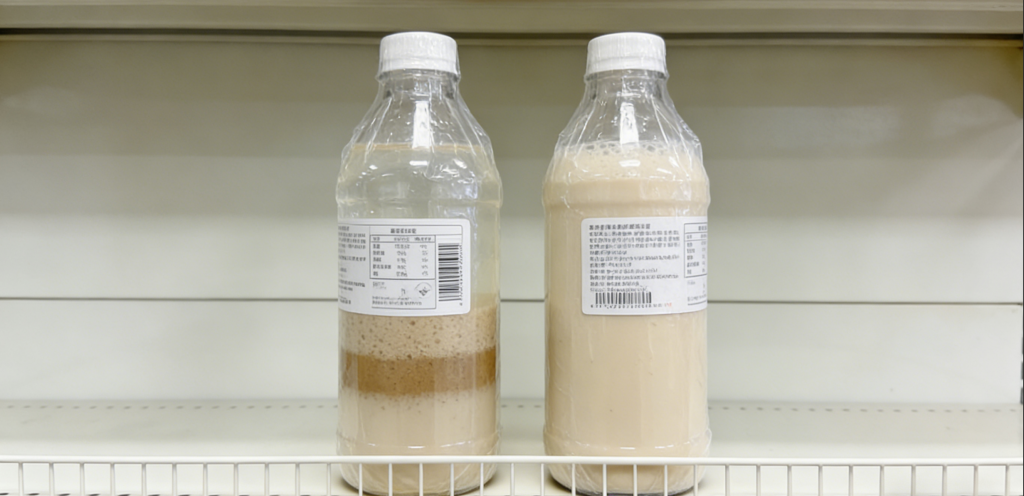
MCC Gel is a cellulose-based stabilizer that forms a three-dimensional network to improve suspension stability in liquid food systems.
Used in:
CMC is a water-soluble stabilizer used to increase viscosity and improve texture uniformity in food formulations.
Typical uses:
Carboxymethyl Cellulose (CMC) Carboxymethyl Cellulose is a water-soluble cellulose derivative that functions as a thickener, emulsifier, and viscosity modifier. CMC is highly effective in beverages, ice cream, sauces, and bakery products — controlling ice crystal growth, preventing syneresis, and stabilizing emulsions across a broad range of pH and temperature conditions. Furthermore,it is compatible with most food ingredients and approved for use globally. Carboxymethyl cellulose (CMC) is widely used as a food stabilizer and thickener in beverages, dairy, and processed foods to improve texture and stability.
HPMC provides heat-stable gel formation for processed food systems requiring structure retention during heating.
Used in:
Hydroxypropyl Methylcellulose (HPMC) HPMC is a semi-synthetic cellulose ether with unique thermal gelation behavior — it gels upon heating and re-dissolves when cooled. Widely used in baked goods, fried foods, and plant-based meat alternatives, HPMC acts as a film-former, water retention agent, and fat barrier, improving texture consistency while reducing oil absorption in processed food applications. CMC and HPMC are widely used cellulose stabilizers in modern formulations.
In food processing applications, stabilizer systems actively control texture, viscosity, and suspension behavior. For example, they help manufacturers maintain smooth and uniform consistency in sauces, desserts, and processed foods by preventing phase separation. Furthermore, these systems improve formulation stability during production, transportation, and long-term storage. As a result, food producers achieve reliable texture performance and consistent product quality across different batches.
Modified starch is a functional ingredient used to increase viscosity and improve short-term texture stability in food formulations.
Modified Starch Modified Starch is a physically or chemically treated starch engineered for superior performance under high temperature, low pH, and freeze-thaw processing conditions. It provides reliable thickening, binding, and moisture management in sauces, soups, dairy products, and convenience foods — applications where native starch would fail to maintain consistency under commercial processing demands.
Food stabilizers function through different physicochemical mechanisms depending on their structure. In modern food systems, cellulose-based stabilizers, cellulose ethers, and modified starch systems provide distinct approaches to controlling viscosity, suspension stability, and texture performance.
Cellulose-based stabilizers work by forming a physical three-dimensional network that provides suspension stability without relying on high viscosity.
For example,Microcrystalline Cellulose (MCC) self-assembles into a colloidal network under shear hydration, physically trapping particles, droplets, and gas bubbles. This network remains stable under heat, shear, and freeze-thaw conditions.
Meanwhile,MCC Gel enhances this mechanism by pre-activating the cellulose network during processing, enabling rapid dispersion and consistent performance in UHT beverages, dairy systems, and emulsions.
Cellulose ethers control food systems through polymer-based rheology modification, gel formation, and electrostatic stabilization.
Specifically,HPMC forms a reversible thermal gel, providing moisture barrier properties in fried foods and gluten-like structure in baked goods.
HEMC improves performance in high-ionic-strength systems due to better salt tolerance and controlled gel behavior.
Finally,CMC stabilizes systems through viscosity enhancement and electrostatic repulsion, preventing particle aggregation in acidic beverages, sauces, and dairy drinks.
Modified starch stabilizes food systems through granule swelling and viscosity development during heating.
Upon gelatinization, starch granules absorb water and increase continuous-phase viscosity, reducing particle sedimentation. However, this structure is thermally dependent and lacks long-term network stability under shear or storage stress.
Consequently,Modified starch is therefore most suitable for soups, sauces, gravies, and other heat-processed, pH-neutral systems where temporary thickening is sufficient.
In industrial formulations, multiple stabilizer mechanisms are often combined to achieve balanced performance.
For instance,Cellulose-based stabilizers provide structural suspension stability, cellulose ethers control rheology and texture behavior, and modified starch contributes body and opacity.
This multi-mechanism approach allows optimization of viscosity, stability, and processing resilience in complex food systems.
In dairy and plant-based food systems, manufacturers use food stabilizers to improve texture, stability, and overall product performance. These ingredients actively support uniform dispersion in yogurt, milk alternatives, cream-based desserts, and plant-based beverages. In addition, they help reduce phase separation and improve resistance to processing stress such as heating, homogenization, and freezing. As a result, formulators achieve smooth mouthfeel, stable structure, and extended shelf life while meeting clean-label formulation requirements.
Food stabilizers work by controlling water binding, viscosity, and particle suspension within food matrices.
Specifically,Different stabilizer systems achieve this through physical network formation, viscosity enhancement, or polymer chain interaction.
Our food stabilizer solutions are designed to meet the specific technical requirements of each food, beverage, and pharmaceutical category. The nine application areas below represent the core industries where our ingredients deliver commercially validated, science-backed performance.
If your product requires suspension stability, protein uniformity, or long shelf-life stability in liquid systems, cellulose-based stabilizers such as MCC Gel and CMC are recommended.
Plant-Based Milk Stabilizers Specialized stabilizers designed to improve suspension, texture, and long-term stability in oat milk, almond milk, soy milk, and other dairy alternatives. Directly addresses sedimentation, phase separation, and mouthfeel challenges inherent to plant-based beverage systems.
If your frozen dessert formulation requires freeze-thaw stability, smooth mouthfeel, and resistance to ice crystal growth, cellulose-based stabilizers are recommended for long-term texture consistency.
These stabilizers improve overrun, maintain creamy texture, and support product stability during frozen storage and cold chain distribution.
👉 Ice cream stabilizers for premium frozen dessert texture
Ice Cream Stabilizers Stabilizers used in frozen desserts to control ice crystal growth, improve overrun, and deliver a consistently smooth, creamy texture. They are critical for maintaining product quality across freeze-thaw cycles and during extended frozen storage and cold chain distribution.
If your beverage formulation shows protein sedimentation, aggregation, or phase separation during storage, suspension stabilizers such as MCC Gel and CMC can improve long-term uniformity.
These systems maintain smooth texture and particle suspension under both refrigerated and ambient storage conditions.
👉 Protein drink stabilizers for suspension stability and texture control
Protein Drink Stabilizers Formulated to prevent protein sedimentation, reduce aggregation, and maintain uniform particle suspension in nutritional and sports beverages. They ensure visual consistency and smooth texture across the full shelf life — including under refrigerated and ambient storage conditions.
If your formulation requires viscosity control, texture enhancement, or flow behavior adjustment, food thickeners provide stable rheology across different processing conditions.
They are widely used in sauces, beverages, dressings, and processed foods requiring controlled consistency and mouthfeel.
👉 Food thickeners for viscosity and texture control applications
Food Thickeners Ingredients used to improve viscosity and body in sauces, dressings, beverages, and processed foods. Provides formulators with precise control over flow behavior and final product texture across varying processing temperatures and formulation conditions.
If your liquid food system contains insoluble particles, fibers, proteins, or mineral fortifications, suspension agents help maintain homogeneous distribution throughout shelf life.
Specifically,Cellulose-based suspension systems physically support particles and reduce sedimentation without excessive viscosity increase.
👉 Food suspension agents for beverage and liquid food systems
Food Suspension Agents Used to keep insoluble particles — including fibers, plant proteins, and mineral fortifications — evenly distributed throughout liquid food systems. They prevent settling and maintains a visually homogeneous product from production through to the end of shelf life.
If your application requires multifunctional stabilization, thickening, or texture control, cellulose food additives provide heat stability, clean-label compatibility, and broad formulation flexibility.
These ingredients are widely approved under FDA GRAS and EU food additive regulations.
👉 Cellulose food additives for stabilization and texture applications
Cellulose Food Additives Cellulose-based ingredients widely used as stabilizers, thickeners, and texture modifiers across food and pharmaceutical applications. They are naturally derived, clean-label compatible, and supported by extensive global regulatory approvals including FDA GRAS and EU food additive status.
If your pharmaceutical formulation requires binder, disintegrant, or suspension functionality, cellulose-based excipients provide stable manufacturing performance and dosage consistency.
These excipients are widely used in tablets, capsules, oral suspensions, and topical systems.
👉 Pharmaceutical excipients for tablets and oral formulations
Pharmaceutical Excipients Functional ingredients used in pharmaceutical formulations including tablets, capsules, oral suspensions, and topical preparations. Provides binder, disintegrant, and suspension functionality to ensure consistent drug delivery performance and manufacturing reliability.
If your tablet formulation requires improved compressibility, hardness, and structural integrity during manufacturing, cellulose-based tablet binders provide reliable compression performance.
These excipients help maintain tablet strength while ensuring predictable disintegration and drug release behavior.
👉 Tablet binders for pharmaceutical tablet manufacturing
Tablet Binders Excipients used in tablet manufacturing to improve mechanical strength, compressibility, and structural integrity. Ensures tablets withstand the rigors of handling and packaging while disintegrating reliably and predictably upon consumption in the target release environment. 👉 Explore Tablet Binders → /food-stabilizers/tablet-binders/
Our stabilizer solutions support a broad range of real-world food production challenges. The following application categories represent the most common use cases where our ingredients deliver measurable, commercially validated performance improvements.
| Application | Key Function | Link |
|---|---|---|
| 🌿 Plant-Based Milk | Suspension, mouthfeel, phase separation control | Explore → |
| 🍦 Ice Cream | Ice crystal control, overrun, smooth texture | Explore → |
| 💪 Protein Drinks | Protein suspension, viscosity, shelf stability | Explore → |
| 🍞 Bakery & Sauces | Moisture retention, binding, texture consistency | Explore → |
| 🥛 Dairy Alternatives | Emulsion stability, creaminess, separation prevention | Explore → |
Beverage formulations demand stabilizers that perform reliably across a wide range of processing conditions — including high-shear mixing, UHT heat treatment, and extended ambient or refrigerated storage. Particle sedimentation, emulsion breakdown, and viscosity loss are among the most common challenges faced by beverage manufacturers, particularly in plant-based, fortified, and protein-enriched drinks.
Our beverage-grade food stabilizers — including Microcrystalline Cellulose, CMC, HPMC, and Modified Starch — are specifically optimized for liquid applications. They maintain uniform suspension, enhance mouthfeel, and ensure long-term stability without negatively affecting flavor or visual clarity. Therefore,Whether you are formulating oat milk, a ready-to-drink protein shake, or a fortified juice, our stabilizer systems are engineered to meet your exact performance and processing requirements.
👉 Explore Full Beverage Stabilizer Range
The global plant-based dairy market continues to expand rapidly, creating strong demand for stabilizers that can accurately replicate the texture, suspension stability, and creamy mouthfeel of traditional dairy products — using only plant-derived ingredients. Unlike cow’s milk, which benefits from a natural casein micelle structure that provides inherent stability, plant-based alternatives such as oat milk, almond milk, coconut yogurt, and soy cream require carefully designed stabilizer systems to achieve comparable sensory performance.
Microcrystalline Cellulose gel, Carboxymethyl Cellulose, and Modified Starch work synergistically in dairy alternative formulations to prevent phase separation, build body, improve viscosity, and deliver a smooth, indulgent texture. These ingredients are clean-label compatible, globally approved, and designed to perform under the full range of dairy alternative processing conditions — including UHT treatment, aseptic filling, and cold chain distribution. For manufacturers seeking to differentiate their plant-based dairy products with superior texture and stability, our stabilizer solutions provide a proven, science-backed foundation.
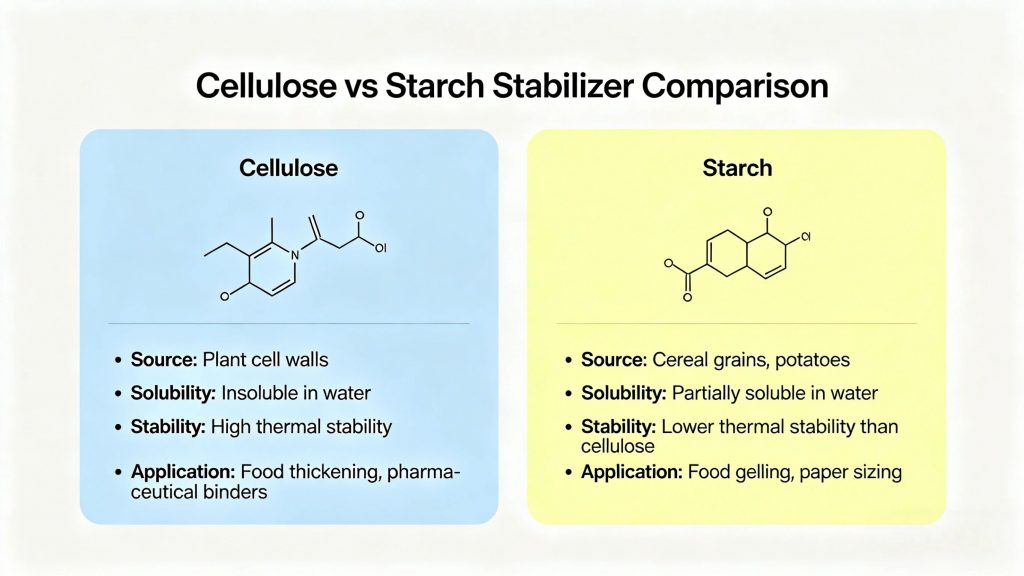
If your sauce breaks under retort, your beverage separates on shelf, or your plant-based product fails freeze-thaw — your stabilizer is the first variable to examine.
Starch and gum have been industry defaults for decades. But in modern manufacturing — more aggressive processing, longer shelf life, growing clean-label pressure — cellulose-based stabilizers consistently pull ahead. Here’s why.
Starch stabilizes through viscosity: granules swell during heating and form a semi-structured gel. In production, three failure modes appear consistently:
Gums — xanthan, guar, locust bean — are effective but come with constraints cellulose systems avoid:
MCC, HPMC, HEMC, and CMC operate through mechanisms that sidestep all three limitations above.
| Performance Factor | Starch | Gum | Cellulose |
|---|---|---|---|
| High-shear stability | ❌ Granules rupture | ⚠️ Viscosity drops | ✅ Network reforms |
| Freeze-thaw stability | ❌ Syneresis common | ⚠️ Variable | ✅ Stable |
| Acid stability (pH < 4) | ❌ Hydrolysis | ⚠️ Type-dependent | ✅ pH 3–11 stable |
| Stability at low dose | ⚠️ Higher load needed | ❌ Viscosity threshold | ✅ Effective below 1% |
| Clean-label perception | ✅ Accepted | ⚠️ Declining | ✅ Widely accepted |
| Protein compatibility | ✅ Compatible | ⚠️ Interaction risk | ✅ CMC protein-protective |
Specifically,MCC forms a colloidal particle network — suspension stability without high viscosity. HPMC and HEMC gel on heating (the reverse of starch), forming instant moisture barriers ideal for fried coatings. CMC’s anionic charge creates electrostatic repulsion that protects particles and proteins in acidic environments where gums flocculate.
The most effective modern formulations don’t replace starch or gum entirely — they use cellulose as the structural anchor and starch or gum in a supporting role.
For regulatory reference and food additive safety standards, cellulose-based food stabilizers are widely recognized under FDA and international food regulations.
👉 FDA food additive guidance for cellulose ingredients
👉 Codex Alimentarius food additive standards
Most stabilizer selection failures share one root cause: choosing by convention (“we always use xanthan in beverages”) rather than matching the mechanism to the actual formulation challenge.
This four-step framework gives you a faster, more reliable path to the right ingredient.
The problem you’re solving determines the mechanism you need — and the mechanism determines the ingredient.
| Primary problem | Lead ingredient |
|---|---|
| Particles settling in liquid | MCC or MCC Gel |
| Emulsion breaking | MCC Gel + CMC |
| Texture loss during freeze-thaw | MCC + CMC |
| Viscosity drop in acidic systems | CMC |
| Excess oil uptake in fried coatings | HPMC |
| Protein flocculation | CMC |
| Gluten replacement in baked goods | HPMC + HEMC |
| Texture breakdown in high-salt systems | HEMC |
| Body and opacity in neutral sauces | Modified starch |
If you have multiple failure modes, rank them. Your highest-priority problem determines the anchor ingredient; secondary ingredients address the rest.
The same stabilizer behaves very differently across production routes.
Temperature: MCC and HPMC are stable through retort (>121°C) and UHT (>135°C). Moreover,MCC and CMC outperform starch and gums across freeze-thaw cycling. Note: HPMC must be added to cold water (<15°C) — adding to hot water causes surface gelation and incomplete dispersion.
pH: Below pH 4.0, use CMC or MCC — both are stable from pH 3 to 11. Avoid native starch in acidic systems. Specifically,CMC’s protein-protective effect is strongest between pH 4.0 and 6.5, making it the go-to for acidified milk drinks and protein beverages.
Shear: For high-shear processing (homogenization, colloid milling), MCC and MCC Gel are the safest choice — their particle network reforms after shear. In contrast,Modified starch carries the highest rupture risk.
Before finalizing any stabilizer:
Start with 4–5 concentration levels bracketing your expected use level. Evaluate suspension stability (24h / 7 days / 28 days), viscosity (fresh and after storage), and freeze-thaw performance (minimum 3 cycles). Identify the lowest dose that meets your specification — then run an accelerated shelf-life test (40°C / 75% RH, 4–8 weeks) before committing.
At production scale, the most common failure point is insufficient hydration shear for CMC and MCC Gel. Document mixer speed and hydration time from your successful lab run and replicate exactly at scale. Addition order matters too: always hydrate CMC in the water phase before introducing protein — adding to a protein system pre-hydration causes localized flocculation.
| Product | Best For | Key Advantage |
|---|---|---|
| MCC | Beverages, sauces, dairy analogs | Suspension without high viscosity |
| MCC Gel | UHT, homogenized systems | Shear-stable, rapid reconstitution |
| HPMC | Fried coatings, gluten-free baking | Reverse thermal gelation |
| HEMC | Cheese analogs, processed meat | High ionic strength stability |
| CMC | Acidic beverages, cocoa milk | pH 3–11 stable; protein-protective |
| Modified Starch | Soups, gravies, baby food | Body, opacity, cost-effective |
For sample requests, technical documentation, or formulation support — contact the ACTA Biotechnology team. [Request a Sample] [Download Selection Guide] [Contact Formulation Support]