

Dry mix mortar additives are materials incorporated into pre-mixed construction products to improve their performance, workability, and durability. Among all available additives, cellulose ethers — particularly HPMC (Hydroxypropyl Methylcellulose) and HEMC (Hydroxyethyl Methylcellulose) — are the most critical for enhancing water retention and workability in mortar systems.They are the leading cellulose ether for mortar solutions trusted by manufacturers and mortar additives suppliers worldwide.
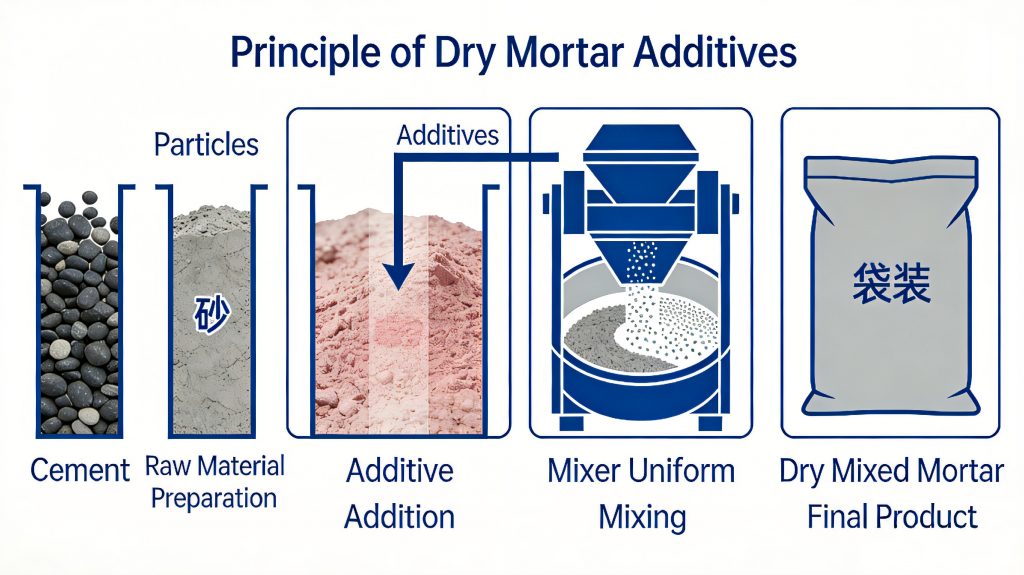
Dry mix mortar is a factory-produced construction material made of cement, sand, and functional additives, including dry mix mortar additives that enhance performance and consistency. It is supplied as a pre-mixed powder and only requires water on-site. Compared with traditional mortar, it offers consistent quality and improved performance. It also reduces labor costs. This is possible thanks to advanced construction additives used in modern formulations.
The mixture typically contains a binder (such as Portland cement, gypsum, or lime), graded aggregates, and a carefully selected package of functional additives. Once delivered to site, the contractor adds the specified amount of water. They mix to a uniform consistency and apply the product.
Dry mix mortar is used across a wide range of construction applications, including:
The global shift toward dry mix mortar over traditional site-mixing is driven by the demand for quality consistency and reduced labor costs. Improved technical performance also plays a key role. All of these benefits depend directly on the quality and selection of additives used in the formulation.
👉 Learn more about specific applications: Tile Adhesive | Exterior Render Systems
Additives play a critical role in determining the overall performance of modern construction materials. Dry mix mortar additives are essential to achieving consistent quality and reliability. Without well-designed dry mix mortar additives, mortar systems often suffer from poor workability, rapid water loss, weak adhesion, and limited open time. By incorporating advanced construction additives such as cellulose ethers and polymer powders, manufacturers can significantly improve application performance, durability, and long-term stability.
Plain cement-and-sand mixtures, while functional in basic applications, lack the performance characteristics required by modern construction. Additives bridge the gap between a raw powder blend and a high-performance building material.
Without additives, dry mix mortars suffer from rapid water loss to the substrate. Poor adhesion on non-absorbent surfaces is also common. Inconsistent open time and brittleness after curing are further issues. These failures lead to delamination, cracking, and costly rework.
Additives address these challenges across four critical dimensions:
Additives such as cellulose ethers act as rheology modifiers, improving the flow and spreadability of the mortar. A workable mix is easier to apply uniformly. It reduces applicator fatigue and allows for smoother finished surfaces. This is particularly important in skim coat and plaster applications where surface quality is paramount.
One of the most important functions of mortar additives is preventing premature water loss to the substrate. When water is absorbed too quickly by porous backgrounds such as brick or aerated concrete blocks, the cement cannot fully hydrate. This leads to weak, powdery, or poorly bonded mortar. Cellulose ether additives form a hydrophilic network that holds water within the mix long enough for complete hydration to occur.
Re-dispersible polymer powders (RDPs) and certain cellulose derivatives significantly enhance the bond strength between the mortar and the substrate. Improved adhesion is critical in applications such as tile fixing, EIFS base coats, and repair mortars, where pull-off failure is a primary performance criterion.
Open time is the window during which the mortar remains workable and bondable after application. It is directly controlled by additive selection. In large-format tile installation or complex facade work, extended open time allows applicators to complete large areas without the mortar skinning over prematurely. Cellulose ether in dry mix mortar is uniquely effective at extending open time without compromising final strength.
“Request Technical Datasheet” →
Cellulose ethers are water-soluble polymers derived from natural cellulose through a series of chemical reactions that introduce functional substituents onto the cellulose backbone. As one of the most critical dry mix mortar additives, cellulose ether for mortar directly controls water retention, workability, and open time. Compared with other dry mix mortar additives such as redispersible polymer powders or defoamers, it is a foundational component in almost every high-performance formulation.
Cellulose ethers dissolve in the mixing water to form a viscous solution that physically restrains water migration. Even when the mortar is applied to highly absorbent substrates, the polymer network holds water in the mix. This gives the cement binder sufficient moisture to hydrate fully. Water retention values above 95% are routinely achievable with well-selected cellulose ether grades, meeting the requirements of EN 14891 and related standards.
The dissolved cellulose ether dramatically increases the viscosity of the mix water. This provides the mortar with body, sag resistance, and anti-slump behavior. This is particularly important in vertical applications — such as wall tiling and exterior render — where the mortar must hold its position against gravity without deformation. The degree of thickening is controlled by the molecular weight and substitution level of the cellulose ether, giving formulators precise control over rheological behavior.
Cellulose ethers improve the homogeneity and stability of the mixed mortar. They prevent segregation of heavy aggregate particles and maintain uniform consistency throughout the pot life. This is critical for quality-sensitive applications such as self-leveling compounds and fine finishing plasters, where any inconsistency in the mix translates directly to surface defects.
These performance improvements align with international standards such as ASTM material standards and European specifications including EN 998 and EN 12004, ensuring consistent quality in construction applications.
👉 Explore our cellulose ether products: HEMC | HPMC
Tile adhesive represents one of the most technically demanding applications for dry mix mortar additives for tile adhesive systems, requiring a precise balance between open time, slip resistance, and final bond strength. HEMC mortar additive at medium-to-high viscosity grades is the cornerstone of any high-performance tile adhesive formulation. It provides the water retention necessary for full cement hydration. It also keeps the adhesive workable long enough to accommodate large-format tile installation. When combined with re-dispersible polymer powders, the resulting system achieves the flexibility and pull-off strength required for classification under EN 12004 Class C2, making it suitable for demanding substrates including underfloor heating systems and facade cladding.
Learn more about tile adhesive additives →
In render and plaster applications, dry mix mortar additives must perform reliably across a wide range of substrate types, application methods, and environmental conditions. Cellulose ethers improve the consistency and sag resistance of freshly applied render on vertical surfaces, while hydrophobic agents and polymer modifiers contribute long-term weather resistance and crack suppression in exterior systems. For interior plaster, additives extend the smoothing window and reduce shrinkage. They also enhance the surface hardness of the finished coat, directly reducing the labor time required to achieve a paint-ready finish.
Beyond tile adhesive and render, the broader category of dry mix mortar products includes self-leveling compounds, waterproof systems, repair mortars, and jointing grouts. Each has its own additive requirements and performance benchmarks. Across all of these systems, the fundamental role of dry mix mortar additives remains consistent: to bridge the gap between a basic powder blend and a construction material that performs predictably under real-world conditions. Selecting the right combination of cellulose ether for mortar, polymer powder, and supplementary chemistry enables manufacturers to deliver products that meet international standards and satisfy professional applicators.
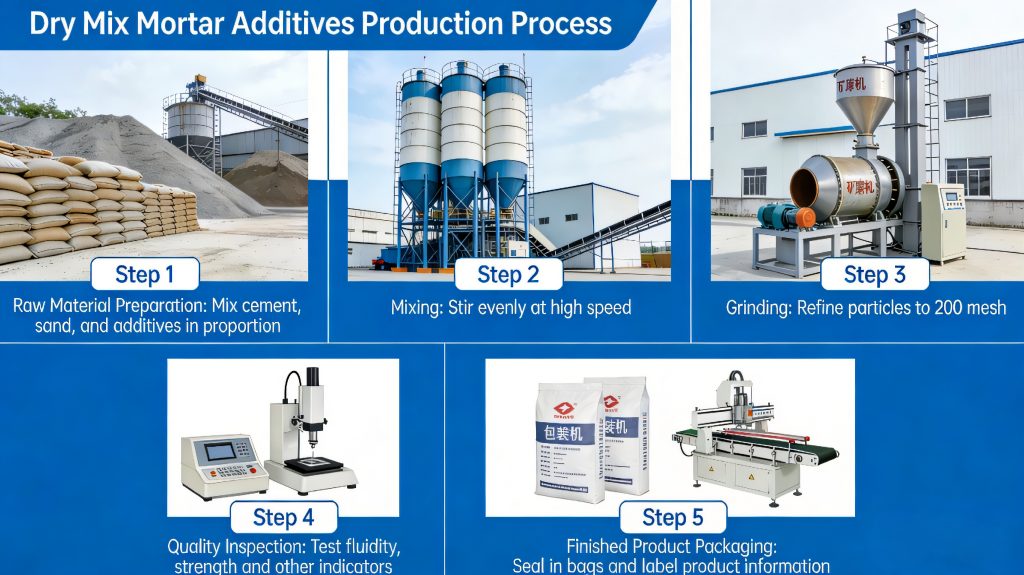
Different mortar systems impose different performance demands on their additive packages. Understanding these differences is essential to selecting the right cellulose ether grade and complementary additives. Each mortar type requires carefully tailored dry mix mortar additives to achieve optimal performance.
Tile adhesive is one of the most technically demanding dry mix mortar applications. It must exhibit high bond strength to both the substrate and the tile. Sufficient open time for large-format installation is also essential, along with slip resistance to prevent tiles from sliding before the adhesive sets. HPMC for dry mix mortar and HEMC grades with medium-to-high viscosity (typically 15,000–60,000 mPa·s) are used alongside re-dispersible polymer powders to achieve the combined flexibility and bond strength required by EN 12004 Class C2.
Exterior render systems are exposed to weathering, thermal cycling, and mechanical impact throughout their service life. Render mortars require good workability for hand and machine application. Strong adhesion to substrates including concrete and masonry is also needed, along with crack resistance over the long term. Medium-viscosity cellulose ethers are commonly specified, often in combination with air-entraining agents and hydrophobic admixtures for water-resistant systems.
Self-leveling underlayments and floor smoothing compounds require exceptional flow — the mortar must spread under gravity to form a flat, bubble-free surface without manual screeding. In this system, cellulose ethers are used at low dosages (0.05–0.15%) primarily as anti-settling agents. They also maintain a brief working window. Superplasticizers and defoamers handle flow and air management.
Waterproof mortar systems used in wet areas, basements, and below-grade construction combine cementitious binders with crystalline waterproofing agents and hydrophobic additives. Cellulose ethers contribute water retention and workability while being compatible with the specialty chemistry of the waterproofing system. Careful grade selection is required to avoid interference with the crystallization mechanism of the waterproofing agent.
Modern dry mix mortar additives are developed in accordance with international construction standards, ensuring reliable performance across different applications and environments.
Both HPMC for dry mix mortar and HEMC mortar additive are methylcellulose derivatives widely used in construction. They differ in their chemical structure, thermal gelation behavior, and performance characteristics in specific applications. Selecting the appropriate cellulose ether is crucial to achieving the desired balance of water retention, workability, and open time within a broader dry mix mortar additives package.
| Property | HPMC | HEMC |
|---|---|---|
| Full Name | Hydroxypropyl Methylcellulose | Hydroxyethyl Methylcellulose |
| Water Retention | Excellent | Excellent |
| Thermal Gelation | Gels at ~65–85°C | Gels at ~70–90°C (slightly higher) |
| Open Time | Good | Excellent — preferred for extended open time |
| Sag Resistance | Good | Very Good |
| Best Applications | Plaster, render, general mortar | Tile adhesive, EIFS, warm-climate applications |
| Hot Weather Performance | Good | Superior — more stable at elevated temperatures |
In practical terms, HEMC is increasingly the preferred choice for tile adhesive formulations in warm or hot climates. Its higher gelation temperature means it maintains lower viscosity at elevated ambient temperatures, keeping the adhesive workable for longer. For standard plastering and rendering in temperate climates, HPMC remains a cost-effective and technically sound choice.
👉 Explore HEMC grades and technical data sheets →
Selecting the correct dosage is one of the most consequential decisions in any dry mix mortar additives package. Even within the same application category, the optimal cellulose ether loading can vary significantly. A tile adhesive for a hot, arid climate requires a notably higher dosage than one intended for temperate use. Water evaporation rates and substrate absorption behavior demand greater protective capacity from the additive.
The effective dosage of cellulose ether depends on the application type, the viscosity grade selected, the porosity of the substrate, and the climatic conditions during application. As a general reference:
These dosage ranges represent industry norms, but optimal performance is achieved through formulation-specific trials. Higher dosages increase water retention and viscosity. However, they can reduce early compressive strength and increase air entrainment if not balanced with appropriate defoamers. Lower dosages improve strength development but may compromise open time on highly absorbent substrates.
It is also important to note that cellulose ether dosage interacts with the w/c ratio of the mix. As viscosity increases, the effective water demand changes. Formulators must account for this relationship to maintain consistent workability at the target water addition level.
“Get Free Sample for Testing” →
The performance gains delivered by a well-engineered dry mix mortar additives system extend far beyond standard laboratory testing. In real-world construction, the difference becomes visible over months and years of service. High-quality additives prevent delamination. Grout lines remain intact after thermal cycling. Rendered facades retain their appearance after years of rain and UV exposure. For manufacturers, specifying premium construction additives is a statement about product quality and brand reliability.
Controlled water retention ensures even hydration throughout the mortar body, minimizing differential shrinkage and the micro-cracking it causes. In combination with flexible polymer additives, the resulting mortar can accommodate minor substrate movement without fracturing — a critical advantage in exterior facade systems subjected to thermal cycling.
The combination of good water retention and polymer modification produces pull-off strengths well above the minimum thresholds set by EN 1015, EN 12004, and equivalent international standards. Water retention keeps the mortar workable long enough for proper substrate wetting. Polymer modification enhances film formation at the bond interface.
Well-formulated mortars with quality cellulose ether additives apply smoothly. They hold their shape on vertical surfaces and respond predictably to trowelling. This translates directly into reduced labor time, lower waste, and more consistent finished quality. These are factors that professional applicators and contractors value highly when selecting products.
Cellulose ethers and compatible additives are chemically stable in the dry mix matrix and do not react with the cementitious binder until water is added. A well-formulated dry mix mortar can achieve shelf lives of 12–24 months without performance degradation, provided it is stored in dry conditions.
According to published research on cellulose ether in cement systems, these materials significantly improve water retention and workability in dry mix mortar formulations.
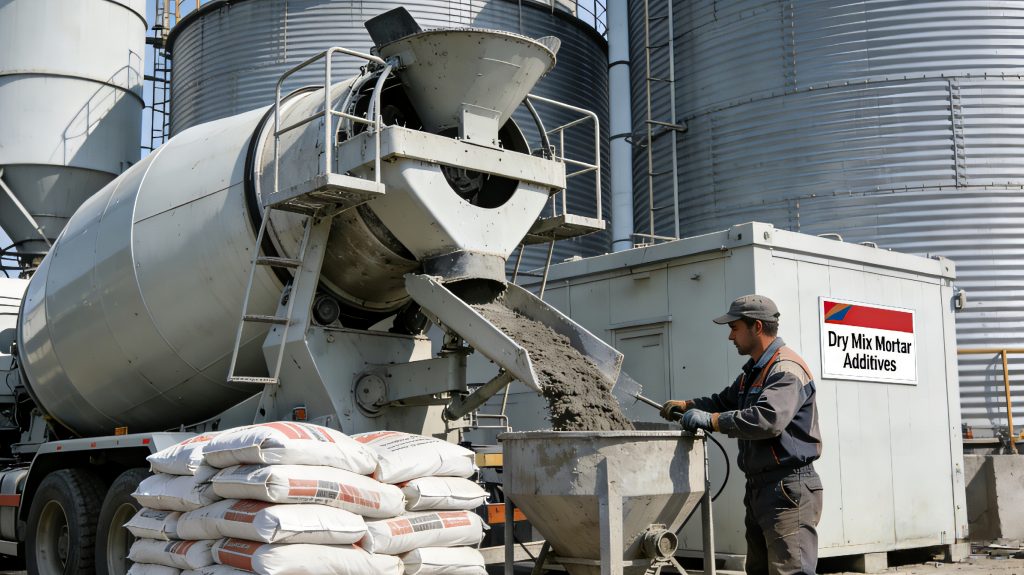
Understanding how to improve mortar performance starts with a systems-level approach to dry mix mortar additives. Each additive in the formulation influences the behavior of every other component. Cellulose ether viscosity affects how polymer dispersions redisperse during mixing. Retarder dosage shifts the window in which air-entraining agents are most effective. Aggregate particle size distribution changes the surface area that the binder and additives must coat and stabilize.
Experienced formulators approach dry mix mortar additives as an integrated system. Simply swapping one cellulose ether grade for another — without revisiting the full additive matrix — frequently produces inconsistent results that are difficult to diagnose and costly to correct.
The optimization process typically follows these steps:
Our technical team has supported formulation projects across tile adhesives, renders, plasters, and specialty systems for markets on five continents. Whether you are developing a new product line or optimizing an existing formulation for a new market, we offer the expertise and sample materials to accelerate your development process.
Q1: What are dry mix mortar additives? Dry mix mortar additives are specialized materials, including HPMC for dry mix mortar and HEMC mortar additive, incorporated into pre-blended mortars to improve workability, water retention, adhesion, and durability. These additives ensure consistent performance in tile adhesive, render, and repair mortars.
Q2: How do HPMC and HEMC differ in tile adhesive applications? HPMC improves workability and water retention, ideal for plaster and render, while HEMC offers higher thermal stability and longer open time, making it preferable for dry mix mortar additives for tile adhesive applications, especially in warm climates. Both are essential dry mix mortar additives.
Q3: What is the recommended dosage of cellulose ether in dry mix mortar? Dosage depends on the application: tile adhesive 0.2–0.4%, render/plaster 0.15–0.35%, self-leveling compounds 0.05–0.15%. Correct dosing of additives for cement mortar workability is key to optimal performance.
Q4: Why are dry mix mortar additives important for tile installation? Additives such as cellulose ethers enhance bond strength, prevent cracking, improve open time, and maintain consistent workability, ensuring tiles remain secure and surfaces smooth.
Q5: How do I find a reliable mortar additives supplier?** A reliable mortar additives supplier should provide technical datasheets, offer sample grades for formulation testing, and support customers with application-specific guidance. Acta Biotechnology supplies HPMC and HEMC to dry mix mortar manufacturers globally.