

Colloidal MCC applications play an important role in modern food and beverage formulations. Manufacturers use colloidal microcrystalline cellulose (MCC) in beverages, dairy products, sauces, and suspension systems to improve stability, texture, and particle suspension.
Colloid microcrystalline cellulose (MCC) is a plant-derived, acid-hydrolyzed cellulose with crystalline, colloidal characteristics. It functions as a binder, thickener, stabilizer, and suspending agent. MCC is widely used in:
Colloidal MCC Applications function as both a suspending agent and a rheology modifier. In addition, they work effectively with other cellulose derivatives, thereby improving suspension stability, texture, and overall product performance.
Furthermore, its safe and biologically inert nature allows manufacturers to use colloidal MCC in both dry and liquid formulations. As a result, it supports a growing range of applications across multiple industries.
Therefore, many manufacturers explore Colloidal MCC Applications as a critical thickener, stabilizer, and suspension aid in pharmaceuticals, food products, beverages, and cosmetics.
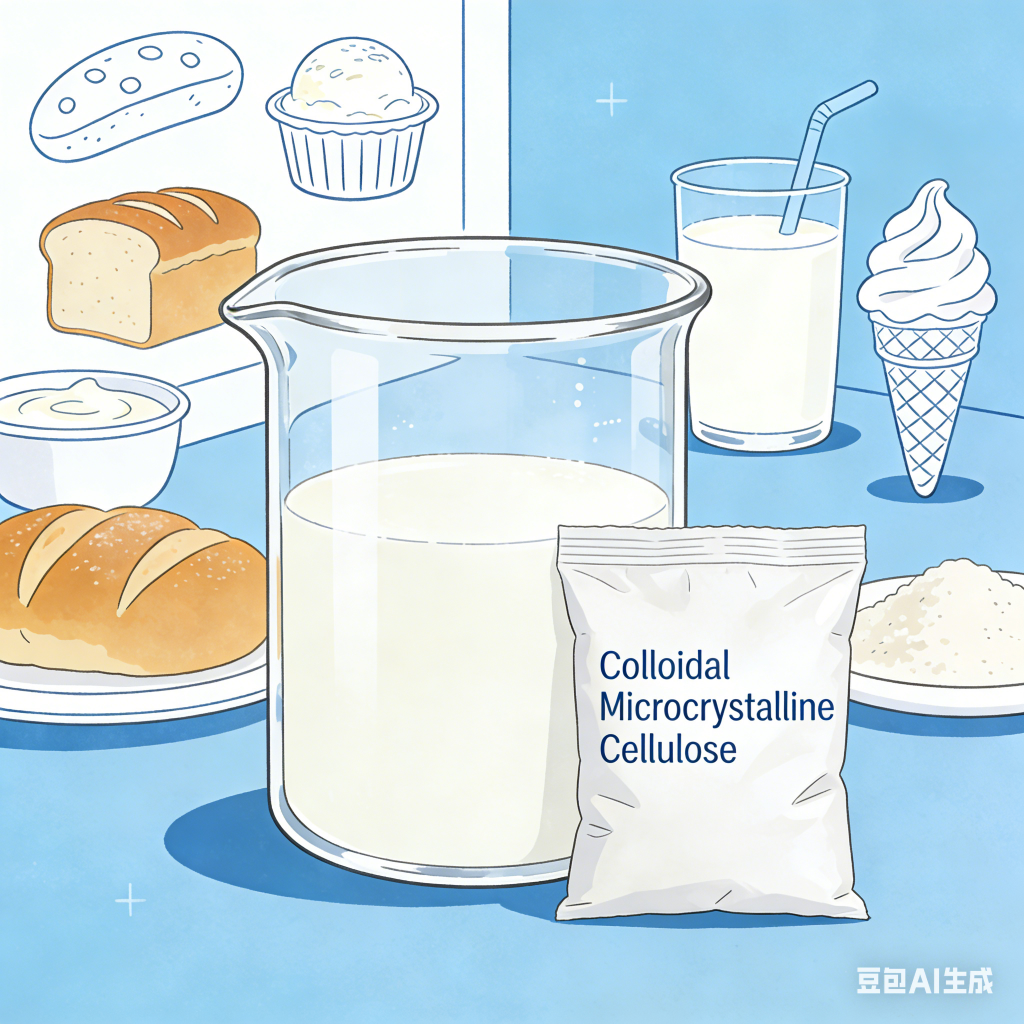
MCC is derived from plant cellulose, primarily wood pulp and cotton, via acid hydrolysis. This process removes amorphous regions of cellulose, leaving highly ordered crystalline domains that confer:
MCC is a fine white powder. While it does not dissolve in water, it readily swells and forms stable colloidal suspensions. Therefore, manufacturers widely use MCC as a thickener, stabilizer, and suspending agent in both dry and aqueous formulations. In addition, its excellent stability and compatibility make it suitable for a wide range of food, pharmaceutical, and cosmetic applications.
MCC acts as a binder and diluent in tablets and capsules. It helps create strong tablets and ensures even distribution of APIs. It allows for precise dosing, even in low-dose forms. This makes it one of the most common excipients in solid oral drugs.
MCC enables direct compression tableting, simplifying manufacturing, reducing production costs, and minimizing exposure to heat or moisture—ideal for heat- or moisture-sensitive APIs.
Different MCC grades vary in particle size and moisture content. This helps formulators improve flow, give, and tablet hardness for specific needs.
MCC promotes strong tablet cohesion during compression. At the same time, it facilitates rapid disintegration through capillary action and internal swelling. As a result, formulators can enhance API release, dissolution, and overall bioavailability.
MCC is chemically inert and widely recognized as safe (GRAS). Therefore, it is compatible with a broad range of APIs, including moisture-sensitive and chemically reactive compounds. In addition, its excellent stability makes it one of the most commonly used pharmaceutical excipients worldwide.
Manufacturers produce MCC by hydrolyzing purified alpha-cellulose derived from refined wood pulp. Through this controlled process, they obtain a high-purity, consistent, and stable excipient. Furthermore, the industry continues to explore sustainable cellulose sources, including agricultural residues and renewable biomass. As a result, manufacturers can reduce their dependence on traditional wood-based feedstocks while supporting sustainability initiatives.
MCC is frequently co-processed with other excipients, such as silicon dioxide, to improve powder flowability and content uniformity in high-drug-load formulations. In addition, these co-processed systems often enhance manufacturing efficiency and tablet performance. However, excessive lubrication with hydrophobic lubricants may reduce MCC’s binding efficiency and compressibility. Therefore, formulators should carefully optimize lubricant levels to achieve the desired balance between manufacturability and tablet quality.
Researchers often use MCC in placebo formulations because it is chemically inactive and closely resembles many active pharmaceutical ingredients in appearance and physical properties. As a result, it helps maintain effective blinding in clinical trials and ensures the reliability of study outcomes.
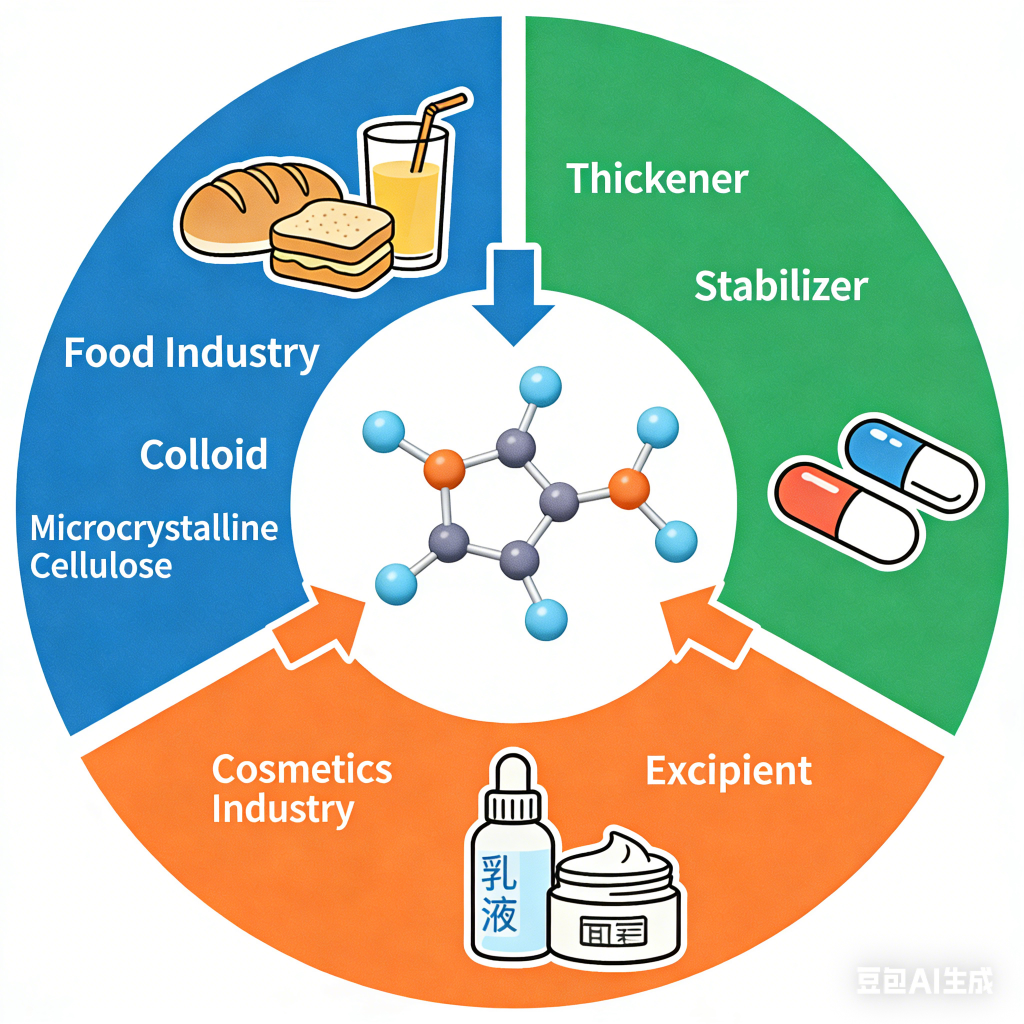
Manufacturers mainly use colloidal MCC (CMC) as a stabilizer, thickener, and suspending agent. You can find it in food, pharm, cosmetics, and industrial coatings. CMC creates a 3D network that stops phase separation and particle settling.
Colloid microcrystalline cellulose is a versatile and essential ingredient across pharm, food systems, cosmetics, and industrial formulations. Its binding, thickening, stabilizing, and suspending capabilities—combined with regulatory safety and formulation flexibility—ensure its continued importance in modern manufacturing. As innovation and long-term workability become more important, experts expect MCC’s uses to grow. This will strengthen its role as a key excipient in many industries.These examples demonstrate why Colloidal MCC applications continue to expand across the food industry.
