

Cellulose-based ingredients are used across multiple industries including food and beverage, pharmaceuticals, nutraceuticals, and construction materials. This section explores real-world applications such as plant-based milk stabilization, pharmaceutical suspensions, and dry mix mortar systems. Learn how different cellulose additives are applied in specific industries to solve formulation challenges and improve product performance.
Ice Cream Stabilizers Guide: Types, Dosage, Formulation, and Supplier Selection Last updated: September 2026 Written by Richard Wang, International Sales & Technical Content, Qingdao ACTA Biotechnology Co., Ltd.Technical Review: Alice Meng about Ice Cream Stabilizers guide Table of Contents This…
Written by: Richard Wang, International Sales & Technical Content, Qingdao ACTA Biotechnology Co., Ltd about MCC in Soy MilkTechnical Review: Alice MengLast Updated: September 2026 Can MCC stabilize soy milk? Yes, MCC can support particle suspension and reduce sedimentation in…
Last updated: September 2026 Written by: Richard, Qingdao ACTA Biotechnology Co., Ltd. Technical review: Alice Meng Topic:MCC in Almond Milk Caption:MCC can support suspension structure in almond milk when grade, dosage, dispersion, and processing are properly controlled. Almond beverages can…
By ACTA Biotechnology Technical Team | September 22, 2026 | Beverage Stabilizers in MCC in oat milk MCC in oat milk is increasingly evaluated as part of a broader stabilization strategy for plant-based beverages. In particular, when manufacturers need to…
Protein Drink Stabilizers: Complete Formulation Guide ACTA Industry | September 21, 2026 | Beverage Stabilizers–Protein drink stabilizers Protein drink stabilizers play a critical role in maintaining physical stability, texture, suspension and consistency in high-protein beverages. Unlike conventional drinks, protein beverages…
SMCC vs MCC: Differences, Benefits & Selection Guide for Direct Compression Tablets Introduction SMCC vs MCC is an important consideration for pharmaceutical manufacturers selecting direct compression excipients for tablet manufacturing. Choosing between these two cellulose-based excipients can directly influence tablet…
Direct Compression Excipients: How MCC Improves Tablet Hardness & Strength Introduction: Why Tablet Hardness Is a Critical Challenge in Pharmaceutical Manufacturing Caption:Overview of direct compression tablet manufacturing and the role of MCC excipients in improving tablet quality. Microcrystalline Cellulose (MCC)…
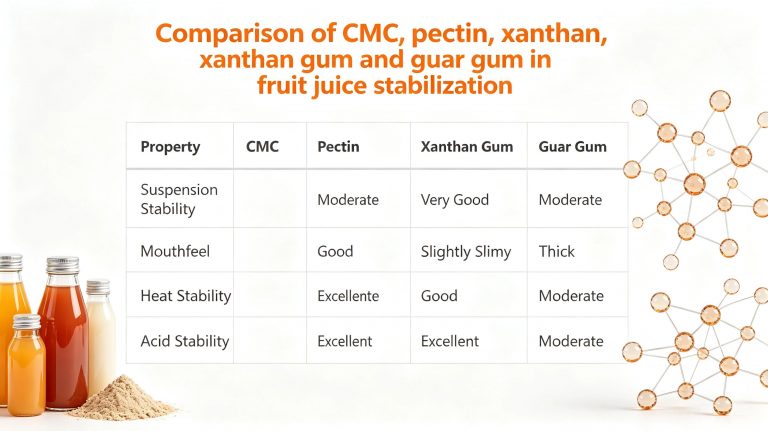
Introduction CMC in fruit juice plays a critical role in improving cloud stability, preventing pulp sedimentation, and extending shelf life in modern beverage formulations. Fresh fruit juice may appear simple, but it is one of the most physically unstable beverage…
HPMC uses in food continue to expand as manufacturers develop healthier, plant-based, gluten-free, and clean-label products. Hydroxypropyl Methylcellulose (HPMC), also known as E464, is one of the most versatile cellulose-based food ingredients used in modern food manufacturing. In This Guide…
MCC Uses in Food: Applications, Benefits, E460(i) Guide & Formulation Tips MCC uses in food have expanded rapidly as food manufacturers seek clean-label ingredients that improve texture, suspension stability, fat replacement, and processing performance. It plays an important role in…