

Bakery and sauce stabilizers — including microcrystalline cellulose (MCC), carboxymethyl cellulose (CMC), and modified starch — are essential functional ingredients for controlling viscosity, texture, and shelf life in modern food formulations.
Bakery sauce stabilizer refers to a group of hydrocolloids such as CMC, MCC, and modified starches that improve texture, emulsion stability, and moisture retention in bakery sauce systems. Moreover, these stabilizers prevent phase separation and ensure consistent product quality during processing and storage.
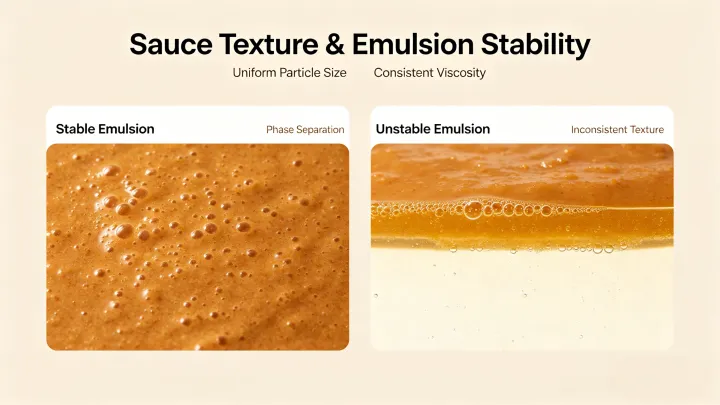
Food manufacturers working with sauces, gravies, bakery fillings, and dressings often face consistent technical challenges that can negatively affect product quality, processing efficiency, and overall profitability. However, these challenges are common across the food industry and require effective formulation solutions.
Functional stabilizers, when correctly selected and dosed, directly resolve these issues. In addition, they improve processing machinability, reduce reformulation waste, and support both clean-label and cost-reduction goals. As a result, manufacturers can achieve more stable and efficient production systems.
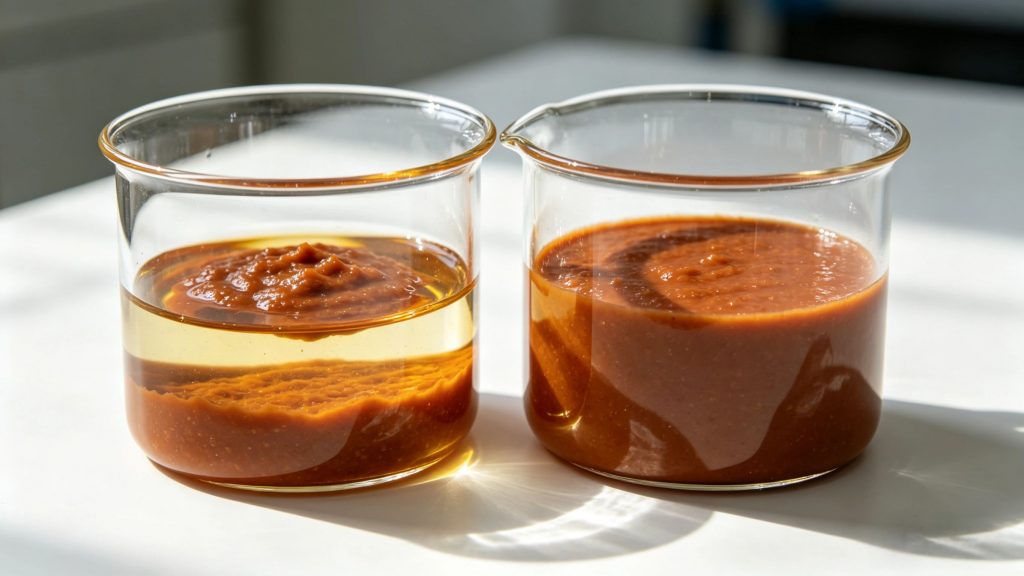
MCC is an insoluble, purified form of cellulose that functions as a water-binding agent, texturizer, and fat replacer in baked goods. Moreover, when hydrated, it forms a colloidal network that improves crumb structure, enhances moisture retention, and ensures consistent volume in finished products. As a result, baked goods achieve better texture stability and overall quality.
Key technical benefits in bakery:
Typical applications: soft bread, cakes, cream fillings, muffins, low-fat pastry products
Typical usage level: 0.3% – 2.0% of total formulation weight
CMC is primarily used in bakery sauce systems as a thickener, emulsion stabilizer, and suspension agent. In addition, it improves viscosity consistency and prevents ingredient separation. As a result, it helps maintain stable texture and appearance in sauces and fillings throughout shelf life.
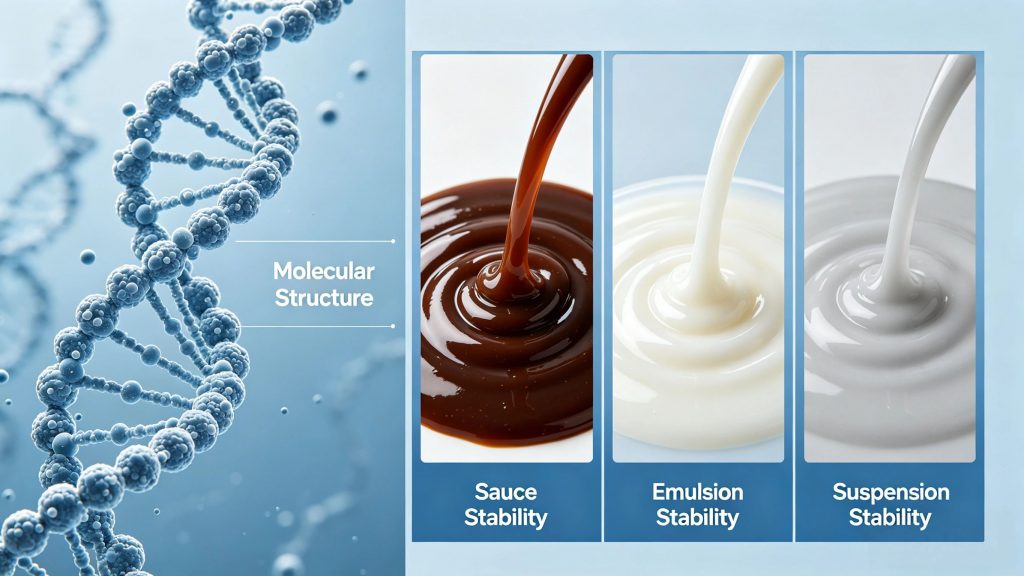
CMC is a water-soluble cellulose ether that provides viscosity, suspension, and emulsion stability in aqueous systems. Moreover, it is one of the most widely used food thickeners globally due to its consistent and reliable rheological performance across a wide pH range. As a result, it ensures stable texture and processing behavior in a variety of food formulations.
Key technical benefits in sauces and dressings:
Typical applications: salad dressings, ketchup, tomato-based sauces, gravies, cooking sauces, mayonnaise-style products
Typical usage level: 0.1% – 0.8% depending on target viscosity and system pH
E1442 modified starch is widely used in bakery applications as a heat-stable thickener and texture modifier. Moreover, it provides excellent resistance to heat, shear, and acid conditions, making it suitable for high-temperature baking processes. As a result, it ensures stable viscosity and structure in bakery fillings and sauce systems even after baking.
E1442 is a cross-linked and substituted modified starch designed to deliver superior thickening performance compared to native starch. In addition, the cross-linking structure provides excellent resistance to heat, shear, and acidic conditions, making it highly suitable for demanding sauce and soup processing environments. As a result, it maintains stable viscosity and texture even under severe processing conditions.
Key technical benefits:
Typical applications: canned gravies, retorted sauces, frozen meal sauces, Asian-style cooking sauces, baby food
Typical usage level: 1.5% – 5.0% of total sauce weight
E1440 is a substituted modified starch that offers improved paste clarity, lower gelatinization temperature, and enhanced cold-storage stability compared to native starch. Moreover, it is widely used as an industry standard ingredient in fruit fillings, custard-style fillings, and bakery glazes. As a result, it helps manufacturers achieve better texture, appearance, and shelf-life stability in bakery applications.
Key technical benefits:
Typical applications: fruit pie fillings, custard fillings, cheese cake bases, bakery glazes, crepe fillings
Typical usage level: 2.0% – 6.0% depending on filling solids and target viscosity
The table below compares the most widely used bakery and sauce stabilizers by functional property.
| Property | MCC (E460i) | CMC (E466) | E1442 Modified Starch | E1440 Modified Starch |
|---|---|---|---|---|
| Primary Function | Water binding, texturizer | Viscosity, emulsion stability | Thickening, freeze-thaw stability | Filling thickener, clarity |
| Solubility | Insoluble (colloidal) | Water soluble | Water dispersible | Water dispersible |
| Heat Stability | Excellent | Good | Excellent | Good |
| Freeze-Thaw Stability | Good | Moderate | Excellent | Good |
| Acid Tolerance (pH) | 3.0–11.0 | 4.0–11.0 | 3.5–7.0 | 3.5–7.0 |
| Appearance in product | Opaque, creamy | Clear to hazy | Clear to slightly opaque | Clear, glossy |
| Main Application | Bakery | Sauce, dressing | Sauce, ready meals | Bakery fillings |
| E-Number / Reg. | E460(i) | E466 | E1442 | E1440 |
In yeast-leavened breads and soft bakery products, MCC is typically used at 0.3%–1.0% to improve dough hydration consistency, slow moisture loss during storage, and maintain a soft and springy crumb texture. Moreover, these functions help improve processing stability during baking and storage.
For gluten-free formulations, higher usage levels of MCC (1.0%–2.0%), when combined with CMC (0.2%–0.5%), create a structured hydrocolloid network that compensates for the absence of gluten. As a result, the final product achieves improved elasticity, structure, and overall eating quality.
Processing tip: Hydrate MCC and CMC separately in water before incorporation into dough to ensure even distribution and avoid lumping.
For fruit fillings, cream fillings, and custard-style bakery fillings, E1440 hydroxypropyl starch provides an optimal balance of gel clarity, syneresis control, and smooth texture. Moreover, it is widely used in bakery systems where appearance and mouthfeel are critical.
In heat-stable fillings that must withstand oven temperatures above 180°C, such as Danish pastries and croissants, E1442 is preferred due to its superior resistance to heat and shear. As a result, it maintains viscosity and structure even after baking.
Recommended combination: E1440 at 3.0%–4.5% + CMC at 0.1%–0.3% for improved suspension of fruit pieces and enhanced cold-storage stability.
The choice of stabilizer for sauces depends on the processing method and pH:
For oil-in-water emulsion systems such as creamy dressings, vinaigrettes, and mayonnaise-style products, CMC functions as an emulsion stabilizer, viscosity modifier, and particle suspension agent. The key is selecting the appropriate viscosity grade:
Synergistic combination: CMC + xanthan gum (1:1 to 2:1 ratio) delivers superior shear-thinning behavior (pourable in the bottle, coating on the salad) and freeze-thaw stability in frozen dressings.
In ready-to-eat and ready-to-heat meal systems, E1442 is the preferred thickener for sauce components due to its resistance to thermal processing, freeze-thaw cycling, and microwave reheating. Moreover, it ensures consistent texture performance throughout processing and consumption.
For composite meal products containing both a sauce and a bakery-style crust or pastry, MCC in the bakery component helps prevent moisture migration into the sauce layer. As a result, the product maintains distinct textures and improved shelf-life stability.
Selecting the right bakery and sauce stabilizers depends on your processing method, target pH, and storage conditions.
| Application | Recommended Ingredient | Usage Level | Processing Notes |
|---|---|---|---|
| Soft bread & rolls | MCC | 0.3%–1.0% | Hydrate before dough mixing |
| Gluten-free baked goods | MCC + CMC | 1.0%–2.0% + 0.2%–0.5% | Blend dry, then hydrate |
| Bakery fruit fillings | E1440 | 3.0%–5.0% | Cook to full gelatinization |
| Cream fillings (ambient) | CMC | 0.3%–0.5% | Disperse in cold water first |
| Salad dressings | CMC | 0.2%–0.6% | Add to water phase before homogenization |
| Ketchup & tomato sauce | CMC or E1442 | 0.3%–0.5% / 1.5%–3.0% | Adjust to pH stability requirement |
| Retorted/UHT sauce | E1442 | 2.0%–4.0% | Pre-gelatinize before retort |
| Frozen sauce (freeze-thaw) | E1442 | 2.5%–4.5% | Ensure full cook-out before freezing |
| Ready meal sauce | E1442 | 2.0%–3.5% | Compatible with microwave reheating |
Processing compatibility notes:
ACTA Biotechnology (Qingdao, China) is a dedicated manufacturer of cellulose-based food additives and modified starches, supplying food ingredient distributors and manufacturers in Europe, North America, Southeast Asia, and the Middle East.Our bakery and sauce stabilizers are trusted by food manufacturers in 30+ countries.
Our food application team provides formulation guidance, troubleshooting support, and custom viscosity-grade matching for your specific processing conditions. We regularly assist customers with:
CMC provides smooth viscosity and excellent acid stability, making it ideal for large-scale bakery sauce production. In addition, it is more cost-effective.
Xanthan gum offers stronger shear-thinning behavior and freeze-thaw stability, but at a higher cost. As a result, many formulations use a CMC/xanthan blend to balance performance and cost.
Q: What is CMC used for in bakery sauce systems?
A: CMC is used as a thickener, emulsion stabilizer, and suspension agent in bakery sauce systems to improve viscosity, texture, and long-term stability.
Q: What is the difference between E1442 and E1440 in bakery fillings?
A: E1440 provides clarity and smooth texture in fillings such as custards and fruit sauces, while E1442 offers superior heat resistance and is used in baked fillings exposed to high temperatures.
Q: Can MCC and CMC be used together in bakery formulations?
A: Yes. MCC and CMC are often combined to create a hydrocolloid network that improves moisture retention, crumb structure, and texture stability, especially in gluten-free bakery products.
Q: Can modified starch replace CMC in salad dressings?
A: Modified starch and CMC serve different functional roles in salad dressing systems. Specifically, CMC provides emulsion stability and particle suspension, while modified starch contributes body and opacity. In many formulations, both ingredients are used together: E1442 is typically applied at 0.5%–1.5% for body enhancement, while CMC at 0.2%–0.4% ensures emulsion stability and seasoning suspension. As a result, the final product achieves improved texture and stability.
Q: Is MCC suitable for gluten-free bakery formulations?
A: Yes. MCC is widely used in gluten-free bakery systems as part of a hydrocolloid network that replaces the structural and water-binding functions of gluten. Moreover, it is typically combined with CMC or HPMC to improve elasticity, moisture retention, and crumb structure. As a result, gluten-free baked goods achieve better texture and overall product quality.
A: Hydroxypropyl distarch phosphate (E1442) is the industry standard for retorted sauce applications due to its cross-linked structure, which resists viscosity breakdown under the high temperatures (121°C+) and pressures of retort processing.
Q: Do you provide technical data sheets and food safety documentation?
A: Yes. We provide complete documentation including COA (Certificate of Analysis), TDS (Technical Data Sheet), and MSDS, along with regulatory compliance support. In addition, our products comply with EU, US FDA, and China GB standards, ensuring suitability for global food applications.
Q: What is the minimum order quantity for samples?
A: We offer 500g–1kg laboratory samples for initial testing. Moreover, standard commercial orders typically start from 25 kg per product, depending on the specific grade and application requirements.
Q: How do your stabilizers perform at low pH?
A: CMC maintains good viscosity performance down to pH 4.0, making it suitable for vinegar-based and tomato-based systems. Moreover, E1442 performs well across a broader pH range of 3.5–7.0. For highly acidic systems below pH 3.5, we recommend consulting our technical team for optimized grade selection. As a result, formulation stability can be ensured under challenging processing conditions.
Whether you are in the R&D stage or scaling up full-scale production, our technical team responds within 24 hours with formulation recommendations, product selection guidance, pricing information, and sample availability. Moreover, we provide tailored support to help you identify the most suitable bakery and sauce stabilizers for your specific application requirements.
Contact us:
📧 wangpengfei@actabiotechnology.com
📞 +86 18263653583 (WhatsApp available)
📠 Fax: +86 532 85782170
📍 Qingdao City, Shandong Province, China
[Request Free Sample] | [Get Bulk Quote] | [Download Technical Data Sheet]
References: European Food Safety Authority (EFSA) food additive evaluations; FDA 21 CFR Part 172; ; IFT Food Hydrocolloid monographs.