

Food manufacturers use cellulose food additives, which are plant-derived ingredients, to improve texture, stability, and consistency in a wide range of products. Common types include microcrystalline cellulose (MCC), carboxymethyl cellulose (CMC), and hydroxypropyl methylcellulose (HPMC), and they function as thickeners, stabilizers, and suspension agents in beverages, dairy, and processed foods. Moreover, because cellulose additives are classified as generally recognized as safe (GRAS), food producers can confidently use them across global manufacturing operations.Cellulose food additives function through multiple stabilization mechanisms in complex food systems.Learn how suspension agents in food improve stability.
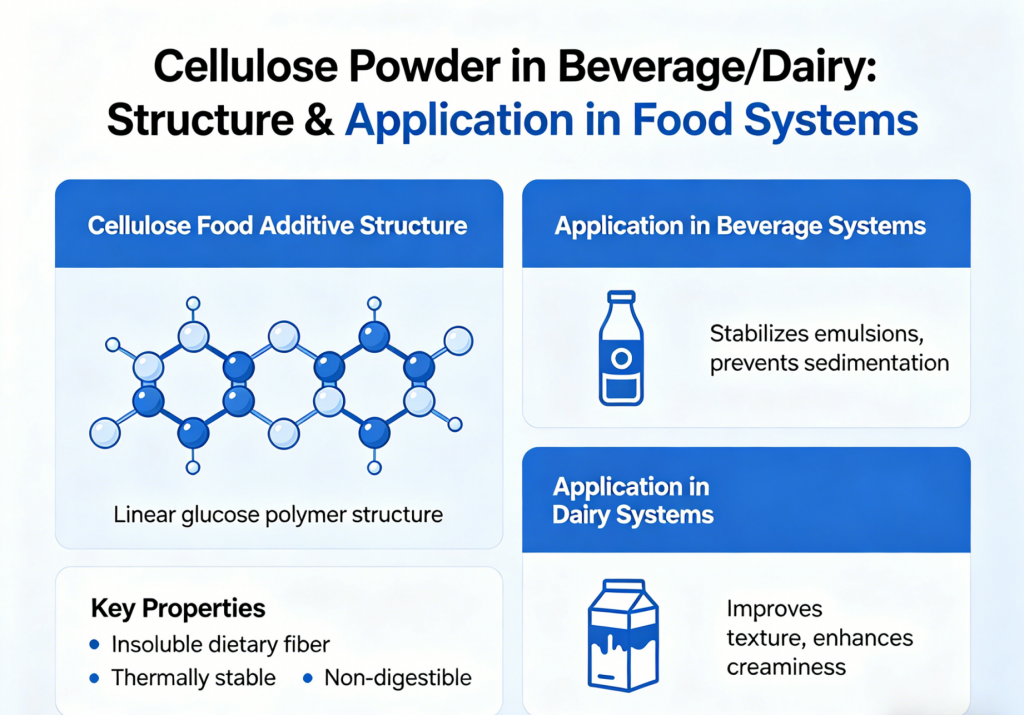
Cellulose is the most abundant natural polymer on earth, forming the structural backbone of plant cell walls. When processed for food use, it becomes one of the most versatile functional ingredient systems available to manufacturers.
As a food additive, cellulose serves multiple simultaneous functions: it controls viscosity, forms stabilizing networks, prevents ingredient separation, and improves the sensory properties that consumers associate with premium food products.
Unlike synthetic polymers, cellulose in the food industry carries a strong safety profile. According to FDA guidelines, cellulose-based additives are classified as Generally Recognized as Safe (GRAS) for use in food application. According to FDA guidelines, cellulose-based additives are widely recognized as safe (GRAS).They are non-digestible, calorie-free, and chemically inert in the gastrointestinal tract, making them ideal for modern clean-label reformulation strategies.
Food manufacturers widely use cellulose additives to improve stability and texture in modern formulations — ranging from ambient-shelf protein drinks to frozen desserts and plant-based dairy alternatives. In addition, their ability to perform consistently across various production conditions, including high-shear mixing, UHT processing, and freeze-thaw cycling, makes them indispensable in industrial food manufacturing.
Importantly, cellulose additives differ fundamentally from simple thickeners. Specifically, cellulose systems provide structural stability at very low use levels (typically 0.1–0.5% by weight), whereas conventional thickeners require much higher concentrations to achieve comparable texture effects.
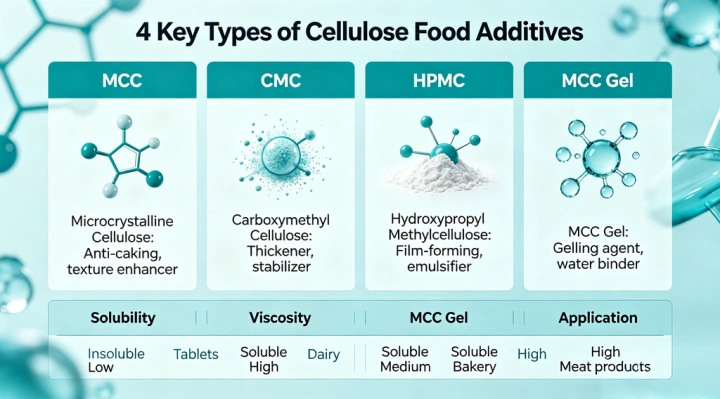
Through distinct chemical modification pathways, manufacturers engineer each cellulose derivative to produce a unique functional profile.Matching the right type to your application is the single most important decision in stabilizer formulation.
Most Versatile
Suspension & structural stability
Colloidal System
Beverage & dairy suspension
Protein Stabilizer
MCC Gel is widely used as a liquid suspension system.
Viscosity & protein interaction
Thermal Gelation
Frozen & bakery systems
In addition to the four primary types, manufacturers design modified cellulose systems — including co-processed MCC/CMC blends and surface-treated variants — to address specific industrial challenges, such as high-acid protein beverages, ultra-high-pressure processing, and extended ambient shelf life.
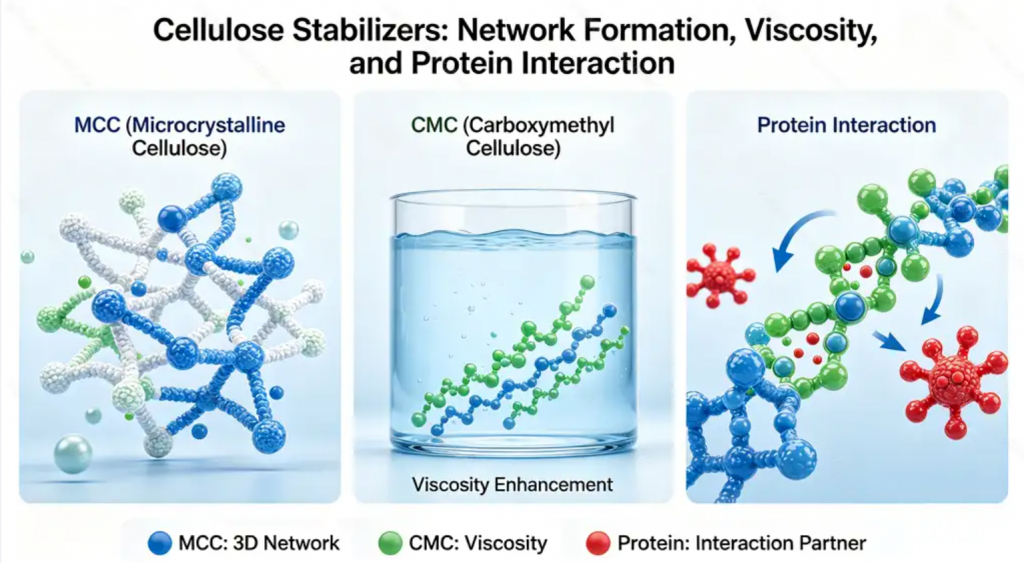
Understanding the mechanism of cellulose-based stabilization moves formulators from guesswork to precision.Peer-reviewed studies published on ScienceDirect highlight the role of cellulose-based systems in improving suspension stability and texture control in complex food matrices. Three primary mechanisms govern the performance of a cellulose stabilizer in any food matrix.This is critical for any beverage suspension stabilizer.
MCC Gel forms a continuous three-dimensional network that physically cradles suspended particles — proteins, minerals, fat droplets — and holds them in uniform distribution. This network is shear-reversible: it breaks down under high shear during processing and rebuilds at rest on shelf, providing both processability and long-term stability.
CMC and other soluble cellulose derivatives increase the continuous phase viscosity, which reduces the velocity of particle settling according to Stokes’ Law. Even modest viscosity increases dramatically extend suspension stability and delay phase separation. As a cellulose thickener, CMC provides this control with precision across different concentration grades.
CMC, being an anionic cellulose derivative, interacts electrostatically with positively charged protein surfaces, particularly caseins and whey proteins, at low pH. As a result, it coats the proteins and creates both a steric and electrostatic repulsion barrier. Consequently, this interaction prevents irreversible protein aggregation, which represents the primary failure mode in acidic dairy and high-protein beverages.
In practice, food manufacturers design a fully optimized stabilizer system in complex products, such as UHT plant-based protein drinks, to employ all three mechanisms simultaneously. Specifically, they use MCC Gel to provide network suspension, CMC to stabilize viscosity and proteins, and HPMC (if the product undergoes heat processing in bakery formats) to deliver thermal gelation.The synergy between these mechanisms produces stability performance that no single ingredient can match alone.
Cellulose-based stabilizers address fundamentally different technical challenges depending on the food system. Below are the three highest-value application categories, each with specific formulation guidance.
Plant-Based Milk Stabilizers High Growth Segment
Plant-based milk products — oat milk, almond milk, soy beverages, oat-pea blends — present severe stability challenges that conventional dairy stabilization systems cannot solve. Suspended proteins, insoluble fibers, and divalent minerals all compete to destabilize the system during processing and shelf life.
Without a proper stabilization strategy, the product separates into a clear aqueous layer and a dense sediment within days — or worse, within hours of opening. Consumer rejection at point of use is the ultimate commercial failure in plant-based beverages.
Primary instability drivers in plant-based milk:
Sedimentation of protein aggregatesPhase separation of fat globulesInconsistent pour viscosityUHT-induced protein denaturationCalcium-mediated flocculation
→ Explore plant-based milk stabilizer solutions for detailed formulation guidance and processing protocols.
Protein Drink Stabilizers High-Value Market
High-protein beverages represent one of the most formulation-intensive categories in the food industry. Concentrations of 20–40 g of protein per serving, combined with low pH targets (often pH 3.2–4.5 for flavored RTD formats), create an environment where protein aggregation and sedimentation are almost inevitable without active stabilization.
Heat treatment — essential for food safety and shelf life — further stresses the protein matrix, promoting irreversible aggregation of denatured proteins into large sediment-forming clusters. A beverage suspension stabilizer is therefore not optional in these systems; it is a fundamental component of the formulation architecture.
Primary instability drivers in protein beverages:
Low-pH protein aggregationSedimentation of denatured wheyViscosity drop post-UHTCasein micelle dissociation
→ Learn more about food suspension agents for high-protein beverage applications.

Ice cream quality is fundamentally a problem of crystal control. The desirable smooth, creamy texture of premium ice cream is the result of millions of microscopic ice crystals — each below 55 microns in diameter. When ice crystals grow through processes such as Ostwald ripening or freeze–thaw recrystallization, manufacturers observe a rapid deterioration in texture, and the product becomes coarse and icy. As a result, consumer perception of quality declines quickly once ice crystals reach a perceptible size.
Traditionally, manufacturers rely on polysaccharides such as guar gum, locust bean gum, and carrageenan to control ice crystal growth by immobilizing water. However, cellulose-based additives — particularly HPMC — provide a distinct and complementary mechanism known as thermal gelation. In contrast, this mechanism delivers functional benefits that conventional hydrocolloids cannot achieve.
Primary quality drivers in frozen desserts:
Ice crystal growth during storageFreeze-thaw recrystallizationUnstable melting behaviorCoarse, icy texture
→ Explore ice cream stabilizer systems for complete frozen dessert formulation guidance.
Beyond these three core categories, food manufacturers use cellulose additives in a wide range of additional applications. For example, they apply them in low-fat sauces and dressings, plant-based cheese analogs, nutritional supplement beverages, bakery fillings, and pharmaceutical-grade food supplements. In addition, food producers widely use cellulose food additives across beverage, dairy, and frozen systems where stability is critical.
Understanding how cellulose-based systems compare with conventional hydrocolloids helps formulators make confident ingredient decisions. The table below benchmarks the four key cellulose types against commonly used alternatives.
| Ingredient | Suspension Stability | Protein Stabilization | Freeze-Thaw Stability | Low pH Performance | Label Status |
|---|---|---|---|---|---|
| MCC Gel (Colloidal MCC) | ✓✓✓ | ◑ | ✓✓ | ✓✓✓ | Clean label |
| CMC | ✓✓ | ✓✓✓ | ✓✓ | ✓✓✓ | E466 |
| HPMC | ◑ | ◑ | ✓✓✓ | ✓✓ | E464 |
| Xanthan Gum | ✓✓ | ◑ | ◑ | ✓✓ | E415 |
| Locust Bean Gum | ✓✓ | ◑ | ✓✓✓ | Limited | E410 |
| Carrageenan (ι/κ) | ◑ | ◑ | Limited | Limited | E407 |
✓✓✓ = Excellent | ✓✓ = Good | ◑ = Moderate | Limited = Not recommended for primary use in this function.
This comparison illustrates why cellulose systems — particularly MCC Gel + CMC combinations — have displaced conventional hydrocolloid blends in technically demanding applications. Their pH stability, synergistic performance, and broad regulatory approval make them the preferred choice for modern food formulation.
Compared with traditional hydrocolloids, cellulose food additives provide a unique balance of suspension stability, process tolerance, and clean-label compatibility.
Unlike food thickeners, manufacturers design suspension agents to maintain particle distribution rather than simply increase viscosity. Therefore, in many beverage formulations, a beverage suspension stabilizer becomes essential to preserve uniform particle distribution and prevent sedimentation during storage. For example, cellulose systems such as MCC Gel form an effective liquid suspension system, which makes them indispensable in plant-based beverages and protein drinks.
Common Questions About Cellulose Food Additives
Are cellulose food additives safe?
Yes. Regulatory authorities approve all major cellulose food additives — including MCC, CMC, and HPMC — for food use, with FDA granting GRAS status, EFSA assigning E numbers, and Codex Alimentarius providing international recognition. Moreover, the human body does not digest or absorb these additives; they pass through the gastrointestinal tract largely intact. Consequently, decades of global use at approved dosage levels have established a comprehensive safety record.
In addition, manufacturers use cellulose as a food additive in pharmaceutical applications at higher concentrations, which further supports its safety profile in food-grade applications.
Regarding the difference between MCC and CMC, MCC (microcrystalline cellulose) represents a partially depolymerized form of cellulose. When manufacturers co-process MCC with CMC, they create a colloidal gel network known as MCC Gel. Its primary function is physical suspension stability — it cradles particles and prevents sedimentation through a three-dimensional network.
CMC (carboxymethyl cellulose) is a water-soluble cellulose ether that functions primarily as a viscosity modifier and protein stabilizer. Its anionic character makes it particularly valuable in acidic, protein-rich systems where it prevents aggregation through electrostatic interaction.
Together, they provide complementary and synergistic stability — MCC for structure, CMC for flow behavior and protein protection. What foods use cellulose additives?
Beverages: Plant-based milks (oat, almond, soy, pea), ready-to-drink protein beverages, acidic dairy drinks (yogurt drinks, kefir), sports nutrition drinks.
Dairy and frozen: Ice cream and frozen desserts, low-fat dairy products, cream cheese analogs, plant-based cheese.
Bakery: Bread, pastry fillings, gluten-free formulations, reduced-fat cakes (HPMC as fat replacer).
Processed foods: Salad dressings, sauces, nutritional supplements, processed meat analogs. How much cellulose additive is used in food?
Use levels are highly application-dependent. For beverages, MCC Gel is typically used at 0.1–0.5% and CMC at 0.05–0.3%. In ice cream, HPMC levels range from 0.1–0.3%. In bakery, HPMC may be used up to 1–2% in specialty formulations as a fat replacer.
The actual optimum use level depends on the protein content, pH, processing conditions (temperature, shear), target viscosity, and shelf-life requirements of each specific product. Professional formulation support is recommended to determine optimal dosage. Can cellulose food additives be used in clean-label products?
MCC (microcrystalline cellulose) and native cellulose products can be labeled as “cellulose” — a recognizable, plant-derived ingredient that most consumers accept positively in clean-label contexts. Modified derivatives like CMC (E466) and HPMC (E464) carry E numbers in European markets, which some clean-label strategies seek to minimize.
For brands targeting clean-label positioning, manufacturers increasingly prefer cellulose-based options, as they compare favorably with alternatives such as carrageenan or synthetic emulsifiers. In addition, formulation teams design strategies that use MCC Gel as the primary stabilizer while minimizing CMC to functional necessity. As a result, these approaches support clean-label objectives without compromising technical performance.
Choosing the right cellulose food additives depends on your formulation goals and processing conditions.
Selecting the optimal cellulose system is not a one-size-fits-all decision. The right choice depends on the application, the processing environment, the target consumer experience, and regulatory requirements in your market.
🥛 Plant-based beverages
MCC Gel + CMC — MCC Gel provides the suspension network; CMC controls viscosity and supports protein stability. Ratio adjusted based on solid content and processing shear.
CMC (primary) + MCC Gel (secondary) — CMC grade and DS must be matched to pH and protein type. High DS CMC performs best in low-pH protein systems.
🍦 Ice cream & frozen desserts
HPMC + cellulose system — HPMC manages ice crystal control through thermal gelation; cellulose systems provide body, mouthfeel, and overrun stability.
🍞 Bakery & heat-processed
HPMC — thermal gelation prevents structure collapse during baking. Also functions as a fat replacer in reduced-calorie formulations.
🧪 General stability
MCC (standard grade) — provides versatile suspension and texture modification for ambient-shelf products without complex processing requirements.
Working with an experienced cellulose stabilizer supplier ensures formulation decisions are grounded in application-specific data. Bench-scale trialing followed by pilot plant validation — accounting for real-world processing parameters — is the most reliable path to optimized stabilizer performance.
What stabilizers are used in plant-based milk?
Common stabilizers for plant-based milk include MCC Gel and CMC. MCC Gel forms a gel network that physically suspends protein, fiber, and mineral particles, preventing sedimentation. CMC improves the viscosity of the continuous phase and can reduce protein aggregation during UHT processing.
The optimal blend ratio depends on the plant base: oat milk requires management of beta-glucan interactions; almond milk requires management of fine particle sedimentation; soy milk requires careful pH management to avoid protein aggregation near the isoelectric point.
To stabilize protein drinks, manufacturers adopt a two-pronged approach: they prevent aggregation during processing and maintain suspension stability throughout shelf life. Specifically, CMC acts as the primary tool because its negative charges interact with positively charged protein groups at low pH, thereby preventing inter-protein bridging and aggregate formation. In addition, its network structure physically supports protein particles and prevents settling. Together, CMC and MCC form the backbone of high-performance protein drink stabilization systems.
Ice cream producers use stabilizers such as HPMC and cellulose systems. HPMC provides unique thermal gelation properties — it gels upon heating and reverts to a liquid when cooled. As a result, it forms a structured matrix during heat treatment in ice cream manufacture, which inhibits ice crystal growth during subsequent freezing and storage.
Furthermore, supporting cellulose systems, including MCC and native cellulose, enhance body and mouthfeel while improving the stability of air cells during hardening. This combination produces uniform overrun and consistent texture that persists throughout shelf life.
A beverage suspension stabilizer consists of an ingredient system that manufacturers design to maintain the uniform distribution of particles in a liquid, thereby preventing sedimentation, creaming, or phase separation during storage and transport. In complex beverages such as plant-based milks and protein drinks, this function represents one of the most critical quality parameters.
MCC Gel acts as the leading cellulose-based beverage suspension stabilizer, because it forms a thixotropic network that supports particles at rest while allowing the product to flow freely when poured or shaken. Manufacturers combine it with CMC to achieve optimized performance in most commercial formulations.
Our technical team provides application-specific stabilizer system recommendations, bench-scale trial support, and optimization guidance for MCC, CMC, and HPMC applications across food and beverage categories.Request a Technical Consultation