

Cellulose ether is the most critical functional additive in dry mix mortar systems. Among all types, HPMC (Hydroxypropyl Methyl Cellulose) and HEMC (Hydroxyethyl Methyl Cellulose) dominate the market due to their balanced performance, chemical stability, and broad compatibility with both cement and gypsum-based systems.
Unlike fillers or pigments that passively occupy volume, cellulose ether actively controls the physical behavior of fresh mortar — from the moment water is added until the mortar sets. Dosage levels are typically low (0.1%–0.5% by weight), yet the impact on product performance is decisive.
👉 Related product: HPMC for dry mix mortar supplier
👉 Related product: HEMC mortar additive supplier
Cellulose ether in mortar is a critical performance driver in modern construction materials. As a professional cellulose ether supplier, we provide HPMC and HEMC solutions designed for dry mix mortar systems including tile adhesives, renders, and plasters.
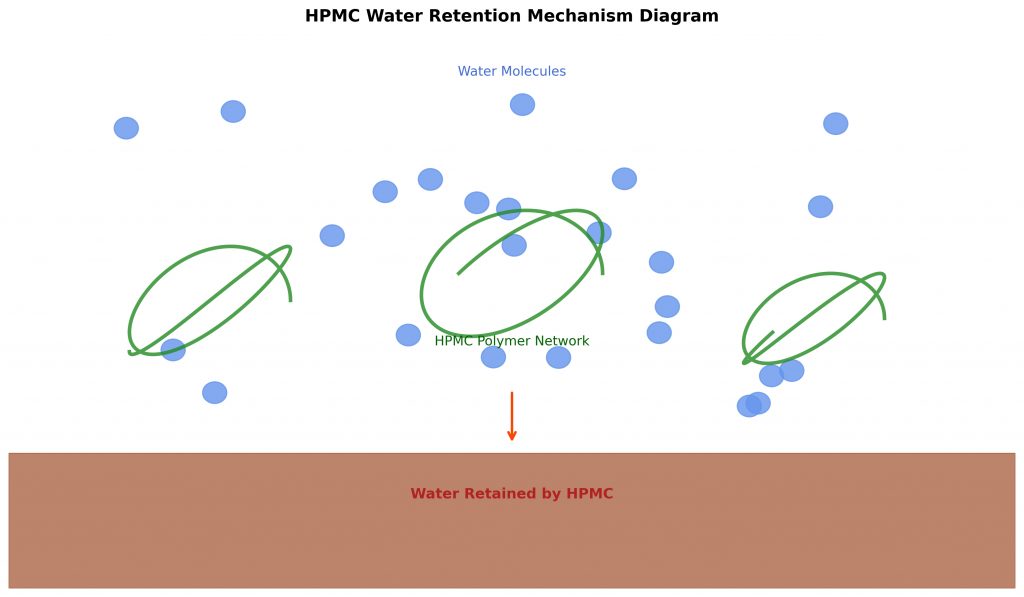
Water retention is the single most important function of cellulose ether in mortar. When fresh mortar contacts a porous substrate — such as an aerated concrete block, fired brick, or absorbent render base — capillary suction rapidly draws water out of the mix. Without adequate water retention, cement hydration is incomplete, leading to weak bonding, surface dusting, and premature cracking.
Cellulose ether works by forming a three-dimensional polymer network in the water phase of the mortar. This network physically restricts water movement without blocking cement hydration reactions. A well-formulated HPMC grade can achieve water retention values above 98% (DIN 18555-7), even on highly absorbent substrates.
Key variables that affect water retention performance:
Workability refers to how easily mortar can be mixed, spread, and shaped. Cellulose ether contributes to workability through two mechanisms: lubrication and thickening.
The dissolved polymer chains act as a lubricant between solid particles (cement, sand, filler), reducing internal friction. This translates directly to reduced trowel resistance and improved spreadability — installers use less force over larger areas without fatigue.
Open time — the window between mortar application and when the surface is no longer workable — is equally important. For tile installation on large wall surfaces, short open time means frequent re-application and wasted material. Cellulose ether slows both evaporation from the exposed surface and suction from the substrate, extending open time from typically 10–15 minutes (without additive) to 20–30 minutes or more depending on grade selection and dosage.
Heavy tiles applied to vertical surfaces must not slip before the adhesive sets. This anti-sag (or anti-slip) property depends on the mortar’s yield stress — the minimum force required to initiate flow.
Cellulose ether builds a soft gel structure in the mortar at rest, providing sufficient yield stress to hold tiles in place. When force is applied (spreading with a trowel), the structure temporarily breaks down, allowing smooth application. This thixotropic behavior — gel-like at rest, fluid under shear — is one of the defining characteristics of well-formulated cellulose ether grades for tile adhesives.
For large-format tiles (600×600mm and above), sag resistance requirements are significantly higher. In these applications, medium-to-high viscosity HPMC grades (75,000–200,000 mPa·s) are typically selected.
Final tensile adhesion strength (measured after curing, per EN 1348) is directly linked to the quality of cement hydration during the early setting phase. Specifically, cellulose ether’s water retention function ensures that cement grains have sufficient moisture for complete hydration — even on dry substrates in warm or windy conditions.
Furthermore, because cellulose ether improves contact between adhesive mortar and tile back surface (better spreadability = more complete contact area), the effective bonding zone increases. Consequently, both factors together contribute to higher and more consistent adhesion values.
| Property | HPMC (Hydroxypropyl Methylcellulose) | HEMC (Hydroxyethyl Methylcellulose) |
|---|---|---|
| Chemical Structure | Cellulose backbone with methyl & hydroxypropyl groups | Cellulose backbone with methyl & hydroxyethyl groups |
| Water Retention | High | Very High (superior, especially at high temperatures) |
| Thermal Gel Temperature | Lower (60–75°C) | Higher (70–90°C) |
| Cold Water Solubility | Good | Excellent (faster dissolution) |
| Thickening Efficiency | High (stronger thickening at same dosage) | Moderate |
| Alkali Resistance | Moderate | High |
| Workability | Good | Excellent (smoother, ‘slippery’ application feel) |
| Enzyme Resistance | Standard | High |
| Cost | Lower (more cost-effective) | Higher (typically 10–15% more) |
| Main Applications | Tile adhesive, wall putty, general mortars | EIFS, high-performance exterior renders, gypsum systems |
Nevertheless, both HPMC and HEMC are methylcellulose derivatives, but their side-chain chemistry creates meaningful performance differences in mortar applications.
| Property | HPMC | HEMC |
|---|---|---|
| Dissolution speed | Standard | Faster |
| Low-temperature performance | Good | Better (down to 5°C) |
| Water retention | Excellent | Excellent |
| Gel temperature | 60–75°C | 65–80°C |
| Compatibility with gypsum | Good | Very good |
| Typical application | Tile adhesive, render, EIFS | Gypsum plaster, cold climate systems |
In practice, HPMC covers the majority of global dry mix mortar applications. Furthermore, formulators prefer HEMC in Northern European and Scandinavian markets, where low-temperature jobsite conditions are common, and in gypsum-based systems, where its faster hydration is advantageous.
👉 HPMC for dry mix mortar | 👉 HEMC mortar additive
In practice, viscosity represents the most important parameter when you select a cellulose ether grade. Specifically, you measure it in mPa·s (2% aqueous solution, 20°C), and it directly determines water retention capacity, open time, and sag resistance.
| Viscosity Range | Typical Application | Key Requirement |
|---|---|---|
| 20,000–40,000 mPa·s | Self-leveling compounds, repair mortars | Low viscosity for flow, basic water retention |
| 40,000–75,000 mPa·s | Cement-based renders, basecoats | Balanced workability and water retention |
| 75,000–150,000 mPa·s | Tile adhesives (standard format) | High water retention, good open time |
| 150,000–200,000 mPa·s | Tile adhesives (large format), EIFS | Maximum sag resistance, extended open time |
Cellulose ether is used across virtually all dry mix mortar product categories:
Indeed, cellulose ether is not a commodity filler — it is the performance core of modern dry mix mortar. Consequently, the right grade selection, based on viscosity, substitution degree, and application system requirements, determines whether a mortar product meets EN classification standards and performs reliably in real construction conditions.
For technical grade recommendations or customized formulation support, contact our team directly.
We supply high-performance HPMC and HEMC for dry mix mortar manufacturers worldwide. We strategically deploy our products as essential components in tile adhesives, renders, gypsum systems, and EIFS applications.
👉 Contact us for samples, technical data sheets, and formulation support.
