

Hydroxypropyl Methylcellulose (HPMC), also known as hypromellose, is a critical pharmaceutical excipient widely used in modern drug formulations. This guide covers HPMC uses in pharmaceuticals, from immediate-release tablets and precision film coatings to sophisticated controlled-release drug delivery systems. HPMC offers a combination of functionality, safety, and global regulatory acceptance that few excipients can match.
Today, pharmaceutical manufacturers face increasing pressure on every front: they must improve drug performance, reduce production costs, accelerate development timelines, and comply with regulations across multiple jurisdictions simultaneously. As a result, multifunctional excipients are no longer merely a convenience—they have become a strategic necessity. In this context, HPMC provides an effective and reliable solution.
Derived from natural cellulose, HPMC is a non-ionic, water-soluble polymer with more than 60 years of documented use in pharmaceutical tablets and controlled-release systems. Moreover, its versatility is unmatched. A single HPMC excipient can function simultaneously as a:
Consequently, formulators can reduce formulation complexity while improving product quality, translating directly into commercial and regulatory advantages.
Furthermore, as pharmaceutical formulations become increasingly sophisticated, the demand for multifunctional and globally accepted excipients continues to grow. Against this backdrop, HPMC has established itself as one of the most widely used pharmaceutical polymers worldwide.
In this comprehensive guide, we explore the major HPMC uses in pharmaceuticals, explain the science behind how it works in different dosage forms, compare HPMC grades for specific applications, and examine why it continues to dominate pharmaceutical formulation development globally.
Whether you are a formulation scientist, R&D director, or procurement specialist, this guide will provide both the technical foundation and practical insights needed to use HPMC more strategically and source it with greater confidence.
Manufacturers produce Hydroxypropyl Methylcellulose, a semi-synthetic cellulose ether, by chemically modifying natural cellulose. Specifically, the process introduces two types of substituent groups onto the cellulose backbone:
The ratio of these two substituents — expressed as the degree of substitution — defines each HPMC grade and, consequently, determines its behavior in formulation. Therefore, grade selection is critical: different ratios produce dramatically different physical and functional outcomes.
As a result of this chemistry, the polymer is simultaneously water-soluble, film-forming, thermally gelling, and chemically inert. Indeed, very few pharmaceutical materials combine all four properties, which explains why HPMC appears in virtually every class of solid oral dosage form manufactured today.
| Property | Value / Behavior | Formulation Relevance |
|---|---|---|
| Appearance | White to off-white powder | Easy visual identification and quality control |
| Solubility | Soluble in cold water; insoluble in hot water | Enables aqueous processing; thermal gelation used in coating |
| pH stability | Stable across pH 3–11 | Consistent GI tract performance from stomach to colon |
| Viscosity range | 3 to 100,000 mPa·s | Supports both coating (low) and controlled release (high) |
| Thermal gelation | Gels on heating; re-dissolves on cooling | Useful in hot-melt and film applications |
| Hygroscopicity | Moderate | Stable in standard pharmaceutical storage conditions |
| Ionic character | Non-ionic | Excellent API compatibility; no ion-exchange interactions |
| Glass transition temperature | ~170°C (dry) | Compatible with hot-melt extrusion processes |
The pH stability across 3–11 deserves special attention. It means HPMC performs consistently from the highly acidic gastric environment (pH ~1.5–3.5) through the neutral conditions of the small intestine and into the slightly basic environment of the colon. For controlled-release formulations, this is not optional — it is essential.
HPMC’s regulatory footprint is one of its most commercially valuable attributes. It is approved and monographed in:
It also holds GRAS (Generally Recognized as Safe) status with the U.S. FDA, is listed extensively in the FDA Inactive Ingredient Database (IID) for multiple routes of administration, and is accepted by EFSA as food additive E464.
Consequently, for manufacturers supplying multiple international markets — the U.S., EU, Japan, India, China simultaneously — this global pharmacopoeial coverage eliminates a significant regulatory variable. A product formulated with pharmacopoeial-compliant HPMC does not need excipient re-justification for each new market submission.
The pharmaceutical industry has thousands of excipients available. Why has HPMC become the default choice across so many applications?
The answer is multifunctionality combined with reliability.
A single HPMC excipient can simultaneously function as:
This multifunctionality translates directly into measurable business advantages:
| Advantage | Business Impact |
|---|---|
| Fewer excipients per formulation | Lower raw material complexity and cost |
| Simplified validation | Faster development timelines |
| Easier regulatory submissions | Reduced submission burden per market |
| Global pharmacopoeial compliance | Access to US, EU, JP markets with single excipient |
| Long safety history (60+ years) | Lower regulatory risk for new formulations |
| Supplier network breadth | Supply chain resilience |
Thus, these advantages explain why manufacturers use HPMC in cardiovascular medications, diabetes treatments, CNS drugs, OTC analgesics, ophthalmic products, nutraceuticals, and veterinary pharmaceuticals — often in multiple functional roles within a single product.
Tablet binding is one of the most fundamental pharmaceutical applications of HPMC, with documented use spanning more than five decades.
In essence, a binder creates physical bridges between powder particles during compression, ensuring the tablet maintains mechanical integrity throughout manufacturing, coating, packaging, shipping, and patient handling. Without adequate binding, tablets crack, crumble, or fail friability testing — any of which constitutes a manufacturing failure.
Mechanistically, here is how HPMC binds: HPMC distributes through the powder blend during mixing. Under compression, the polymer chains deform and create adhesive contact points between particles. Upon hydration (either in wet granulation or during dissolution), HPMC further strengthens particle bonding through hydrogen bonding and chain entanglement.
Performance advantages over traditional binders:
| Binder | Binding Strength | Hygroscopicity | Compatibility | Dual Function (CR) |
|---|---|---|---|---|
| HPMC | Excellent | Moderate | Excellent | Yes |
| PVP (Povidone) | Excellent | High | Good | No |
| Starch | Moderate | High | Moderate | No |
| HPC | Good | Low | Good | Limited |
| Gelatin | Good | High | Limited | No |
Therefore, HPMC’s lower hygroscopicity compared to PVP provides a significant advantage: granules bound with HPMC maintain better physical stability under varying humidity storage conditions, thereby reducing the risk of moisture-induced hardness changes or dissolution failures during shelf life.
Applications:
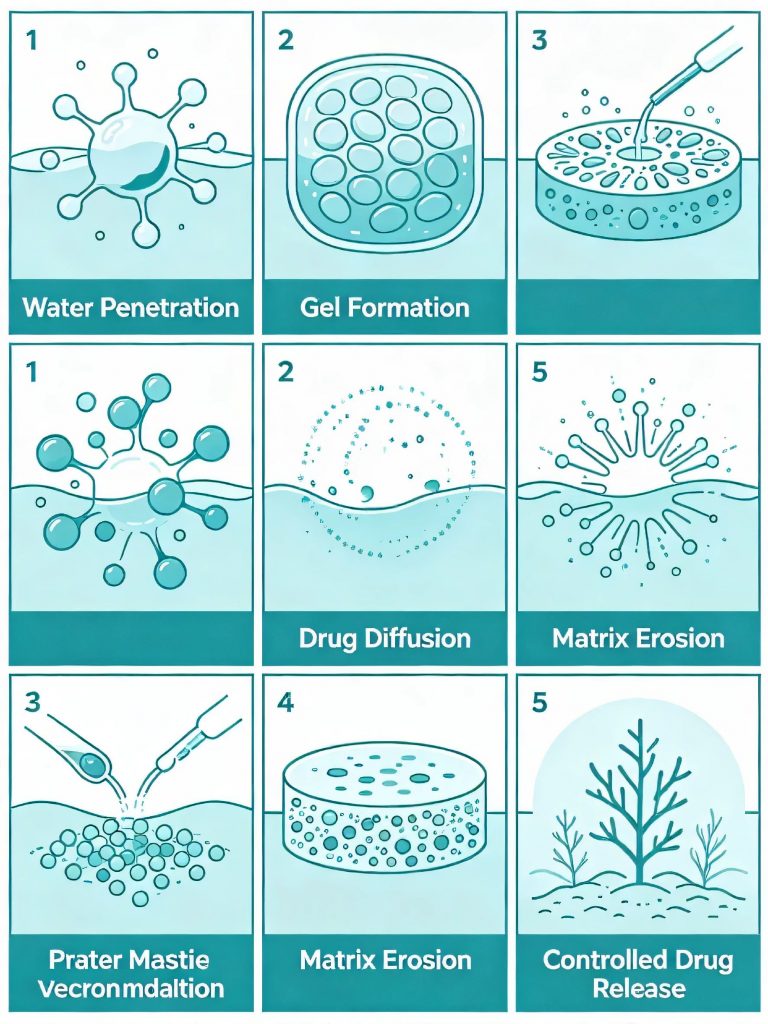
When an HPMC matrix tablet comes into contact with gastrointestinal fluids, a controlled hydration process begins.One of the most valuable HPMC Uses in Pharmaceuticals is controlled-release drug delivery.
Gastrointestinal fluids penetrate the tablet surface and begin hydrating HPMC polymer chains.
Hydrated HPMC swells and forms a viscous gel barrier around the tablet.
Drug molecules slowly diffuse through the hydrated gel layer.
The outer gel layer gradually erodes while new HPMC hydrates underneath, maintaining controlled release. Consequently, this dual mechanism produces near-zero-order release kinetics — meaning drug is delivered at an approximately constant rate over the intended release period, rather than in a burst-then-decline pattern.
Clinical significance of controlled release:
| Parameter | Immediate Release | HPMC Controlled Release |
|---|---|---|
| Dosing frequency | 3–4× daily | Once daily |
| Plasma concentration | Peak-trough fluctuation | Stable plateau |
| Side effect risk | Higher at peaks | Reduced |
| Patient adherence | Lower | Significantly higher |
| Therapeutic window compliance | Variable | Consistent |
The WHO identifies poor patient adherence as one of the leading causes of treatment failure in chronic disease management. Once-daily dosing, made possible by HPMC matrix technology, is one of the most evidence-backed strategies for improving adherence in real-world clinical practice.
Therapeutic areas where HPMC controlled-release systems dominate:
Metformin extended-release deserves specific mention. HPMC matrix technology transformed this drug — originally limited by significant GI side effects and three-times-daily dosing — into a well-tolerated, once-daily formulation that dramatically improved patient quality of life and adherence rates in Type 2 diabetes management. This is HPMC’s impact at a population health scale.
Effect of viscosity grade on release kinetics:
| HPMC Grade | Viscosity (mPa·s) | Gel Strength | Typical Release Duration |
|---|---|---|---|
| K4M | 4,000 | Moderate | 6–8 hours |
| K15M | 15,000 | Strong | 12–16 hours |
| K100M | 100,000 | Very strong | 18–24 hours |
Higher viscosity = thicker gel layer = slower erosion = longer release duration. This relationship gives formulators precise, predictable control over release profiles through grade selection alone.
Therefore, beyond standard controlled release, formulators choose HPMC as the excipient for designing hydrophilic matrix tablets, as they specifically engineer these tablets for challenging drug delivery problems — particularly BCS Class II compounds (low solubility, high permeability) where dissolution rate limits bioavailability.
So, why choose hydrophilic matrix design?
Hydrophilic matrix tablets using HPMC offer three critical manufacturing advantages over other extended-release technologies (such as membrane coating, osmotic systems, and multiparticulates):
As a result, for generic drug manufacturers in particular, HPMC hydrophilic matrix technology is frequently the fastest path from API to approved extended-release product.
Film coating is far more than cosmetic — it is a functional pharmaceutical process that directly affects product stability, shelf life, patient acceptability, and commercial success.
Nevertheless, among all HPMC uses in pharmaceuticals, tablet manufacturing remains the largest application segment globally.
Even so, film coating is another important area among modern HPMC uses in pharmaceuticals.
What HPMC film coating delivers:
| Function | Mechanism | Commercial Benefit |
|---|---|---|
| Moisture protection | Semi-permeable film slows vapor transmission | Extended shelf life |
| Taste masking | Physical barrier prevents API contact with taste buds | Improved palatability; OTC market advantage |
| Light protection | Opacified film reflects UV/visible light | Photosensitive API protection |
| Swallowability | Smooth film surface reduces friction | Patient compliance, especially elderly |
| Brand differentiation | Color, gloss, embossing | Market recognition |
| Stability improvement | Barrier against oxidation | Reduced degradant formation |
How HPMC film coating works:
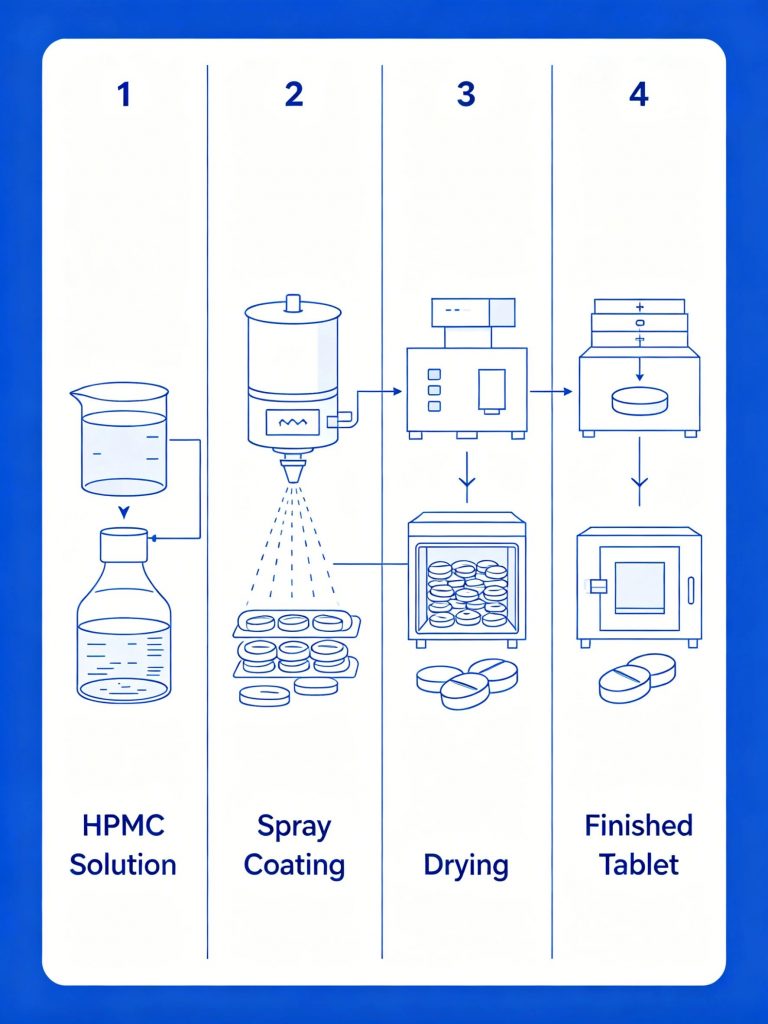
The film coating process typically follows four stages.
HPMC is dissolved in purified water with plasticizers and pigments.
The solution is sprayed onto rotating tablets.
Warm air evaporates water and forms a continuous film.
A smooth and protective coating is formed.
Low-viscosity grades for coating:
Grades E3, E5, and E15 are most commonly used for film coating. Their low viscosity allows dissolution at coating-compatible concentrations (3–8% w/v) while maintaining excellent film-forming behavior. In contrast, higher viscosity grades produce solutions too viscous for efficient spray application at practical concentrations..
Aqueous vs. solvent coating:
The industry has largely transitioned from organic solvent-based to aqueous coating systems for safety, environmental, and regulatory reasons. HPMC is optimally suited for aqueous coating — it dissolves readily in cold water and produces stable, low-viscosity coating solutions that process efficiently under standard pan coating conditions.
For most of pharmaceutical history, hard capsule shells were manufactured from gelatin — a protein derived from animal collagen. However, capsule production now represents one of the fastest-growing HPMC Uses in Pharmaceuticals. While gelatin performs adequately in many applications, it nonetheless carries limitations that have become increasingly commercially significant.
HPMC capsule shells address every one of these limitations simultaneously.
| Parameter | HPMC Capsules | Gelatin Capsules |
|---|---|---|
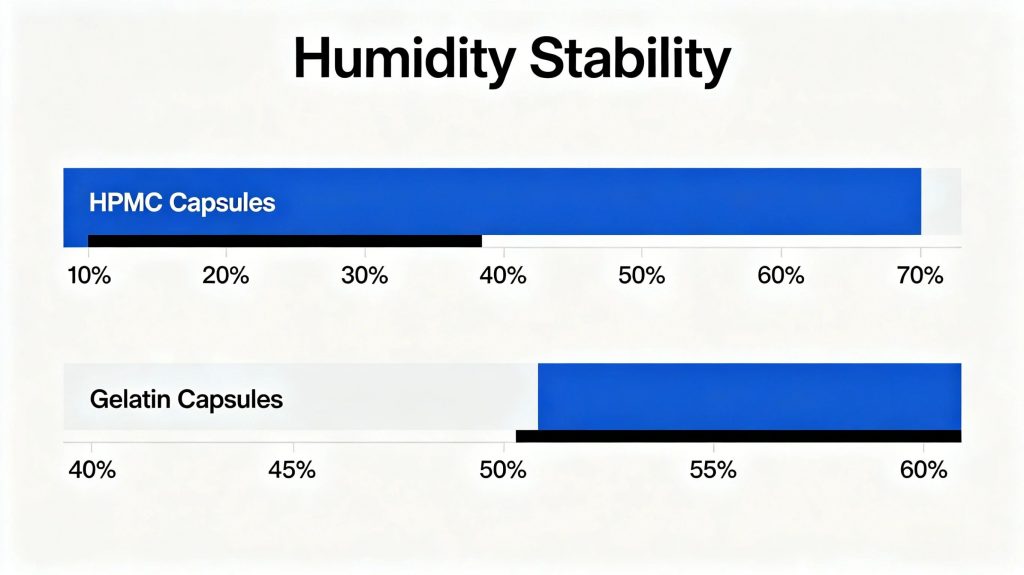
| Humidity stability range | 10–70% RH | 40–60% RH |
| Vegetarian/Vegan | ✓ | ✗ |
| Halal certified | ✓ | Depends on source |
| Kosher certified | ✓ | Depends on source |
| Cross-linking risk | None | Present |
| Moisture content | ~3–5% | ~13–15% |
| API moisture sensitivity | Lower risk | Higher risk |
| Dissolution reliability | Consistent | Variable (cross-linking) |
The moisture content difference is particularly important for hygroscopic APIs. Specifically, gelatin capsules contain 13–15% moisture by weight, whereas HPMC capsules contain only 3–5%. As a result, for moisture-sensitive APIs—many of which are used in nutraceutical and specialty pharmaceutical formulations—this difference can determine whether a product maintains its potency throughout its stated shelf life. Consequently, HPMC capsules are often preferred when formulation stability and long-term product quality are critical considerations.
For nutraceutical brands, botanical supplement manufacturers, and pharmaceutical companies targeting health-conscious or religiously observant consumer demographics, HPMC capsules are no longer a premium specialty option. They have become the mainstream choice.
HPMC is one of the most widely used viscosity-enhancing agents in ophthalmic formulations—from prescription eye drops to the OTC artificial tear products used by hundreds of millions of dry eye patients globally. Moreover, beyond solid dosage forms, HPMC uses in pharmaceuticals also extend to ophthalmic and liquid formulations, where viscosity control, lubrication, and formulation stability are critical performance requirements.
One of the primary reasons HPMC is widely used in ophthalmic formulations is its unique rheological behavior. At concentrations of 0.3–1.0% w/v, HPMC solutions exhibit pseudoplastic (shear-thinning) characteristics—they become less viscous under the mechanical shear of blinking and quickly regain viscosity when the eye is at rest.
As a result, this behavior maximizes patient comfort during instillation while simultaneously increasing ocular surface contact time during the inter-blink interval. Consequently, both tolerability and therapeutic effectiveness can be significantly improved.
In addition, HPMC’s non-ionic character ensures broad compatibility with ophthalmic preservatives such as benzalkonium chloride and EDTA, as well as tonicity agents including sodium chloride. Therefore, formulators can reduce the risk of compatibility issues that often complicate ophthalmic product development. Furthermore, this compatibility provides greater formulation flexibility when incorporating a wide range of active pharmaceutical ingredients (APIs).
Common ophthalmic applications:
In oral liquid preparations for pediatric and geriatric patients unable to swallow solid dosage forms, HPMC functions as a suspending agent — maintaining uniform API distribution throughout the suspension and preventing rapid particle sedimentation.
Its low intrinsic taste and odor are particularly valuable in pediatric formulations, where palatability is a major driver of patient compliance. As a result, children are more likely to accept and consistently take medications formulated with HPMC-containing systems. Furthermore, HPMC’s non-ionic character ensures excellent compatibility with the flavoring agents, sweeteners, and buffering systems typically required in oral pediatric preparations. Consequently, formulators can achieve both improved patient acceptability and greater formulation stability without compromising product performance.
In topical pharmaceutical formulations, HPMC provides the rheological structure that keeps active ingredients at the application site. It is used in:
Its non-ionic behavior eliminates ionic incompatibilities that complicate formulation of charged APIs with ionic polymers like carbomers.
Selecting the correct HPMC grade is one of the most consequential formulation decisions a pharmaceutical scientist makes. The same molecule, at different viscosity grades, produces dramatically different outcomes.
HPMC grades are classified by two parameters:
Choose E3 or E5.
Choose E15.
Choose K4M.
Choose K100M.
| Grade | Viscosity (mPa·s) | Substitution Type | Primary Pharmaceutical Application |
|---|---|---|---|
| E3 | 3 | 2910 | Film coating, oral films |
| E5 | 5 | 2910 | Film coating, light binding |
| E6 | 6 | 2910 | Film coating, granulation binder |
| E15 | 15 | 2910 | Film coating, granulation binder |
| E50 | 50 | 2910 | Matrix tablets, wet granulation |
| K4M | 4,000 | 2208 | Sustained-release matrices (6–8 hr) |
| K15M | 15,000 | 2208 | Extended-release matrices (12–16 hr) |
| K100M | 100,000 | 2208 | Once-daily extended-release (18–24 hr) |
For film coating: Select E3, E5, or E15. Low viscosity allows dissolution at coating-compatible concentrations. E5 is the most commonly specified grade for standard immediate-release tablet coating worldwide.
For tablet binding (direct compression): Select E15 or E50. These grades provide adequate binding strength under direct compression without significantly retarding disintegration in immediate-release formulations.
For tablet binding (wet granulation), in contrast: Select E5 or E15 dissolved in water at 3–6% concentration. Lower viscosity grades are preferred to ensure uniform distribution during spraying.
For controlled-release matrices (6–8 hours): Select K4M. Adequate gel strength for moderate-duration release; frequently used in twice-daily formulations.
For controlled-release matrices (12–16 hours): Select K15M. Stronger gel layer supports twice-daily to once-daily dosing. The most widely used grade for sustained-release tablet development globally.
For once-daily extended-release (18–24 hours): Select K100M. Maximum gel layer thickness; essential for 24-hour zero-order release profiles in cardiovascular and CNS applications.
For ophthalmic viscosity enhancement: Select low-to-medium viscosity grades (E5 to K4M) at 0.3–1.0% concentration. Grade selection determines viscosity and residence time.
Understanding when to choose HPMC — and when another excipient is more appropriate — is as important as understanding what HPMC does.
| Application | HPMC | HPC | PVP/PVA | Eudragit | Carbomer | MCC |
|---|---|---|---|---|---|---|
| Controlled-release matrix | ✓✓ Best | Limited | Poor | pH-dependent | Limited | Poor |
| Film coating (aqueous) | ✓✓ Best | Good | Good | Good | Poor | Poor |
| Vegetarian capsule shells | ✓✓ Best | ✗ | ✗ | ✗ | ✗ | ✗ |
| Ophthalmic viscosity | ✓✓ Best | Good | Poor | ✗ | Good | ✗ |
| Wet granulation binder | Good | ✓✓ Best | Good | ✗ | ✗ | Poor |
| Direct compression filler | Poor | Poor | Poor | ✗ | ✗ | ✓✓ Best |
| Enteric coating | ✗ | ✗ | ✗ | ✓✓ Best | ✗ | ✗ |
| pH-triggered release | ✗ | ✗ | ✗ | ✓✓ Best | ✗ | ✗ |
| Multifunctionality | ✓✓ Highest | Moderate | Moderate | Low | Low | Moderate |
Key insight: HPMC dominates pH-independent, sustained-release, coating, and multi-functional applications. Where pH-triggered enteric release is required, Eudragit polymers are the appropriate choice. Where maximum direct compression performance is the priority, MCC is unmatched. Understanding these boundaries prevents costly reformulation.
The FDA’s IID lists approved concentration ranges for inactive ingredients by route of administration. HPMC appears extensively across:
Formulating within established IID precedent levels generally streamlines regulatory review. When concentrations exceed IID precedents, additional safety justification documentation is required. For new markets entering the IID with HPMC, this represents a meaningful time-to-market advantage.
Under ICH Q8 (Pharmaceutical Development) and Q10 (Pharmaceutical Quality System) guidelines, excipient selection and specification must be scientifically justified and fully documented in the regulatory submission. For HPMC used in critical quality attribute-determining roles — particularly controlled-release matrices — the excipient specification should include:
Changes to HPMC grade or supplier in approved pharmaceutical products typically require a CBE-30 (Changes Being Effected in 30 days) or Prior Approval Supplement filing with the FDA, depending on the functional role and the magnitude of the change. Therefore, early qualification of a primary and secondary HPMC supplier — combined with appropriate comparability data generated during development — is sound risk management. By doing so, manufacturers can avoid costly post-approval change submissions and ensure regulatory compliance.
The next decade of pharmaceutical development will place even greater demands on excipient multifunctionality, sustainability, and compatibility with advanced manufacturing technologies. HPMC is well-positioned to meet all three.
HPMC is emerging as a leading excipient in pharmaceutical additive manufacturing, particularly in fused deposition modeling (FDM) and semisolid extrusion 3D printing. Its thermal behavior — processable at elevated temperatures, solid at room temperature — makes it compatible with hot-melt extrusion filament production for FDM printing of personalized dosage forms with patient-specific release profiles.
Consequently, regulatory agencies are actively developing frameworks for 3D-printed pharmaceuticals. HPMC’s established safety profile and pharmacopoeial compliance position it as the excipient of choice for early regulatory submissions in this space.
HPMC-AS (hydroxypropyl methylcellulose acetate succinate) — a derivative of standard HPMC — has become the polymer of choice for amorphous solid dispersion formulation of poorly soluble BCS Class II and IV drugs. ASD technology using HPMC-AS is now a primary enabling strategy for compounds that would otherwise have unacceptable oral bioavailability.
As the pharmaceutical pipeline continues to shift toward complex, poorly soluble new chemical entities, demand for HPMC-AS-based ASD technology is expected to grow substantially through the late 2020s.
Notably, pharmaceutical continuous manufacturing — favored by the FDA and EMA for quality and efficiency reasons — requires excipients with consistent, highly reproducible physical properties. HPMC’s narrow batch-to-batch viscosity and particle size variability (when sourced from qualified pharmaceutical-grade suppliers) makes it well-suited to continuous manufacturing environments where real-time release testing replaces traditional batch testing.
Pharmaceutical manufacturers must submit a CBE-30 (Changes Being Effected in 30 days) or Prior Approval Supplement to the FDA whenever they change the HPMC grade or supplier in approved pharmaceutical products, because the required submission depends on the functional role and the magnitude of the change.Therefore, early qualification of a primary and secondary HPMC supplier — combined with appropriate comparability data generated during development — is sound risk management. By doing so, manufacturers can avoid costly post-approval change submissions and ensure regulatory compliance.
Regulatory agencies worldwide — including EMA’s Paediatric Regulation and FDA’s Best Pharmaceuticals for Children Act — are mandating age-appropriate formulations. HPMC’s adaptability across mini-tablets, multiparticulates, oral suspensions, orodispersible films, and easy-swallow coated tablets makes it central to patient-centric formulation strategies for pediatric and geriatric populations.
| Application | Recommended Grade |
|---|---|
| Film Coating | E3, E5 |
| Binder | E15 |
| Controlled Release | K4M |
| Extended Release | K15M |
| Once Daily Release | K100M |
For instance, specifically, HPMC serves as a binder in tablet manufacturing, a film-coating agent for tablets and capsules, a matrix former for controlled-release drug delivery, a thickening agent in ophthalmic and topical preparations, a suspending agent in oral liquid formulations, and a shell material for vegetarian capsules.
HPMC forms a viscous gel layer when gastrointestinal fluids hydrate it. Consequently, this gel layer controls drug release through a combination of diffusion and erosion, thereby producing sustained, predictable plasma concentrations. Moreover, selecting the appropriate viscosity grade controls the release rate — higher viscosity grades produce slower, more prolonged release.
Low-viscosity grades — E3, E5, and E15 — are preferred for tablet film coating. They dissolve readily at coating-compatible concentrations in aqueous systems and produce smooth, uniform, adherent films. E5 is the most widely specified grade for standard pharmaceutical film coating applications worldwide.
Yes. HPMC has a safety record spanning more than 60 years of pharmaceutical use. It is non-toxic, non-ionic, and biocompatible. It is approved by USP, EP, JP, IP, and ChP, holds FDA GRAS status, and appears in the FDA Inactive Ingredient Database for multiple routes of administration.
Yes. In fact, HPMC capsule shells are a well-established alternative to gelatin, offering broader humidity stability (10–70% RH vs. 40–60% RH for gelatin), no cross-linking risk, and certification as vegetarian, vegan, Halal, and Kosher. Therefore, they are particularly advantageous for hygroscopic APIs and for products targeting health-conscious, religious, or plant-based consumer markets.
These grades differ in viscosity: K4M = 4,000 mPa·s; K15M = 15,000 mPa·s; K100M = 100,000 mPa·s. Therefore, higher viscosity produces a thicker, slower-eroding gel layer in matrix tablets. Consequently, manufacturers use K4M for 6–8 hour release, K15M for 12–16 hour release, and K100M for 18–24 hour once-daily release systems.
Both are effective tablet binders, but HPMC offers lower hygroscopicity (better stability in varying humidity), dual functionality as a controlled-release polymer (PVP cannot provide controlled release), and broader regulatory acceptance across liquid and semi-solid dosage forms. Conversely, PVP may offer marginally stronger binding in some high-shear wet granulation applications.
HPMC-AS (hydroxypropyl methylcellulose acetate succinate) incorporates additional acetate and succinate substituents onto the HPMC backbone. Specifically, it exhibits pH sensitivity — dissolving above approximately pH 5.5–6.8 depending on grade — and therefore finds primary use in enteric applications and amorphous solid dispersion formulation of poorly soluble APIs. In contrast, standard HPMC shows pH-independent behavior and serves the applications described in this guide.
The most common HPMC Uses in Pharmaceuticals include tablet binding, film coating, controlled-release matrices, capsule shells, ophthalmic preparations, and oral suspensions.
HPMC Uses in Pharmaceuticals continue to grow because HPMC combines excellent safety, multifunctionality, and global regulatory acceptance.
Hydroxypropyl Methylcellulose has earned its position as one of the most important pharmaceutical excipients in the world — not through any single outstanding property, but through the combination of versatility, reliability, safety, and global regulatory acceptance that no competing material has matched over six decades of use.
In practice, from once-daily cardiovascular tablets that maintain stable plasma levels for 24 hours, to vegetarian capsule shells for Halal-certified nutraceutical markets, to film-coated analgesics that children will actually swallow, to artificial tear drops used by dry eye patients worldwide — indeed, HPMC is the excipient enabling better pharmaceutical outcomes across virtually every therapeutic category and every dosage form.
Therefore, for formulators, the key is not simply choosing HPMC, but choosing it intelligently: matching the right grade to the application, specifying the right quality attributes, and qualifying a supplier capable of delivering the consistency that modern pharmaceutical manufacturing demands.
Meanwhile, for procurement specialists, the questions are supplier GMP certification, pharmacopoeial compliance documentation, batch-to-batch consistency data, and supply chain resilience — because excipient quality directly determines product quality.
At Acta Biotechnology, we supply pharmaceutical-grade HPMC with full pharmacopoeial compliance, comprehensive batch documentation, and technical formulation support. Therefore, whether you are in early-stage formulation development or scaling to commercial production, we are ready to help you source the right grade, validate its performance, and build formulations that meet the highest global quality standards.
Ready to discuss your HPMC requirements? Visit actabiotechnology.com to learn more about our pharmaceutical excipient portfolio and technical support capabilities.
