

Meta :Discover how HPMC improves direct compression tablets — binding performance, grade selection, real formulation cases, and how to choose a qualified pharmaceutical HPMC supplier.
HPMC (hydroxypropyl methylcellulose) is a multifunctional pharmaceutical excipient used in HPMC in Direct Compression Tablets as a dry binder, flow aid, and controlled-release matrix polymer. It improves tablet hardness and mechanical integrity. It also supports consistent powder flow. In addition, it enables both immediate and sustained drug release in HPMC in Direct Compression Tablets, depending on viscosity grade and concentration.
Direct compression (DC) is the simplest, most cost-efficient tablet manufacturing process available to pharmaceutical manufacturers. By eliminating wet granulation and drying steps, DC reduces processing time, energy consumption, and equipment complexity — making it the preferred manufacturing route wherever the API and excipient blend allows.
The trade-off is demanding: powders must flow consistently, compress predictably, and bond into mechanically robust tablets without the homogenizing benefit that granulation provides. These requirements place the burden of performance squarely on excipient selection. A direct compression formulation is only as good as the excipients that carry it.
Hydroxypropyl methylcellulose — more commonly known as HPMC — has emerged as one of the most versatile and widely adopted excipients in direct compression tablet formulation. Its combination of binding efficiency, broad API compatibility, and capacity for both immediate and controlled release profiles makes HPMC in direct compression tablets a formulation strategy used across virtually every therapeutic category in modern pharmaceutical manufacturing.As pharmaceutical manufacturers continue to prioritize efficiency and product quality, HPMC in Direct Compression Tablets has become one of the most important formulation approaches in modern solid dosage development.
Hydroxypropyl methylcellulose (HPMC), also designated by its INN name hypromellose, is a semi-synthetic cellulose ether used in HPMC in Direct Compression Tablets. Manufacturers produce it by chemically modifying natural cellulose with methyl and hydroxypropyl groups. The resulting polymer is:
These properties make HPMC one of the most adaptable pharmaceutical excipients available, capable of serving entirely different formulation functions simply by adjusting viscosity grade and use level. No other single cellulose excipient spans the range from immediate release binding to high-performance controlled release matrix formation with equal reliability.
HPMC functions as an effective dry binder in HPMC in Direct Compression Tablets. It forms intermolecular hydrogen bonds between cellulose chains and adjacent API or excipient particles during compression.
As a result, tablet hardness improves. In addition, the incidence of capping and lamination decreases. Tablet mechanical strength also increases. Therefore, downstream processing such as coating, packaging, and transport becomes more reliable.
For APIs with poor self-bonding characteristics, HPMC plays an even more critical role. This is a common limitation in direct compression formulations. In such cases, HPMC binding capacity can determine whether a compressible blend is achieved. It also helps avoid wet granulation.
HPMC grades optimized for HPMC in Direct Compression Tablets show good bulk flow characteristics. These characteristics improve blend uniformity and weight consistency during high-speed tablet compression.
As a result, consistent powder flow reduces tablet weight variation. It also minimizes die-fill discrepancy. In addition, it supports operation at high turret speeds. Manufacturers do not need oversized safety margins on blend properties.
For continuous manufacturing lines, flow consistency is critical. It directly affects output quality. Therefore, HPMC improves overall process robustness.
Tablets produced with HPMC in HPMC in Direct Compression Tablets show low friability. They also show reduced capping. In addition, they resist lamination. These are three common mechanical failure modes in DC tablet manufacturing.
During compression, HPMC shows viscoelastic behavior. Therefore, it absorbs compaction forces. It also redistributes these forces across the tablet matrix. As a result, stress concentrations decrease. This reduces delamination at tablet interfaces.
The final result is a tablet with a clean surface. It also has strong mechanical integrity. Therefore, it withstands film coating and blister packaging processes.
HPMC’s non-ionic character eliminates the electrostatic incompatibilities that limit the application of charged polymers in pharmaceutical formulations. It has documented compatibility with antibiotics (penicillins, cephalosporins, macrolides), vitamins and micronutrients, nutraceutical actives, and herbal extracts with complex phytochemical matrices. This breadth of compatibility makes HPMC a default candidate for new formulation screening across therapeutic categories, reducing the likelihood of excipient-driven development setbacks.
Formulators working with pharmaceutical HPMC grades should note the polymer’s excellent compatibility with microcrystalline cellulose (MCC). In addition, this compatibility enables binary excipient blends. These blends combine the complementary strengths of both polymers.
As a result, formulators achieve better balance between flow, compression, and binding performance.
The mechanism of HPMC action in direct compression follows a sequential physical process:
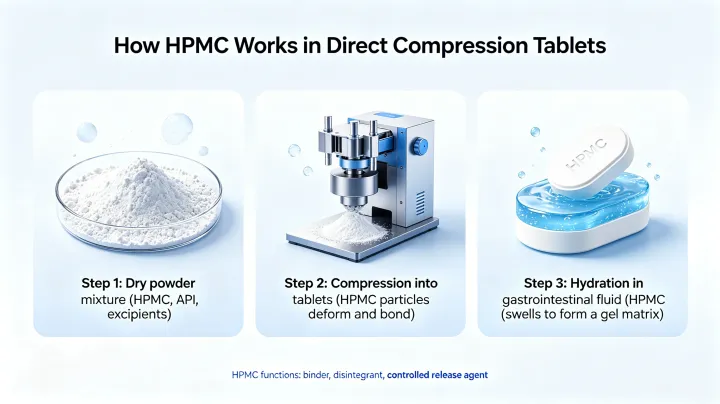
For controlled release formulations in HPMC in Direct Compression Tablets, this mechanism continues in the dissolution environment. When the tablet contacts gastrointestinal fluid, HPMC hydrates and forms a viscous gel layer around the surface. This gel layer controls water ingress and drug diffusion. As a result, it sustains drug release over a programmed time period. This mechanism forms the basis of HPMC controlled release matrix technology. It is one of the most widely used strategies in oral solid dosage manufacturing.
| Application | Recommended HPMC Level |
|---|---|
| Immediate Release | 1–5% |
| Dry Binder | 2–8% |
| Sustained Release | 10–40% |
| High Dose Tablets | 3–10% |
Use levels in HPMC in Direct Compression Tablets should be confirmed through compressibility and dissolution screening at the target tablet hardness and weight. Formulators should adjust the concentration based on performance results. Higher API loads or poorly compressible APIs require higher use levels within each range. For sustained-release formulations, HPMC concentration depends on the desired release rate, tablet geometry, and drug solubility.
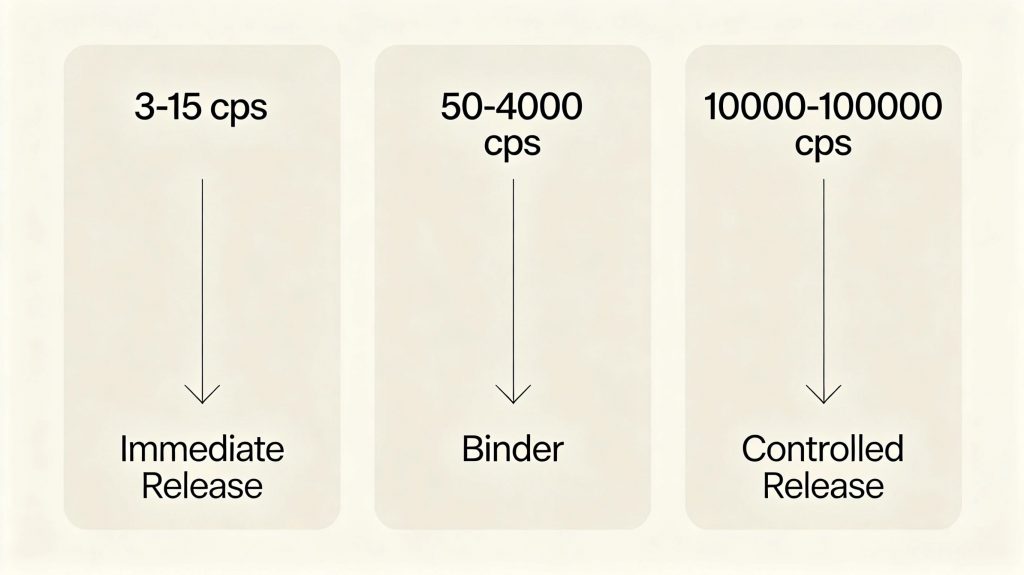
Low viscosity grades of HPMC in Direct Compression Tablets hydrate rapidly and create minimal resistance to dissolution. They suit immediate release tablet formulations that require fast disintegration and complete drug release within 30–45 minutes. At 1–5% use levels, they provide adequate binding without delaying dissolution. These grades are commonly used in paracetamol tablets, vitamin supplements, and immediate-release antibiotic tablets.
Medium viscosity grades of HPMC in Direct Compression Tablets offer enhanced binding strength. Therefore, formulators prefer them for dry binder applications where tablet hardness is the main performance requirement.
In addition, the higher molecular weight of these grades increases interparticle bonding during compression. As a result, tablet production requires lower compaction forces. This also reduces tooling wear.
Typically, formulators use these grades at 2–8%. The exact level depends on API characteristics and target hardness specifications.
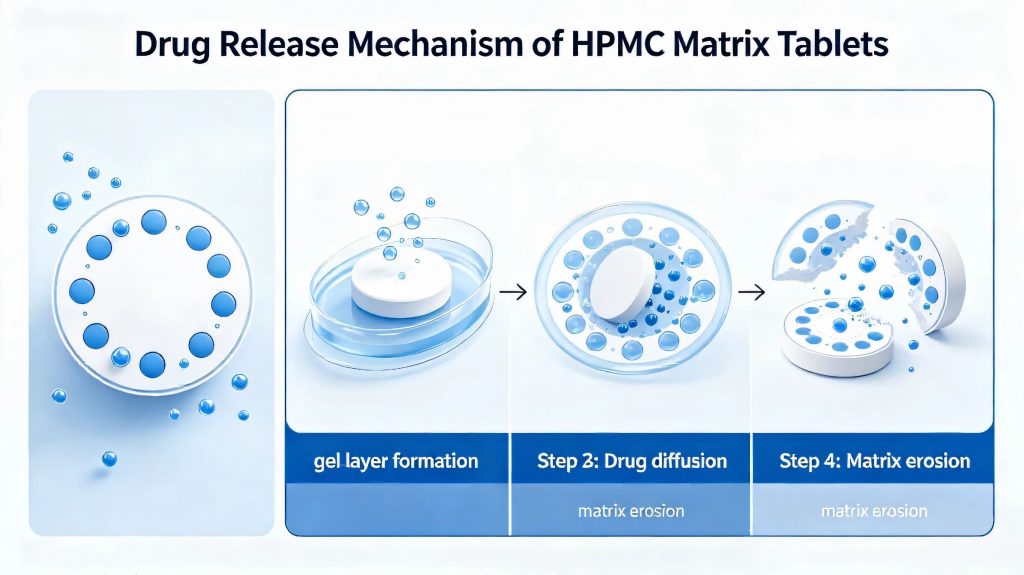
High viscosity grades of HPMC in Direct Compression Tablets form the functional foundation of controlled release matrix formulations. When they contact aqueous media, they form a dense gel layer. This gel layer is persistent and stable.
As a result, it controls drug diffusion and tablet erosion. Therefore, it produces predictable sustained release profiles across a wide range of drug solubilities.
Typically, formulators use 10–40% HPMC. Higher concentrations slow drug release further. In addition, they produce longer and more prolonged release profiles. Learn more about HPMC for controlled release tablets and how viscosity grade selection affects in vitro and in vivo release kinetics.
In HPMC in Direct Compression Tablets immediate-release applications, HPMC functions mainly as a binding agent. It does not act as a dissolution modifier.
Therefore, formulators use low-to-medium viscosity grades. They apply them at 1–5% concentrations. As a result, they achieve the following performance characteristics:
Common immediate release applications include paracetamol and ibuprofen tablets, multivitamin and mineral supplements, and first-line antibiotic tablets where rapid onset of therapeutic action is the clinical requirement.
Controlled release is the highest-value application of HPMC in Direct Compression Tablets. HPMC acts as the gold-standard matrix polymer for oral sustained release systems. This position comes from long-term regulatory use and commercial product experience. The reasons are well documented across decades of pharmaceutical development.
The adoption of HPMC in Direct Compression Tablets is increasing. This is driven by its binding performance. In addition, its versatility supports immediate-release, sustained-release, pharmaceutical, and nutraceutical applications.
Formulators apply it across these formulation types. Therefore, it delivers consistent performance in real formulation systems. Understanding its behavior in practice helps developers use it more effectively in new product development.
The following cases show common pharmaceutical and nutraceutical applications. These applications use HPMC direct compression technology. They deliver consistent and commercially validated results.
Acetaminophen is one of the most widely manufactured OTC tablets globally. Manufacturers produce it at large scale. The API has limited self-bonding capacity in direct compression. Therefore, formulators add HPMC in HPMC in Direct Compression Tablets at 2–4% (low-to-medium viscosity grade) as a dry binder. This helps achieve target tablet hardness of 80–120 N. It also prevents capping and lamination.
Formulators maintain disintegration within 15 minutes. They co-formulate with croscarmellose sodium and microcrystalline cellulose. In addition, this system improves tablet performance consistency.
This combination represents a mature application of HPMC in Direct Compression Tablets. It has strong regulatory support. It also has extensive NDA and ANDA precedent in the FDA Inactive Ingredient Database.
Ascorbic acid is a hygroscopic, chemically reactive API that demands an excipient system with low moisture sensitivity and chemical inertness. HPMC’s non-ionic character and relatively low moisture uptake compared to MCC alone make it the preferred binder for vitamin C direct compression tablets. Low viscosity HPMC at 2–3% provides the necessary binding strength while preserving the rapid dissolution expected in nutritional supplement formats. It also prevents physical incompatibilities that can arise between ascorbic acid and ionic or amine-containing excipients, making it the standard binder selection for vitamin supplement manufacturers globally.
Metformin HCl is a high-dose, highly water-soluble API that presents a significant challenge for controlled release formulation. High viscosity HPMC (K15M and K100M grades) at 20–35% is used to form a robust hydrophilic matrix that moderates the drug’s inherent tendency toward rapid dissolution. High viscosity HPMC forms a gel layer in HPMC in Direct Compression Tablets. This gel layer maintains structural integrity under gastrointestinal conditions. It enables 12–24 hour release profiles in commercially approved products.
Formulators tune the HPMC grade, concentration, and tablet geometry. As a result, they can achieve near-zero-order release kinetics. This is a widely used extended-release formulation. It is also one of the most commercially significant applications of HPMC matrix technology in the global pharmaceutical market.
Standardized herbal extracts — including echinacea, turmeric (curcumin), and milk thistle (silymarin) — present unique tableting challenges due to their complex phytochemical matrices, variable particle properties, and frequent hygroscopicity. HPMC’s non-ionic character and compatibility with polyphenolic, terpenoid, and flavonoid compounds makes it the preferred binder for botanical direct compression tablets. Low-to-medium viscosity HPMC at 3–5% provides sufficient cohesive strength to produce tablets that withstand coating and packaging operations, while supporting adequate dissolution of the botanical actives across a range of simulated gastrointestinal conditions.
The global shift toward tablet-format nutraceuticals — driven by consumer preferences for precision dosing and convenience over soft chews and gummies — has expanded HPMC’s application scope well beyond pharmaceutical use. Omega-3 concentrate tablets, coenzyme Q10 tablets, and probiotic-containing tablets are among the product categories adopting HPMC direct compression technology. HPMC’s clean label appeal (cellulose origin, absence of synthetic monomer residues), combined with its regulatory acceptance in both pharmaceutical and food supplement markets, positions it as the preferred binder for premium nutraceutical tablets targeting health-conscious consumers globally.
Formulators evaluating binders for direct compression tablets routinely compare HPMC against PVP (polyvinylpyrrolidone), HPC (hydroxypropyl cellulose), MCC (microcrystalline cellulose), and starch. The following table summarizes the key performance and compliance differences across these commonly used binder options.
| Property | HPMC | PVP (Povidone) | MCC | HPC | Starch |
|---|---|---|---|---|---|
| Binding Strength | Excellent | Excellent | Excellent | Good | Moderate |
| Powder Flowability | Good | Poor | Excellent | Moderate | Poor |
| Direct Compression Suitability | Good | Limited | Excellent | Moderate | Poor |
| Controlled Release Capability | Excellent | Poor | Poor | Moderate | Poor |
| Moisture Sensitivity | Low–Moderate | High | High | Moderate | High |
| Disintegration Support | Moderate | Moderate | Strong | Moderate | Strong |
| Organic Solvent Required | No | Sometimes | No | Sometimes | No |
| Regulatory Status (USP/EP/JP) | Yes | Yes | Yes | Yes | Yes |
| Compatibility with Ionic APIs | Excellent (non-ionic) | Limited | Good | Good | Good |
| Sustained Release Matrix | Yes | No | No | Limited | No |
| Typical DC Use Level | 1–40% | 1–5% | 5–30% | 2–6% | 3–15% |
HPMC is the only binder in this group that delivers a full controlled-release matrix at practical use levels. Therefore, formulators choose it as the default option when modified release is the objective.
PVP provides excellent binding at low concentrations. However, it usually requires wet granulation for optimal performance. As a result, it is not suitable for sustained-release matrices.
MCC is the preferred compression aid for direct compression. This is because it offers superior flowability and compressibility. However, it does not provide controlled-release functionality.
HPC is sometimes used as an alternative to HPMC in immediate-release formulations. In addition, it has a narrower viscosity grade range. It also has less regulatory precedent for controlled-release applications.
Starch is a cost-effective option. However, it shows weaker flow and compressibility than cellulose-based excipients.
For formulators who need both direct compression performance and release control in one system, HPMC remains the leading choice. This position is supported by strong regulatory precedent across major global markets. It also comes from its combined advantages in binding, flow, and matrix formation.
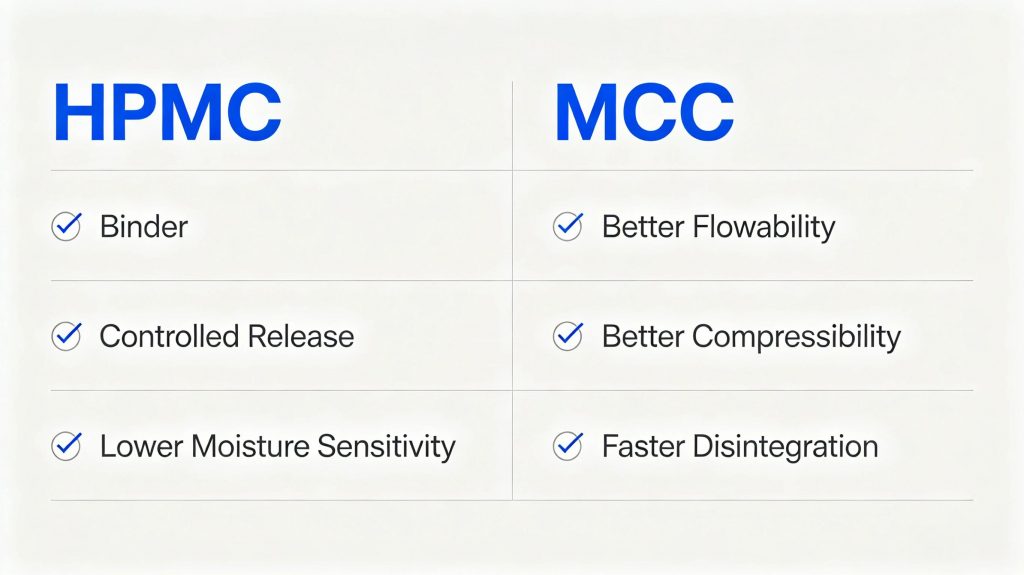
Microcrystalline cellulose (MCC) and HPMC are both widely used in direct compression tablet formulation, and they are frequently used together. Understanding their complementary roles is essential for rational excipient selection.
| Property | HPMC | MCC |
|---|---|---|
| Binding Performance | Excellent | Excellent |
| Powder Flowability | Good | Excellent |
| Direct Compression Suitability | Good | Excellent |
| Controlled Release Capability | Excellent | Poor |
| Moisture Sensitivity | Lower | Higher |
| Disintegration Support | Moderate | Strong |
| Sustained Release Matrix | Yes | No |
MCC delivers compression performance and disintegration support; HPMC delivers controlled release function and additional binding strength. In combination, the two excipients cover the full range of direct compression requirements — MCC providing the flowability and compressibility backbone, HPMC contributing binding enhancement and programmable drug release at higher concentrations. Binary MCC/HPMC blends are among the most commonly encountered excipient combinations in commercial oral solid dosage forms. See our detailed guide to MCC in direct compression tablets and microcrystalline cellulose supplier options for companion excipient selection.
Cause: Insufficient HPMC concentration or selection of a viscosity grade too low to provide adequate interparticle bonding at the target compaction force.
Solution: Increase HPMC use level by 2–3% and re-evaluate hardness across the compaction force range. If hardness targets still cannot be met, consider upgrading to a medium viscosity grade or evaluating a co-binder system with [microcrystalline cellulose].
Cause: Use of a high viscosity HPMC grade at concentrations that form a persistent gel network throughout the tablet matrix, impeding water penetration and disintegration.
Solution: Switch to a low viscosity HPMC grade (3–15 cps) for immediate release formulations. Grades in the 3–15 cps range will provide adequate binding without significantly retarding disintegration.
Cause: Excessive fine particle fraction in the blend, often arising from fine API powders or HPMC grades with small particle size distributions, leading to cohesive flow behavior and inconsistent die fill.
Solution: Evaluate roller compaction or slugging to improve blend flow characteristics, or incorporate [MCC] at 20–30% as a flow-improving co-excipient. Ensure HPMC particle size is matched to the overall blend particle size distribution.
HPMC (Hypromellose) is fully monographed in the United States Pharmacopeia / National Formulary (USP-NF), with defined specifications for substitution type, viscosity grade, loss on drying, heavy metals, and microbial limits. USP compliance is a baseline requirement for any HPMC grade used in drug products intended for the US market.
The European Pharmacopoeia (Ph. Eur.) includes a hypromellose monograph applicable to all EU member states and EP-aligned regulatory jurisdictions. EP-compliant HPMC grades are required for products filed under EMA centralized procedures or national EU marketing authorization applications.
The Japanese Pharmacopoeia (JP) monographs hydroxypropyl methylcellulose for pharmaceutical use, as required by PMDA for drug products marketed in Japan. Suppliers serving the Japanese market should provide JP compliance documentation as part of their standard quality package.
HPMC is listed in the FDA Inactive Ingredient Database (IID) for oral solid dosage forms, including immediate-release and modified-release tablets. Therefore, it has established precedent concentration data from previously approved products.
In addition, IID listing helps formulators reference proven use levels in NDA and ANDA submissions. As a result, it reduces the likelihood of excipient-related review queries.
Beyond the three major pharmacopoeial markets, HPMC is accepted as an established pharmaceutical excipient by Health Canada, TGA (Australia), ANVISA (Brazil), NMPA (China), and most ICH-aligned regulatory systems globally. This breadth of acceptance supports multi-market regulatory submissions without market-specific excipient justification in most cases.
Beyond its technical advantages, HPMC offers several commercial and manufacturing benefits that make it a preferred excipient for pharmaceutical companies worldwide.
HPMC supports direct compression processing, eliminating the need for wet granulation and drying in many formulations. This reduces equipment requirements, shortens production cycles, lowers energy consumption, and decreases overall manufacturing costs.
Because HPMC functions as both a binder and a controlled-release polymer, formulators can often reduce the total number of excipients in a formulation. This simplifies development, accelerates scale-up, and reduces regulatory complexity.
HPMC improves tablet hardness, reduces friability, and minimizes common compression defects such as capping and lamination. These performance benefits help manufacturers achieve consistent product quality at commercial scale.
HPMC is recognized by USP-NF, Ph. Eur., and JP, and is widely referenced in FDA-approved immediate-release and modified-release products. Its extensive regulatory history reduces excipient qualification risk during product registration.
Multiple pharmaceutical manufacturers rely on HPMC because of its broad global availability and established supply chain. Pharmaceutical-grade HPMC is available in a wide range of viscosity grades, supporting both immediate-release and controlled-release tablet development.
For these reasons, HPMC in Direct Compression Tablets remains one of the most widely adopted formulation strategies across pharmaceutical, nutraceutical, and contract manufacturing sectors.
Selecting the right material source is essential because the performance of HPMC in Direct Compression Tablets depends heavily on viscosity consistency, particle size distribution, and manufacturing quality control.Selecting the right pharmaceutical HPMC supplier is as critical to formulation success as selecting the right viscosity grade. Inconsistent excipient quality — lot-to-lot variation in viscosity, particle size distribution, or moisture content — can introduce significant batch-to-batch variability in tablet hardness, dissolution behavior, and controlled release profiles. When evaluating HPMC suppliers or hypromellose manufacturers for pharmaceutical applications, the following criteria should govern the qualification process.
Pharmaceutical-grade HPMC must demonstrate lot-to-lot consistency across all critical quality attributes defined in the relevant pharmacopoeial monograph — viscosity, substitution type, particle size distribution, moisture content, heavy metals, and microbial limits. A reliable HPMC manufacturer provides comprehensive Certificate of Analysis (CoA) documentation for each production lot, with all quality attributes traceable to an approved manufacturing specification and confirmed through in-house or third-party laboratory testing.
Any hypromellose supplier serving pharmaceutical customers should manufacture under current Good Manufacturing Practice (cGMP) conditions and be capable of providing the full complement of regulatory support documentation required for drug product submissions — including Drug Master File (DMF) support letters, pharmacopoeial compliance statements (USP, EP, JP), TSE/BSE declarations, and impurity profile data. GMP-certified HPMC grades are a non-negotiable requirement for NDA, ANDA, and MAA submissions across all major regulatory markets. Suppliers unable to provide auditable GMP records represent a significant regulatory risk for downstream drug product manufacturers.
Pharmaceutical development programs frequently require formulation screening across multiple HPMC viscosity grades before the optimal grade for a specific API and release profile is identified. A capable HPMC supplier should offer a complete product range — from low viscosity (3–15 cps) through medium (50–4,000 cps) to high viscosity (10,000–100,000 cps) grades — preferably under a single Drug Master File or regulatory reference dossier. This simplifies the excipient change control process if grade optimization is required at any point in the product lifecycle.
Supply chain continuity is a critical risk factor in pharmaceutical procurement. When selecting a pharmaceutical HPMC manufacturer, evaluate manufacturing site redundancy, raw cellulose sourcing diversity, strategic inventory programs, and track record of on-time delivery across global markets. Single-site HPMC manufacturers represent higher supply chain exposure than suppliers with multi-site production capabilities or qualified secondary manufacturing arrangements. For high-volume or regulated commercial products, supplier qualification should include an assessment of capacity and continuity of supply under demand surge or force majeure conditions.
Formulation development with HPMC in HPMC in Direct Compression Tablets requires strong technical guidance. This is especially important for controlled-release matrix systems with complex API solubility profiles or unusual tablet geometries.
Therefore, formulators need support in grade selection, use level optimization, and dissolution method development. In addition, these factors directly affect final product performance.
A value-adding HPMC supplier should provide access to formulation scientists. These experts should have solid dosage development experience. As a result, they can support development decisions with application-specific data.
They should also support collaborative problem-solving. Therefore, they should not limit interaction to quotations or order fulfillment only.
For specialized applications in HPMC in Direct Compression Tablets, formulators work with patient-centric mini-tablets, rapidly disintegrating formats, or fixed-dose combinations with unusual release requirements. In these cases, standard commercial HPMC grades may not deliver the optimal balance of particle morphology, viscosity, and substitution profile.
Therefore, leading pharmaceutical manufacturers develop custom or modified HPMC grades. These tailored grades meet specific formulation needs. As a result, they reduce the need for costly process workarounds or post-approval changes.
ACTA Biotechnology supplies pharmaceutical-grade HPMC to global formulation teams. It ensures full USP, EP, and JP compliance. In addition, it maintains cGMP manufacturing certification.
The company also provides direct access to formulation scientists. Therefore, customers receive technical guidance for development decisions.
Formulators can contact the technical team to request samples, DMF support documentation, and grade recommendations for HPMC in Direct Compression Tablets applications.
The pharmaceutical industry’s transition from batch to continuous manufacturing is accelerating adoption of direct compression as the preferred continuous solid dosage form process. HPMC’s robust flow and compressibility characteristics make it well-suited to continuous twin-screw blending and direct compression lines, where real-time blend uniformity and consistent tablet quality are monitored by PAT (Process Analytical Technology) systems. The excipient properties that make HPMC effective in batch DC manufacturing translate directly to continuous DC environments with minimal process development overhead.Future innovation in HPMC in Direct Compression Tablets will focus on improving manufacturing efficiency, release profile precision, and compatibility with continuous pharmaceutical production systems.
Modern rotary tablet presses operate at 1,000,000+ tablets per hour. Therefore, they place extreme demands on powder flow and compressibility in HPMC in Direct Compression Tablets systems.
In response, manufacturers develop HPMC grades with optimized particle morphology and enhanced bulk density. As a result, these grades support high-speed direct compression applications.
In addition, they help achieve throughput targets that earlier excipient technologies could not reach. This improves overall manufacturing efficiency.
Therefore, formulation teams investing in high-speed DC capacity should work closely with HPMC manufacturers. They should select grades validated under commercial high-speed press conditions.
The global nutraceutical market is shifting toward tablet formats, driven by consumer convenience preferences and the dosing precision advantages of tablets over gummies and soft chews. HPMC’s clean regulatory profile, natural cellulose origin, and compatibility with botanical and nutritional actives position it as the preferred binder for premium nutraceutical direct compression tablets targeting health-conscious consumers seeking pharmaceutical-grade supplement quality.
The pipeline of new chemical entities requiring modified release profiles — driven by once-daily dosing preferences, patient adherence requirements, and pharmacokinetic optimization — continues to expand. HPMC matrix tablet technology remains the most cost-effective and regulatorily precedented approach to oral controlled release, and demand for high-viscosity HPMC grades with consistent, validated release characteristics is growing in parallel with the NCE pipeline.
Orally disintegrating tablets, mini-tablets, and unit-dose formats designed for pediatric, geriatric, and dysphagia patient populations are driving development of HPMC grades with specific particle size profiles and hydration kinetics that support rapid disintegration without sacrificing mechanical robustness. Patient-centric direct compression formulation is one of the fastest-growing segments of pharmaceutical oral solid dosage development globally.
HPMC (hydroxypropyl methylcellulose) is a cellulose-derived polymer used in HPMC in Direct Compression Tablets. Manufacturers use it as a dry binder and flow aid. At higher concentrations, it acts as a controlled release matrix former.
It helps tablet manufacturers produce robust and consistent tablets. They do not need a wet granulation step. As a result, they reduce manufacturing complexity and cost.
HPMC functions primarily as a binder in direct compression formulations, forming intermolecular bonds between particles during compaction to produce mechanically strong tablets. At low viscosity grades and low concentrations, it can also support disintegration by swelling on contact with aqueous media. It is not classified as a disintegrant — dedicated disintegrants such as croscarmellose sodium or sodium starch glycolate are typically co-formulated where rapid tablet break-up is required.
Yes. Low viscosity HPMC grades (3–15 cps) at concentrations of 1–5% are well-suited for immediate release direct compression tablets. These grades provide adequate binding without retarding dissolution, and the resulting tablets disintegrate within the standard immediate release specification of 30–45 minutes in dissolution testing.
Formulators select HPMC grades in HPMC in Direct Compression Tablets based on the formulation objective. For immediate-release applications, they use low viscosity grades (3–15 cps). They apply them at 1–5%.
For dry binder applications, formulators require higher hardness. Therefore, they choose medium viscosity grades (50–4,000 cps). They use them at 2–8%.
For sustained-release matrices, formulators select high viscosity grades (10,000–100,000 cps). They apply them at 10–40%. This is the standard choice for controlled release performance.
Both HPMC and PVP (povidone) offer strong binding performance, but they differ in several important respects. HPMC is preferred for direct compression due to its better dry powder flow and suitability for dry addition without solvent. PVP typically achieves its optimal binding performance in wet granulation and is not suitable for controlled release matrix applications. For dry binder use in DC formulations, HPMC is the more versatile and regulatorily precedented choice.
Yes. HPMC contributes to tablet hardness by forming hydrogen bond networks between particles during compaction. The degree of hardness improvement depends on the viscosity grade and use level selected. Medium viscosity grades at 4–8% typically provide the most significant hardness improvement in direct compression formulations.
Neither is categorically superior — they serve complementary functions. MCC delivers excellent flowability, compressibility, and disintegration support, making it the preferred compression aid. HPMC provides additional binding strength and is the only option for controlled release matrix formation. Most commercial direct compression tablet formulations combine both excipients to leverage their complementary performance profiles.
Yes. This is one of HPMC’s most commercially important pharmaceutical functions. High viscosity grades form a coherent gel layer upon hydration that controls drug diffusion and tablet erosion, producing sustained release profiles programmable from 4 to 24 hours depending on grade, concentration, and tablet geometry. HPMC matrix technology is the most widely used approach to oral controlled release in the pharmaceutical industry.
HPMC (Hypromellose) is fully monographed in the USP-NF, the European Pharmacopoeia (Ph. Eur.), and the Japanese Pharmacopoeia (JP). It is also listed in the FDA Inactive Ingredient Database for oral solid dosage forms. In addition, global regulatory authorities accept it widely. These include EMA, PMDA, Health Canada, and TGA.
Formulators design sustained release HPMC in Direct Compression Tablets using 10–40% HPMC w/w. They select the exact concentration based on the target release rate, drug solubility, tablet weight, and viscosity grade.
Higher HPMC concentrations slow drug release. Higher viscosity grades also extend release duration. Therefore, both factors produce more prolonged release profiles.
Formulators screen multiple concentrations and grades. They run in vitro dissolution testing. Finally, they confirm the optimal use level for each API.
A qualified pharmaceutical HPMC supplier demonstrates cGMP manufacturing. They also ensure full pharmacopoeial compliance (USP, EP, JP). In addition, they provide Drug Master File (DMF) support and maintain a stable global supply chain. They also offer technical support from excipient scientists.
Formulators request sample lots with full CoA documentation. Then they evaluate material quality. Finally, they conduct a supplier qualification audit against internal quality standards. Contact ACTA Biotechnology to request samples, DMF support letters, and formulation guidance for pharmaceutical-grade HPMC.
In immediate release formulations at standard binder concentrations (1–8%), HPMC does not significantly affect bioavailability for most APIs. In controlled release matrix tablets, the extended release profile designed by HPMC concentration and grade selection is itself the intended modulation of drug absorption rate. For highly permeable, highly soluble BCS Class I drugs, HPMC sustained release matrices can reliably achieve bioequivalence to reference products with appropriate formulation optimization.
Formulators select HPMC levels in HPMC in Direct Compression Tablets based on the intended formulation function. For immediate-release tablets, they use HPMC at 1–5% w/w. For dry binding, they apply 2–8% concentrations.
About sustained-release matrix tablets, formulators use 10–40% HPMC. The exact level depends on the target release profile, API solubility, and selected viscosity grade. Therefore, they optimize the formulation through compression and dissolution testing. This step helps them confirm the final grade selection.
In some formulations in HPMC in Direct Compression Tablets, formulators partially replace MCC with HPMC. However, both excipients serve different primary functions. MCC provides excellent flowability, compressibility, and disintegration support. In contrast, HPMC provides binding strength and controlled-release functionality.
In most commercial direct compression formulations, formulators use HPMC and MCC together. They do not use them as direct substitutes. Therefore, they combine both excipients to benefit from their strengths.
ACTA Biotechnology is a trusted [pharmaceutical HPMC supplier] providing [hypromellose] to formulation development teams and manufacturing organizations globally. Our pharmaceutical-grade HPMC product range covers all viscosity grades required for direct compression, immediate release, and controlled release tablet applications, with full USP, EP, and JP pharmacopoeial compliance and cGMP manufacturing certification.
Available HPMC viscosity grades:
Support services from ACTA Biotechnology:
Explore our full [HPMC grades] range, or learn how HPMC compares to HPMC for capsules and MCC in direct compression tablets for parallel excipient decisions in your formulation program.
Contact our technical team for formulation guidance, samples, and quotations.
