

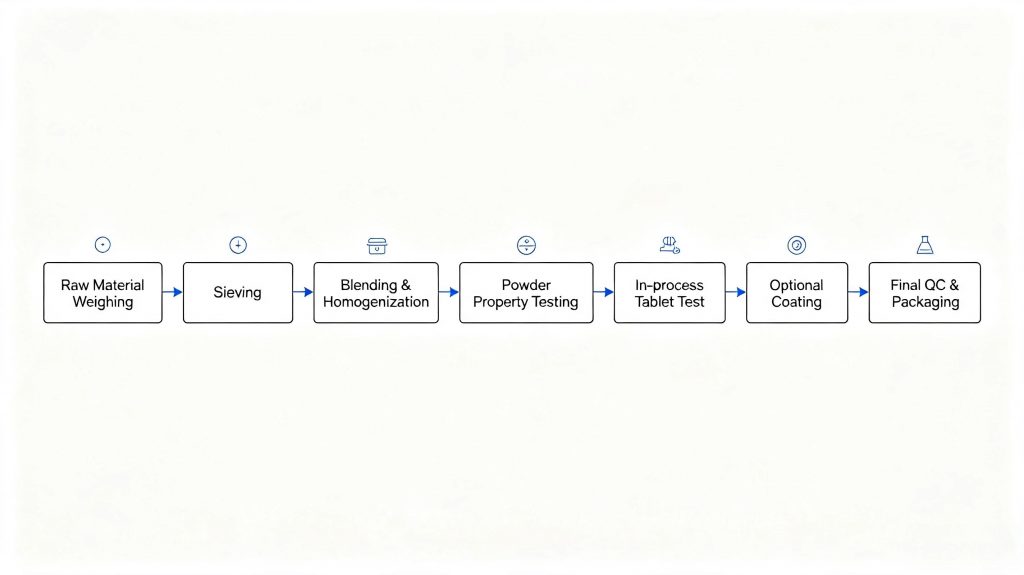
Caption:Direct compression tablet manufacturing process: from pharmaceutical excipients and API blending to final tablet production.
Image Description:Illustration showing the direct compression tablet manufacturing process, including excipient selection, powder blending, compression, and final tablet formation.
Direct compression excipients are pharmaceutical ingredients used in tablet manufacturing to improve powder flow, compressibility, and tablet formation without granulation.
For pharmaceutical manufacturers searching for reliable direct compression excipient suppliers, selecting the correct excipient grade is essential for achieving consistent tablet quality. Unlike wet granulation or dry granulation, direct compression lets pharmaceutical manufacturers compress powder blends straight into tablets without any additional granulation step.
However, the success of direct compression depends heavily on choosing the right direct compression excipients. A suitable excipient must deliver excellent powder flowability, strong compactibility, reliable blending performance, and consistent tablet quality during high-speed production runs. Among all pharmaceutical excipients available today, Microcrystalline Cellulose (MCC) stands out as one of the most commonly used direct compression excipients, thanks to its outstanding binding ability, compressibility, and compatibility with a wide range of active pharmaceutical ingredients (APIs).
This guide walks through the major types of direct compression excipients, explains their functions and advantages, and shows pharmaceutical manufacturers how to select the most suitable excipient system for different tablet applications.
Choosing the correct excipient grade can significantly influence tablet quality and manufacturing efficiency.
Our technical team can help evaluate:
Suitable MCC grade selection
Tablet formulation requirements
Compression performance
Technical documentation
Request MCC samples or technical consultation from ACTA.
Direct compression excipients are pharmaceutical ingredients that improve powder processing and tablet formation without requiring granulation. They help manufacturers achieve proper flow, compression strength, disintegration performance, and tablet stability during direct compression manufacturing.
The table below summarizes the most common direct compression excipients and what each one brings to a formulation.
| Excipient | Main Function | Key Advantages |
| Microcrystalline Cellulose (MCC) | Binder / Diluent | Excellent compressibility and tablet hardness |
| Lactose | Diluent / Filler | Good flowability and pleasant mouthfeel |
| Starch | Binder / Disintegrant | Cost-effective and multifunctional |
| Mannitol | Diluent | Excellent taste and low moisture sensitivity |
| Povidone (PVP) | Binder | Strong binding performance |
| Croscarmellose Sodium | Superdisintegrant | Rapid tablet disintegration |
Among these materials, MCC for direct compression tablets remains the top choice, since its unique deformation characteristics let manufacturers produce strong tablets with low friability.
Direct compression is a tablet manufacturing process in which pharmaceutical powders are blended and compressed straight into tablets without a granulation step. Direct compression is widely used in pharmaceutical manufacturing because it simplifies the production process and reduces the need for additional granulation steps. According to the United States Pharmacopeia (USP), excipient quality and functionality are critical factors affecting pharmaceutical dosage form performance.The basic workflow looks like this:
API + Direct Compression Excipients → Powder Mixing → Lubrication → Tablet Compression → Finished Tablets
Compared with traditional wet granulation, direct compression offers several distinct advantages.
Traditional granulation requires wet mixing, binder solution preparation, granulation, drying, milling, and a final blending stage. Direct compression eliminates most of these steps, so manufacturers can streamline the entire production workflow. As a result, the process delivers:
Some active pharmaceutical ingredients are sensitive to water exposure, heat during drying, or extended processing conditions. Because direct compression skips liquid binders and drying entirely, it often becomes the preferred approach for moisture-sensitive formulations. Consequently, choosing low-moisture pharmaceutical excipients becomes especially important.
Modern pharmaceutical production demands higher speed, consistent tablet quality, lower cost, and fewer production risks. Direct compression meets these goals whenever the powder blend offers good flow properties, uniform particle distribution, and suitable compressibility. Therefore, selecting the right excipient system ranks among the most important formulation decisions a manufacturer makes.
Not every pharmaceutical excipient suits direct compression. During tablet compression, powder particles must undergo controlled deformation and bonding under pressure, so poor excipient selection can quickly lead to low tablet hardness, high friability, capping, lamination, weight variation, or poor dissolution performance. A successful direct compression formulation therefore requires excipients with balanced physical properties.
Good powder flow ensures uniform die filling, accurate tablet weight, and consistent API distribution. In contrast, poor flowability causes weight variation, content uniformity problems, and reduced production efficiency. Particle size, particle shape, moisture content, and bulk density all influence how well a powder flows.
Compactibility determines how well powder particles form a strong tablet under compression. An ideal direct compression excipient forms strong interparticle bonding, maintains tablet integrity, and reduces friability — which is exactly why MCC has become a preferred excipient for direct compression applications.
Direct compression excipients also need chemical stability, low reactivity, and good compatibility with different APIs. When formulators select the right excipient system, they help maintain drug stability, dissolution performance, and manufacturing consistency across every batch.
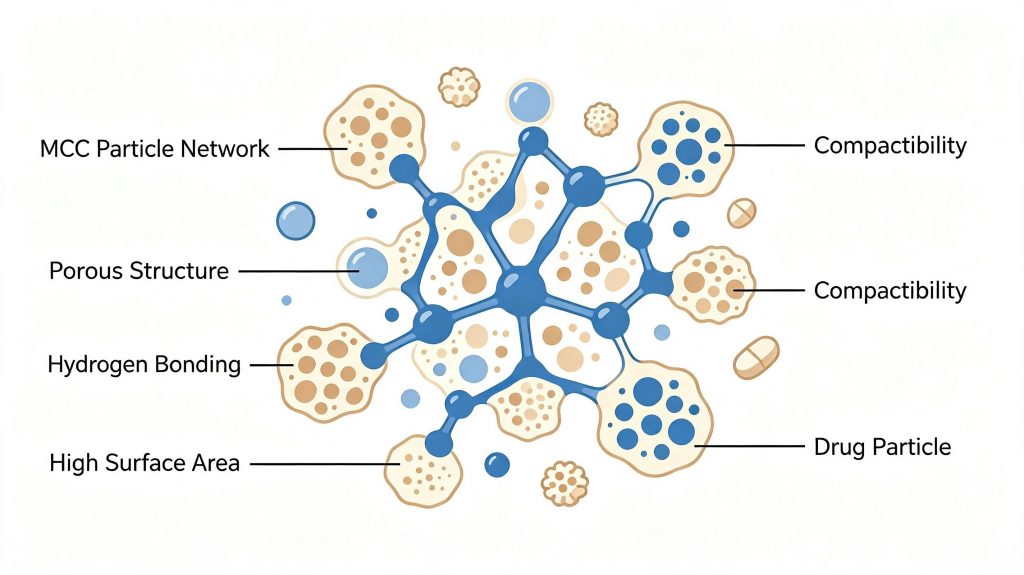
Caption:Microcrystalline Cellulose (MCC) particle structure and its role in direct compression tablet formulation.
Description:Microscopic illustration of pharmaceutical-grade Microcrystalline Cellulose (MCC), showing particle structure related to compressibility and tablet formation performance.
Regulatory databases such as the FDA Inactive Ingredient Database provide reference information regarding excipient usage in approved pharmaceutical products.
Selecting the right direct compression excipient ranks among the most critical decisions in tablet formulation, since different excipients deliver different functional benefits — including binding, dilution, flow improvement, lubrication compatibility, and disintegration. Although many excipients work in direct compression formulations, Microcrystalline Cellulose (MCC) remains one of the most widely selected materials because it combines excellent compressibility, binding performance, and manufacturing flexibility.
Caption:Microcrystalline Cellulose (MCC) particle structure and its role in direct compression tablet formulation.
Description:Microscopic illustration of pharmaceutical-grade Microcrystalline Cellulose (MCC), showing particle structure related to compressibility and tablet formation performance.
Microcrystalline Cellulose (MCC) is a purified, partially depolymerized cellulose derived from high-quality cellulose sources. Pharmaceutical manufacturers use it worldwide, and it appears in every major pharmacopeia, including USP/NF, EP, JP, and BP. In tablet formulations, MCC mainly functions as a diluent (filler), dry binder, compression aid, and flow improvement agent. Its unique physical properties make it particularly well suited for direct compression tablet manufacturing.
1. Excellent Compressibility
The most important advantage of MCC lies in its ability to undergo plastic deformation during compression. As MCC particles receive pressure, they deform and create larger contact areas; this, in turn, produces strong interparticle bonding and yields hard, stable tablets. Because of this mechanism, manufacturers achieve higher tablet hardness, lower friability, better mechanical strength, and improved tablet integrity. Compared with many brittle excipients, MCC delivers excellent bonding even at relatively low compression force.
2. Strong Binding Ability
Every direct compression formulation needs sufficient binding strength to maintain tablet structure. Since MCC naturally provides this binding performance without requiring additional wet granulation binders, it becomes especially valuable for immediate-release tablets, nutraceutical tablets, vitamin tablets, herbal tablets, and generic pharmaceutical formulations. For APIs with poor compressibility, formulators often select MCC as the primary excipient to improve tablet formation.
3. Good Compatibility With Many APIs
MCC offers excellent chemical stability and pairs well with a wide range of pharmaceutical ingredients, including analgesics, vitamins, minerals, cardiovascular APIs, nutraceutical ingredients, and herbal extracts. That said, formulators should still confirm compatibility through laboratory testing, since API characteristics, dosage level, and formulation requirements can all influence final tablet performance.
4. Low Moisture and Good Stability
Compared with carbohydrate-based excipients, MCC delivers superior physical stability. It suits many moisture-sensitive formulations, offers good storage stability, and behaves consistently during processing — making it an important option for manufacturers who want to simplify production through direct compression.
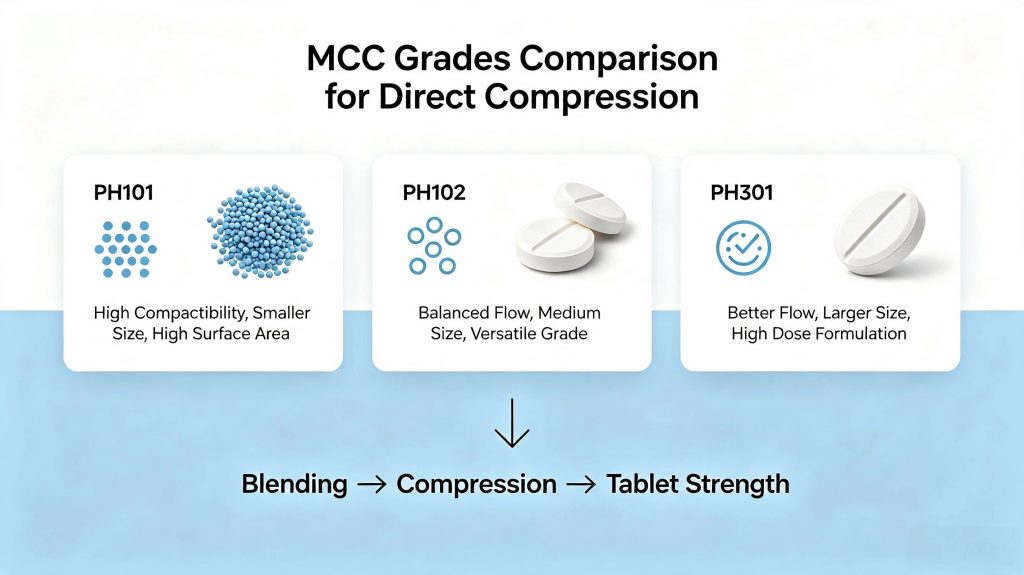
Caption:Comparison of MCC PH101, PH102, and PH301 grades for different direct compression tablet applications.
Description:Comparison chart showing the differences between MCC PH101, MCC PH102, and MCC PH301 regarding flowability, compressibility, and pharmaceutical tablet applications.
Because different MCC grades feature different particle size and bulk density characteristics, choosing the correct grade can significantly influence tablet performance.
| Grade | Typical Characteristics | Main Applications |
| MCC PH101 | Smaller particle size, excellent binding ability | Wet granulation, low-dose tablets, formulations requiring strong binding |
| MCC PH102 | Larger particle size, improved flowability | Direct compression tablets, high-speed tableting |
| MCC PH301 | Higher bulk density, improved die filling efficiency | High-speed compression, larger tablet production |
MCC PH102: The Preferred Choice for Direct Compression
Among all MCC grades, PH102 remains one of the most commonly used materials for direct compression applications, because it strikes a balanced combination of flowability, compressibility, and manufacturing efficiency. Its larger particle size improves powder movement during blending, feeding, and die filling, which helps maintain tablet weight consistency during high-speed production. At the same time, PH102 retains MCC’s excellent compression properties while offering better processing performance than smaller particle grades. For manufacturers running modern rotary tablet presses, PH102 supports faster production speeds, more stable compression, and fewer powder handling problems.
MCC PH301: When Higher Density Is Required
MCC PH301 targets applications where higher bulk density and improved powder handling matter most. Manufacturers often consider it for high-speed tablet production, large-volume tablets, and formulations that need better die filling. Its higher density characteristics can further optimize production efficiency in these specific formulations.
Lactose serves as another widely used pharmaceutical diluent for direct compression formulations, and it comes in several common types: spray-dried lactose, anhydrous lactose, and monohydrate lactose.
Advantages of Lactose: good flow properties, pleasant mouthfeel, cost-effectiveness, and good availability — which is why manufacturers commonly use it in immediate-release tablets, chewable tablets, and low-dose formulations.
Limitations of Lactose: compared with MCC, lactose shows different compression behavior. It can offer lower binding ability in some formulations, greater sensitivity to moisture, and possible compatibility concerns with certain APIs. Therefore, lactose and MCC aren’t always interchangeable — the right choice depends on API properties, required tablet hardness, the manufacturing process, and stability requirements.
Manufacturers have long relied on starch as a pharmaceutical excipient because of its multifunctional properties: it can act as a diluent, binder, or disintegrant.
Advantages: low cost, natural origin, wide availability, and multiple functional roles.
Limitations in Direct Compression: native starch generally delivers weaker direct compression performance than MCC, since it shows lower compactibility, flow limitations, and higher formulation optimization requirements. Modified starch grades can improve performance, but the right choice still depends on specific tablet requirements.
Mannitol shines in formulations that demand a pleasant taste, a cooling sensation, and low moisture absorption — think chewable tablets, orally dissolving tablets, and nutraceutical products.
Advantages: excellent mouthfeel, low hygroscopicity, and good chemical stability.
Limitations: mannitol generally offers lower binding performance than MCC, so formulators often combine it with other binders or compression aids.
Povidone (PVP) commonly serves as a pharmaceutical binder, and it proves especially valuable in wet granulation systems and formulations that require strong binding. However, because PVP mainly suits wet binding applications, manufacturers running a pure direct compression process usually prefer MCC instead.
Choosing the right direct compression excipient requires a clear understanding of how each material behaves during powder blending, compression, and tablet performance evaluation. Although many pharmaceutical excipients work in tablet manufacturing, they aren’t identical — their differences in compressibility, flowability, binding ability, moisture sensitivity, and application flexibility directly affect final tablet quality.
For pharmaceutical manufacturers, selecting the correct excipient system helps prevent common production problems such as low tablet hardness, high friability, capping and lamination, poor weight uniformity, slow disintegration, and inconsistent dissolution performance. The comparison below offers a practical guide for selecting excipients in direct compression tablet formulations.
| Property | MCC | Lactose | Starch | Mannitol |
| Main Function | Binder, diluent, compression aid | Diluent, filler | Binder, disintegrant, filler | Diluent |
| Direct Compression Performance | Excellent | Good | Moderate | Good |
| Compactibility | Excellent | Moderate | Moderate | Moderate |
| Powder Flowability | Good–Excellent | Good | Moderate | Good |
| Tablet Hardness | High | Medium | Medium | Medium |
| Friability Control | Excellent | Good | Moderate | Good |
| Moisture Sensitivity | Low | Medium | Medium | Very Low |
| Suitable for High-Speed Tableting | Excellent | Good | Limited | Good |
| Common Application | Immediate-release tablets, nutraceuticals, generic drugs | IR tablets, chewable tablets | General tablets | Chewable and ODT tablets |
Among direct compression excipients, MCC has become one of the most widely selected materials because it delivers a unique combination of benefits.
Excellent Compression Performance: during compression, MCC particles deform plastically rather than simply breaking apart. This creates larger bonding areas between particles, a stronger tablet structure, and better mechanical strength — so manufacturers achieve higher hardness, lower friability, and better resistance during packaging and transportation.
Better Formulation Flexibility: MCC works with many different APIs and excipient systems, including superdisintegrants, lubricants, glidants, active ingredients, and other fillers, which makes it suitable for a wide range of formulations.
Suitable for Low-Dose and High-Dose Formulations: many formulations struggle when API loading is low, since a tablet with very little API needs extra excipient volume to achieve uniform blending, proper tablet weight, and good compression behavior. MCC delivers both filling function and compression support at once.
Both MCC and lactose serve as widely used pharmaceutical fillers, yet they behave quite differently.
MCC advantages over lactose include stronger binding ability (which improves tablet hardness, mechanical strength, and production stability), better performance in low-lubricant systems (since excessive lubricant levels can reduce tablet hardness), and better moisture stability for moisture-sensitive formulations.
Lactose may be preferred when a pleasant taste matters, a smooth mouthfeel is important, or cost optimization takes priority — for example, in chewable tablets and certain nutritional supplements. Even so, formulators still need to evaluate lactose compatibility with specific APIs before finalizing a formulation.
Starch has a long history as a pharmaceutical excipient and can function as a filler, binder, or disintegrant. However, compared with MCC, native starch generally delivers weaker direct compression performance.
MCC benefits over starch:
Mannitol excels in chewable tablets, orally disintegrating tablets (ODTs), and nutritional products thanks to its excellent taste, low hygroscopicity, and cooling mouthfeel. However, MCC still provides stronger binding and compression performance overall.
| Requirement | Recommended Excipient |
| Maximum tablet hardness | MCC |
| Pleasant taste | Mannitol |
| Low moisture absorption | Mannitol |
| Strong binding | MCC |
| High-speed compression | MCC |
| Chewable tablets | Mannitol |
No single excipient suits every tablet formulation. Instead, the best choice depends on several formulation factors: API properties, dose level, compression behavior, tablet size, required hardness, disintegration requirements, and storage conditions.
When the API has poor compressibility, an MCC-based formulation works best, since MCC improves powder bonding, tablet hardness, and compression reliability.
When the API has good compressibility, lactose, mannitol, or MCC blends all become possible choices — the final selection then depends on cost, stability, and product requirements.
Immediate-release tablets typically rely on MCC, lactose, and a superdisintegrant, balancing hardness, disintegration, and dissolution.
Nutraceutical tablets usually demand high tablet strength, larger tablet size, and natural ingredient compatibility, so formulators frequently select MCC because it supports high-dose formulations.
Chewable tablets often favor mannitol, lactose, or MCC combinations, since taste and mouthfeel become critical considerations.
For high-speed rotary tablet presses, manufacturers should prioritize good powder flow, stable die filling, and consistent compression. MCC PH102 and MCC PH301 are commonly considered suitable options, since their particle size and density characteristics support efficient processing.
Choosing the right excipient depends on the formulation challenge, manufacturing process, and tablet performance requirements.
| Manufacturing Challenge | Recommended Excipient Solution |
|---|---|
| Low tablet hardness | MCC PH101 |
| Need stronger binding performance | MCC PH101 |
| General direct compression tablets | MCC PH102 |
| High-speed rotary tablet compression | MCC PH102 |
| Poor powder flow | MCC PH301 / PH302 |
| Large tablet production | Higher-density MCC grades |
| Moisture-sensitive API formulation | MCC-based excipient system |
| Need faster disintegration | MCC combined with croscarmellose sodium |
Microcrystalline Cellulose is not a single universal material. Different MCC grades feature different particle size, bulk density, flowability, and compression characteristics to match the requirements of various tablet manufacturing processes. For pharmaceutical manufacturers, selecting the correct MCC grade is essential, because it directly affects powder flow during blending, die filling performance, tablet hardness, friability, compression speed, and final tablet quality. Among all pharmaceutical MCC grades, PH101, PH102, PH301, and PH302 are the most commonly evaluated for direct compression applications.
MCC PH101 is a fine-particle-size grade known for its excellent binding ability and compression performance. Its smaller particle size delivers strong interparticle bonding, excellent compactibility, and high tablet hardness.
| Property | MCC PH101 |
| Particle Size | Smaller particle size |
| Flowability | Moderate |
| Compressibility | Excellent |
| Binding Ability | Excellent |
| Main Function | Binder / Diluent |
Typical applications include immediate-release tablets, low-dose API formulations, tablets requiring strong binding, and formulations where tablet hardness is critical.
Advantages: the smaller particle size creates more contact points between particles during compression, which results in strong particle bonding, high mechanical strength, and reduced tablet breakage. PH101 also performs effectively at lower concentrations, so it delivers excellent compression performance without excessive excipient loading whenever a formulation needs extra binding support.
Considerations: because of its smaller particle size, PH101 generally offers lower flowability than larger particle grades. As a result, it may require careful formulation optimization for high-speed rotary compression or large-scale direct compression production.
MCC PH102 ranks among the most widely used MCC grades for direct compression tablet manufacturing. Compared with PH101, PH102 offers a larger particle size, better powder flow, and improved die filling performance — which makes it especially suitable for modern high-speed tablet production.
1. Balanced Compressibility and Flowability: direct compression requires a balance between good powder movement and strong tablet formation, and PH102 delivers both. It gives manufacturers smooth powder feeding, uniform die filling, stable tablet weight, and good tablet hardness all at once.
2. Suitable for High-Speed Tablet Presses: modern pharmaceutical manufacturing often relies on rotary tablet presses, automated feeding systems, and continuous production processes. PH102 performs well under these conditions, since its particle characteristics support better powder handling.
3. Wide Application Range: manufacturers commonly use PH102 for generic pharmaceutical tablets, nutraceutical tablets, vitamin supplements, herbal tablets, and immediate-release formulations.
Typical formulation role: PH102 can function as a primary diluent, dry binder, or compression enhancer, and it’s often combined with croscarmellose sodium, sodium starch glycolate, magnesium stearate, lactose, and other functional excipients.
MCC PH301 is a higher-density grade designed for applications where powder handling efficiency matters most. Compared with standard MCC grades, PH301 delivers higher bulk density, better material flow characteristics, and improved die filling efficiency.
Improved Feeding Performance: higher bulk density reduces powder bridging, feeding instability, and poor die filling — a valuable benefit in large-scale tablet manufacturing.
Suitable for High-Speed Compression: manufacturers can consider PH301 for formulations that require higher production speed, larger tablet weight, and better powder handling. Typical applications include high-speed direct compression, large-volume tablets, nutraceutical products, and pharmaceutical formulations that need efficient filling.
MCC PH302 is another high-density grade built for improved flow and compression efficiency. Manufacturers often select it when they need better powder handling, higher bulk density, and efficient manufacturing performance.
| Feature | PH301 | PH302 |
| Density | Higher than standard MCC | Higher density grade |
| Flowability | Improved | Improved |
| Compression | Excellent | Excellent |
| Application | High-speed compression | Advanced direct compression systems |
1 — Tablet hardness is the priority: choose MCC PH101, since its smaller particles and strong bonding ability deliver excellent compactibility.
2 — High-speed direct compression production: choose MCC PH102, since it offers balanced flowability, good compression, and a long track record in industrial production.
3 — Better powder flow and higher density needed: choose MCC PH301 or PH302, since they deliver improved bulk density, better feeding performance, and strong compatibility with modern production equipment.
MCC Grade Decision Table
| Manufacturing Requirement | Recommended MCC Grade |
| Maximum binding performance | MCC PH101 |
| General direct compression tablets | MCC PH102 |
| High-speed rotary compression | MCC PH102 / PH301 |
| Improved powder flow | MCC PH301 / PH302 |
| Large tablet size | PH301 / PH302 |
| Nutraceutical tablets | PH102 / PH301 |
ACTA provides pharmaceutical-grade MCC solutions including:
Looking for the Right MCC Grade for Your Tablet Application?
ACTA provides pharmaceutical-grade MCC solutions including:
Contact our technical team for product recommendations and sample evaluation.
Even with advanced tablet presses, manufacturers can still run into compression problems caused by an unsuitable excipient choice. Fortunately, MCC solves many of these issues directly.
Problem 1: Low Tablet Hardness — usually caused by poor API compressibility, insufficient binder, or the wrong excipient selection. MCC improves particle bonding, compactibility, and mechanical strength, so manufacturers typically turn to MCC PH101 or PH102 to solve this problem.
Problem 2: Tablet Capping and Lamination — often triggered by poor powder deformation, air entrapment, or compression stress. Because MCC’s plastic deformation behavior absorbs compression stress, it helps improve overall tablet integrity.
Problem 3: Weight Variation — typically caused by poor powder flow or uneven die filling. Switching to better-flowing grades such as MCC PH102 or PH301 improves powder movement during compression and stabilizes tablet weight.
Problem 4: High Friability — usually the result of weak particle bonding or insufficient compression support. MCC strengthens tablets and reduces mechanical damage during packaging, transportation, and handling.
In most commercial tablet formulations, MCC doesn’t work alone. Instead, a well-designed excipient system combines multiple materials to achieve balanced performance.
Example 1 — Immediate Release Tablet: a typical system pairs the API with MCC PH102, croscarmellose sodium, and magnesium stearate. Here, MCC handles compression and binding, croscarmellose sodium delivers fast disintegration, and magnesium stearate provides lubrication.
Example 2 — High-Dose Nutraceutical Tablet: a typical system combines plant extract, vitamins or minerals, MCC PH102, and a flow enhancer. Together, these ingredients improve compressibility, maintain tablet strength, and support large-scale tablet production.
Selecting the right direct compression excipient supplier matters just as much as selecting the correct excipient grade. For pharmaceutical manufacturers, excipients aren’t simply raw materials — they directly influence tablet quality, manufacturing efficiency, regulatory compliance, product stability, and long-term production consistency. Reliable pharmaceutical excipient suppliers should follow internationally recognized quality management systems to ensure consistent product performance and regulatory support.A reliable supplier therefore needs to provide high-quality excipients along with strong technical support, complete documentation, and consistent supply capability.A professional MCC manufacturer should provide consistent pharmaceutical-grade MCC together with complete technical documentation and application support.
1. Product Quality and Manufacturing Standards: the first consideration should always be the supplier’s quality management system. A professional pharmaceutical excipient manufacturer maintains stable production processes, strict raw material control, batch-to-batch consistency, and complete quality inspection procedures. Because even small variations in particle size, moisture content, bulk density, or flowability can influence tablet compression performance, consistency becomes critical.
A qualified excipient supplier provides complete technical documentation to support customer evaluation and regulatory requirements, including:
Direct compression looks simple because it eliminates granulation, but successful direct compression still demands careful formulation optimization. A supplier with real technical experience can help customers evaluate MCC grade selection, excipient ratio optimization, powder flow improvement, compression performance, and tablet defect solutions. For example, a customer facing low tablet hardness doesn’t necessarily need higher compression force — the real solution might involve changing the MCC grade, adjusting the excipient ratio, optimizing lubricant level, or improving powder properties. Strong technical support can significantly shorten formulation development time.
Microcrystalline Cellulose ranks among the most important direct compression excipients, yet not all MCC products perform identically. Different manufacturers produce MCC with differences in crystallinity, particle size distribution, moisture level, bulk density, and compression behavior. As a result, pharmaceutical manufacturers typically evaluate suppliers based on:
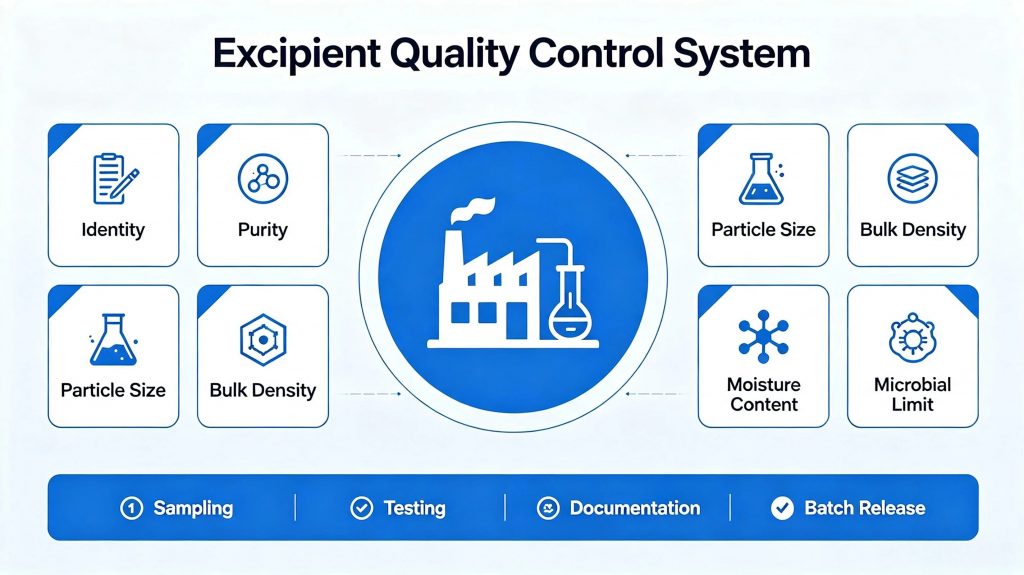
Caption:Quality control and laboratory testing support for pharmaceutical-grade excipient manufacturing.
Description:Quality control laboratory supporting pharmaceutical excipient production, including testing and documentation for cellulose-based excipients.
Selecting the right direct compression excipient supplier is not only about comparing product specifications and prices.
For pharmaceutical manufacturers, excipient quality directly affects:
Therefore, choosing an experienced pharmaceutical excipient manufacturer is an important part of successful tablet development.
Direct compression tablet manufacturing requires excipients with consistent physical properties, including:
Even small variations in excipient characteristics may influence:
An experienced manufacturer understands how excipient production processes influence final tablet performance.
As a cellulose-based pharmaceutical excipient manufacturer, Qingdao ACTA Biotechnology Co., Ltd. specializes in providing pharmaceutical-grade cellulose solutions for global pharmaceutical and nutraceutical manufacturers.
Our product portfolio includes:
These cellulose-based excipients are widely evaluated for applications including:
Selecting the correct excipient grade is often more important than selecting the lowest-cost material.
ACTA provides technical support including:
MCC grade selection for direct compression tablets
Tablet formulation evaluation
Compression performance optimization
Technical document support including TDS, COA, and SDS
Sample testing assistance
Application recommendations based on formulation requirements
A reliable excipient supplier should provide more than raw materials.
Long-term pharmaceutical cooperation requires:
By combining cellulose expertise with application knowledge, ACTA helps pharmaceutical manufacturers evaluate suitable excipient solutions for their tablet development projects.
Successful direct compression formulation requires balancing several critical factors, including powder flow, compactibility, tablet hardness, and manufacturing efficiency.
During tablet development, pharmaceutical formulators commonly encounter challenges such as:
In these situations, Microcrystalline Cellulose (MCC) is frequently evaluated because of its multifunctional performance as:
One of the most common challenges in direct compression manufacturing is achieving sufficient tablet strength without increasing compression force excessively.
MCC helps improve tablet performance through plastic deformation.
During compression:
MCC particles deform and create larger bonding areas between particles.
This contributes to:
Higher tablet hardness
Improved mechanical strength
Reduced friability
Better tablet integrity
Modern pharmaceutical production requires:
For high-speed rotary compression, MCC grades such as MCC PH102 are commonly considered because they provide a balanced combination of:
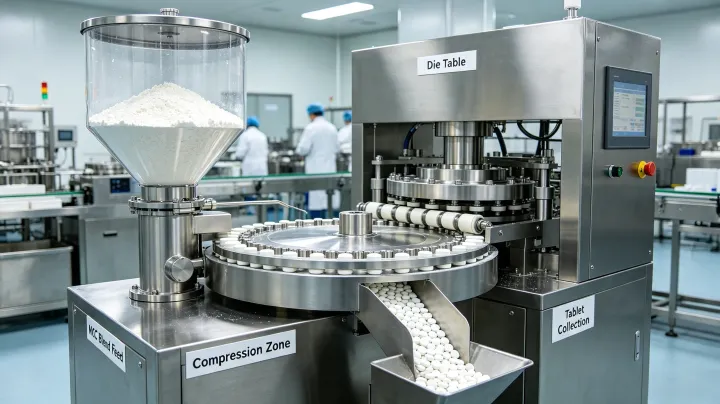
Caption:Rotary tablet compression machine used in pharmaceutical manufacturing with direct compression excipients.
Description:Industrial tablet compression equipment used for pharmaceutical manufacturing, demonstrating the importance of excipient performance in direct compression processes.
Different MCC grades provide different advantages.
For example:
MCC PH301 and PH302 may be considered when higher density and improved powder handling are required.
PH101 is often selected when stronger binding performance is required.
MCC PH102 is widely used for general direct compression applications because of balanced flow and compression properties.
The growing demand for efficient pharmaceutical manufacturing continues to drive wider adoption of direct compression technology. Compared with traditional granulation processes, direct compression delivers simplified manufacturing, fewer processing steps, reduced production complexity, and improved efficiency overall. However, successful direct compression still depends on selecting the correct excipient system, and among available excipients, MCC remains a preferred choice because of its excellent compressibility, strong binding ability, good compatibility, and wide formulation flexibility. For pharmaceutical manufacturers developing immediate-release tablets, nutraceutical products, and high-speed compression systems, selecting the correct MCC grade can significantly improve manufacturing performance.
As a cellulose-based pharmaceutical excipient manufacturer, Qingdao ACTA Biotechnology Co., Ltd. specializes in providing cellulose solutions for pharmaceutical and nutraceutical applications. Our product portfolio includes:
ACTA supports customers with pharmaceutical-grade quality control, technical documentation support, customized packaging solutions, application recommendations, and sample evaluation support. For pharmaceutical manufacturers selecting direct compression excipients, our technical team can assist with MCC grade selection, tablet formulation evaluation, compression performance optimization, and excipient application recommendations.
Choosing the correct excipient directly influences tablet quality, production efficiency, and long-term manufacturing stability. Our technical team can support MCC grade selection, direct compression formulation evaluation, tablet performance optimization, technical document preparation, and sample testing support.
Contact ACTA for pharmaceutical excipient recommendations and sample evaluation.
The best excipient for direct compression tablets depends on the formulation requirements, API properties, and manufacturing process. That said, Microcrystalline Cellulose (MCC) is widely considered one of the most effective direct compression excipients, since it delivers excellent compressibility, strong binding ability, good flow properties, low friability, and wide compatibility with pharmaceutical ingredients. For most immediate-release and nutraceutical tablets, manufacturers commonly select MCC PH102 because it balances flowability and compression performance so well. The final choice should still consider API dose, tablet size, required hardness, disintegration requirements, and production speed.
MCC earns its place in direct compression thanks to its unique deformation behavior under pressure. Unlike brittle materials that mainly fracture, MCC undergoes plastic deformation: particles deform under compression force, increase their contact area, create stronger bonding, and form stable tablets. This process improves tablet hardness, mechanical strength, compression reliability, and manufacturing consistency, which is why MCC ranks among the most important pharmaceutical excipients for direct compression tablet production.
The main difference between MCC PH101 and PH102 comes down to particle size and powder flow behavior.
| Feature | MCC PH101 | MCC PH102 |
| Particle Size | Smaller | Larger |
| Binding Ability | Higher | Excellent |
| Flowability | Moderate | Better |
| Compressibility | Excellent | Excellent |
| Main Advantage | Strong binding | Better processing performance |
| Typical Application | Formulations requiring high hardness | Direct compression and high-speed tableting |
Manufacturers usually pick MCC PH101 when maximum binding performance matters most, while they generally prefer MCC PH102 for industrial direct compression thanks to its improved flowability.
MCC can replace lactose in many direct compression formulations, though the two aren’t fully interchangeable. MCC offers better tablet binding, higher compactibility, stronger tablet hardness, and better support for APIs with poor compressibility. Lactose, on the other hand, offers a pleasant taste, good mouthfeel, and cost-effectiveness. Manufacturers who prioritize tablet strength and compression performance generally favor MCC, while chewable or taste-sensitive products often call for lactose or mannitol instead.
Both MCC PH102 and PH301 work well for direct compression, but their physical characteristics differ.
| Feature | MCC PH102 | MCC PH301 |
| Flowability | Very Good | Excellent |
| Bulk Density | Standard | Higher |
| Application Focus | General direct compression | High-speed production |
| Powder Handling | Good | Improved |
| Tablet Production | Wide applications | Large-scale manufacturing |
Most manufacturers treat MCC PH102 as the standard choice for direct compression tablets, while they reach for MCC PH301 when they need improved powder flow and higher density performance.
Direct compression offers several advantages over wet granulation. It reduces manufacturing steps by eliminating wet mixing, granulation, drying, and milling, which simplifies production. It also lowers production cost by cutting energy consumption, labor requirements, and equipment usage. In addition, it can better protect moisture-sensitive APIs, since it skips water exposure and drying entirely, and it supports faster, more efficient large-scale tablet manufacturing overall.
For high-speed tablet production, manufacturers usually prefer MCC grades with better powder flow. MCC PH102 offers balanced flowability, excellent compression, and wide use in rotary tablet presses, while MCC PH301 and PH302 provide higher bulk density, improved die filling, and better powder handling. The final selection still depends on tablet weight, compression machine type, API characteristics, and formulation design.
A professional pharmaceutical excipient supplier should provide complete technical documentation, including a Certificate of Analysis (COA), a Technical Data Sheet (TDS), and a Safety Data Sheet (SDS). Depending on market requirements, the supplier may also need to offer USP/NF information, EP compliance, JP compliance, Halal certification, Kosher certification, and ISO certification. Together, these documents help pharmaceutical manufacturers complete supplier qualification and formulation evaluation.
When selecting a supplier, pharmaceutical companies should evaluate manufacturing capability (stable production capacity, strict quality control, consistent batch performance), technical support (MCC grade selection, formulation optimization, compression troubleshooting), documentation ability (complete technical files for R&D evaluation, quality approval, and regulatory review), and long-term supply reliability. Since consistency matters more than short-term price for pharmaceutical production, a stable supplier helps manufacturers maintain product quality, production continuity, and supply chain security.
Direct compression has become an increasingly important tablet manufacturing technology, since it provides a simpler, faster, and more efficient production approach. However, successful direct compression still depends on selecting the correct excipient system. Among pharmaceutical excipients, Microcrystalline Cellulose (MCC) remains one of the most widely used choices because of its excellent compressibility, strong binding ability, good compatibility, and flexible application range.
Different MCC grades bring different advantages to the table: MCC PH101 delivers stronger binding and compactibility, MCC PH102 balances flowability and compression performance, and MCC PH301/PH302 improve density and support high-speed manufacturing. For pharmaceutical manufacturers, selecting the correct direct compression excipient can significantly improve tablet quality, manufacturing efficiency, production stability, and final product performance. Working with an experienced pharmaceutical excipient supplier further simplifies formulation development through technical support, documentation assistance, and reliable supply.
Need help selecting the right MCC grade for your tablet formulation? ACTA provides pharmaceutical-grade cellulose excipient solutions, including MCC PH101, MCC PH102, MCC PH301, Colloidal MCC, HPMC, and CMC. Our technical team can support MCC grade recommendation, tablet formulation evaluation, sample testing, and technical documentation.
Contact ACTA for direct compression excipient samples and technical consultation.
