

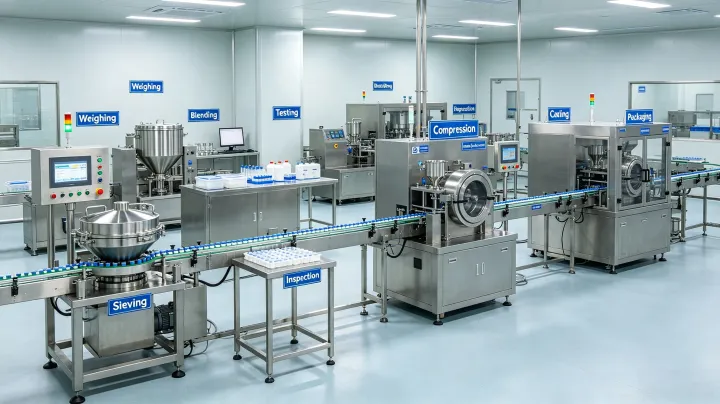
Caption:Overview of direct compression tablet manufacturing and the role of MCC excipients in improving tablet quality.
Microcrystalline Cellulose (MCC) is one of the most widely used direct compression excipients in pharmaceutical tablet manufacturing.
According to the United States Pharmacopeia (USP), Microcrystalline Cellulose is recognized as a pharmaceutical excipient widely used for its compressibility and binding properties in solid dosage formulations.
Tablet hardness ranks among the most important physical quality attributes in modern pharmaceutical manufacturing. Throughout production, storage, transportation, and patient use, tablets must maintain sufficient mechanical strength while still delivering the disintegration and dissolution performance a formulation requires.
Direct compression excipients play an essential role in modern tablet manufacturing because they allow pharmaceutical manufacturers to produce tablets without a wet granulation process.
Among various direct compression excipients, Microcrystalline Cellulose (MCC) remains one of the most widely selected options because of its excellent compressibility, binding capability, and compatibility with many APIs.
When tablet hardness falls short, pharmaceutical manufacturers run into multiple production challenges, including:
These challenges become even more critical in direct compression manufacturing, since powders are compressed straight into tablets without a granulation step — which means excipient selection carries far more weight.
Among pharmaceutical excipients, Microcrystalline Cellulose (MCC) stands out as one of the most effective materials for improving tablet hardness, thanks to its excellent compressibility, binding capability, and compatibility with a wide range of active pharmaceutical ingredients (APIs).
Unlike traditional binders that work mainly through adhesive mechanisms, MCC strengthens tablets through its unique particle deformation behavior during compression. When pressure hits an MCC particle, it deforms plastically, which allows stronger interparticle bonding and produces a stable tablet structure. For this reason, formulators frequently reach for MCC when developing:
Improving tablet hardness is not only related to compression force. The selection of the correct excipient grade, product consistency, and supplier technical support also play important roles in pharmaceutical manufacturing.
For commercial tablet production, pharmaceutical manufacturers need excipients that provide stable compression performance, consistent quality, and reliable long-term supply.
As a cellulose-based pharmaceutical excipient manufacturer, ACTA specializes in providing pharmaceutical-grade Microcrystalline Cellulose (MCC), Colloidal Microcrystalline Cellulose (MCC Gel), HPMC, and CMC solutions for pharmaceutical and nutraceutical manufacturers worldwide.
With experience in cellulose-based excipient applications, ACTA supports customers in selecting suitable MCC solutions according to:
API characteristics
Tablet formulation requirements
Compression equipment
Production conditions
Target tablet performance
Our technical support includes:
MCC grade selection for direct compression tablets
MCC PH101, PH102, and PH301 application guidance
Tablet formulation evaluation
Compression performance optimization
COA, TDS, SDS and regulatory documentation support
Sample testing assistance
A reliable pharmaceutical excipient supplier should provide more than raw materials. Consistent quality, technical expertise, documentation support, and application experience are essential factors for successful tablet development and commercial manufacturing.
Yes, Microcrystalline Cellulose (MCC) improves tablet hardness through excellent compressibility, plastic deformation properties, and dry binding capability.Pharmaceutical excipients used in tablet manufacturing must comply with international pharmacopeial standards, including USP-NF, European Pharmacopoeia (Ph. Eur.), and other recognized quality standards.
During tablet compression, MCC particles deform and create strong interparticle bonding networks, improving:
Tablet hardness
Tensile strength
Mechanical stability
Friability resistance
MCC PH101 is commonly selected when maximum binding performance is required because of its excellent compactibility.
MCC PH102 is widely used in commercial direct compression tablets because it provides a balanced combination of:
Tablet hardness
Powder flowability
Compression efficiency
Therefore, MCC remains one of the most widely used pharmaceutical excipients for improving tablet strength and manufacturing consistency.ess?
Microcrystalline Cellulose improves tablet hardness by enhancing powder compressibility, increasing interparticle bonding, and creating a stronger tablet matrix during compression.
| MCC Function | Effect on Tablet Hardness |
| Plastic deformation | Creates stronger bonding between particles |
| Excellent compressibility | Improves tablet mechanical strength |
| Dry binding ability | Enhances tablet integrity without wet granulation |
| Porous particle structure | Supports efficient compression behavior |
| Good compatibility | Allows combination with various APIs and excipients |
For many direct compression formulations, selecting the appropriate MCC grade can significantly influence final tablet hardness, friability, and production stability.
Tablet hardness refers to the mechanical strength of a compressed tablet — specifically, the force required to break it under controlled testing conditions. Although hardness is an important quality parameter, formulators should never evaluate it in isolation. Instead, pharmaceutical manufacturers need to balance hardness with other critical tablet properties, including:
An extremely hard tablet may disintegrate too slowly, while a tablet with insufficient hardness may suffer physical damage during handling. Therefore, formulation development shouldn’t simply chase maximum hardness — it should target the optimal balance between:
Mechanical strength + Drug release performance + Manufacturing efficiency
This is exactly where MCC delivers its greatest advantage.
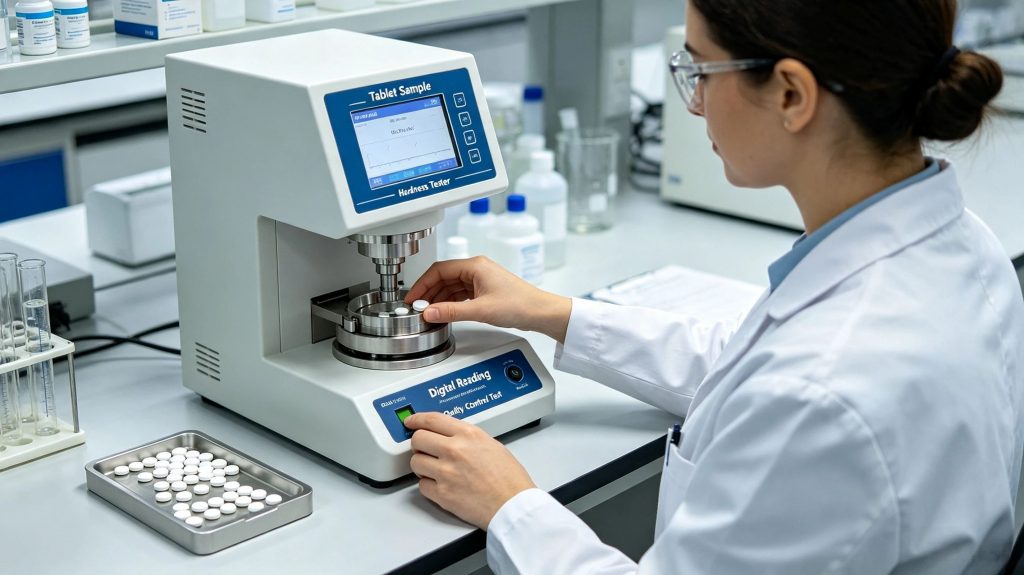
Caption:Tablet hardness testing helps evaluate compression performance and excipient selection.
Low tablet hardness usually traces back to several formulation and manufacturing factors. Understanding these factors helps pharmaceutical engineers choose the correct excipient system from the start.
Weak tablets often stem from poor powder compression behavior. Some APIs bring irregular particle shapes, low compactibility, poor deformation properties, or limited binding capability to the mix. When manufacturers compress these materials alone, the contact area between particles may fall short, resulting in weak tablets. MCC helps overcome this challenge because its particles deform under compression and create stronger bonding networks.
Every tablet formulation needs excipients that can hold powder particles together after compression. When a formulation lacks sufficient binding capacity, manufacturers typically see low tablet hardness, increased friability, tablet edge damage, and poor resistance during packaging. MCC functions as an effective dry binder, which makes it particularly suitable for direct compression formulations that skip traditional wet granulation binders entirely.
Consistent powder flow is essential for high-speed tablet production. Poor flow leads to uneven die filling, tablet weight variation, inconsistent compression force, and variable tablet hardness. MCC grades with optimized particle size distribution, such as MCC PH102, are commonly selected whenever manufacturers need improved flow performance alongside good compressibility.
Lubricants such as magnesium stearate improve tablet manufacturing efficiency, but excessive lubricant levels can reduce particle bonding and hurt tablet hardness. This happens because lubricant particles coat surrounding powder particles and reduce interparticle contact. Consequently, formulation optimization requires a careful balance between lubrication performance and tablet strength.
Different MCC grades offer different functional advantages, so selecting the wrong grade can lead to poor powder flow, insufficient compression performance, and higher production variation. For example, MCC PH101 provides excellent binding thanks to its smaller particle size, MCC PH102 balances flowability and compressibility, and MCC PH301 delivers improved flow characteristics for certain direct compression applications. Choosing the right MCC grade is therefore an essential step toward achieving consistent tablet hardness.
Microcrystalline Cellulose has become one of the most widely used pharmaceutical excipients because it packs multiple formulation benefits into a single ingredient.
1. Excellent Compressibility. MCC behaves differently under compression than many other fillers. During tablet compression, MCC particles rearrange under pressure, deform, and create larger contact areas; stronger interparticle bonding then develops, forming a mechanically stable tablet structure. This plastic deformation mechanism is one of the key reasons MCC performs so well in direct compression applications.
2. Strong Dry Binding Capability. Traditional tablet manufacturing often requires additional binders through wet granulation. MCC, however, delivers effective binding performance without any additional granulation steps, which simplifies the manufacturing process, reduces processing time, lowers production complexity, and suits direct compression far better than wet-bound alternatives.
3. Balanced Hardness and Disintegration Performance. A common formulation challenge is achieving high hardness without hurting disintegration. MCC’s porous structure lets tablets maintain mechanical strength while still supporting liquid penetration during disintegration, which makes MCC well suited to many immediate-release tablet applications.
Direct compression is widely used in pharmaceutical manufacturing because it simplifies production processes and can reduce manufacturing complexity compared with wet granulation methods.
Regulatory agencies such as the U.S. Food and Drug Administration (FDA) emphasize the importance of maintaining consistent quality, process control, and product performance throughout pharmaceutical manufacturing.
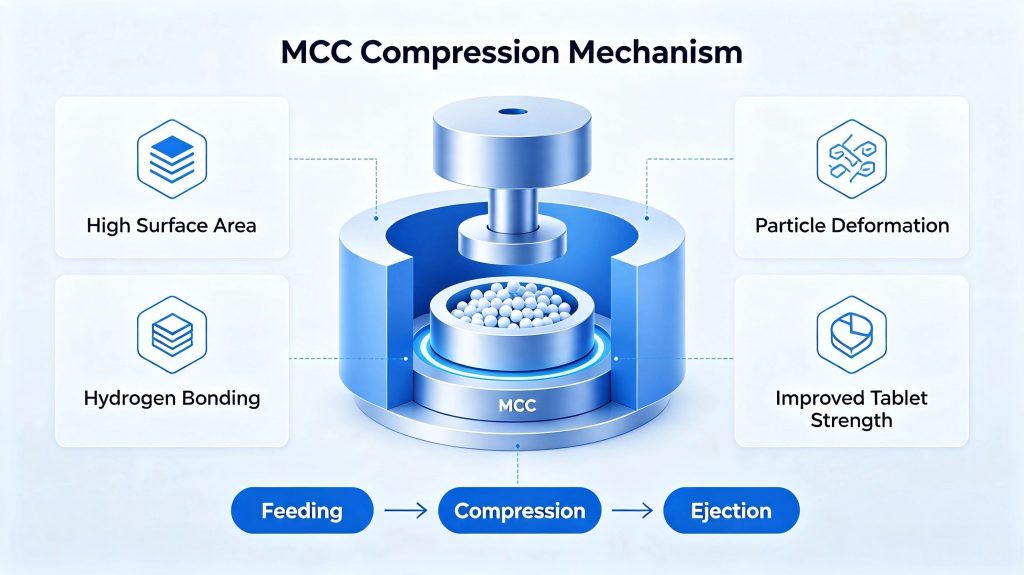
Caption:MCC improves tablet hardness through plastic deformation and particle bonding during compression.
To understand why MCC is so widely selected for improving tablet hardness, it helps to look at how MCC behaves during the compression process itself. Tablet compression isn’t simply a matter of applying force to powder — it’s a complex interaction between particle rearrangement, elastic deformation, plastic deformation, fragmentation, and interparticle bonding. An excipient’s ability to undergo these changes directly determines the final tablet strength, and among commonly used pharmaceutical excipients, MCC demonstrates excellent plastic deformation characteristics that let it form strong, stable compacts under compression.
During tablet production, MCC particles respond to compression pressure in several stages:
At the start of compression, powder particles move and rearrange to fill empty spaces within the tablet matrix. A well-designed MCC grade improves packing efficiency because of its controlled particle size distribution and porous structure. Better particle arrangement, in turn, produces higher contact area between particles, more uniform compression, and improved tablet consistency.
The most important mechanism behind MCC’s tablet-hardening ability is plastic deformation. When compression force is applied, MCC particles don’t simply break apart — instead, they deform and create larger contact surfaces with neighboring particles, which creates stronger bonding points throughout the tablet structure. The result is increased tablet tensile strength, better resistance to mechanical stress, and reduced risk of tablet breakage. This property makes MCC especially valuable in direct compression formulations.
After deformation, MCC particles establish stronger interactions with surrounding particles. These bonds contribute to higher tablet hardness, improved structural integrity, and better resistance during handling and packaging. How effective this bonding process turns out to be depends on MCC grade selection, compression pressure, particle size distribution, formulation composition, and lubricant concentration.
The performance of direct compression excipients directly influences tablet mechanical strength.
An ideal direct compression excipient should provide:
Good compressibility
Strong binding ability
Stable powder flow
Consistent tablet hardness
Not every excipient behaves the same way during compression. Some materials mainly act as fillers, while others provide both filling and binding functions. MCC earns its preference because it combines several important properties in one material.
| Property | Benefit in Tablet Manufacturing |
| Excellent compactibility | Higher tablet hardness |
| Plastic deformation | Strong particle bonding |
| Dry binding ability | Suitable for direct compression |
| Porous structure | Supports liquid penetration |
| Chemical compatibility | Suitable for various APIs |
Because MCC delivers all of this multifunctionality on its own, formulators need fewer additional excipients, which simplifies the entire formulation development process.
Although manufacturers commonly measure tablet hardness, many formulation scientists also evaluate tablet tensile strength, since it provides a more accurate picture of tablet mechanical performance. Tensile strength reflects internal bonding strength, resistance to breaking forces, and overall compact quality. MCC improves tensile strength because its particles form a strong compact structure during compression. For direct compression tablets, achieving appropriate tensile strength matters because tablets must survive dedusting, film coating, packaging, and transportation — all while maintaining acceptable dissolution performance.
Different MCC grades produce different compression behaviors because particle size influences flowability, surface area, packing behavior, and compression response. Generally, the pattern breaks down as follows.
Smaller particle size MCC (for example, MCC PH101) offers higher surface area, stronger binding capability, and excellent compactibility. As a result, it delivers better tablet hardness and suits formulations requiring stronger binding — typically low-dose tablets and formulations that need maximum binding performance.
Larger particle size MCC (for example, MCC PH102) improves flowability, balances compressibility, and suits high-speed tableting better. Consequently, it delivers good tablet hardness, more consistent die filling, and better production efficiency — making it a natural fit for direct compression tablets and large-scale pharmaceutical production.
Coarser MCC grades (for example, MCC PH301) provide a larger particle size distribution and improved powder flow, which suits formulations that require better flow properties and helps maintain consistent tablet weight during high-speed compression.
Selecting the correct MCC grade depends on the main formulation challenge and manufacturing objective.
Need maximum tablet hardness?
→ Choose MCC PH101
Reason:
MCC PH101 provides excellent compactibility and strong binding performance.
Need high-speed direct compression production?
→ Choose MCC PH102
Reason:
MCC PH102 provides better powder flow and balanced compression performance for rotary tablet production.
Need improved powder flow and higher bulk density?
→ Choose MCC PH301 / PH302
Reason:
Higher-density MCC grades can support better powder handling and manufacturing efficiency.
This selection approach helps manufacturers balance:
Tablet hardness
Powder flow
Compression speed
Production efficiency
Final tablet quality
Choosing the correct MCC grade ranks among the most important decisions during formulation development. A common mistake is selecting MCC purely on hardness — in reality, manufacturers need to balance hardness, flowability, compression speed, tablet weight, and API characteristics. The table below offers a practical starting point.
Selecting suitable direct compression excipients depends on tablet requirements, API properties, and production conditions.
Different MCC grades provide different performance advantages for direct compression applications.
| Manufacturing Requirement | Recommended MCC Grade | Reason |
| Maximum binding performance | MCC PH101 | Higher surface area and strong compactibility |
| Direct compression production | MCC PH102 | Balance between flow and hardness |
| High-speed rotary compression | MCC PH102 / PH301 | Better flow performance |
| Low-dose API formulation | MCC PH101 | Improved binding ability |
| Large tablet production | MCC PH102 | Better powder handling |
The amount of MCC used in a formulation also shapes tablet performance. Increasing MCC concentration typically improves tablet hardness, compactibility, and mechanical strength. However, excessive MCC levels can reduce drug loading capacity, alter disintegration behavior, and increase tablet size — so formulation optimization remains necessary. In practical development, formulators commonly evaluate MCC concentration alongside API properties, disintegrant level, lubricant amount, and compression force to reach the desired tablet profile.
Compression force directly influences tablet hardness. Generally, higher compression force strengthens tablet bonding and increases hardness. However, excessive compression can create new problems, including longer disintegration time, capping, lamination, and reduced porosity. MCC provides a wider processing window because its deformation characteristics let manufacturers achieve sufficient hardness without relying solely on extremely high compression pressure — one of the main reasons MCC remains so popular in modern direct compression manufacturing.
Direct compression continues to gain ground in pharmaceutical manufacturing because it offers fewer processing steps, lower manufacturing cost, reduced moisture exposure, and improved production efficiency. However, direct compression demands excipients with excellent compression properties, and MCC meets these demands by providing:
✓ Strong binding performance ✓ Excellent compressibility ✓ Good compatibility with APIs ✓ Suitable flow characteristics ✓ Reliable tablet hardness improvement
For many immediate-release tablet formulations, MCC remains one of the most established and trusted excipients available.
When developing MCC-based tablet formulations, manufacturers should evaluate three areas closely.
1. API Characteristics. Different APIs bring different compression behaviors — particle size, dose level, flowability, and compressibility all play a role. Because MCC can compensate for many API limitations by improving overall powder compactibility, it often becomes the go-to fix for difficult APIs.
2. Tablet Press Conditions. Compression equipment influences final tablet properties, so parameters such as compression speed, main compression force, pre-compression force, and dwell time all matter. MCC grade selection should match the production equipment in use.
3. Lubricant Optimization. Lubricants remain necessary for efficient production, but excessive amounts can reduce tablet hardness. Formulators should therefore optimize lubricant type, lubricant concentration, and mixing time to maintain proper tablet strength.
Microcrystalline Cellulose improves tablet hardness through a combination of plastic deformation, strong interparticle bonding, excellent compressibility, dry binding functionality, and optimized particle characteristics. By selecting the appropriate MCC grade, manufacturers can achieve a better balance between tablet hardness, manufacturing efficiency, and drug release performance.
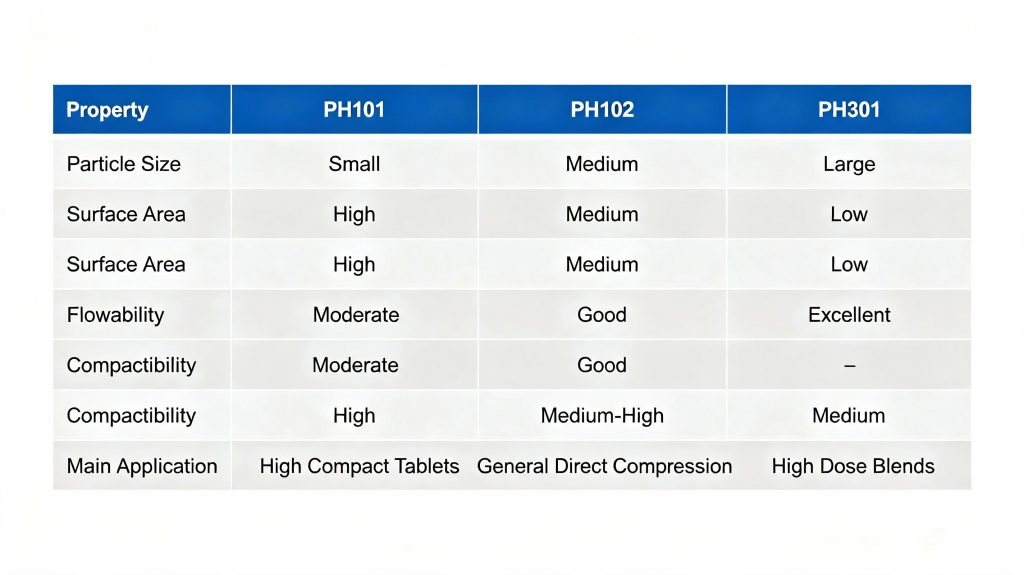
Caption:Comparison of MCC grades based on tablet hardness, flowability, and compression performance.
Selecting the right MCC grade ranks among the most important decisions in pharmaceutical tablet formulation. Although every MCC grade delivers excellent compressibility and binding properties, each grade features a different particle size distribution and different functional characteristics. Choosing between MCC PH101, MCC PH102, and MCC PH301 depends on the specific formulation requirements, production equipment, API properties, and desired tablet performance.
A common misconception holds that the “best” MCC grade is always the one that produces the highest tablet hardness. In practice, the optimal grade is the one that provides the best balance between tablet hardness, powder flowability, compression performance, disintegration behavior, and manufacturing efficiency.
Grade Comparison Overview
| MCC Grade | Main Feature | Tablet Hardness Performance | Typical Application |
| MCC PH101 | Smaller particle size, high surface area | Excellent binding and hardness improvement | Low-dose tablets, formulations requiring strong binding |
| MCC PH102 | Balanced particle size and flowability | Excellent hardness with improved production efficiency | Direct compression tablets, high-speed manufacturing |
| MCC PH301 | Larger particle size, improved flow | Good hardness with superior powder handling | Large-scale tablet production |
PH101 is a fine-particle-size grade that formulators reach for when they need strong binding performance. Because of its smaller particle size and higher surface area, PH101 provides excellent contact between particles during compression, which allows for stronger bonding throughout the tablet matrix.MCC PH101 is one of the most commonly used direct compression excipients when pharmaceutical manufacturers require strong binding performance and excellent tablet hardness.
PH101 improves tablet hardness in three main ways:
That said, PH101’s smaller particle size can lower powder flow compared with larger particle grades, so it may not always suit large-scale rotary compression lines where powder flow is critical.
Among pharmaceutical MCC grades, MCC PH102 ranks as one of the most commonly selected grades for direct compression manufacturing. The reason lies in its balanced performance: good compressibility, excellent flowability, reliable tablet hardness, and suitability for high-speed production. For many manufacturers, PH102 delivers the best overall balance between formulation performance and manufacturing efficiency.For high-speed tablet production, MCC PH102 is often selected among direct compression excipients because it provides a balanced combination of flowability and compactibility.
PH102 strengthens tablets in three main ways:
MCC PH102 vs PH101 for Tablet Hardness
A common question from formulation engineers asks whether PH101 or PH102 produces harder tablets. The honest answer: it depends on the formulation.
| Factor | MCC PH101 | MCC PH102 |
| Particle size | Smaller | Larger |
| Surface area | Higher | Lower |
| Binding ability | Excellent | Excellent |
| Flowability | Moderate | Better |
| High-speed compression | Less preferred | Highly suitable |
| Direct compression | Suitable | Very common |
For formulations where maximum binding matters most, PH101 may offer an advantage. For commercial tablet production, however, manufacturers usually prefer PH102 because it strikes a better balance between hardness and manufacturing performance.
MCC PH301 is a larger particle size grade built to deliver improved flow characteristics. In high-volume pharmaceutical manufacturing, powder handling becomes increasingly important, since poor powder flow causes tablet weight variation, production interruptions, and inconsistent hardness. PH301 addresses these challenges directly.
Although manufacturers select PH301 mainly for flow improvement, it still delivers good compressibility, effective binding, and stable tablet formation — making it suitable whenever manufacturers need better powder movement, efficient die filling, and consistent production output.
| Requirement | Recommended MCC Grade | Reason |
| Need maximum tablet hardness | MCC PH101 | Higher surface area and binding ability |
| Direct compression tablets | MCC PH102 | Best balance of hardness and flow |
| High-speed rotary compression | MCC PH102 | Stable production performance |
| Poor powder flow | MCC PH301 | Improved flow characteristics |
| Low-dose API | MCC PH101 | Strong binding effect |
| Large batch production | MCC PH102 / PH301 | Better manufacturing efficiency |
In practical tablet development, formulation scientists rarely base MCC grade selection on hardness alone. Instead, they typically weigh several factors together.
1. API Properties. Poorly compressible APIs often need MCC with stronger binding capability, while high-dose APIs typically need MCC with better flow and dilution properties.
2. Tablet Manufacturing Process. The production method strongly shapes MCC selection. For direct compression, PH102 and PH301 remain common choices because of their flow and compression balance; for low-speed development trials, PH101 remains the common choice because of its excellent binding characteristics.
3. Desired Tablet Performance. Manufacturers must balance higher hardness (which needs strong compactibility) against lower friability (which needs good binding), faster production (which needs better flowability), and stable compression (which needs consistent particle characteristics).
For most commercial direct compression tablet applications, MCC PH102 is often the first choice, since it delivers reliable tablet hardness, good powder flow, excellent compression behavior, and compatibility with high-speed production. For specialized applications, choose MCC PH101 when maximum binding matters most, and choose MCC PH301 when powder flow and production efficiency become the priority.
Choosing the correct MCC grade can significantly influence final tablet quality, so a reliable pharmaceutical excipient supplier should provide technical specifications, COA documentation, application recommendations, sample evaluation support, and grade selection guidance. At ACTA, we provide pharmaceutical-grade Microcrystalline Cellulose solutions suited to direct compression tablets, immediate-release formulations, nutraceutical applications, and custom formulation development. Our technical team helps customers select the appropriate MCC grade according to API characteristics, tablet requirements, compression equipment, and production objectives.
In pharmaceutical tablet development, MCC ranks among the most widely used excipients for improving tablet hardness and compression performance. However, MCC isn’t the only option available. Depending on formulation requirements, manufacturers may also consider lactose, starch, povidone (PVP), mannitol, or calcium phosphate. Each excipient brings different functional properties to the table — binding capability, compressibility, flow behavior, moisture sensitivity, API compatibility, and suitability for direct compression — so selecting the best excipient for tablet hardness requires understanding what each material can and can’t do.
Quick Comparison: MCC vs Other Tablet Hardness Excipients
| Excipient | Tablet Hardness Performance | Main Advantage | Common Application |
| MCC | Excellent | Strong compressibility and dry binding | Direct compression tablets |
| Lactose | Moderate | Good dilution properties | Pharmaceutical fillers |
| Starch | Moderate | Binding and disintegration functions | Wet granulation tablets |
| PVP | Very strong binding | Excellent adhesive properties | Granulated formulations |
| Mannitol | Moderate | Excellent taste and mouthfeel | Chewable tablets |
| Calcium phosphate | Good | High density and flow | High-dose formulations |
MCC earns its place in direct compression formulations because of its plastic deformation ability, strong particle bonding, excellent compactibility, and dry binding functionality — during compression, MCC particles deform and create strong internal bonding networks, resulting in tablets with solid mechanical strength.
Lactose, by contrast, serves mainly as a diluent, offering good compatibility, pleasant taste, and suitable dilution properties. However, lactose behaves quite differently under compression than MCC does: many lactose grades undergo fragmentation rather than extensive plastic deformation, which means less particle deformation, a different bonding mechanism, and often a lower binding contribution overall.
| Property | MCC | Lactose |
| Tablet hardness improvement | Excellent | Moderate |
| Compression mechanism | Plastic deformation | Fragmentation |
| Direct compression suitability | Excellent | Depends on grade |
| Dry binding ability | Strong | Limited |
| Common role | Binder + diluent | Mainly diluent |
Manufacturers typically choose MCC over lactose when a formulation needs higher tablet hardness, lower friability, better compression performance, direct compression manufacturing, or improved mechanical stability. For formulations where tablet strength matters most, MCC generally proves the more effective choice.
Starch has served as a traditional pharmaceutical excipient for decades, functioning as a binder, diluent, or disintegrant depending on the manufacturing process. However, native starch generally needs specific processing conditions to deliver strong binding performance.
Compared with starch, MCC offers better direct compression performance (since MCC’s excellent compactibility suits direct compression naturally, while starch performs better only when modified or processed through granulation), more consistent tablet hardness (since MCC’s particle deformation properties stay consistent batch after batch), and better manufacturing flexibility (since MCC works across immediate-release tablets, nutraceutical tablets, and direct compression formulations with fewer processing requirements).
| Property | MCC | Starch |
| Direct compression suitability | Excellent | Limited for native starch |
| Tablet hardness | Excellent | Moderate |
| Binding ability | Strong dry binder | Requires processing |
| Disintegration support | Good | Excellent |
| Common role | Binder/diluent | Binder/disintegrant |
Povidone (PVP) delivers powerful adhesive properties and can significantly increase tablet strength, which is why it’s so commonly used as a binder in wet granulation processes. Even so, PVP usually requires granulation processing, additional manufacturing steps, and careful moisture exposure control. MCC offers a different advantage set instead: direct compression capability, no wet granulation requirement, and a simpler manufacturing process overall.
| Property | MCC | PVP |
| Binding strength | Excellent | Very strong |
| Direct compression | Excellent | Limited |
| Wet granulation | Not required | Common |
| Moisture exposure | Lower risk | Requires consideration |
| Manufacturing simplicity | High | Lower |
Manufacturers typically choose MCC over PVP when direct compression is the goal, production steps need trimming, moisture-sensitive APIs are involved, or faster manufacturing is a priority. PVP, on the other hand, becomes the better choice when a formulation needs strong wet granulation binding or high adhesive strength.
Mannitol shows up widely in chewable tablets, orally disintegrating tablets, and nutraceutical products because of its pleasant cooling sensation, good mouthfeel, and low hygroscopicity. While mannitol delivers acceptable compression performance, it generally doesn’t match MCC’s binding effect, so manufacturers usually reach for MCC whenever mechanical strength becomes the primary requirement.
| Property | MCC | Mannitol |
| Tablet hardness improvement | Excellent | Moderate |
| Mouthfeel | Moderate | Excellent |
| Direct compression | Excellent | Good |
| Chewable tablets | Less common | Widely used |
Calcium phosphate finds regular use in pharmaceutical formulations because of its high density, good flowability, and chemical stability, and manufacturers often select it for high-dose formulations. However, calcium phosphate generally shows lower deformation characteristics than MCC.
| Property | MCC | Calcium Phosphate |
| Compressibility | Excellent | Good |
| Density | Lower | Higher |
| Binding ability | Strong | Moderate |
| Direct compression | Excellent | Good |
MCC’s popularity comes down to a unique combination of properties packed into one ingredient: a binding function that improves tablet strength through particle bonding, compression support that enhances compact formation under pressure, dilution capacity that allows tablet weight adjustment while maintaining formulation stability, and manufacturing efficiency that supports direct compression production with fewer processing steps.
No universal “best” excipient exists for every tablet formulation — the correct selection always depends on API characteristics, tablet type, production process, required hardness, and disintegration requirements. As a practical starting point:
| Formulation Requirement | Recommended Excipient |
| Direct compression tablet | MCC |
| Maximum dry binding | MCC PH101 |
| High-speed production | MCC PH102 |
| Strong wet granulation binding | PVP |
| Chewable tablet | Mannitol |
| High-density formulation | Calcium phosphate |
In many commercial formulations, MCC doesn’t work alone. Instead, formulators pair it with complementary excipients to hit specific targets: MCC + Croscarmellose Sodium improves hardness while maintaining fast disintegration; MCC + Magnesium Stearate improves lubrication and supports manufacturing efficiency; and MCC + Lactose adjusts tablet weight while balancing compression characteristics. The final formulation always depends on API properties, target tablet performance, and manufacturing equipment.
During formulation development, manufacturers typically evaluate MCC across three dimensions: compression performance (tablet hardness, tensile strength, compression force requirements), physical properties (friability, weight variation, disintegration time), and production behavior (powder flow, die filling consistency, high-speed compression performance). Together, these evaluations determine whether MCC delivers the tablet quality a formulation needs.
Compared with many traditional tablet excipients, MCC offers a unique combination of excellent compressibility, strong dry binding ability, superior direct compression performance, reliable tablet hardness improvement, and compatibility with many APIs. For manufacturers seeking improved tablet strength and efficient production, MCC remains one of the most established and widely accepted excipient solutions available today.
Achieving consistent tablet hardness ranks among the most important goals during formulation development and commercial production. However, compression force alone doesn’t determine tablet hardness. Many manufacturers first try to fix weak tablets by simply increasing compression pressure — and although higher force may temporarily boost hardness, excessive pressure creates new problems, including longer disintegration time, capping and lamination, reduced production efficiency, tablet sticking or picking, and increased equipment stress.
A successful formulation instead requires a balanced approach involving appropriate excipient selection, the correct MCC grade, optimized MCC concentration, proper lubricant level, suitable compression parameters, and solid API-excipient compatibility. Among these factors, MCC plays a central role, since it directly influences powder compactibility, bonding strength, and tablet mechanical stability.
MCC’s performance in tablet formulations depends on several formulation and manufacturing variables: MCC grade selection, MCC concentration, compression force, particle size distribution, moisture content, lubricant concentration, and API characteristics. Understanding each factor helps formulators get the most out of MCC.
One of the most common reasons for insufficient tablet hardness is choosing an MCC grade that doesn’t match the formulation. MCC PH101 suits formulations that need strong binding ability, higher compactibility, and improved tablet strength — its smaller particle size delivers higher surface area, more particle contact points, and stronger bonding during compression, so manufacturers commonly reach for it in low-dose tablets, formulations with poorly compressible APIs, and tablets requiring higher mechanical strength. PH102, meanwhile, balances tablet hardness, powder flowability, and compression efficiency, making it suitable for high-speed rotary tablet presses, large-scale production, and immediate-release formulations. PH301 comes into play when powder flow becomes the key manufacturing challenge — it’s often beneficial for large tablet production, formulations that need improved powder handling, and high-throughput manufacturing, and it can still deliver good tablet strength when properly formulated.
| Tablet Manufacturing Challenge | Recommended MCC Grade |
| Tablet hardness too low | MCC PH101 |
| Direct compression formulation | MCC PH102 |
| High-speed tablet production | MCC PH102 |
| Poor powder flow | MCC PH301 |
| Low-dose API requiring strong binding | MCC PH101 |
| Commercial scale production | MCC PH102 / PH301 |
The amount of MCC in a formulation has a significant impact on tablet hardness. Increasing MCC content generally improves compression performance, tablet tensile strength, and mechanical stability, but excessive MCC levels can hurt drug loading capacity, tablet size, disintegration characteristics, and overall formulation cost — so formulators must optimize MCC concentration around the formulation objective, not around hardness alone. A low MCC level risks insufficient binding, lower tablet hardness, and higher friability risk; an optimized MCC level delivers improved tablet strength, better compression behavior, and stable production performance; and an excessive MCC level risks reduced API loading capacity, larger tablets, and possible changes to disintegration behavior. Formulation scientists should evaluate MCC concentration together with other excipients rather than in isolation.
Compression force is one of the most visible parameters affecting tablet hardness — generally, higher compression force increases particle bonding and hardness. That relationship isn’t unlimited, though: excessive compression can lengthen disintegration time (since very dense tablets slow water penetration), trigger capping and lamination (since over-compression traps air inside the tablet structure), and reduce manufacturing efficiency (since higher pressure increases machine wear, energy consumption, and production limitations). MCC provides a wider compression operating range because of its excellent deformation characteristics, so instead of relying only on extreme pressure, manufacturers can achieve sufficient tablet strength through improved particle bonding, better compact formation, and stable compression behavior — a benefit that proves particularly valuable in direct compression manufacturing.
Particle size is another important factor affecting MCC performance. Smaller MCC particles (such as MCC PH101) offer higher surface area, a stronger binding effect, and improved compactibility, while larger MCC particles (such as MCC PH102 and PH301) offer better flowability, improved powder handling, and better suitability for automated production. The optimal particle size ultimately depends on whether the formulation priority is maximum hardness, better flow, faster production, or consistent tablet weight.
Although MCC is relatively stable, moisture content can still influence tablet compression behavior. Appropriate moisture levels can support better particle bonding and improved compact formation, but excessive moisture can hurt powder flow, API stability, and tablet quality. For moisture-sensitive formulations, manufacturers should carefully evaluate MCC storage conditions, environmental humidity, and final blend moisture.
Lubricants such as magnesium stearate reduce friction between powder and tooling, which improves manufacturing efficiency. However, excessive lubricant levels can negatively affect tablet hardness, since lubricant particles coat excipient surfaces and reduce bonding between particles — potentially lowering tablet strength, increasing friability, and reducing compression efficiency. To avoid this, formulators should optimize lubricant percentage, mixing time, and compression parameters together, aiming for a balance between manufacturing efficiency and tablet strength.
The active pharmaceutical ingredient itself plays an important role in final tablet hardness. Some APIs bring poor compressibility, low particle bonding, or high dosage requirements — all of which can reduce tablet strength. MCC helps offset these challenges by providing additional binding capacity, better powder compactibility, and improved compression behavior.
Problem 1: Tablet Hardness Is Too Low. Possible causes include insufficient binder effect, an incorrect MCC grade, low compression force, or poor API compressibility. Possible solutions include increasing the MCC proportion, evaluating MCC PH101 or PH102, optimizing compression pressure, and reviewing lubricant level.
Problem 2: High Friability. Friability reflects a tablet’s tendency to lose material during handling, and it usually traces back to weak particle bonding, poor compression, or incorrect excipient selection. MCC helps reduce friability by improving tablet cohesion, mechanical strength, and structural integrity.
Problem 3: Tablet Capping or Lamination. Capping and lamination occur when tablets separate during or after compression, typically because of excessive compression force, air entrapment, or poor formulation balance. Potential solutions include optimizing the compression profile, adjusting the MCC grade, and improving powder properties.
Problem 4: Good Hardness but Poor Disintegration. A tablet can pass the hardness test yet still fail dissolution requirements, usually because of excessive compression, too much binding material, or insufficient disintegrant. The fix isn’t always to reduce hardness — instead, formulators should optimize MCC level, the disintegrant system, and compression force together to maintain the required balance.
A typical development workflow moves through four steps. Step 1: Evaluate API Properties — analyze compressibility, flowability, and dose requirement. 2: Select MCC Grade — choose based on hardness requirement, production speed, and powder behavior. 3: Optimize Excipient Ratio — balance MCC, disintegrant, lubricant, and other fillers. Step 4: Evaluate Tablet Performance — test hardness, friability, disintegration, and dissolution.
During direct compression tablet development, formulators commonly face several challenges, including:
Low tablet hardness
High friability
Poor powder flow
Weight variation during compression
Insufficient mechanical strength after packaging and transportation
MCC is frequently evaluated as a multifunctional direct compression excipient because it provides excellent compressibility, dry binding capability, and tablet structure support.
In immediate-release tablet development, insufficient hardness is often related to poor particle bonding, unsuitable excipient selection, or incorrect compression parameters.
MCC PH101 is commonly evaluated when stronger binding performance is required due to its excellent compactibility and deformation characteristics.
The optimization process usually considers:
MCC grade selection
API compressibility
Lubricant level
Compression force
Tablet target hardness
For high-speed rotary tablet production, powder flow and die filling consistency become critical factors.
MCC PH102 is widely selected because it provides a balanced combination of:
Good flowability
Reliable compression performance
Stable tablet weight
Efficient manufacturing operation
Nutraceutical formulations often contain vitamins, minerals, plant extracts, and functional ingredients with poor compressibility.
By incorporating MCC as a multifunctional excipient, formulators can improve:
Powder handling
Tablet strength
Production consistency
Final tablet quality
These practical formulation considerations demonstrate why MCC remains one of the preferred direct compression excipients in pharmaceutical and nutraceutical tablet manufacturing.
Improving tablet hardness requires a comprehensive formulation strategy, not a single fix. MCC contributes excellent compressibility, strong dry binding capability, improved particle bonding, and better tablet mechanical strength — but the best results still depend on selecting the correct MCC grade, usage level, compression parameters, and overall excipient system. By optimizing these factors together, manufacturers can achieve tablets with higher hardness, lower friability, and reliable manufacturing performance.
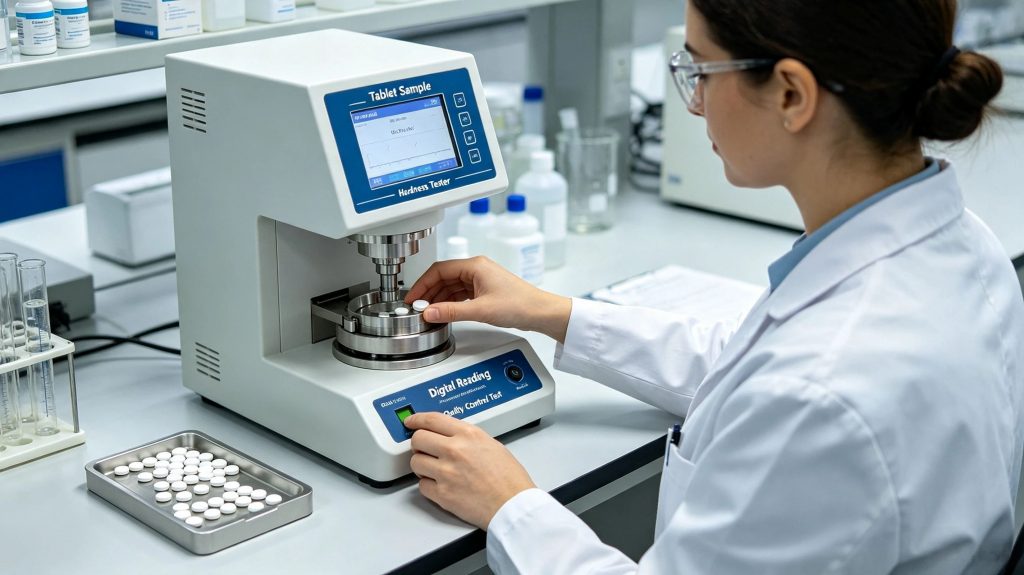
Caption:Quality control and technical evaluation of pharmaceutical-grade MCC production.
Selecting the right direct compression excipient supplier and pharmaceutical grade MCC supplier is critical for pharmaceutical manufacturers.
A reliable MCC manufacturer should provide not only consistent excipient quality but also technical support, regulatory documentation, and stable global supply capability.
For tablet manufacturers, excipient selection directly influences:
Tablet hardness
Compression performance
Production efficiency
Batch-to-batch consistency
Regulatory compliance
Therefore, choosing an experienced pharmaceutical excipient supplier is an important part of successful direct compression formulation development.
A reliable pharmaceutical grade MCC manufacturer should provide:
✓ Consistent product quality ✓ Complete technical documentation ✓ Stable production capability ✓ Professional formulation support ✓ Long-term supply reliability
For drug manufacturers and nutraceutical companies alike, the right MCC supplier can become a long-term technical partner rather than simply a material provider.
1. Pharmaceutical-Grade Quality System. The first consideration should always be whether the supplier can consistently produce pharmaceutical-grade MCC. Important quality factors include raw material control, manufacturing process control, particle size consistency, moisture control, microbial control, and batch-to-batch stability. A pharmaceutical excipient supplier needs a strict quality management system to ensure every batch meets specification requirements.
2. Product Specification and Technical Documentation. Before approving an MCC supplier, pharmaceutical companies typically require complete technical documentation, including:
3. MCC Manufacturing Experience and Technical Capability. A professional MCC manufacturer shouldn’t just supply product — it should understand how MCC performs in real pharmaceutical formulations. That technical experience matters most when customers face challenges such as low tablet hardness, poor powder flow, high friability, compression problems, or disintegration issues. A knowledgeable supplier can recommend suitable MCC grades, appropriate particle size, and application-specific solutions. For direct compression tablets, that usually means recommending MCC PH102 because it balances compressibility, flowability, and production efficiency; for tablets requiring strong binding, MCC PH101, because of its higher surface area, strong particle bonding, and excellent compactibility; and for high-speed manufacturing, MCC PH301, because of its improved powder flow and better handling characteristics.
| Evaluation Factor | Why It Matters |
| Manufacturing experience | Ensures stable supply and technical knowledge |
| Product consistency | Prevents production variation |
| COA/TDS/SDS availability | Supports quality approval |
| Sample testing support | Reduces formulation risk |
| Technical communication | Helps solve application problems |
| Production capacity | Ensures long-term supply |
MCC performance depends on more than product specifications alone — formulation design matters just as much. The same MCC grade can perform differently depending on API characteristics, other excipients, compression equipment, and tablet design. As a result, pharmaceutical manufacturers often need supplier support throughout initial formulation development, sample evaluation, scale-up production, and commercial manufacturing.
A professional MCC supplier should be able to support:
A reliable MCC manufacturer controls quality throughout the entire production process. That means raw material control (ensuring a suitable cellulose source, stable raw material quality, and controlled impurities), production process control (monitoring reaction conditions, purification, drying, and particle size control), and final product testing (covering appearance, identification, moisture, pH, particle size distribution, bulk density, and microbial testing).
Long-term pharmaceutical cooperation demands more than competitive pricing. Experienced suppliers deliver supply reliability (continuous availability, predictable delivery schedules, reduced supply chain risk), technical confidence (a real understanding of tablet formulation challenges, excipient selection, and manufacturing requirements), and faster product development (since strong technical support cuts trial-and-error time, formulation uncertainty, and development costs).
Choosing the right direct compression excipients supplier is critical for pharmaceutical manufacturers.
A reliable supplier of pharmaceutical direct compression excipients should provide consistent MCC quality, technical support, documentation, and application guidance.
Our technical support focuses on helping customers select the right excipient solution for their formulation requirements. For direct compression and tablet formulation projects, ACTA supports customers with:
✓ MCC grade recommendation ✓ Technical documentation support ✓ Sample evaluation ✓ Application guidance ✓ Customized supply solutions
Our MCC products serve applications including direct compression tablets, immediate-release formulations, nutraceutical tablets, and broader pharmaceutical excipient systems.
Need Help Selecting the Right MCC Grade?
Choosing the correct MCC grade can significantly influence:
Tablet hardness
Compression performance
Production efficiency
Final tablet quality
Our technical team can support pharmaceutical manufacturers with:
MCC PH101 / PH102 / PH301 selection
Direct compression formulation evaluation
Technical document support
COA, TDS, SDS assistance
Sample testing support
Request MCC samples or technical consultation today.
MCC remains one of the most trusted pharmaceutical excipients for improving tablet hardness and direct compression performance. However, success still depends on choosing the right MCC grade, the right technical support, and the right manufacturing partner. A reliable pharmaceutical MCC supplier should provide not only consistent products but also the expertise formulation success requires. By working with an experienced MCC manufacturer, pharmaceutical companies can achieve stable tablet quality, improved production efficiency, reliable supply, and long-term cooperation.As pharmaceutical formulations continue to develop, selecting suitable direct compression excipients remains an important factor affecting tablet quality, production efficiency, and manufacturing consistency.
MCC-based direct compression excipients provide pharmaceutical manufacturers with reliable solutions for improving tablet hardness and compression performance.
