

Written by: Richard Wang, International Sales & Technical Content, Qingdao ACTA Biotechnology Co., Ltd about MCC in Soy Milk
Technical Review: Alice Meng
Last Updated: September 2026
Can MCC stabilize soy milk? Yes, MCC can support particle suspension and reduce sedimentation in many soy beverage formulations when the grade, dosage, dispersion, homogenization, and heat process are properly matched to the product.
MCC in soy milk is primarily used as a functional stabilizer. It forms a particle network that helps keep insoluble components suspended and supports physical stability during storage. Soy milk is a demanding system, though, because protein, fat, fiber, minerals, and heat all interact. Therefore, MCC rarely solves every instability on its own.
Quick Answer
MCC can help stabilize soy milk by supporting the suspension of insoluble particles and contributing to a structured colloidal system. For initial laboratory screening, 0.10–0.50% can be evaluated as a starting range, but the final dosage depends on soy solids, protein, pH, minerals, processing, and the complete stabilizer system. If sedimentation is the main problem, screen colloidal MCC first; if the problem is protein aggregation, pH, minerals, or heat treatment, MCC alone may not solve it.Colloidal MCC or MCC Gel may be particularly relevant when suspension is the main formulation challenge.Can MCC stabilize soy milk?
Yes. MCC can support suspension of insoluble particles and reduce settling tendency in many soy beverage systems, but it does not automatically correct protein aggregation, creaming, or mineral-related instability.
What is the starting MCC dosage for soy milk?
An initial laboratory screening range of 0.10–0.50% can be evaluated. The final dosage must be established through application testing.
Is colloidal MCC better than ordinary MCC for soy milk?
When suspension is the primary problem, colloidal MCC may be more relevant because it is designed as a dispersible suspension system, often combining MCC with a hydrophilic colloid such as CMC.
The key question is not simply whether MCC works, but which grade, dosage, and processing conditions fit the specific soy beverage.
| MCC can help with | MCC does not automatically solve |
|---|---|
| Particle suspension | Protein aggregation |
| Sedimentation control | Poor homogenization |
| Colloidal structure | Mineral incompatibility |
| Body and mouthfeel | All types of phase separation |
| Physical stability support | Incorrect heat processing |
Most developers search for this topic because they already face a problem. This guide therefore answers the practical questions that R&D and procurement teams ask: which grade to screen, how much to start with, how to disperse it, why sedimentation still happens, when to add CMC or starch, and how to qualify a supplier before scale-up.
Microcrystalline cellulose (MCC) is a cellulose-derived functional ingredient that manufacturers widely use in food and pharmaceutical applications. MCC does not dissolve in water; instead, it forms a dispersed structure that supports suspension, texture, and physical stability. For a formal definition and regulatory information, see the relevant microcrystalline cellulose reference from a recognized food-ingredient authority.
Ordinary MCC powder and colloidal MCC are not the same material. Many commercial colloidal MCC systems combine MCC with a hydrophilic colloid such as CMC to create a more readily dispersible suspension system. Consequently, buyers who search for “MCC for soy milk” often need colloidal MCC or MCC Gel rather than plain MCC powder.
| Function | MCC | CMC |
|---|---|---|
| Suspension support | Primary function | Supporting function |
| Viscosity contribution | Moderate | Stronger |
| Particle network | Important | More rheology-oriented |
| Water binding | Moderate | Strong |
| Main role | Suspension / structure | Rheology / water management |
Many articles say soy milk “tends to sediment” and stop there. To choose the right stabilizer, however, you need to know why each instability happens.
Soy protein is sensitive. Soy protein is sensitive to pH, ionic strength, heat, and other formulation conditions. Changes in these variables can influence protein aggregation and the physical stability of soy-based beverages. For additional background, see research on soy protein stability and aggregation.
Insoluble particles settle at different rates. Soy milk carries protein aggregates, fiber, residual soybean particles, and mineral components. Because these differ in size, density, and surface characteristics, sedimentation appears over time.
Oil causes creaming. Oil droplets can rise and form a cream layer, the opposite direction of sedimentation. Since these mechanisms differ, diagnose them separately.
| Instability | Physical Cause | Typical Symptom | First Investigation | MCC Relevance |
|---|---|---|---|---|
| Sedimentation | Particle settling | Bottom layer | MCC / dispersion | High |
| Creaming | Droplet rise | Top cream layer | Homogenization | Indirect |
| Serum separation | Weak continuous phase | Clear liquid layer | CMC / hydration | Moderate |
| Protein aggregation | Protein interactions | Flocs / haze | pH / heat / minerals | Limited |
| Grit | Poor hydration / coarse particles | Rough mouthfeel | Dispersion | Process-dependent |
| High viscosity | Excess hydrocolloid | Heavy body | Total stabilizer load | Moderate |
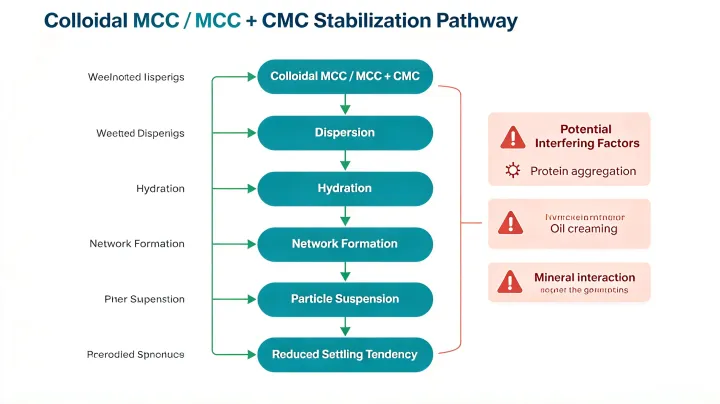
Title:Colloidal MCC suspension mechanism in soy milk Caption:Colloidal MCC can form a hydrated network that supports particle suspension and reduces the tendency of insoluble particles to settle.
Because results depend on formulation and process, we describe MCC’s functions with cautious language.
There is no universal “best” soy milk stabilizer. Each ingredient serves a different function, so start by matching the function to the instability.
| Ingredient | Main Role | Evaluate When |
|---|---|---|
| MCC | Suspension / structure | Sedimentation |
| CMC | Water binding / viscosity | Serum separation / thin body |
| Xanthan | Rheology | Yield behavior / suspension |
| Gellan | Low-dose suspension | Specific particle systems |
| Modified starch | Body / texture | Thin or weak body |
| Carrageenan | Structure | Specific formulation systems |
Section 13 turns this function map into a formulation decision.
MCC is one functional option within a soy beverage stabilizer system. A complete soy milk stabilizer system may include MCC, CMC, modified starch, xanthan, gellan, or other hydrocolloids depending on the instability being addressed.
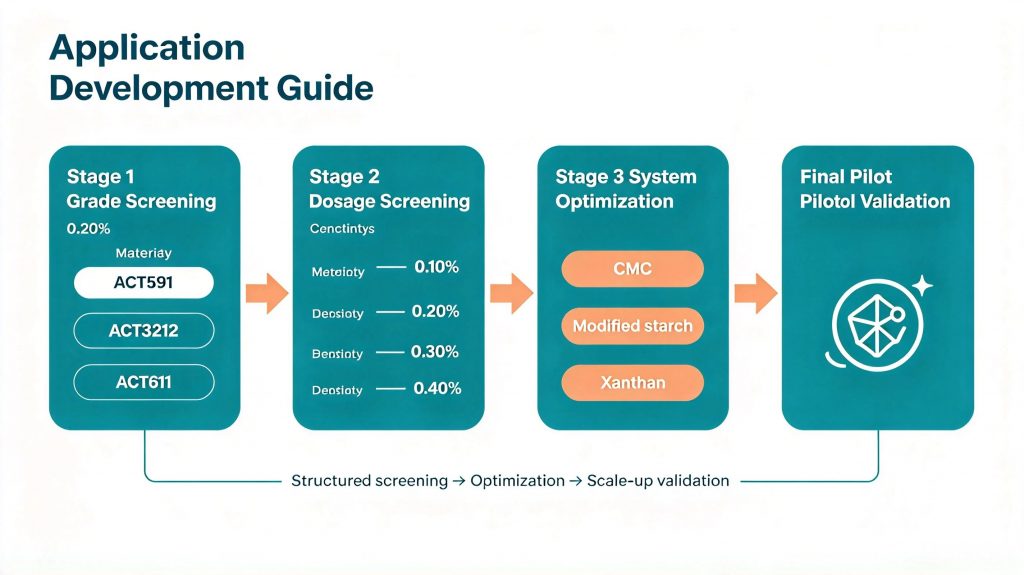
Title:Practical MCC dosage screening strategy for soy milk Caption:A staged approach to screen MCC grades, optimize dosage, and develop the complete soy milk stabilizer system.
No universal dosage exists. For laboratory screening, 0.10–0.50% may be evaluated as an illustrative starting range, rather than a universal formulation recommendation. The final dosage should be established using the actual soy base, protein level, mineral system, processing conditions, and sensory target.
| MCC Level | Screening Purpose |
|---|---|
| 0.10% | Low-level suspension screening |
| 0.20% | Compare suspension response |
| 0.30% | Evaluate stronger structure |
| 0.40% | Check body and viscosity trade-off |
| 0.50% | Upper screening point; assess mouthfeel and processing |
The optimum also depends on fat content, particle size, homogenization, heat treatment, pH, ionic strength, and other hydrocolloids. In addition, apply one simple principle: choose the lowest effective dosage that meets your stability and sensory targets.
Fill in the blank cells with your own test data.
| Trial | MCC Grade | Dosage | CMC | Viscosity | Sediment | Redispersibility | Sensory |
|---|---|---|---|---|---|---|---|
| Control | — | 0 | Existing | Record | Record | Record | Record |
| A | ACT591 | 0.10% | Fixed | — | — | — | — |
| B | ACT591 | 0.20% | Fixed | — | — | — | — |
| C | ACT591 | 0.30% | Fixed | — | — | — | — |
| D | ACT3212 | 0.10% | Fixed | — | — | — | — |
| E | ACT3212 | 0.20% | Fixed | — | — | — | — |
| F | ACT521 | 0.20% | Fixed | — | — | — | — |
This matrix is a template. It contains no experimental results.
A 0.10–0.50% screening range is useful as a starting point, but testing every dosage across every MCC grade can quickly create unnecessary experiments. A more efficient approach is to separate grade screening, dosage optimization, and stabilizer-system optimization.
Start by comparing two or three candidate colloidal MCC grades at the same dosage. For example, 0.20% can be used as an initial screening point.
Keep the following conditions constant:
For example:
| Trial | MCC Grade | Dosage | Purpose |
|---|---|---|---|
| A | ACT591 | 0.20% | Lower-viscosity candidate |
| B | ACT3212 | 0.20% | Higher-structure candidate |
| C | ACT611 | 0.20% | Mid-range comparison |
At this stage, the objective is not to find the final dosage. The objective is to identify which grade gives the most suitable balance of suspension, viscosity, mouthfeel, and processing behavior under the same conditions.
Record at least:
Once one or two promising grades have been identified, test dosage more systematically.
A practical second-stage matrix could be:
| Trial | Selected Grade | Dosage | Main Objective |
|---|---|---|---|
| D | Selected grade | 0.10% | Low-dose response |
| E | Selected grade | 0.20% | Reference point |
| F | Selected grade | 0.30% | Stronger suspension screening |
| G | Selected grade | 0.40% | Stability vs. viscosity trade-off |
If 0.40% already produces excessive viscosity or an undesirable mouthfeel, there may be little value in increasing the dosage further. Conversely, if 0.10–0.20% provides insufficient suspension, the higher screening points can show whether additional MCC produces a meaningful improvement.
The objective is to identify the lowest effective dosage, rather than simply selecting the highest-stability sample.
MCC should then be evaluated within the complete formulation.
Once the MCC grade and approximate dosage have been established, review other stabilizers such as:
For example, if MCC provides adequate suspension but the beverage lacks body, modified starch may be evaluated for texture rather than increasing MCC. If viscosity is already high but serum separation remains visible, increasing CMC may not be the best solution; instead, review hydration, process conditions, and the balance between the stabilizer components.
This staged approach reduces the number of unnecessary experiments and makes the cause of each formulation change easier to understand.
Grade screening → dosage screening → system optimization → process validation → shelf-life testing
This sequence also makes supplier comparisons more meaningful. If two suppliers provide different colloidal MCC grades, compare them at equivalent test conditions rather than comparing price or nominal viscosity alone.
R&D Tip: Change one major variable at a time during early screening. Otherwise, if grade, dosage, CMC level, and processing conditions all change together, it becomes difficult to determine which factor actually caused the improvement.
Choose the grade first, then optimize the dosage. Otherwise, you may spend weeks tuning a material that does not fit the problem.
Do not select by viscosity alone. A higher-viscosity grade may produce a thicker beverage, but that does not necessarily mean it provides the most efficient particle suspension at the lowest practical dosage. Compare grades under identical conditions. Also read the Technical Data Sheet (TDS) and the Certificate of Analysis (COA) together: the TDS describes what the material is designed to do, while the COA shows what a specific batch measured.
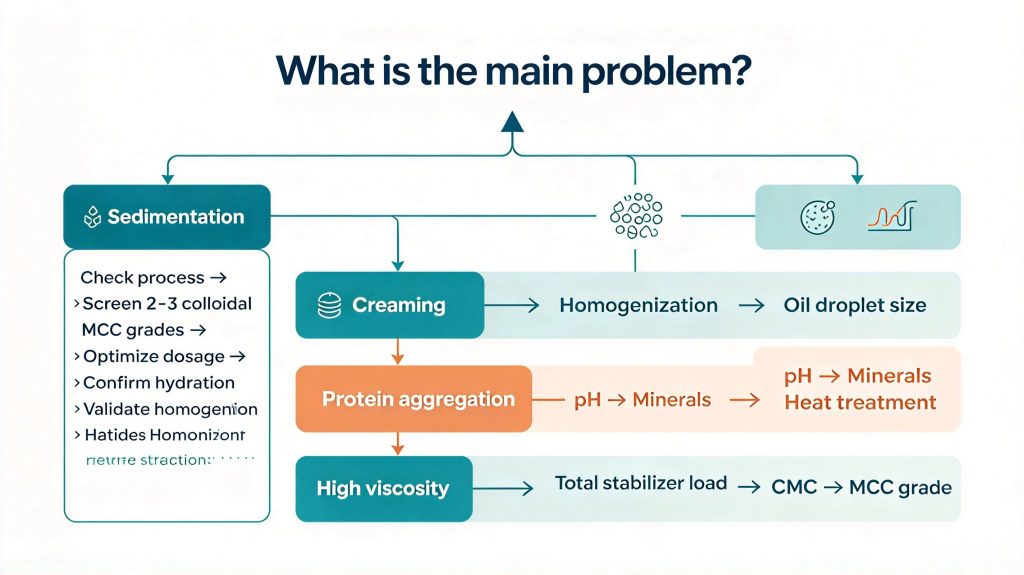
Title:How to choose an MCC grade for soy milk Caption :A practical decision path for screening colloidal MCC grades according to the main soy beverage stability problem.
The order matters: diagnose, check the process, screen grades, set dosage, and then validate.
Practical Formulation Note
In laboratory screening, we recommend evaluating MCC grade and dosage separately rather than changing both variables at once. For example, a manufacturer can first compare two or three colloidal MCC grades at the same dosage. Once the grade with the most suitable suspension behavior is identified, dosage can then be optimized. This approach makes the result easier to interpret and reduces the risk of selecting a grade simply because it produces higher viscosity.
Need help selecting an MCC grade for soy milk?
If you already know your soy solids, protein level, current stabilizer system, and main stability problem, you can send these details to ACTA for an initial grade discussion.
Many colloidal MCC systems combine MCC with CMC because the two ingredients solve different parts of the problem. MCC provides the structural and suspension function, while CMC provides water management and rheology. Together, they can improve suspension, serum stability, viscosity balance, and particle distribution.
However, excessive CMC can increase viscosity without necessarily solving the underlying suspension problem. A thick beverage can still sediment if the particle network is weak.
Note also that colloidal MCC for soy milk differs from adding MCC powder and CMC separately. A colloidal grade is engineered to disperse and interact in a coordinated way, whereas two separate powders depend heavily on your own mixing and hydration.
Dispersion often decides whether MCC works. Even an excellent grade underperforms when it is poorly dispersed.
Step 1 — Prepare the water phase. Start with clean water at the temperature your process requires.
Step 2 — Add MCC under controlled agitation. Add the powder gradually, because adding it too quickly can create lumps.
Step 3 — Apply sufficient shear. For laboratory screening only, a high-shear mixer may be evaluated around 3,000–5,000 rpm for 5–10 minutes as one possible starting condition, followed by a hydration and rest period of 15–30 minutes. Do not transfer this rpm directly to commercial equipment, because rpm alone is not a transferable parameter.
For scale-up, engineers should compare tip speed, power input, mixing time, and equipment geometry rather than attempting to match rpm alone. The basic impeller tip speed calculation is:
Tip speed = π × impeller diameter × rpm / 60
For scale-up, compare tip speed, power input, mixing time, and equipment geometry rather than attempting to match rpm alone. Consequently, 3,000 rpm on a laboratory rotor-stator does not equal 3,000 rpm in a 2,000 L tank.
Step 4 — Introduce the remaining ingredients according to the process design. Depending on the formulation and equipment, soy base, sugar, minerals, oil, and other ingredients may be introduced before or after MCC hydration. The important point is to control powder incorporation, hydration, shear history, and ingredient interactions consistently between trials.
Step 5 — Homogenize. Homogenization reduces particle and droplet size, and it directly affects sedimentation and creaming.
Step 6 — Apply heat treatment. Pasteurization or UHT can alter protein behavior and stabilizer performance.
Step 7 — Evaluate final stability. Measure after processing and during storage. Because each step can change the outcome, record your conditions carefully.
| Parameter | Lab | Production |
|---|---|---|
| RPM | Easy to control | Equipment-dependent |
| Tip speed | Important | Important |
| Impeller diameter | Small | Large |
| Batch volume | Small | Large |
| Mixing geometry | Simple | Complex |
| Hydration time | Short | Variable |
| Dead zones | Limited | Possible |
Soy milk sedimentation after adding MCC is rarely solved by “adding more MCC.” Instead, work through the most common causes below.
Undispersed particles cannot form a network. Check powder incorporation, lumps, and shear.
The network needs time to develop. A sample that is evaluated too early may look weaker than it really is.
The grade may not suit your solids or protein level. Screen two or three candidates under identical conditions.
MCC cannot fully correct a protein stability problem. Review pH, heat, and mineral interactions.
Coarse particles and large droplets destabilize the system, and no stabilizer fully compensates for them.
Beyond these five, also check excessive minerals, incorrect pH, an unbalanced stabilizer system, and storage temperature.
If you see a given symptom, what should you check first, and what should you avoid changing first?
| Symptom | Likely Mechanism | First Variable to Check | What Not to Change First |
|---|---|---|---|
| Bottom sediment | Weak suspension | MCC grade / hydration | Do not immediately double MCC |
| Top cream layer | Large oil droplets | Homogenization | Do not treat it as only an MCC problem |
| Thick but still settling | Excess rheology, weak particle network | MCC/CMC balance | Do not simply add more CMC |
| Flocculation | Protein instability | pH / heat / minerals | Do not keep increasing MCC |
| Gritty texture | Poor dispersion | Powder incorporation / shear | Do not judge grade from viscosity alone |
Use this framework to move from problem to variable, measurement, and decision.
| Failure Mode | Primary Variable | First Test | Secondary Test | Decision |
|---|---|---|---|---|
| Sedimentation | MCC grade | 0.10–0.30% screening | Hydration | Compare grades |
| High viscosity | Total stabilizer load | Reduce CMC | Compare MCC grade | Rebalance system |
| Creaming | Homogenization | Droplet size | Oil phase | Review homogenization |
| Protein aggregation | pH / heat | Process review | Minerals | Address protein stability |
| Gritty texture | Dispersion | Hydration | Shear | Correct dispersion |
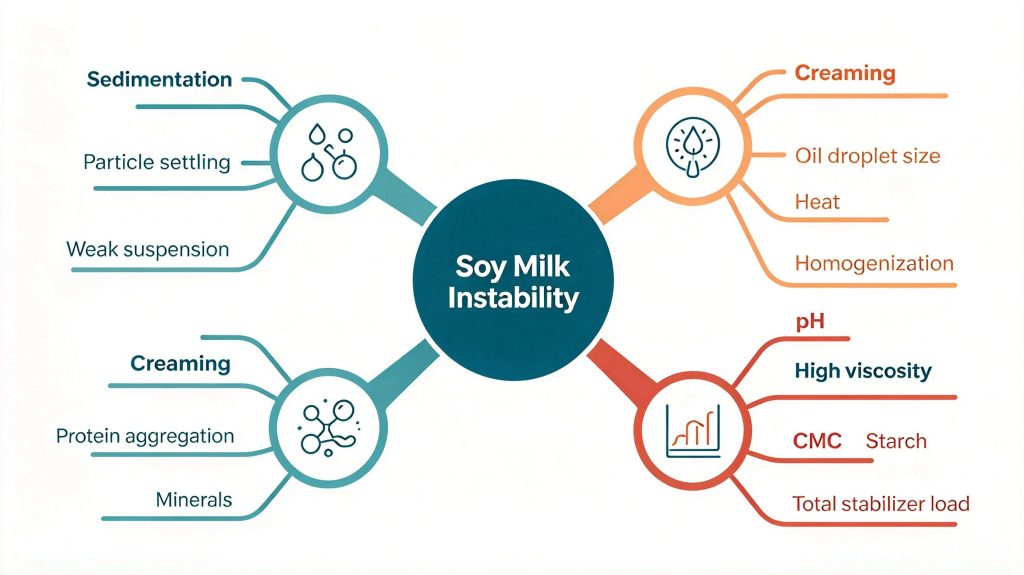
Title:Soy milk stability troubleshooting with MCC Caption:Soy milk instability can result from different mechanisms, so sedimentation, creaming, protein aggregation and viscosity should be investigated separately.
Lab stability does not equal commercial stability. A formula that performs well in a beaker can behave differently in a production tank, because mixing geometry, shear, hydration time, heating profile, and homogenization all change with scale.
| Stage | Typical Purpose |
|---|---|
| Laboratory | Compare grades and dosage |
| Pilot | Confirm mixing, hydration, and processing behavior |
| Commercial trial | Confirm repeatability under production conditions |
Define actual batch size according to the manufacturer’s equipment and production process, and repeat batches at each stage.
| Laboratory | Commercial |
|---|---|
| Fast hydration | Poor powder incorporation |
| High shear | Lower effective shear |
| Small batch | Dead zones |
| Uniform heating | Temperature gradients |
| Short transfer distance | Longer process time |
Immediate stability is not enough. A soy milk can look perfect on Day 0 and separate by Day 14.
Test your existing system without MCC first. This baseline shows whether MCC produces a measurable improvement.
An example early-development schedule is Day 0, Day 3, Day 7, Day 14, and Day 30. The actual schedule should be matched to the intended shelf life and product specification, which may range from weeks to many months. Test at room temperature, under refrigeration, and under accelerated storage, and record the same parameters with the same method at every point.
Stability Observation Matrix (example)
| Parameter | Day 0 | Day 7 | Day 14 | Day 30 |
|---|---|---|---|---|
| Appearance | ✓ | ✓ | ✓ | ✓ |
| Viscosity | ✓ | ✓ | ✓ | ✓ |
| Sediment | ✓ | ✓ | ✓ | ✓ |
| Serum layer | ✓ | ✓ | ✓ | ✓ |
| Cream layer | ✓ | ✓ | ✓ | ✓ |
| Redispersibility | — | ✓ | ✓ | ✓ |
| pH | ✓ | ✓ | ✓ | ✓ |
Sedimentation ratio (%) = sediment height / total sample height × 100
Keep container dimensions, filling volume, storage conditions, and observation method identical across samples. This is a comparative development tool, not an absolute quality standard.
A loose sediment that redisperses easily signals a different situation from a compact layer that resists shaking. Record that difference.
Compare the sample at several heights. Look for a cream layer at the top, a serum layer in the middle, and a compact layer at the bottom.
Accelerated storage can be useful for comparative development, but accelerated conditions should not automatically be treated as a direct prediction of real-world shelf life. For broader guidance, see established food shelf-life and stability testing principles.
Change one variable at a time. Before you begin, define “acceptable”: an allowable viscosity range, a sediment limit, and a sensory standard.
What We Evaluate in an MCC Soy Milk Trial
At the application-development stage, we normally separate three questions. Can the MCC disperse correctly? Can it maintain the required suspension? Can it do so without creating excessive viscosity? Keeping these questions separate prevents a high-viscosity result from being mistaken for good stabilization.
In comparative MCC screening, we recommend keeping the soy base, hydration sequence, shear conditions, homogenization conditions, and storage protocol constant while changing only the MCC grade. Otherwise, differences in processing can be mistaken for differences between grades.
The following example is an illustrative development framework, not a customer result.
| Variable | Trial |
|---|---|
| Soy base | Fixed |
| MCC grade | ACT591 |
| Dosage | 0.10–0.30% |
| CMC | Fixed |
| Homogenization | Fixed |
| Heat treatment | Fixed |
| Storage | Day 0–30 |
| Evaluation | Sediment + viscosity + sensory |
MCC Supplier Qualification Checklist

Sample
↓
Sample COA
↓
Grade
↓
Manufacturing Site
↓
Pilot Trial
↓
Commercial Trial
↓
Batch Consistency
↓
Change Control
↓
Approved Supplier
MCC in soy milk is an informational search, but many readers arrive at this point ready to qualify a supplier. A good trial can still fail commercially if the supplier cannot deliver the same material every time. Therefore, treat supplier qualification as part of formulation control.
| Qualification Item | What to Ask | Why It Matters |
|---|---|---|
| Product identity | MCC / colloidal MCC / MCC + CMC | Prevents material mismatch |
| TDS | Grade and specifications | Defines the target material |
| COA | Batch-specific results | Verifies consistency |
| Sample COA | COA for the exact sample batch | Connects the trial to commercial material |
| Batch consistency | Three consecutive COAs | Assesses variability |
| Manufacturing site | Actual production location | Supports traceability |
| MOQ | Standard MOQ | Supports procurement planning |
| Capacity | Monthly supply capacity | Reveals scale-up risk |
| Change control | Material and process change notification | Protects the formula |
| Technical support | Application assistance | Improves development efficiency |
A successful laboratory sample is only the beginning. Before commercial approval, confirm that the production material will match the evaluated sample in grade, specification, manufacturing site, and relevant quality parameters.
Also check technical specifications such as viscosity, moisture, particle size, microbiological limits, and heavy metals.
Do not test a material once and immediately treat the supplier as qualified. For a beverage ingredient that will be used continuously in production, supplier qualification should cover both product performance and supply-chain reliability.
Move from laboratory screening to pilot validation and, where appropriate, commercial production trials. At the same time, clarify whether you are buying directly from the manufacturer or through a trading or distribution company.
The distinction does not automatically determine which supplier is suitable. However, it can affect how buyers manage traceability, specification control, change notification, technical support, and supply continuity.
| Qualification Area | What Buyers Should Check | Why It Matters |
|---|---|---|
| Batch traceability | Can the supplier trace the exact production batch? | Connects samples, COAs, and commercial shipments |
| Production-site consistency | Is the same manufacturing site used for future orders? | Reduces unexpected material variation |
| Specification control | Who controls the product specification? | Helps maintain consistent quality requirements |
| Change notification | How are raw-material or process changes communicated? | Protects an established formulation |
| Sample-to-bulk consistency | Is the commercial material from the same approved specification? | Reduces qualification risk |
| Technical support | Can the supplier provide application support? | Helps resolve formulation problems |
| Lead time | What is the normal production and delivery lead time? | Supports production planning |
| Capacity | Can the supplier support the required monthly volume? | Reduces supply-continuity risk |
For example, a buyer may receive a technically suitable sample but still need to confirm where the commercial material will be manufactured, whether the specification will remain unchanged, and whether the supplier can maintain the required supply volume.
A trading company may be useful when it provides market access, logistics coordination, local service, or sourcing flexibility. A direct manufacturer may provide more direct access to production information, batch traceability, technical personnel, and change-control procedures. However, these characteristics vary by supplier, so buyers should verify them rather than assuming them from the supplier type alone.
Before approving an MCC or colloidal MCC supplier, ask:
These questions help separate a one-time sample supplier from a supplier that can support a long-term formulation.
One of the most important checks is the relationship between the sample and the material that will eventually enter production.
The buyer should record the:
Supplier → Manufacturing site → Product grade → Specification → Sample batch → Sample COA → Trial result
When the commercial order is placed, compare the approved specification and batch documentation with the qualified sample. If the manufacturing site, grade, specification, or key quality parameters change, determine whether requalification is necessary.
For beverage manufacturers, supplier qualification should therefore be treated as part of formulation control rather than as a purchasing formality.
Do not test once and decide. Move from laboratory to pilot to commercial trials. Clarify whether the supplier is the actual manufacturer, a trading company, or a distributor, and evaluate the implications for traceability, technical support, change control, and supply continuity.
Once the formula and supplier have been qualified, record the exact MCC grade, manufacturing site, specification, supplier, and quality requirements. Two products may both carry the “colloidal MCC” label, yet they are not interchangeable. Furthermore, when a stability complaint occurs, compare the COA, soy solids, pH, stabilizer dosage, hydration, homogenization, heat treatment, and storage between the good batch and the problem batch. Often the cause lies in process variation rather than the ingredient.
Request a Colloidal MCC Sample
If you are ready to test candidate grades, send ACTA your soy base details and main stability problem. We can discuss suitable colloidal MCC grades, sample options, and the technical documents required for evaluation.
Section 4 mapped each ingredient’s function. This section helps you decide, because a soy beverage stabilizer system should follow the failure mode rather than the other way around.
| Situation | Consider | Why |
|---|---|---|
| Insoluble particles settle, body is acceptable | MCC or colloidal MCC alone | Addresses suspension without adding viscosity |
| Suspension is weak and serum separates | MCC + CMC system | MCC builds structure; CMC manages water and rheology |
| Body is thin, particles are stable | Modified starch, evaluated with MCC | Adds body without relying on the particle network |
| Yield behavior is needed at low dose | Xanthan in a combined system | Adds rheology through a different mechanism |
| Beverage is thick but still settles | Rebalance MCC and CMC | More viscosity does not mean stronger suspension |
Note that modified starch mainly contributes body and texture, so raising it may not solve sedimentation. Also evaluate suspension and viscosity separately: the lowest viscosity is not always better, and the most stable formula is not always the best formula. Likewise, protein stability is a separate problem, and MCC does not automatically fix aggregation caused by pH, minerals, or heat.
Finally, change one variable at a time: diagnose the failure mode, screen the MCC grade, optimize dosage, add CMC, starch, or xanthan only if needed, and then validate the process.
Purchasing teams rarely care about $3/kg versus $4/kg alone. They care about cost per finished beverage.
Ingredient cost per kg of beverage = MCC price per kg × dosage fraction
Remember that 0.50% equals 0.005. For example, $3/kg × 0.005 = $0.015 per kg of beverage, or $15 per metric ton.
| Price | Dosage | Cost per Metric Ton of Beverage | |
|---|---|---|---|
| Supplier A | $3/kg | 0.50% | $15 |
| Supplier B | $4/kg | 0.25% | $10 |
The same calculation works per 1,000 kg of beverage. For Supplier B, 1,000 kg × 0.25% = 2.5 kg of MCC, and 2.5 kg × $4/kg = $10. Although Supplier B costs more per kilogram, it costs less in the finished beverage. This calculation is purely illustrative.
A full evaluation also counts freight, import duty, packaging, yield, processing, waste, rejected batches, and stability failure.
Effective formulation cost = ingredient cost + processing cost + logistics cost + quality-related cost
Therefore, compare suppliers on a functional basis rather than on USD per metric ton.
Different soy products stress the stabilizer in different ways, so screen each application on its own terms.This approach is also relevant to broader plant-based beverage stabilizer systems.
More protein raises the risk of aggregation and sedimentation. Screen grades carefully, and review pH and heat treatment alongside the stabilizer.
Minerals add interaction risk. Check mineral compatibility, and consider whether the mineral source affects protein and stabilizer behavior.
Heat treatment can change protein behavior and stabilizer performance. Validate the grade under your actual UHT conditions rather than relying on laboratory results alone.
Cocoa particles need strong suspension support, so evaluate suspension performance separately from viscosity.
Additional particles need suspension support, and the fiber may change hydration and viscosity.
Other products, such as sweetened, vitamin-fortified, vegetable-oil, coffee, reduced-sugar, low-fat, and shelf-stable soy beverages, each shift solids, fat, acidity, or heat load. Consequently, screen every product on its own terms.
If your company sells several soy products, build an internal application map, and give each product its own grade, dosage, process, specification, and stability record. Moreover, test the ingredient where it will actually be used. A simplified soy-water model helps early screening, but it should never replace validation in the final formula.
For manufacturers evaluating colloidal MCC for beverage stabilization, ACTA provides several candidate grades for comparative application testing. As a colloidal MCC supplier, ACTA offers grades with different viscosity and functional characteristics, so you can screen them against your own formulation.
| Grade | 1.2% Viscosity | Screening Role | When to Evaluate |
|---|---|---|---|
| ACT591 | 39–91 mPa·s | Lower-viscosity candidate | Lighter body |
| ACT3212 | 50–200 mPa·s | Higher-structure candidate | Stronger suspension screening |
| ACT611 | 50–151 mPa·s | Mid-range candidate | Balanced comparison |
| ACT538 | 39–175 mPa·s | Broad comparison | Comparative trials |
| ACT521 | 50–100 mPa·s | Lower-to-mid candidate | Moderate structure |
These descriptions are screening directions rather than fixed application claims. Final grade selection should be confirmed through the customer’s formulation and process. In other words, the most suitable grade should be selected through application testing rather than viscosity alone.
Before you request samples, define the failure mode and record your current system. Then run a controlled screening matrix (Section 5), keep the process constant, validate at pilot scale, and keep a repeatable trial record. The table below shows what to record first.
| Parameter | Record Before Trial |
|---|---|
| Soy solids | ___ % |
| Protein | ___ % |
| Fat | ___ % |
| pH | ___ |
| Current stabilizer | ___ |
| Current MCC dosage | ___ % |
| Homogenization | ___ |
| Heat treatment | ___ |
| Storage temperature | ___ |
| Target viscosity | ___ |
| Main failure | ___ |
| Monthly volume | ___ |
Send this completed trial brief to your ingredient supplier before requesting samples. Also remember that MCC is not always the whole solution: if protein aggregation, mineral interaction, or weak homogenization drives the problem, address those factors too.
Can MCC stabilize soy milk?
Yes, it can help by supporting particle suspension. The outcome depends on grade, dosage, dispersion, and processing.
Does MCC reduce soy milk sedimentation?
MCC can reduce sedimentation in many formulations, but no stabilizer guarantees prevention in every product. Test it in your own system.
What is the recommended MCC dosage for soy milk?
For laboratory screening, 0.10–0.50% may be evaluated as an illustrative starting range. It is not a commercial formulation recommendation, and the final dosage must come from application testing.
What is the difference between MCC and colloidal MCC?
Ordinary MCC powder is not designed for coordinated hydration. Many commercial colloidal MCC systems combine MCC with a hydrophilic colloid such as CMC to create a more readily dispersible suspension system.
Why is soy milk still sedimenting after adding MCC?
Common causes include poor dispersion, insufficient hydration, the wrong grade, protein aggregation, poor homogenization, excess minerals, and an unbalanced stabilizer system.
Can MCC be used with CMC?
Yes. MCC supports structure while CMC supports water management and rheology, and many colloidal MCC systems already combine both.
Which MCC grade is suitable for soy milk?
It depends on your solids, protein, stabilizer system, and process. Screen two or three candidate grades at the same dosage, and do not choose by viscosity alone.
Can MCC be used in UHT soy milk?
Performance depends on the grade and process, so validate it under your actual heat treatment.
Can MCC be used in high-protein soy beverages?
Yes, it can be evaluated there. High-protein products often need careful grade and system screening.
How do I choose an MCC supplier?
Compare technical performance, batch consistency, documentation, application support, supply capability, and change control, not price alone.
The objective is not simply to add MCC to soy milk. The objective is to build a stable, reproducible, scalable, and commercially practical soy beverage system. In practice, that means following one chain: failure-mode diagnosis → grade screening → dosage optimization → stabilizer system optimization → dispersion and process validation → shelf-life testing → pilot validation → supplier and specification control.
Qingdao ACTA Biotechnology Co., Ltd. supplies MCC, colloidal MCC / MCC Gel, CMC, HPMC, HEMC, and modified starch for food and industrial applications.
Send us 6 details:
If available, you can also include pH, fat content, heat treatment, target viscosity, and packaging format.
What ACTA Can Discuss With You
Always confirm the final grade, dosage, and stabilizer system through your own formulation, process, sensory evaluation, and shelf-life validation.
