

Author: Richard Wang, Qingdao ACTA Biotechnology Co., Ltd. | Technical Review: Alice Men ,this product is about food grade mcc
Food Grade MCC (microcrystalline cellulose, E460(i) where applicable) is used in selected food formulations to support bulking, texture modification, and powder handling. However, choosing the right grade requires more than comparing product names or prices. Particle characteristics, purity, moisture, regulatory requirements, and processing conditions can all affect suitability.
For food manufacturers and ingredient buyers, three questions matter most: Which MCC type fits the application? What specifications and documents should a supplier provide?And How can performance be verified before a commercial order?
This guide compares standard MCC with colloidal MCC, explains the quality parameters buyers should review, and provides a practical framework for supplier evaluation, sample testing, and quotation requests.
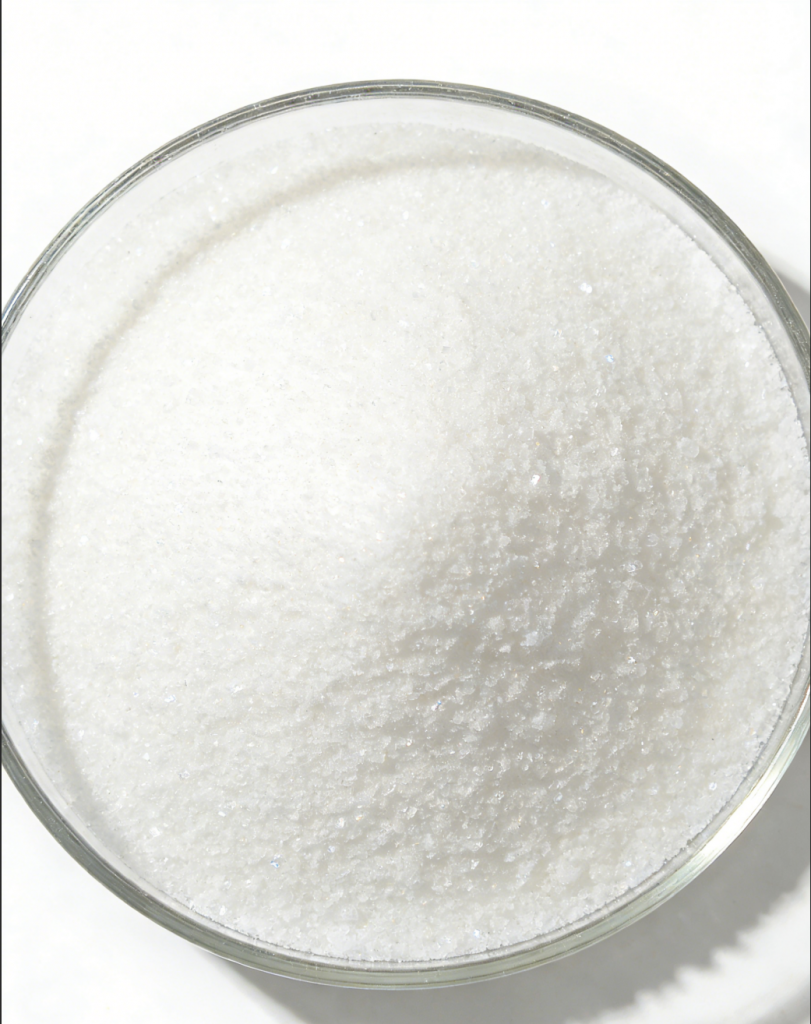
Caption:Food grade microcrystalline cellulose powder for ingredient evaluation and food formulation development.
Food grade microcrystalline cellulose is a purified, partially depolymerized cellulose. Typically, manufacturers produce it from cellulose-containing plant material through controlled processing. During this process, they purify the raw material, treat it, wash it, dry it, and control its particle size. As a result, the final product is a white or nearly white, odorless powder with limited solubility in water. Although it does not dissolve like a gum, it still interacts with water and contributes to the physical structure of a formulation.
Depending on the grade and formulation, food grade MCC may contribute to bulking, texture modification, and powder-handling performance. However, its suitability for anti-caking applications should be confirmed through product-specific data and application testing.
Microcrystalline cellulose is identified as E460(i) under the applicable European food additive framework and as INS 460(i) in the international numbering system. However, these identifiers establish the additive’s identity but do not replace a review of permitted uses, purity criteria, and labeling requirements in the destination market.
Furthermore, permitted uses may vary depending on the food category, applicable standard, and conditions of use. Therefore, buyers should verify the regulatory requirements for their target market before selecting a product. In addition, supplier documents must correspond to the actual product and its manufacturing source to support appropriate quality and regulatory checks.
The two grades may share the same basic cellulose chemistry, yet their specifications, testing requirements, and documentation can differ. A pharmaceutical buyer may require compendial compliance and tablet performance data. A food manufacturer, on the other hand, focuses on additive identity, applicable purity criteria, sensory neutrality, and local food rules. Read the actual specification rather than phrases such as “high purity” or “premium grade.”
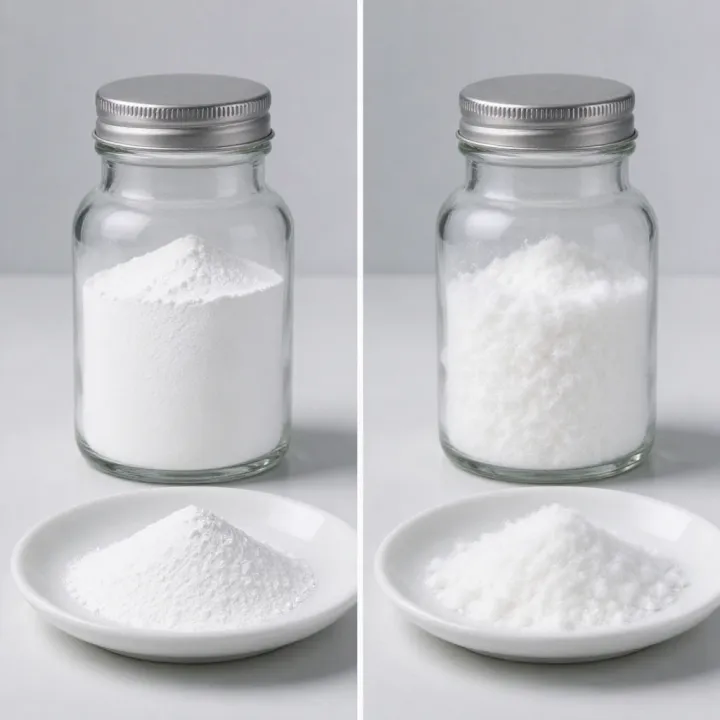
Caption:Standard MCC and colloidal MCC have different functional characteristics and should be selected according to the target application.
This is the most important product distinction in the guide. Standard MCC is generally water-insoluble. Colloidal MCC systems typically combine MCC with a dispersing component such as sodium carboxymethyl cellulose (CMC). Depending on the grade and under suitable dispersion and hydration, they form a dispersed colloidal system.
| Feature | Standard Food Grade MCC | Colloidal MCC |
|---|---|---|
| Basic composition | Microcrystalline cellulose | Typically MCC with a dispersing component such as sodium CMC |
| Water behavior | Insoluble; may absorb or retain water | Forms a dispersed colloidal system under suitable processing |
| Functional focus | Bulk, texture, powder-handling support, grade-dependent functions | Suspension, structure, and stabilization |
| Dispersion needs | Depends on grade and application | Often needs controlled dispersion and hydration |
| Key evaluation criteria | Particle properties, purity, moisture, function | Dispersion quality, viscosity, suspension, stability |
| Typical uses | Selected dry mixes and processed foods | Selected beverages, sauces, structured foods |
Treat this table as a screening tool, not a universal specification. Colloidal MCC formulations, dispersion requirements, and performance differ between products, so confirm the details for each grade. Thickening, suspension, emulsification, texture modification, and stabilization are also different functions, and standard MCC does not automatically form the same suspension structure as colloidal MCC.
| Your actual need | Direction to evaluate first | Factors to confirm |
|---|---|---|
| Improve the handling of a specific powder | Standard MCC or another suitable powder ingredient | Particle size, flowability, formulation compatibility |
| Improve suspension in a plant-based milk | Colloidal MCC or another suspension and stabilization system | Dispersion, hydration, heat treatment, storage conditions |
| Improve particle distribution in a sauce | Colloidal MCC or another suitable stabilization approach | pH, salt content, viscosity, processing conditions |
| Increase the viscosity of a liquid | Assess a suitable thickening system first | Target viscosity, shear conditions, formulation compatibility |
Once you know your direction, use this table to see which information to request before you select a specific product for evaluation.
| Product category | Main evaluation objective | Information to request |
|---|---|---|
| Standard food grade MCC | Bulking, texture, or other defined particulate functions | Grade, particle size, moisture, purity criteria, and intended application |
| Colloidal MCC | Suspension, particle distribution, and stabilization | Grade, viscosity test conditions, dispersion instructions, and application performance |
| Customized MCC selection | A specific formulation or processing challenge | Target function, food matrix, process conditions, and destination market |
Do not transfer the specification of one product category to the other. A viscosity value that matters for colloidal MCC is not a parameter that every MCC product must have.
Choosing between standard MCC and colloidal MCC depends on your target function, formulation, and processing conditions.
Share your application, target function, and destination market with ACTA. We can review the relevant product information and discuss which available grades may be suitable for sample evaluation.
Contact ACTA for Product Selection
Explore our food grade microcrystalline cellulose and colloidal MCC product pages.
This chapter explains the mechanisms behind each function and the measurements that confirm them.
Seasonings, flavor blends, dry beverage mixes, and nutritional powders can cake because of moisture uptake, temperature swings, storage pressure, or hygroscopic ingredients. In suitable formulations, MCC’s porous particles may change how powder components touch each other and interact with moisture. A porous particle does not guarantee an anti-caking effect, though, so confirm it with a controlled test:
MCC adds solids without the sweetness, strong flavor, or high solubility of many bulking ingredients. Because it stays particulate, it behaves differently from soluble carbohydrates. It does not match sugar’s sweetness, browning, or freezing-point effects, and it does not gelatinize like starch. Define the function you want to replace first. Then evaluate bulk, texture, water management, and powder handling separately.
Cellulose particles influence mouthfeel through their physical presence and their interaction with the food matrix. Mouthfeel can change even when measured viscosity barely moves. Particle size, dispersion quality, water availability, processing conditions, and dosage all play a role. Poor dispersion creates specks and agglomerates, which people often blame on the ingredient, while excessive dosage can create a powdery or chalky sensation. Combine instrumental data, such as viscosity and texture analysis, with sensory panel feedback.
Standard MCC interacts with water to a degree that depends on the grade and system, but it does not build viscosity the way xanthan gum, guar gum, or soluble cellulose ethers do. Colloidal MCC, however, can form a dispersed particulate network under suitable processing. Particles settle because of density differences, particle size, liquid viscosity, and the structure of the continuous phase. A properly prepared colloidal MCC system can help maintain particle distribution and reduce visible sedimentation under validated conditions.
Results depend on pH, salts, proteins, heat treatment, packaging, and other stabilizers. High electrolyte content or low pH can interfere with network formation, so pre-hydrate colloidal MCC before acidification or mineral addition where the grade instructions allow it. Test sedimentation, redispersibility, appearance, viscosity, and shelf-life stability under your real heat treatment, homogenization, and filling conditions.
MCC’s value depends on the intended function and the finished product.
Potential benefits:
Important limitations: MCC does not replace starch, gums, emulsifiers, or other functional ingredients. Standard MCC does not dissolve, and colloidal MCC needs suitable dispersion and hydration. Assess both under your actual processing, storage, and regulatory conditions.
This chapter focuses on what each application needs you to test and why trials fail. It describes general evaluation approaches and does not claim that ACTA has validated every product in every food category.
Caking, segregation, inconsistent filling, and poor dispersion trouble these products. Moisture migration, particle-size and density differences, and electrostatic effects usually cause them.
Typical failure causes: A team adds MCC to treat caking that packaging actually causes. A blend separates because heavy particles settle away from light ones during transport. In that case, particle-size matching, blending time, bulk density, and packaging matter more than another powder.
Test priorities: blend uniformity, flow through your filling equipment, caking after storage under your humidity conditions, flavor and appearance neutrality, and reconstitution behavior where relevant. Always test the final commercial blend rather than the MCC powder alone.
Bakery formulas combine flour, starch, water, fat, sugar, protein, and leavening, so a small functional change can alter dough handling and crumb structure. MCC does not replace flour, starch, or conventional hydrocolloids.
Typical failure cause: A team changes the MCC dosage without adjusting water or other ingredients, and the dough or batter consistency shifts.
Test priorities: dough or batter consistency, specific volume where applicable, moisture content, crumb texture, and changes during storage.
These products often carry suspended spices or vegetable pieces. A low-viscosity herb dressing needs a different strategy from a thick tomato sauce, because pH, salt, oil content, and heat processing all affect results.
Typical failure cause: A team expects standard MCC powder to build the suspension structure that a colloidal system is designed to provide.
Test priorities: formulation composition and pH, addition sequence and dispersion method, mixing equipment, initial viscosity and appearance, separation during storage, sensory acceptability, and performance after the actual thermal treatment.
A dry dairy powder, a spoonable dessert, and a ready-to-drink beverage need different functions, so evaluate each separately. Check compatibility with proteins, fats, minerals, and emulsifiers, then test the full process sequence, since a formula that looks stable after mixing can change after heating, homogenization, or storage. Decide whether you need a thickener, an emulsifier, a suspension aid, or a combination, because MCC alone should not be expected to perform all of those roles.
Oat, soy, almond, and pea beverages contain insoluble plant particles, proteins, oils, and minerals. When suspension support is the main goal, colloidal MCC for beverage stabilization is usually a more relevant candidate than standard MCC powder. For deeper guidance, read about plant-based milk stabilization, MCC in soy milk, and MCC in almond milk.
| Customer problem | Factors to check | Sample test focus |
|---|---|---|
| Sediment at the bottom of a plant-based milk | Particle size, dispersion, suspension system | Sediment volume, storage stability, redispersibility |
| Beverage feels chalky or powdery | Particle characteristics, dispersion quality, dosage | Sensory evaluation, grittiness, mouthfeel change |
| Lumps after mixing | Addition sequence, wetting, mixing conditions | Dispersion uniformity, lump formation |
| Stability drops after heating | Heat treatment, formulation compatibility | Appearance, sedimentation, and viscosity before and after heat treatment |
These factors are troubleshooting directions, not proof that MCC causes every problem.
Frozen desserts must balance body, smoothness, melt resistance, and ice-crystal control. Do not treat MCC as a replacement for a complete stabilizer system. If you evaluate a cellulose ingredient, measure mix viscosity, overrun, hardness, melting behavior, ice-crystal growth during storage, and smoothness while holding processing constant. For the wider picture, see our ice cream stabilizers guide.
| Application | Evaluate first | Main focus |
|---|---|---|
| Powdered blends and seasonings | Standard MCC or another powder-handling ingredient | Flow, segregation, caking |
| Bakery products | Standard MCC where a defined function exists | Dough handling, texture |
| Sauces and dressings | Colloidal MCC if suspension is required | Particle distribution, separation, pouring |
| Dairy-style products | Grade matched to the target function | Texture, compatibility, stability |
| Plant-based beverages | Colloidal MCC when suspension is key | Sedimentation, redispersibility, mouthfeel |
| Frozen desserts | A validated stabilizer system | Texture, melting, storage stability |

Caption:Buyers should verify product identity, test methods, specification limits, and batch-specific results before approving an MCC supplier.
This chapter covers document review: which parameters to audit and how to compare an MCC COA. Two suppliers can both sell “food grade MCC” with different particle characteristics, moisture levels, and test methods, and no single universal specification exists.
Buying tip: Do not just ask for a parameter value. Ask which test method was used, what acceptance range applies, and whether the reported value is typical or guaranteed.
Key principle: Identity, purity, regulatory status, and application performance are four different evaluation questions. A document that answers one does not answer the others.
| Parameter | Typical identification | What buyers should verify |
|---|---|---|
| Product name | Microcrystalline cellulose | Matches the quotation, label, specification, and COA |
| Additive number | INS 460(i) or E460(i), where applicable | Fits the destination market |
| CAS number | 9004-34-6 is commonly used for cellulose listings, including MCC | Matches the identity information in the supplier’s TDS, SDS, and COA |
| Intended use | Food grade | Supplier provides supporting specification and documents |
Keep four ideas separate:
Do not rely on a single purity percentage without knowing what it measures. Request the test method, the specification limit, and the actual batch result for each critical parameter. Relevant areas may include identity against the applicable monograph, impurity and residue limits, residue on ignition, heavy metals or other contaminants where required, and microbiological quality where required. Ask which limits are regulatory, which are internal, and which are customer-specific.
Specifications often report moisture as loss on drying (LOD), which measures mass lost under defined conditions rather than water alone. In particular, moisture affects powder handling, storage stability, batch consistency, and the amount of dry material you actually add. Therefore, request both the agreed limit and the batch result. However, remember that the lowest moisture is not automatically the best.
Suppliers may report mesh, a size range, or laser-diffraction values such as D50; however, these measurements are not interchangeable. For this reason, ask which method produced the figure, whether it is nominal, typical, or guaranteed, and whether a full distribution is available. Moreover, smaller is not always better. Dry blends often require good flow and minimal segregation, whereas reconstituted products place greater emphasis on wetting performance.
Suppliers may report loose or tapped bulk density, and these figures differ. Bulk density affects storage volume, packaging weight, and volumetric dosing. Confirm the method, units, and batch consistency.
Food grade MCC normally looks white or nearly white and has no odor, subject to the specification. Unusual color, foreign matter, or smell may signal a handling or contamination problem, yet normal appearance does not prove compliance. For microbiology, ask the supplier to name the indicators, limits, and methods, and agree on any extra testing before you finalize the order.
Buyers must separate three kinds of numbers:
Before ordering, agree on the test method, acceptance limits, and batch documentation.
| Item | Information to request | Why it matters |
|---|---|---|
| Product identity | Full name and grade | Confirms the material |
| Purity or assay | Definition, method, limit, result | Enables fair comparison |
| Moisture / LOD | Method, limit, batch result | Supports storage and consistency |
| Particle size | Method and agreed range | Shows handling suitability |
| Bulk density | Loose or tapped, method, units | Supports dosing and packaging |
| Contaminants and microbiology | Required tests, limits, methods | Supports compliance and food safety |
| Packaging and traceability | Material, closure, batch identification | Protects product and supports complaints |
| MCC TDS | Typical properties, recommended use, handling | Supports grade selection |
| MCC COA | Batch-specific test results | Confirms the delivered batch |
| SDS and declarations | Safety and applicable regulatory documents | Enables qualification |
Document availability and test parameters vary by product, manufacturer, and destination-market requirements. Confirm which documents and test results are available for the specific grade before placing an order. For product details, see our MCC specifications and product range.
First, check whether each Certificate of Analysis (COA) accurately identifies the product and batch being supplied. Next, compare the test methods, specification limits, and actual results. However, remember that a COA documents batch test results; it does not establish how the ingredient will perform in your formulation. Therefore, conduct application testing to verify performance under your actual processing conditions before approving the ingredient for commercial use.
Fill each cell with the supplier’s reported data and method, not with an assumed industry value.
| Parameter | Supplier A | Supplier B | What the buyer should verify |
|---|---|---|---|
| Product identity | MCC food grade | MCC food grade | Same type and target grade |
| Loss on drying | Supplier’s reported value | Supplier’s reported value | Test method, limit, and batch result |
| Particle size | Supplier’s reported range | Supplier’s reported range | Measurement method and suitability for the application |
| Bulk density | Supplier’s reported value | Supplier’s reported value | Loose or tapped density, test method, and consistent units |
| Microbiological limits | Supplier’s declared limits | Supplier’s declared limits | Parameters, methods, and applicable requirements |
| Regulatory documents | Documents provided | Documents provided | Documents match the actual product and manufacturing source |
| Application performance | Trial results | Trial results | Same formulation and process in both trials |
Qingdao ACTA Biotechnology Co., Ltd. lists the following MCC product directions on its microcrystalline cellulose product page. The table separates two things: the product directions and parameters ACTA publishes, and what you must still confirm before a grade goes into your food, namely whether that specific grade has the specification and documents suited to your target food application and destination market.
| Product direction | Published reference information | What buyers should confirm |
|---|---|---|
| PH-101 | Typical average particle size of about 50 μm, as published | Whether this grade suits the intended food application and which specification applies |
| PH-102 | About 100 μm, described as offering improved flowability | Food-grade status, particle-size specification, and application suitability |
| PH-200 | About 180 μm average particle size, as published; confirm the exact wording of the stated flowability or processing claim against the current product documentation | Intended use, food-grade status, applicable specifications, and supporting documents for the target application |
| PH-301 / PH-302 | Dense grades intended for higher bulk density | Bulk-density method, target specification, and suitability for the intended application |
| Colloidal MCC | Co-processed MCC and CMC; indicative MCC:CMC ratio of 85:15 to 90:10, as published | Exact grade, composition and ratio basis, viscosity test conditions, dispersion instructions, and applicable food-grade documentation |
These values are published reference information, not guaranteed specification limits or batch results. Ask the supplier to label every figure by type: typical average particle size, guaranteed specification limit, actual batch result, indicative formulation range, or to be confirmed for the selected grade. ACTA’s product page describes the PH series mainly in pharmaceutical terms and states that food-grade and colloidal MCC grades are also available. Do not assume that any PH grade is a food grade.
ACTA provides product documentation and technical information according to the specific grade and customer requirements. Available documents, test parameters, and applicable standards should be confirmed for each product and destination market. Buyers should verify the exact product specification, the batch-specific COA, and any additional regulatory documentation required for their intended food application.
| Information | What you can ask ACTA |
|---|---|
| Product name and grade | The exact grade under evaluation and its food-grade status |
| Product type | Standard MCC or colloidal MCC |
| Key specifications | Confirmed limits, units, and test methods |
| Typical applications | Application directions supported by available information |
| Available documents | TDS, COA, SDS, or other documents for that grade |
| Sample evaluation | How to request a sample and which application details to provide |
Product suitability, document availability, and commercial terms should be confirmed for each specific requirement.
Before comparing suppliers, confirm the product grade, test methods, specification limits, and batch documentation relevant to your application.
Contact ACTA with your target grade, intended use, destination market, and required documents. We can discuss the product information and documentation available for your evaluation.
Request MCC Product Information
This chapter covers supply stability: batch consistency, supply-chain transparency, and supplier scoring. The manufacturing route varies by producer and grade, yet a capable manufacturer can explain how each stage ties to a measurable specification. The stages below describe a typical route, not the process of any single producer, so ask each supplier to document its own.
The manufacturing route for microcrystalline cellulose (MCC) can vary by producer, raw material, and product grade. Understanding the typical production stages helps buyers identify the quality controls that may affect product consistency, documentation, and suitability for a specific food application.
The stages below describe a general MCC manufacturing route, not the verified process of any particular manufacturer. Buyers should ask suppliers to confirm their actual manufacturing arrangements, quality controls, and product-specific specifications.
MCC production begins with cellulose-containing raw materials. The source and quality of these materials can affect traceability and the controls required throughout production. Ask the supplier how incoming materials are identified, assessed, and linked to finished-product batches.
Manufacturers use controlled processing to obtain cellulose with the characteristics required for the intended grade. However, buyers do not necessarily need access to proprietary manufacturing parameters. Instead, suppliers should be able to explain how they control product identity, relevant quality attributes, and consistency between batches. Furthermore, these explanations help buyers assess whether the supplier’s quality controls are appropriate for the intended application.
Washing and drying are important stages in managing residual substances and moisture. However, moisture levels can also change during storage and transportation. Therefore, buyers should review the agreed loss-on-drying (LOD) limit, the test method, and the batch results. In addition, they should check packaging integrity and storage conditions to help maintain product quality throughout the supply chain.
Milling and particle-size control help establish the physical characteristics of the finished powder. Particle size can influence flowability, dispersion, and performance in a particular formulation. Buyers should confirm the measurement method, reported particle-size range, and whether the stated value is typical or guaranteed.
A suitable quality-control system should define the tests required for each product grade, the applicable acceptance limits, and the process for releasing finished batches. Depending on the product and market requirements, buyers may need to review identity, purity-related parameters, moisture, particle size, microbiological results, or other specified characteristics.
Quality control does not end when production is complete. Packaging, storage, and transportation conditions can affect product protection and traceability. Confirm that each shipment can be linked to its batch documentation and that the supplier has a process for handling complaints, deviations, and relevant product changes.
When qualifying an MCC supplier, ask for the product specification, a representative or batch-specific Certificate of Analysis (COA), relevant technical documentation, and an explanation of the quality controls applicable to the grade under evaluation. In addition, confirm that the documents identify the actual product and manufacturing source and that the stated specifications are appropriate for your intended food application and destination market.
Furthermore, these checks help buyers evaluate a supplier’s quality-management approach. However, they do not, by themselves, establish that a particular MCC grade complies with food-grade requirements or is suitable for every application. Therefore, confirm the product-specific documentation and verify performance through controlled application testing before granting commercial approval.
A batch can pass its chemical specification and still behave differently in your formula. Judge supply stability with four checks:
A reseller is not inherently unsuitable. However, buyers should ask whether the supplier manufactures the product or resells it. In either case, confirm that the documents correspond to the actual product and its manufacturing source. For this reason, first-time buyers should begin with a document review and sample testing. Furthermore, larger purchasing programs may justify additional verification to assess product consistency and supply reliability.
| Area | Question | Evidence |
|---|---|---|
| Manufacturing capability | Can the supplier explain its production and finishing controls? | Product and manufacturing documentation |
| Quality management | How does it manage raw materials, in-process checks, and batches? | Procedures or audit evidence |
| Consistency | Can it show consistent commercial batches? | Representative COAs |
| Traceability | Can it link a shipment to its batch records? | Traceability procedures |
| Change management | How does it communicate significant changes? | Agreed notification process |
Use the table below as your own tool to move from “who has the lowest unit price” to “who suits long-term supply.” The weights are suggested evaluation weights, not an industry standard. Adjust them to your risk profile.
| Evaluation area | Suggested weight | Evidence to review |
|---|---|---|
| Product quality and consistency | 25% | Multi-batch COAs, specifications, test results |
| Regulatory and technical documentation | 20% | TDS, COA, SDS, applicable regulatory declarations |
| Application suitability | 20% | Sample tests and real application results |
| Supply reliability | 15% | Capacity, lead time, batch supply arrangements |
| Commercial competitiveness | 10% | Quotation, packaging, delivery terms, total cost of use |
| Communication and technical support | 10% | Response speed, problem handling, technical dialogue |
How to use the table:
Weighted score = Σ (individual score × assigned weight). For example, a score of 4 in an area weighted at 25% contributes 1.00 point to the final score.
Apply the gate first. A supplier whose product fails applicable regulations or critical quality requirements should not pass the review because other areas score highly.
Once you have identified the appropriate MCC product category, the next step is to verify its suitability for your formulation. A reliable selection process should cover four areas: specification review, controlled sample testing, production-scale validation, and total cost of use.
The goal is not simply to find an ingredient that works in a laboratory trial. It is to confirm that the selected grade meets your requirements consistently under the intended processing, storage, and regulatory conditions.
First, distinguish the symptom from the underlying cause. For example, if powder cakes because of moisture during storage, MCC alone may not resolve the packaging issue. Similarly, if a sauce requires increased viscosity, a conventional hydrocolloid may be more suitable. Therefore, record the current formula, production conditions, observed defect, and desired improvement. Finally, define clear acceptance criteria before conducting any tests.
If a colloidal MCC trial fails, review dispersion and hydration before you blame the ingredient.
No universal dosage exists. Start from the supplier’s grade-specific guidance and the permitted use conditions in your destination market. For preliminary evaluation, ACTA’s published product information cites a beverage suspension use level of 0.3%–1.2% of finished product weight under certain application conditions. Treat this range as an initial reference, not a universal recommendation. Confirm the applicable grade, dosage basis, processing conditions, and permitted use requirements, then establish the working level through formulation trials. Test several levels, record dosage basis, grade, batch, and results, and aim for the lowest practical level that delivers the function.
Move from laboratory screening to commercial qualification:
| Trial stage | What to record | Decision criteria |
|---|---|---|
| Laboratory screening | Grade, batch, formulation, addition sequence | Does the ingredient improve the target function? |
| Repeat testing | Mixing conditions, temperature, test method, results | Are the results reproducible? |
| Pilot production | Equipment, processing parameters, batch size | Does performance remain consistent at a larger scale? |
| Storage evaluation | Appearance, sedimentation, texture, storage conditions | Does the product remain acceptable during the planned storage period? |
| Commercial qualification | Agreed specifications, batch documents, supply plan | Can the supplier support routine production? |
A successful laboratory result does not automatically guarantee the same performance during commercial production.
Ingredient cost per metric ton of finished product = dosage (kg per metric ton) × delivered price per kg.
For illustration only, a formula using 2 kg of ingredient per metric ton multiplies those 2 kg by the delivered price. This dosage is an example, not a recommended MCC level. Add freight, insurance, duties, processing time, rejects, extra testing, and storage. A higher unit price can still produce a lower total cost. For related guidance, see our food stabilizers range.
| Stage | Main question | Outcome |
|---|---|---|
| Application definition | What must the ingredient solve? | A clear technical goal |
| Product selection | Standard or colloidal MCC? | The right category |
| Documentation review | Do specifications and regulations fit? | Initial qualification |
| Sample testing | Does it work in the real formula? | Evidence of suitability |
| Process validation | Does it hold up in production? | Lower scale-up risk |
| Cost evaluation | Is delivered cost acceptable? | A commercial comparison |
| Supplier approval | Can the supplier sustain quality? | A documented decision |
Regulatory rules vary by country and food category. Therefore, take four actions before approval. First, identify the additive’s permitted uses, conditions, and use limits in your destination market. Second, confirm the applicable purity criteria and labeling requirements. Third, collect the supplier’s specification, COA, TDS, SDS, and regulatory declarations, then verify that each matches the product and manufacturing source. Fourth, confirm traceability so you can investigate any complaint quickly. An additive number or a food grade statement never covers every food category in every country.
Use primary sources for the market where you will sell the finished food, and check the current consolidated version, because regulations are amended over time:
The GSFA is a Codex reference, not the national law of each destination country. Likewise, a listing in any of these sources does not prove that a specific ACTA product meets the requirements of a specific market, so confirm that with product documents and your regulatory advisor.
What is food grade MCC used for?
Manufacturers evaluate it for bulk, texture, and powder handling. In colloidal form, they evaluate it for suspension and stabilization in suitable foods.
Is food grade MCC the same as E460(i)?
E460(i) is the European additive designation for microcrystalline cellulose. It identifies the additive category but does not prove approval for every use or market.
Can standard MCC replace colloidal MCC in a beverage?
Not automatically. Standard MCC is an insoluble powder, whereas colloidal MCC systems are designed for suspension and stabilization.
What dosage of food grade MCC should I use?
No universal dosage exists. Start from the supplier’s grade-specific guidance and destination-market limits, then confirm the level through testing.
How do I choose a food grade MCC supplier?
Compare product identity, specifications, test methods, batch COAs, and documents against the actual manufacturing source. Then confirm performance in sample tests and assess supply reliability.
What should I include in an MCC request for quotation?
List your application, target function, specifications, destination market, estimated quantity, packaging requirements, and required documents.
Can I compare two MCC suppliers by price alone?
Only when product type, specifications, test methods, and application performance are comparable. After that, add freight, duties, testing, storage, and actual cost of use.
What is the difference between a typical specification and a guaranteed specification?
A typical value describes normal production. A guaranteed specification is the acceptance requirement written into the purchase agreement.
Not sure which MCC grade fits your formulation? Share the food application, target function, and destination market with ACTA. We can review the relevant product information and discuss available specifications, sample evaluation, and quotation requirements for your project.
Choosing the right food grade MCC requires more than comparing unit prices. You need a product that matches your application, meets the agreed specifications, and performs consistently under your processing conditions.
Qingdao ACTA Biotechnology Co., Ltd. supplies cellulose-based ingredients, including microcrystalline cellulose and colloidal MCC for different formulation requirements.
To help us review your needs, please share:
Based on the information available, we can review relevant product specifications and discuss sample evaluation, documentation, and quotation requirements. Product suitability, document availability, and commercial terms should be confirmed for each specific requirement.
Email: wangpengfei@actabiotechnology.com | WhatsApp: +86 182 6365 3583
