

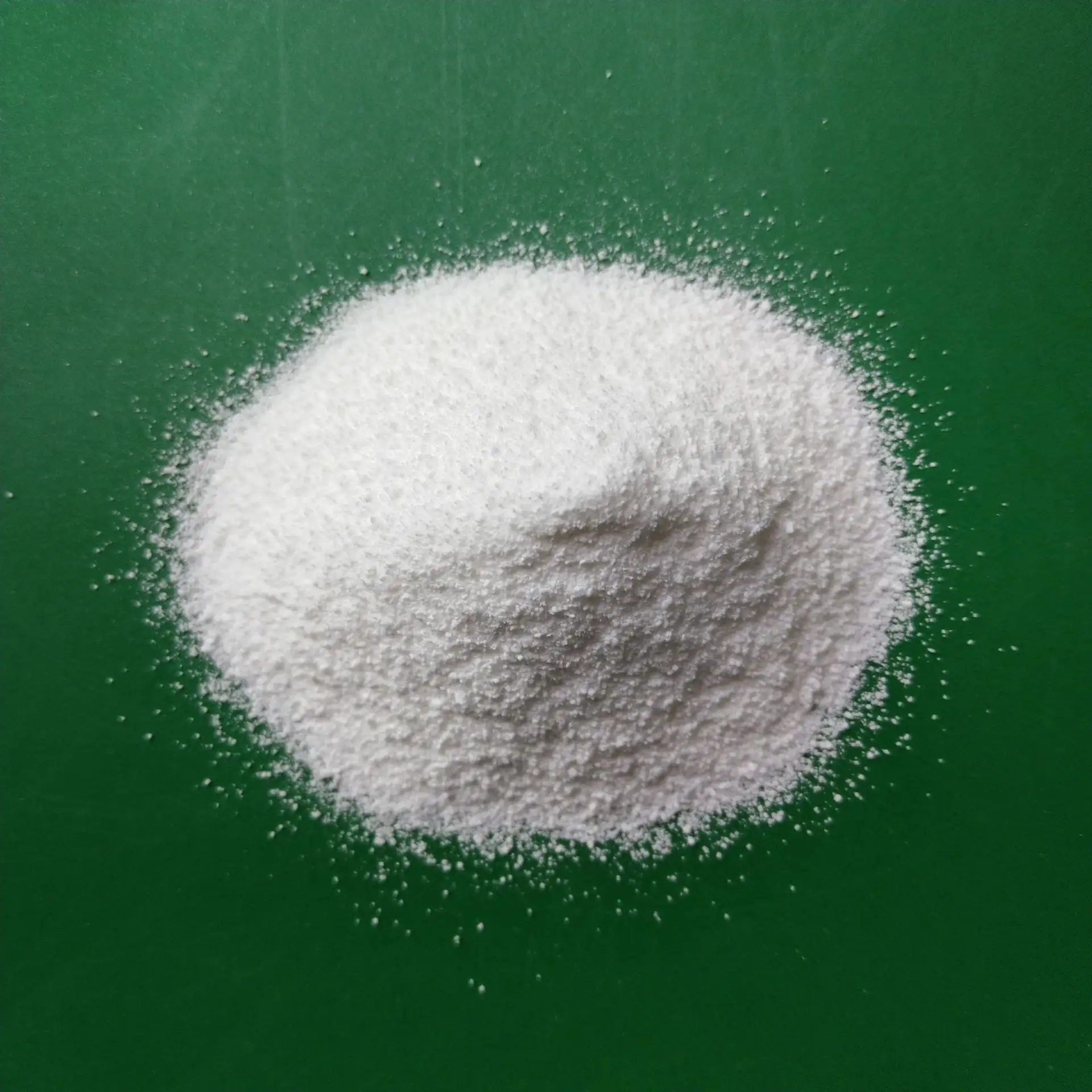
HPMC is a non-ionic and water-soluble cellulose ether. It is widely used in food, pharmaceutical, and construction formulations. As a professional HPMC supplier, we provide multiple viscosity grades. We also offer stable global supply and technical formulation support.
Moreover,We are a professional Hydroxypropyl Methyl Cellulose (HPMC) supplier providing high-performance HPMC thickener solutions for food, pharmaceutical, and construction industries.
✔ Multiple viscosity grades ✔ Stable bulk supply ✔ Technical formulation support
Request a Quote | Get Free Sample
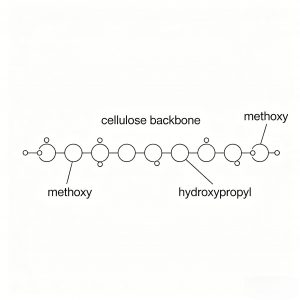
During production, methyl chloride and propylene oxide react with cellulose under alkaline conditions. As a result, hydroxyl groups on the cellulose backbone are partially substituted with methoxy (–OCH₃) and hydroxypropyl (–OCH₂CHOHCH₃) groups.
The final product is a white to off-white and odorless powder. It dissolves easily in cold water and forms clear, stable, and viscous solutions. HPMC carries no electrical charge. Therefore, it remains stable in systems containing electrolytes, metal ions, and different pH conditions.
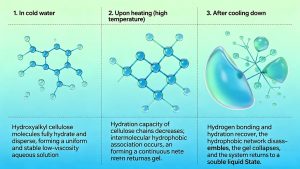
One of the most important characteristics of Hydroxypropyl Methyl Cellulose is its thermal gelation behavior. HPMC solutions remain fluid at low temperatures but form reversible gels when heated. This unique property differs from most traditional hydrocolloids and enables advanced applications in food, pharmaceutical, and construction formulations.
In addition, HPMC offers excellent film-forming performance and broad regulatory acceptance. Consequently, many manufacturers use HPMC in industrial formulations that require viscosity control, heat stability, and long-term performance consistency.
HPMC is manufactured in a spectrum of grades differentiated by methoxy content, hydroxypropyl content, and viscosity — parameters that collectively determine behavior in solution and dictate suitability for specific end applications.
Hydroxypropyl Methyl Cellulose (HPMC) thickener performance is defined not merely by its ability to increase solution viscosity, but by the precision and reliability with which it does so across demanding production environments. As an HPMC thickener, it stands apart from competing hydrocolloids through three core functional mechanisms.
It is available across an exceptionally wide viscosity range — from as low as 3 mPa·s to in excess of 200,000 mPa·s (measured as a 2% aqueous solution at 20°C). This range allows formulators to dial in precise rheological behavior: low-viscosity grades for sprayable coatings and eye drops; medium grades for tablet coatings and beverage stabilization.What is more, high-viscosity grades for construction mortars, sustained-release matrices, and heavy-bodied gels.
Hydroxypropyl Methyl Cellulose (HPMC) solutions show pseudoplastic behavior. Their viscosity decreases during mixing, pumping, or application. However, viscosity quickly recovers when the system returns to rest. This property is essential for construction applications where workability during application and structural rigidity at rest are simultaneously required.Also it makes equally important in pharmaceutical suspensions that must flow through filling equipment yet maintain stability in the bottle.
HPMC’s most distinctive property is its thermoreversible sol-gel transition. At room temperature, Hydroxypropyl Methyl Cellulose (HPMC) dissolves to form a stable, viscous liquid. When heated above its gelation temperature, HPMC forms a firm and cohesive gel. The gelation temperature usually ranges from 50–90°C depending on grade, concentration, and formulation conditions.
Consequently,This behavior is the inverse of gelatin and most natural gums, which gel on cooling. The mechanism arises from hydrophobic interactions between methoxy groups that strengthen at elevated temperature, driving intermolecular association and network formation.
Meanwhile,in food applications, this enables hot-fill stability and fat-mimicking texture. In pharmaceuticals, it is leveraged for sustained-release matrix design. In construction, it prevents mortar slump in vertical applications where heat from substrate or environment would otherwise reduce viscosity.
Hydroxypropyl Methyl Cellulose (HPMC) forms continuous, flexible, transparent films upon drying from aqueous solution. These films are mechanically robust, resistant to oils and fats, and can be plasticized with polyols such as glycerin or propylene glycol to tune flexibility. Film-forming capacity underpins HPMC’s dominant role in pharmaceutical tablet coating — where it forms the basis of both immediate-release aqueous coatings and elegant, consistent film coat appearance. In food, the same property enables edible coatings that reduce moisture loss and extend shelf life.
In beverage systems, free water is the enemy of long-term stability. Unbound water migrates toward suspended particles, promoting aggregation, sedimentation, and phase separation over shelf life. HPMC’s hydroxyl groups form hydrogen bonds with water molecules, effectively binding a portion of the free water in the system and reducing its mobility.
This water retention function works synergistically with HPMC’s thickening effect: together, they slow particle settling rates and maintain a homogeneous product appearance from first pour to last. In protein beverages and fortified drinks, where insoluble particles are inherently difficult to stabilize, HPMC’s water-binding capacity provides meaningful stability improvement — particularly when producing with colloidal MCC for enhanced suspension performance.
→ Learn more: Microcrystalline Cellulose Excipient | Colloidal MCC StabilizerHPMC Supplier for Food Applications
HPMC’s combination of thermal gelation, viscosity control, and water retention makes it applicable across a broad range of food and beverage product categories.HPMC is widely used in food formulations as a stabilizer, emulsifier, and thickening agent. It is also commonly produced with other ingredients used in Food Thickeners for sauces, dairy products, bakery fillings, and processed foods. The following outlines the most commercially significant applications.Hydroxypropyl Methyl Cellulose (HPMC) complies with food additive regulations defined by the FDA.
In beverage formulations, Hydroxypropyl Methyl Cellulose (HPMC) can improve suspension stability and mouthfeel when used together with other Beverage Stabilizers in plant-based drinks, protein beverages, and nutritional formulations.
In UHT-processed beverages — including plant-based milks, fortified dairy alternatives, cocoa drinks, and ready-to-drink meal replacements — Hydroxypropyl Methyl Cellulose (HPMC) serves as both a process stabilizer and a shelf-life stability agent. It protects the beverage matrix during thermal processing. In addition, it reduces particle sedimentation during storage and improves mouthfeel consistency. Usage levels typically range from 0.1% to 0.4% depending on the particle load and viscosity target of the finished product.
In pourable and spoonable sauces — including tomato-based sauces, cream sauces, gravies, and dressings — HPMC contributes to viscosity stability during cooking and hot-fill processing. Its thermal gelation behavior helps sauces maintain proper viscosity during heat treatment. Therefore, it reduces the thinning effect often seen in starch-based systems. HPMC also provides freeze-thaw stability in refrigerated and frozen sauce formats. Learn more about cellulose-based solutions for bakery and sauce applications.
In dairy-based beverages — flavored milks, drinking yogurts, kefir-style products, and extended-shelf-life dairy drinks — HPMC improves viscosity consistency and reduces whey separation. Unlike some natural stabilizers, it is compatible with the mineral content of dairy systems and performs reliably across the pH range encountered in lactic acid-fermented products (pH 3.8–4.5). It is also an effective thickener in dairy analogs where plant proteins create stability challenges that standard gums cannot fully address.
High-protein beverages are among the most technically challenging products to stabilize. Protein particles aggregate under heat, create sedimentation under gravity, and interact unpredictably with charged stabilizers. HPMC’s non-ionic character means it does not interfere with protein charges or compete with protein–water interactions. In protein drinks processed under UHT conditions, HPMC provides a neutral, compatible thickening matrix that improves suspension stability and mouthfeel without the chalky texture sometimes associated with starch-based thickeners. For formulations combining HPMC with colloidal MCC, see our beverage stabilizer and protein drinks application pages for detailed formulation guidance.
Ultra-high-temperature (UHT) processing exposes beverages to temperatures between 135°C and 150°C for a few seconds. Therefore, beverage stabilizers must tolerate extreme thermal stress while maintaining viscosity and suspension performance.
Most hydrocolloids lose viscosity or degrade under high-temperature processing. However, HPMC behaves differently. It forms a reversible gel structure during heating and returns to solution after cooling.
As a result, manufacturers use HPMC in plant-based drinks, protein beverages, and fortified dairy products that require long shelf life and stable texture.
HPMC helps maintain ingredient suspension during storage. For example, it keeps cocoa powder, calcium, proteins, and fiber evenly distributed throughout the beverage.
In addition, HPMC reduces sedimentation and phase separation by binding free water inside the system. Consequently, the beverage maintains a smoother appearance and more stable mouthfeel over time.
Plant proteins often create instability during UHT processing. Nevertheless, HPMC remains compatible with protein systems because of its non-ionic structure.
Therefore, many beverage manufacturers combine HPMC with colloidal MCC stabilizers to improve suspension performance, viscosity consistency, and texture stability.

Pharmaceutical-grade HPMC is among the most extensively characterized excipients in global pharmacopoeias, with monographs in the USP, EP, JP, and ChP. Its combination of safety, functional versatility, and regulatory acceptance makes it irreplaceable in modern solid and liquid dosage form development.Leading pharmaceutical companies work with our HPMC supplier team for USP and EP compliant excipients.
In wet granulation and direct compression, HPMC acts as a binder that confers cohesion to tablet masses. Its water solubility ensures that granules disintegrate efficiently upon dissolution, supporting bioavailability.
When compressed into a hydrophilic matrix tablet, HPMC hydrates upon contact with gastrointestinal fluids, forming a gel layer around the tablet. Drug diffusion through this swelling gel layer controls the rate of release — enabling once-daily dosing for drugs with short half-lives. HPMC is often used alongside microcrystalline cellulose excipient systems to improve tablet structure and drug release control, combining HPMC’s gel-forming capacity with MCC’s compressibility and disintegration performance.
HPMC replaced shellac and sugar as the dominant tablet coating polymer and remains the standard today. Aqueous HPMC coating systems offer fast processing, elegant aesthetics, and compatibility with a broad range of active ingredients.
HPMC’s viscosity, clarity, and biocompatibility make it the thickening agent of choice in artificial tears, contact lens solutions, and ophthalmic drug delivery systems.
HPMC capsules are now the leading alternative to gelatin capsules for vegetarian, vegan, and halal-certified markets — a segment growing rapidly across global dietary supplement and pharmaceutical markets.
In some advanced formulations, combining HPMC with colloidal MCC stabilizer provides enhanced suspension stability and texture control, particularly in liquid and semi-solid dosage forms where long-term physical stability is critical.
→ Learn more about microcrystalline cellulose excipient systems for pharmaceutical formulations
→ Related excipient: Microcrystalline Cellulose Excipient — Full Technical Overview
The construction industry represents the largest volume application of HPMC globally, and it is here that its rheological properties translate most directly into product performance, workability, and commercial value.Many dry mix manufacturers choose our HPMC supplier solutions for stable viscosity and water retention performance.
Tile adhesive is one of the most demanding applications for any functional additive. The adhesive must remain workable long enough for tiles to be positioned and adjusted, provide sufficient initial grab to hold tile weight without slippage, develop strong bond strength upon cure, and resist water penetration in wet areas.
Therefore,HPMC for tile adhesive addresses all four requirements simultaneously. At the dosage levels typically used (0.2–0.4% by weight of dry mix), HPMC delivers:
In addition,Grade selection matters critically in tile adhesive: medium-to-high viscosity grades (40,000–100,000 mPa·s) are standard, with the specific choice depending on the tile format, substrate type, and application method.
Dry mix mortars — pre-blended cement, sand, and functional additive systems — are the backbone of modern construction, used in plastering, rendering, self-leveling underlayments, grouts, repair mortars, and external insulation composite systems (ETICS/EIFS).
HPMC for dry mix mortar functions across the entire performance lifecycle of the material:
Cement hydration requires sustained moisture. Without adequate water retention, cement in thin mortar beds loses water too rapidly to substrate absorption. That leads to incomplete hydration, weak bond strength, and cracking. HPMC’s exceptional water retention capacity — holding up to 97% of mix water even on highly absorbent substrates such as aerated concrete blocks — ensures complete hydration regardless of substrate conditions or ambient temperature.
HPMC imparts a smooth, buttery consistency to mortar that spreads and adheres readily to walls and ceilings. The pseudoplastic behavior means the mortar flows easily under the mechanical action of a trowel or spray system, then stiffens immediately at rest — preventing sagging and making application to vertical and overhead surfaces.
HPMC-modified mortars exhibit consistent open time, set behavior, and application properties across a wide temperature range, reducing the need for on-site adjustments in variable weather.
Surface Quality: Renders and plasters modified with HPMC produce smoother surfaces with reduced pin holes and better paintability — reducing labor time for finishing and improving the quality of the final decorative layer.
Specific Applications Include:
Related product: Carboxymethyl Cellulose (CMC) Supplier for Construction Applications
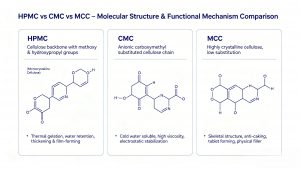
| Property | HPMC | CMC | MCC |
|---|---|---|---|
| Charge | Non-ionic | Anionic | Non-ionic |
| Solubility | Cold & hot water | Cold & hot water | Insoluble (dispersible) |
| Thermal behavior | Gels on heating | Stable (no thermal gel) | No thermal gel |
| Primary function | Thickening, film-forming, water retention | Thickening, stabilizing, binding | Bulking, anti-caking, structural network |
| Key industries | Pharma, food, construction | Food, pharma, industrial | Pharma, food |
| Ionic sensitivity | Insensitive | Sensitive to electrolytes | Insensitive |
HPMC’s non-ionic character and thermoreversible gelation are its defining features. It thrives in electrolyte-rich environments and at elevated temperatures where ionic polymers like CMC would precipitate or lose viscosity. It is the first choice when thermal stability, film formation, or construction-grade water retention are required.
CMC’s anionic character gives it strong protein-binding capacity and excellent suspension stabilization in neutral to slightly alkaline systems. It is more cost-competitive than HPMC in many food applications and excels in ice cream stabilization, beverage suspension, and pharmaceutical tablet binding. However, its ionic nature makes it sensitive to divalent cations (Ca²⁺, Mg²⁺) and low pH environments, limiting its applicability in certain formulations.
Microcrystalline cellulose excipient functions through the formation of a colloidal network of insoluble cellulose particles that trap and immobilize the aqueous phase. This structural mechanism is entirely distinct from both HPMC and CMC. MCC excels as a direct compression filler and disintegrant in tablet manufacturing, and as a fat replacer and stabilizer in food systems where physical particle structure — rather than solution viscosity — determines performance.
In advanced formulations, combining HPMC with colloidal MCC stabilizer systems delivers superior suspension stability compared to single-polymer systems.
→ CMC Supplier — Full Technical Overview | Colloidal MCC Stabilizer — Product Page
When selecting a cellulose ether or hydrocolloid thickener, understanding performance differences across real processing conditions is critical to making the right formulation decision.
Compared with CMC, starch-based thickeners, and other hydrocolloids, HPMC offers a distinct set of advantages that make it the preferred solution across a wide range of demanding applications:
Most natural gums and starch derivatives lose viscosity or degrade irreversibly at elevated processing temperatures. HPMC not only maintains stability but actively gels upon heating — providing structure and viscosity exactly where other thickeners fail.
Ionic thickeners such as CMC are vulnerable to electrolytes, divalent cations, and low pH environments. HPMC’s non-ionic character makes it robust in complex formulation matrices including cement mortars, high-salt food systems, and multi-component pharmaceutical formulations.
Unique thermal gelation behavior. No other widely available hydrocolloid combines cold-water solubility with heat-induced gelation in the same thermoreversible system. This property is non-replicable with starch, guar, xanthan, or CMC — and is the defining reason HPMC dominates in gluten-free baking, construction mortars, and sustained-release pharmaceutical matrices.
Superior performance in construction materials. Starch ethers and CMC are used in construction, but neither matches HPMC’s water retention capacity, anti-slump performance, and open time extension in tile adhesive and dry mix mortar systems at comparable dosage levels.
For applications requiring high stability, process tolerance, and functional versatility, HPMC is consistently the preferred choice over CMC or starch-based thickeners — across food, pharmaceutical, and construction sectors alike.
Looking to buy HPMC powder for your commercial application? As a dedicated bulk HPMC supplier with established production capacity and global logistics, we provide reliable supply for manufacturers at every scale — from formulation development through full commercial production.As a global HPMC supplier, we provide technical support and stable bulk supply for manufacturers worldwide.
Whether you are scaling a new product or securing a consistent supply for existing production, our team provides pricing, samples, and technical support to help you move forward with confidence.
Request a Quote | Get Free Sample
When you need to source hydroxypropyl methylcellulose for regulated or high-performance applications, supplier reliability is as critical as product quality. We operate as a full-service bulk HPMC supplier with technical depth across all three major sectors.
Product Range: Full viscosity spectrum from 3 mPa·s to 200,000 mPa·s in food, pharmaceutical, and construction grades. Custom particle size distributions available.
Quality Assurance: Every batch released against comprehensive Certificates of Analysis. Pharmaceutical grades meet USP, EP, and JP specifications with full regulatory support documentation.
Supply Stability: Established raw material partnerships and production capacity deliver consistent lead times and flexible volume commitments.
Technical Support: Grade selection guidance, formulation development support, and troubleshooting across food, pharma, and construction applications.
Global Reach: Active supply to North America, Europe, Southeast Asia, the Middle East, and South America with full export documentation and REACH compliance.
HPMC is used across food manufacturing (thickener, fat replacer, gluten substitute in gluten-free baking), pharmaceuticals (tablet binder, film coating, sustained-release matrix, ophthalmic lubricant, vegetarian capsules), and construction (tile adhesive, dry mix mortar, renders, plasters, self-leveling compounds). Its non-ionic character, thermal gelation, and precise viscosity control are the functional properties that enable this cross-industry versatility.
Yes. Hydroxypropyl Methyl Cellulose has an extensive safety record supported by decades of regulatory review. It is approved for food use by the FDA (21 CFR 172.874) and the European Food Safety Authority (E464), and is monographed in the USP, EP, and JP for pharmaceutical use. HPMC is non-metabolized, non-toxic, non-allergenic, and physiologically inert at typical use levels across all application sectors.
It is non-ionic and gels reversibly upon heating — making it stable across a wide pH range and resistant to electrolytes and metal ions. CMC is anionic and carries a negative charge in solution, giving it strong protein-binding and stabilization properties in neutral to alkaline systems, but making it sensitive to divalent cations and acidic environments. CMC does not exhibit thermal gelation. The choice between them depends on the formulation environment: HPMC is preferred where ionic stability, thermal performance, or construction-grade water retention are required; CMC is preferred in cost-sensitive food applications and certain pharmaceutical suspension systems.
In beverage formulations, HPMC (E464) is used primarily as a thickener, suspension stabilizer, and mouthfeel enhancer. It helps maintain an even distribution of insoluble particles — including cocoa powder, plant proteins, minerals, and fiber — throughout the product during storage. It also improves the viscosity and body of the beverage, making it more appealing to consumers. In UHT-processed products, HPMC additionally provides heat stability by temporarily gelling during the thermal processing step, then re-dissolving in the cooled final product.
Yes —
Hydroxypropyl Methyl Celluloseis one of the few food-grade hydrocolloids that performs well under high-temperature processing, including UHT (135–150°C). Its thermal gelation mechanism means it actually becomes more structured at high temperatures rather than breaking down. Once the product cools, HPMC returns to its dissolved, solution-thickening state. This reversible thermal behavior makes it particularly well-suited for beverages and sauces that undergo pasteurization, hot-fill, or UHT sterilization. The polymer backbone itself is thermally stable and does not undergo irreversible degradation under standard food-processing conditions.
Yes. HPMC contributes directly to the perceived texture and mouthfeel of a beverage in two ways. First, by increasing solution viscosity, it creates a slightly fuller, more body-rich sensation on the palate — preventing the thin, watery mouthfeel that is common in low-fat or plant-based drinks. Second, by binding free water and slowing particle settling, it maintains a homogeneous appearance throughout the bottle.That makes consumers associate with a higher-quality product. In protein beverages and fortified drinks especially, the texture-building contribution of HPMC can meaningfully improve consumer acceptability compared to unstabilized formulations.
Selecting the right HPMC supplier goes beyond comparing price per kilogram. For manufacturers in regulated industries, the following criteria should be evaluated systematically:
A capable supplier should offer a full viscosity spectrum — from low-viscosity grades (3–15 mPa·s) for pharmaceutical coatings and eye drops, through medium grades for food and construction, to high-viscosity grades (4,000–200,000 mPa·s) for sustained-release matrices and tile adhesives. If your application requires a specific particle size distribution or a blend of substitution types, your supplier should be able to accommodate that.
For pharmaceutical applications, verify that the supplier can provide USP, EP, and JP compliant grades with full Certificate of Analysis (CoA), Safety Data Sheet (SDS), and Drug Master File (DMF) support letters. For food applications, confirm E464 compliance and FDA GRAS status documentation. Suppliers who cannot produce complete regulatory paperwork on request are not suitable for regulated supply chains.
Volatile raw material sourcing or limited production capacity translates directly into delayed shipments and quality variability. Ask prospective suppliers about their raw material partnerships, batch-to-batch viscosity consistency data, and lead time commitments across different order volumes.
A reliable HPMC supplier should be able to advise on grade selection, dosage optimization, and formulation compatibility — not merely fulfill purchase orders. Access to application engineers who understand your industry is a meaningful differentiator, particularly during new product development or when troubleshooting a stability or performance issue.
Confirm the supplier’s export experience, documentation capacity (including REACH compliance for EU customers), and ability to handle both full container loads and smaller development quantities with equivalent reliability.
The difference between a professional HPMC supplier and a commodity trading company becomes most apparent not when everything goes right — but when a formulation challenge arises, a regulatory audit occurs, or a production line requires a rapid grade adjustment.
A professional supplier provides more than product. They provide:
Years of cross-industry application experience mean a professional supplier can identify grade mismatches, anticipate compatibility issues before they reach production, and recommend the optimal HPMC type and concentration for your specific processing conditions and end-product requirements — saving time and cost during development.
Professional suppliers operate under systematic quality management frameworks — ISO 9001, GMP-aligned manufacturing, and rigorous incoming and outgoing QC. This means the HPMC you receive on your tenth container performs identically to your first sample, a standard that commodity channel supply cannot reliably guarantee.
Pharmaceutical and food manufacturers operate in environments where documentation failures carry direct commercial consequences. A professional supplier maintains up-to-date regulatory files, responds rapidly to audit requests, and proactively communicates changes in manufacturing or specification that could affect your product registrations.
Professional suppliers invest in raw material inventory, production capacity, and logistics infrastructure specifically to protect their customers from market disruptions. This supply chain resilience is particularly valuable in periods of raw material volatility or global logistics pressure.
Accountability. When a quality concern arises, a professional supplier has the technical capability and organizational commitment to investigate root causes, provide corrective action reports, and stand behind their product — a standard of accountability that is simply not available through unverified spot-market sources.
For manufacturers who treat HPMC as a strategic ingredient rather than an interchangeable commodity, working with a professional supplier is not a premium — it is a risk management decision that protects product quality, regulatory standing, and production continuity.
For technical datasheets, regulatory documentation, and bulk supply inquiries: https://www.actabiotechnology.com/product/hpmc/
Reviews
There are no reviews yet.