

HPMC for controlled release is one of the most widely used approaches for developing sustained-release and extended-release oral tablets. Pharmaceutical-grade Hydroxypropyl Methylcellulose (HPMC) functions as a hydrophilic matrix former, helping control how quickly an active pharmaceutical ingredient (API) is released over an extended period rather than releasing the full dose immediately.
Written by ACTA technical team
Looking for pharmaceutical-grade HPMC? → Request TDS & Sample
Introduction: Why HPMC Drives Modern Controlled-Release Formulation
HPMC absorbs water, hydrates, swells, and forms a gel layer around the tablet core. This hydrated barrier regulates how quickly water enters the dosage form and how quickly the dissolved drug diffuses out. Because the final release profile depends on viscosity grade, polymer concentration, drug solubility, and manufacturing conditions — not on any single one of those variables in isolation — HPMC gives formulators a flexible and cost-effective tool for building sustained-release and extended-release oral solid dosage forms.
This guide walks through the science, the formulation variables, the common failure modes, and the sourcing decisions that determine whether a pharmaceutical-grade HPMC matrix tablet performs the way it should.
HPMC (hydroxypropyl methylcellulose) is a semi-synthetic cellulose ether produced by substituting methyl and hydroxypropyl groups onto the cellulose backbone. As a pharmaceutical excipient, it is valued in controlled-release formulation because it forms a reliable hydrophilic gel barrier, is available across low, medium, and high viscosity grades, and is compatible with direct compression, wet granulation, and dry granulation.
HPMC has become the default choice for hydrophilic matrix tablets because it simplifies development without sacrificing control. Formulators can often skip complex reservoir systems or specialized coatings and instead rely on a conventional compression process, letting the hydrated gel matrix do the work.
However, HPMC is not a “set it and forget it” excipient. Once a tablet contacts an aqueous environment, it becomes a dynamic system: water penetrates, the polymer hydrates, the matrix swells, the drug dissolves and diffuses, and the outer layer erodes — all simultaneously. If the gel layer forms too weakly, release happens too fast. If the polymer concentration is too high, release slows more than intended. HPMC should be treated as a functional matrix-forming ingredient, not simply a thickener added at a fixed percentage.
The controlled-release process unfolds in a predictable sequence once the tablet reaches gastrointestinal fluid:
GI Fluid
↓
Water Penetration
↓
HPMC Hydration
↓
Gel Layer Formation
↙ ↘
Drug Diffusion Polymer Erosion
↓
Controlled Drug Release
Two mechanisms dominate this system: diffusion, where dissolved drug molecules travel through the swollen gel, and erosion, where the outer polymer physically disintegrates and carries trapped API with it. Most real-world HPMC tablets rely on a combination of both, and the balance between them can shift over the course of a single dissolution test — diffusion often dominates early, while erosion becomes more significant later. This is why HPMC systems are frequently described as showing “non-Fickian” or anomalous transport rather than simple, textbook diffusion.
During dissolution, the tablet can be visualized as four moving zones:
As dissolution progresses, the hydration front moves inward while the erosion front also moves inward from the surface — and the thickness of the gel layer sandwiched between them determines how well the tablet controls release.
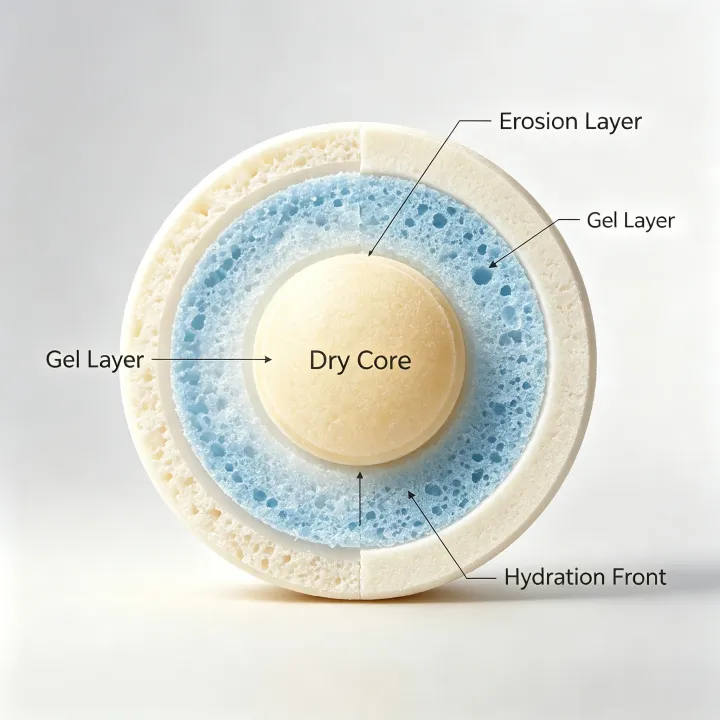
Two batches of HPMC with an identical nominal viscosity do not necessarily behave identically once hydrated, and the starting point for understanding why is the polymer’s substitution chemistry.
HPMC manufacturers introduce two types of side groups onto the cellulose backbone: methoxy groups and hydroxypropoxy groups. The ratio between these groups — expressed through the degree of methoxyl and hydroxypropyl substitution — influences how the polymer interacts with water. Methoxy substitution influences the polymer’s thermal gelation behavior and its general hydrophilic-hydrophobic balance, while hydroxypropoxy substitution tends to improve water solubility and cold-water dispersibility. Different USP/NF substitution types (commonly designated by a numeric type, such as 2208 or 2910) reflect different ratios of these two groups, and formulators sometimes find that one substitution type hydrates more readily or forms a more cohesive gel than another at the same nominal viscosity.
Substitution pattern also affects temperature-dependent behavior. HPMC in aqueous solution can exhibit a thermal gelation point — a temperature above which the polymer’s solubility decreases and gelation becomes more pronounced. This matters less for solid oral dosage forms tested near physiological temperature than it does for topical or liquid formulations, but it is a reminder that HPMC’s gel-forming behavior is a function of its underlying chemistry, not just its bulk viscosity rating.
Molecular weight — and its distribution — is the other major driver of viscosity and gel strength. Two HPMC samples can carry the same viscosity specification on a Certificate of Analysis while differing in molecular weight distribution, particle size, and moisture content, all of which influence how quickly the polymer hydrates and how mechanically robust the resulting gel layer is.
The practical takeaway for formulators and buyers is straightforward: viscosity grade is a useful screening parameter, but it is not a complete specification. When qualifying a pharmaceutical-grade HPMC source, formulators and buyers should review substitution type, particle size, and moisture alongside viscosity, particularly when switching suppliers or scaling up a formulation developed with a different lot.
A persistent misconception is that a higher-viscosity HPMC always produces slower, better-controlled release. In practice, viscosity is only one variable among many. A highly soluble API may need a stronger gel matrix or higher polymer concentration to prevent rapid diffusion, while a poorly soluble API may become dissolution-limited long before the polymer barrier becomes the bottleneck — so adding more high-viscosity polymer can actually make release too slow or incomplete.
The more useful question is never “which HPMC has the highest viscosity?” It is: “which combination of HPMC viscosity, concentration, and tablet design delivers the release profile this specific API requires?”
HPMC is available across low-, medium-, and high-viscosity grades, commonly represented by products such as HPMC K4M, K15M, and K100M. As viscosity increases, the hydrated gel generally becomes stronger and more persistent, which can extend release duration — but this relationship is not linear, and concentration matters just as much as grade.
Because concentration and viscosity interact, a formulation using 35% medium-viscosity HPMC can sometimes outperform one using 10% high-viscosity HPMC — the higher-viscosity grade cannot compensate indefinitely for insufficient polymer quantity. Formulators should therefore screen both variables together rather than treating viscosity as the sole lever.
| Grade | Typical Viscosity Class | Hydration Speed | Gel Strength | Typical Development Use |
|---|---|---|---|---|
| HPMC K4M | Medium | Faster | Moderate | Initial screening; formulations needing easier processing and moderate gel strength |
| HPMC K15M | Medium-high | Moderate | Strong | Balanced control; common second-round screening grade |
| HPMC K100M | High | Slower | Very strong | Highly soluble APIs; formulations targeting an extended release window |
This table describes functional tendencies, not fixed release durations. Actual release duration is determined by the full formulation — polymer concentration, drug loading, tablet geometry, porosity, compression, and API solubility — not by grade selection alone. A formulation containing 20% K4M may release faster than required, while the same API at 30% K100M may release too slowly, and 15% K15M at an optimized level may land exactly on target. Blending two grades (for example, a lower- and higher-viscosity HPMC together) is also common practice, allowing formulators to fine-tune hydration speed, gel strength, and erosion rate without pushing total polymer load unnecessarily high.
| HPMC Grade | Typical Polymer Level Screened | Expected Function | Typical Development Use |
|---|---|---|---|
| K4M | 10–30% | Moderate gel strength | Initial screening |
| K15M | 10–30% | Stronger gel | Medium/longer release targets |
| K100M | 5–20% | Very strong gel | Highly soluble API / longer release targets |
These ranges are starting points for formulation screening, not specifications — confirm with dissolution testing for your specific API and tablet design.
Need help selecting an HPMC grade for your controlled-release formulation? Explore our pharmaceutical-grade HPMC options or contact ACTA for technical documentation and sample availability.
Because HPMC functions as an active structural component of the dosage form rather than an inert filler, two products can carry an identical nominal viscosity specification and still hydrate and gel differently in practice. The main contributors are:
Therefore, pharmaceutical formulators should not qualify an HPMC source based on viscosity alone. A viscosity number is a necessary but not sufficient basis for comparing suppliers or grades.Material properties can also influence processing performance in direct compression tablet formulations.
START
  ↓
API Solubility?
 ├── Highly Soluble
 │     ↓
 │  K15M / K100M
 │     ↓
 │  Evaluate Burst Release
 │
 ├── Moderately Soluble
 │     ↓
 │  K4M / K15M
 │
 └── Poorly Soluble
       ↓
 Is Release Dissolution‑Limited?
       ↓
 Optimize API / Wetting / Porosity
A practical starting point is to work through API solubility first, then narrow toward a grade and concentration to screen.
What is your API solubility?
This is a starting framework for hypothesis generation, not a substitute for side-by-side dissolution screening on the actual API and tablet design.
Selecting an HPMC grade for a controlled-release tablet is usually more effective as a structured screening exercise than as a one-step selection based on viscosity alone.
The following hypothetical example illustrates how a formulation scientist might compare several HPMC matrix options for a highly water-soluble API. Because highly soluble drugs can diffuse rapidly once water enters the tablet, the initial objective is to establish a sufficiently strong and continuous gel barrier without making the matrix so restrictive that complete release becomes difficult.
Need HPMC samples for formulation screening? Contact ACTA to discuss available pharmaceutical HPMC grades, technical documentation and sample options.
| Formulation | HPMC Grade | Polymer Level | Expected Development Observation |
|---|---|---|---|
| A | HPMC K4M | 15% | Faster hydration and a less persistent gel layer; potentially faster drug release |
| B | HPMC K15M | 15% | Stronger gel formation and increased resistance to rapid drug diffusion |
| C | HPMC K100M | 15% | More robust and persistent matrix; possible risk of overly slow or incomplete release depending on the API |
| D | HPMC K15M + K100M | 20% total | Intermediate balance between hydration speed and gel strength; useful for evaluating blended-polymer control |
The purpose of this type of screening is not to predict the final dissolution profile from viscosity alone. Instead, it helps formulators compare how changes in polymer molecular weight, gel strength and total polymer concentration influence the release behavior of the same API.
A practical development sequence may look like this:
For example, if Formulation A shows excessive early release, the next experiment may increase the polymer concentration or move toward a stronger gel-forming grade such as K15M. If Formulation C produces an overly slow profile, reducing the polymer level or screening a lower-viscosity grade may be more effective than changing unrelated process parameters.
The key principle is that HPMC selection should be treated as a formulation screening matrix, where viscosity grade and polymer concentration are evaluated together rather than independently.
Important: This example is provided for formulation-development illustration only. It does not represent experimental dissolution data from ACTA or any commercial pharmaceutical product. Actual performance depends on API properties, drug loading, tablet composition, manufacturing process and dissolution conditions.
Selecting the right HPMC grade is only half the job — manufacturing choices shape the final dissolution curve just as strongly.
Manufacturing process. Direct compression offers a simple, low-moisture route but demands good powder flow and uniform HPMC distribution. Wet granulation improves flow and content uniformity but introduces moisture-related variables that can subtly change hydration behavior. Dry granulation (roller compaction) avoids water exposure entirely but can alter particle density and porosity in ways that affect dissolution.
Compression force and tablet hardness. Higher compression generally lowers porosity, which slows water penetration and can extend release — but this relationship is formulation-specific and should never substitute for the underlying polymer matrix design.
Tablet porosity and geometry. More porous tablets hydrate faster; tablet diameter, thickness, and surface-area-to-volume ratio all influence how quickly the matrix activates. Changing tablet geometry during scale-up is never a purely cosmetic decision — it warrants fresh dissolution testing.
Moisture control during wet granulation. Residual moisture affects both processing and finished-tablet performance. Excessive moisture can cause poor powder flow, sticking during compression, and stability concerns for moisture-sensitive APIs, while insufficient or inconsistent moisture can affect granule density and compressibility. Moisture should be treated as a critical, actively controlled process variable rather than an incidental byproduct of granulation.
API particle size, fillers, and lubricants. Smaller API particles dissolve faster, which matters most for poorly soluble drugs. Soluble fillers can create channels that speed water penetration; hydrophobic lubricants used in excess can reduce wettability and slow hydration. Blending uniformity ties all of this together — if HPMC is not evenly distributed, some regions of the tablet will hydrate and release differently than others, producing batch variability and unwanted burst release.For formulations requiring improved compressibility and flow, microcrystalline cellulose (MCC) is also commonly evaluated as a companion excipient.
Polymer concentration and drug loading must be evaluated together, not separately. Consider a 500 mg tablet built two different ways. In the first version, the API accounts for 100 mg and HPMC accounts for 150 mg — a healthy 30% polymer share relative to tablet weight. In the second version, the API rises to 350 mg while HPMC drops to 75 mg, or just 15% of the tablet. Even with an identical HPMC grade, the second formulation has far less polymer available to build a continuous gel network, so it is far more likely to show faster release, weaker matrix integrity, and greater batch-to-batch variability.
This becomes especially important for high-dose APIs. A large dose leaves limited room in the tablet for HPMC, fillers, and lubricants, forcing formulators to consider a larger tablet size, a higher-viscosity grade at a lower percentage, or a blend of HPMC grades rather than simply scaling up polymer content.
Tablet geometry compounds these effects. Diameter, thickness, shape, and the surface-area-to-volume ratio all influence how quickly water reaches the matrix and how quickly the outer layer erodes. A formulation validated on a small laboratory punch should always be re-evaluated when moved to a different tablet size or commercial tooling, because geometry is part of the release-control design — not a cosmetic afterthought.
A common mistake in controlled-release development is judging a formulation by a single dissolution checkpoint, such as “less than 30% released at 2 hours.” A formulation can pass that single test and still fail overall — releasing too slowly afterward, failing to reach complete release by the final time point, or showing unacceptable batch-to-batch spread.
Instead, formulators should map the entire curve across several checkpoints (commonly 1, 2, 4, 6, 8, 12, and 24 hours, depending on the target product). Two formulations can both reach 90% release at the 12-hour mark and still tell very different stories: one may dump most of the drug in the first two hours and plateau, while the other releases gradually and evenly across the full period. The second is almost always the better controlled-release outcome, even though both technically “pass” the endpoint specification. This is why dissolution testing should be treated as a profile-shape evaluation, not a pass/fail checkbox.
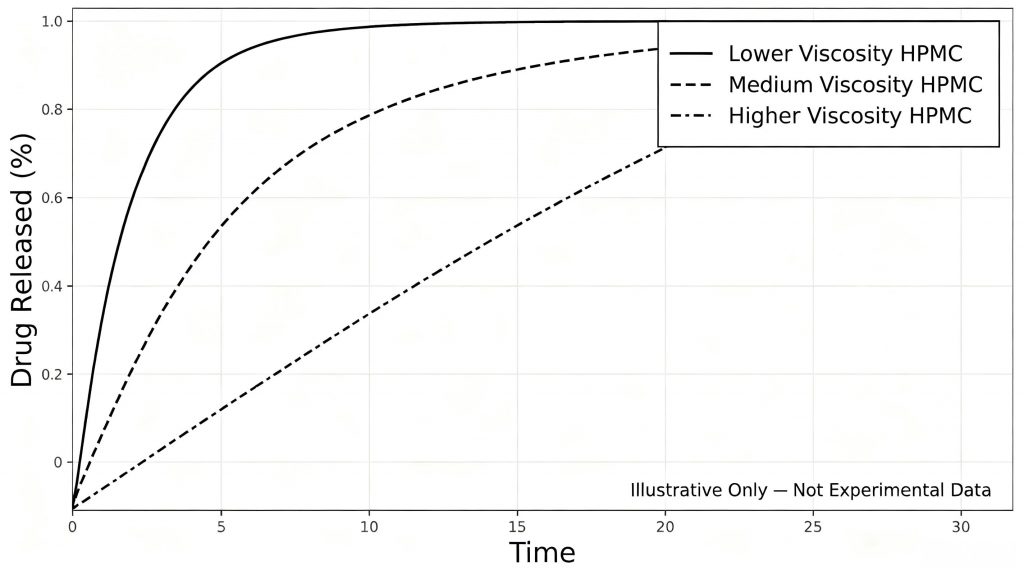
Image Title:llustrative Effect of HPMC Viscosity on Drug Release
HPMC is not the only hydrophilic matrix-forming polymer available, and it is useful to understand where it fits relative to alternatives when scoping a formulation.
| Polymer | Water Solubility | Processing | Typical Release Control | Common Use |
|---|---|---|---|---|
| HPMC | Water-soluble, forms hydrophilic gel | Compatible with direct compression, wet or dry granulation | Flexible; tunable via grade and concentration | Sustained-release hydrophilic matrix tablets |
| HPC (hydroxypropyl cellulose) | Water-soluble | Generally good processability | Moderate; often used alongside other matrix formers or as a binder | Matrix systems, film coating |
| PEO (polyethylene oxide) | Water-soluble, high molecular weight grades available | Requires careful process control | Can provide strong, extended control at high molecular weight | Long-duration release, some abuse-deterrent formulations |
| Ethylcellulose | Water-insoluble | Used in coating or as an insoluble matrix component | Strong barrier function; typically paired with a pore-former or used in reservoir systems | Coating, insoluble matrix/reservoir systems |
HPMC’s position in this landscape is largely a function of its combination of hydrophilic gel-forming behavior, broad viscosity-grade availability, and processing flexibility — it is rarely the single “strongest” barrier polymer, but it is often the most adaptable one for hydrophilic matrix tablet design.
When an HPMC controlled-release formulation misses its target, the instinct to simply “add more polymer” or “switch to a higher-viscosity grade” is usually the wrong first move. A mechanism-based diagnosis works far better.
If release is too fast: Check → HPMC concentration sufficient? Viscosity grade matches target window? Polymer uniformly distributed? Tablet porosity unusually high? Run full dissolution profile. Highly soluble APIs are especially prone to this failure mode.
If release is too slow or incomplete: Check → HPMC concentration excessive? Viscosity grade too high? Tablet hardness excessive? API poorly soluble and dissolution-limited? Run full dissolution profile. The goal is never to build the strongest possible matrix — it is to hit the target dissolution window with complete, reproducible release.
If an initial burst release occurs: Check → API concentrated near tablet surface? Polymer distribution uneven? Porosity excessive? These usually respond to increased polymer concentration, improved blending, or adjusted compression — but any fix should be re-tested across the entire dissolution curve, since reducing early release can inadvertently slow the later stages too much.
If batch-to-batch dissolution varies: Check → Compare raw material consistency (HPMC batch, particle size, moisture) against process consistency (mixing, granulation, compression). Scale-up is a common trigger: a formulation that performed correctly at lab scale can shift after moving to commercial equipment, because mixing intensity, granulation endpoint, and compression speed rarely translate one-to-one.
A useful rule throughout: change one major variable at a time, and always evaluate the full dissolution profile — not a single time point.
| Symptom | Most Likely Causes | First Adjustments to Test |
|---|---|---|
| Release too fast overall | Low HPMC concentration, low viscosity grade, high porosity | Increase HPMC %, evaluate higher-viscosity grade, review compression |
| Release too slow / incomplete | Excessive HPMC concentration or viscosity, dense tablet, poor API solubility | Reduce HPMC %, evaluate lower-viscosity grade, review particle size and wetting |
| Initial burst release | Surface-concentrated API, poor polymer distribution, high porosity | Improve blending uniformity, increase polymer %, adjust granulation |
| Batch-to-batch variation | HPMC lot variation, inconsistent blending, compression drift | Compare raw-material COAs, tighten blending/compression controls |
| Profile shifts after scale-up | Different mixing intensity, granulation, or compression at scale | Re-run dissolution testing at each scale-up stage, don’t assume equivalence |
This table is a starting framework for hypothesis generation, not a substitute for actual dissolution data.
When release is too fast, formulators generally face two levers: increase the concentration of the current HPMC grade, or move to a higher-viscosity grade at a similar dosage level. If tablet size is already near its practical maximum, changing viscosity grade is usually the more practical route, since adding more polymer would make the tablet too large. If tablet size still has room to spare and the current grade is otherwise well-behaved, increasing concentration is often the simpler first experiment. Either way, the decision should be confirmed with side-by-side dissolution data rather than assumption.
When sourcing HPMC for a controlled-release formulation, pharmaceutical buyers and formulation teams should compare more than nominal viscosity and price. HPMC functions as a matrix-forming polymer, which means that differences in material properties and manufacturing consistency can affect hydration, gel formation and ultimately the dissolution profile of the finished tablet.
When evaluating a pharmaceutical HPMC manufacturer or pharmaceutical-grade HPMC supplier, start by confirming that the proposed material matches the formulation requirements rather than simply selecting the closest viscosity grade by name.
For sustained-release tablet development, buyers may need to evaluate pharmaceutical HPMC grades such as K4M, K15M or K100M, depending on the API, target release profile and tablet design. However, products with similar nominal viscosity may still differ in substitution characteristics, particle size, moisture, bulk density and batch-to-batch consistency.
For buyers searching specifically for an HPMC K4M supplier, HPMC K15M supplier or HPMC K100M supplier, the grade name should be only the starting point of the qualification process. Before switching from an existing material or approving a new supplier, the proposed HPMC should ideally be evaluated in the actual tablet formulation using side-by-side dissolution testing.
This is particularly important when a controlled-release product is already established. Even a material that meets the same nominal viscosity specification may behave differently after hydration because controlled-release performance depends on the interaction between the HPMC, API, excipients, tablet structure and manufacturing process.
A practical sourcing strategy is therefore to move through three stages:
Confirm the HPMC grade, viscosity specification, substitution type, relevant pharmacopoeial compliance and supporting documentation.
Obtain a representative sample and compare the proposed HPMC against the current or reference material using the same formulation and dissolution method.
Confirm manufacturer identity, manufacturing site, batch consistency, MOQ, packaging, lead time and long-term supply capability before commercial approval.
For controlled-release formulations, the lowest quoted price does not always represent the lowest qualification cost. A material that causes dissolution variability, requires repeated reformulation or lacks consistent technical documentation can create significantly greater development and supply-chain costs than a slightly higher-priced but consistent pharmaceutical-grade HPMC source.
Looking for pharmaceutical-grade HPMC for controlled-release tablets? Send us your target viscosity grade, application and formulation requirements to request technical documentation, sample availability and commercial supply information.
To recommend a starting HPMC screening strategy, you can provide:
Sample: Need to compare HPMC performance in your matrix formulation? Request a pharmaceutical-grade HPMC sample and COA for laboratory evaluation. [Request Sample & COA →]
What Information Should You Send When Requesting HPMC Grade Support?
Selecting a starting HPMC grade is easier when the formulation requirements are clearly defined. If you are developing or troubleshooting a controlled-release tablet, providing the following information can help establish a more relevant starting point for HPMC grade and concentration screening:
You do not need to disclose confidential formulation details. Even general information about the API solubility, target release duration and current HPMC grade can help establish a practical starting point for laboratory screening.
Need help identifying a starting HPMC grade for your controlled-release formulation? Send us your application requirements and current formulation challenge to request pharmaceutical HPMC technical information, available grades and sample options.
List only documentation ACTA can actually provide — do not include items your organization cannot supply.
Following this sequence — rather than jumping straight to “the highest viscosity available” — consistently produces a more predictable path from laboratory bench to commercial manufacturing.
Controlled-release performance is not purely a formulation-development question — it is also a quality-control discipline. On the raw-material side, relevant HPMC specifications typically include identification, viscosity, moisture, pH, residue on ignition, and particle characteristics, with microbiological limits where applicable. On the finished-tablet side, standard release testing covers appearance, weight variation, hardness, friability, assay, content uniformity, and, critically, the full dissolution profile rather than a single time point.
Physical tablet quality and controlled-release performance are related but distinct properties. A tablet can pass every appearance, hardness, and friability check and still miss its dissolution target, because none of those tests directly measure hydration behavior, gel-layer strength, or matrix porosity. For this reason, dissolution testing should remain a core release criterion throughout development, scale-up, and routine commercial manufacturing — not just during the initial formulation study.
There is no single “best” grade. The right viscosity depends on API solubility, dose, target release duration, and tablet design, and should be confirmed through side-by-side dissolution screening rather than assumed from viscosity alone.
There is no universal percentage. The right concentration depends on API solubility, dose, target release duration, and the chosen viscosity grade, and it must be established through formulation screening and dissolution testing.
No. Viscosity is only one variable. Polymer concentration, drug solubility, and tablet structure all interact with viscosity to determine the final release rate, so a higher-viscosity grade does not guarantee slower or better-controlled release.
Common causes include insufficient polymer concentration, uneven HPMC distribution, API concentrated near the tablet surface, and excessive tablet porosity that lets water in too quickly.
Because drug solubility changes which mechanism dominates. Highly soluble APIs are diffusion-limited and need stronger polymer control; poorly soluble APIs are often dissolution-limited, so the polymer barrier plays a smaller role.
Yes. Formulators can blend lower- and higher-viscosity HPMC grades to fine-tune hydration speed, gel strength, and erosion rate without unnecessarily increasing the total polymer content.
Even when suppliers provide HPMC with the same nominal viscosity, differences in substitution pattern, particle size, moisture content, and manufacturing consistency can alter hydration and gel formation. Therefore, formulators should re-validate the formulation with side-by-side dissolution testing whenever they switch HPMC suppliers.
Compare the incoming HPMC batch COAs for viscosity and moisture consistency, then review blending, granulation, and compression parameters, since either raw material or process variation can drive batch-to-batch differences.
No. K100M can form a strong and persistent gel matrix, but a stronger polymer barrier does not automatically produce a better release profile. At excessive concentrations, K100M may slow drug release too much or contribute to incomplete release, particularly with poorly soluble APIs. The appropriate grade should be selected through formulation screening and full dissolution-profile evaluation.
HPMC K15M generally has a higher viscosity than K4M and can form a stronger, more persistent hydrated gel matrix. K4M may hydrate and erode more readily, while K15M may provide greater resistance to rapid drug diffusion. The practical difference in a controlled-release tablet depends on polymer concentration, API properties, tablet structure and manufacturing conditions, so both grades should be compared through dissolution testing.
Yes. Manufacturers can produce HPMC matrix tablets by direct compression when the API and excipient blend provides adequate flow, compressibility, and content uniformity. However, formulators should still evaluate direct-compression formulations for powder segregation, HPMC distribution, tablet porosity, and compression force, since these factors can influence hydration and the final dissolution profile.
Commercial: Need a pharmaceutical-grade HPMC supplier for sustained-release tablets? Contact ACTA for grade selection, technical documentation, samples and commercial quotation. [Request a Quote →]
