

| Application Need of Pharmaceutical Excipients | Recommended Excipient | Main Benefit |
|---|---|---|
| Direct compression tablets | MCC | Excellent compressibility |
| Controlled release tablets | HPMC | Release control |
| Oral suspension stabilization | MCC Gel | Suspension stability |
| Capsule filling | MCC | Good flowability |
| Wet granulation | PVP | Strong binding |
| Tablet coating | HPMC | Film formation |
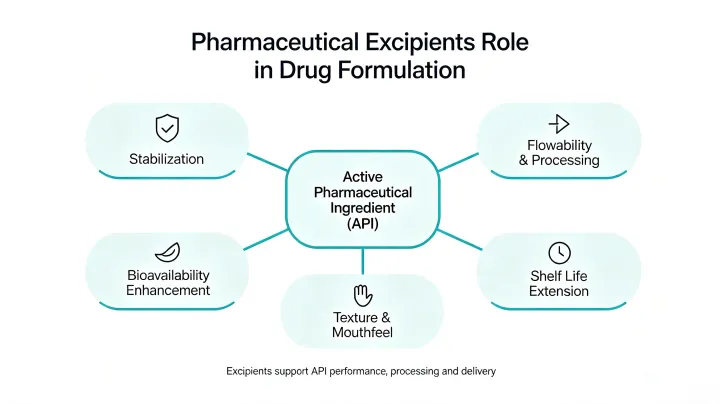
Pharmaceutical Excipients play a critical role in modern drug formulation, supporting tablet manufacturing, drug stability, controlled release, and overall product performance. While active pharmaceutical ingredients (APIs) provide therapeutic effects, pharmaceutical excipients ensure that medicines can be manufactured effectively, remain stable, and deliver consistent results.
Formulators add excipients to improve manufacturing performance, protect stability, enhance bioavailability, and make dosage forms easier for patients to take. From fillers and binders that shape a tablet to coating polymers and controlled-release matrices that govern how a drug behaves inside the body, excipients influence nearly every stage of pharmaceutical development.
A well-designed formulation therefore depends on far more than picking the right API. It also requires excipients with the right compressibility, flowability, binding ability, disintegration performance, stability, API compatibility, and regulatory acceptance. Consider three widely used examples:
Because the right excipient can transform tablet quality, production efficiency, and overall drug performance, manufacturers cannot treat excipient selection as an afterthought. This guide walks through the major excipient categories, explains their functions and applications, and shows pharmaceutical manufacturers how to select the right excipients for any dosage form.
Choosing the right pharmaceutical excipient depends on the required formulation function, dosage form, and manufacturing process.
The following table provides a quick reference for commonly used pharmaceutical excipients.
| Formulation Requirement | Recommended Pharmaceutical Excipient | Main Function |
|---|---|---|
| Direct compression tablets | Microcrystalline Cellulose (MCC) | Filler, dry binder, compression aid |
| Controlled-release tablets | HPMC | Matrix former and release modifier |
| Oral suspension stabilization | Colloidal MCC (MCC Gel) | Suspension stabilization and viscosity control |
| Tablet disintegration | Croscarmellose Sodium | Rapid tablet breakup |
| Wet granulation binding | PVP | Wet binder |
| Powder flow improvement | Colloidal Silicon Dioxide | Flow enhancer |
| Tablet lubrication | Magnesium Stearate | Reduces compression friction |
Selecting the correct excipient system can significantly improve:
Pharmaceutical excipients are substances other than the API that are deliberately included in a drug formulation. Global pharmacopeial standards require them to be safe for human use, pharmacologically inactive at their intended levels, compatible with the API and other formulation components, and consistent in quality from batch to batch.
Unlike APIs, which produce a direct therapeutic effect, excipients support the manufacturing process and improve how the medicine performs overall. Most modern formulations combine several excipients — a filler, a binder, a disintegrant, and a lubricant, for instance — working together to achieve the desired release profile and processing efficiency. Because these ingredients interact with each other and with the API, choosing them correctly requires as much scientific rigor as choosing the API itself.
Tablet production demands powders with good flow and compressibility, yet many APIs flow poorly, compress unevenly, or bind weakly on their own. Left unaddressed, these limitations cause tablet weight variation, capping, lamination, and low mechanical strength. Excipients solve these problems by improving powder processing characteristics. MCC, for example, remains one of the most widely used excipients precisely because it delivers excellent compressibility, strong binding ability, good dilution capacity, and full compatibility with direct compression technology.
Modern medicines increasingly require a specific release profile — immediate, sustained, delayed, or enteric. Hydrophilic polymers such as pharmaceutical-grade HPMC make this possible: once hydrated, HPMC forms a gel barrier that controls how quickly the API diffuses out of the tablet. As a result, HPMC has become indispensable for extended-release tablets, matrix systems, and film coatings.
A pharmaceutical product must hold its quality throughout storage and transport. Excipients protect formulations against moisture changes, chemical degradation, and physical damage. Film-coating polymers shield tablets from environmental exposure, stabilizing agents keep suspensions uniform, and well-chosen fillers improve hardness so tablets survive shipping intact.
Finally, excipients shape the patient’s experience. They influence tablet appearance, swallowability, taste masking, mouthfeel, and overall dosage convenience. For pediatric and elderly patients especially, excipient selection directly affects whether a patient actually takes the medicine as prescribed — making it a compliance issue, not just a technical one.
Rather than grouping excipients by chemical structure, the industry classifies them by functional role. The table below summarizes the major categories.
| Excipient Category | Examples | Main Function |
|---|---|---|
| Fillers / Diluents | MCC, Lactose, Starch | Increase tablet bulk and improve compression |
| Binders | MCC, PVP, HPMC | Improve tablet strength |
| Disintegrants | Croscarmellose Sodium, Crospovidone | Help tablets break apart after administration |
| Lubricants | Magnesium Stearate | Reduce friction during compression |
| Coating Agents | HPMC, HPMC-AS | Protect tablets and control release |
| Suspending Agents | Cellulose derivatives | Improve liquid formulation stability |
| Glidants | Colloidal Silicon Dioxide | Improve powder flow |
Fillers increase the bulk volume of a tablet when the API alone is too small a quantity to compress into a practical dosage form. An ideal filler offers good compressibility, chemical stability, low moisture sensitivity, and broad compatibility with different APIs.
Microcrystalline Cellulose (MCC) stands out as the benchmark cellulose-based filler. Manufacturers rely on it for direct compression tablets, nutraceutical tablets, hard capsules, and general powder formulations because it delivers excellent tablet hardness, low lubricant requirements, strong compactibility, and a plant-derived origin. Different MCC grades vary in particle size and density, so formulators can fine-tune flowability and compressibility to match a specific production line.
Lactose, available as spray-dried, anhydrous, or monohydrate grades, remains popular for its good taste and wide pharmaceutical acceptance. However, it is not always the right fit — lactose-intolerant applications, certain moisture-sensitive formulations, and some API compatibility issues can rule it out.
Starch, sourced from corn, potato, or modified derivatives, has traditionally served as a diluent, binder, and disintegrant all at once, making it a flexible but generally lower-performing alternative to MCC in high-speed manufacturing.
Binders improve cohesion between powder particles during granulation or compression. Without sufficient binding strength, tablets show low hardness, high friability, and poor handling strength. MCC again plays a leading role here, functioning simultaneously as a filler and a dry binder — a multifunctionality that makes it especially valuable in direct compression systems. Polyvinylpyrrolidone (PVP), by contrast, is the standard wet-granulation binder, prized for strong binding performance, good solubility, and broad API compatibility. HPMC rounds out the binder category by also acting as a film former and controlled-release polymer, making it essential for modified-release dosage forms.
Disintegrants help a tablet break apart after administration so the API can dissolve and become available for absorption. An effective disintegrant absorbs water rapidly, expands or otherwise promotes breakup, and preserves formulation stability. Croscarmellose Sodium, a cross-linked cellulose derivative, delivers rapid water uptake and strong swelling at a low usage level, making it a workhorse for immediate-release tablets. Crospovidone, a cross-linked PVP derivative, achieves fast disintegration primarily through capillary action, which suits fast-dissolving formulations particularly well.
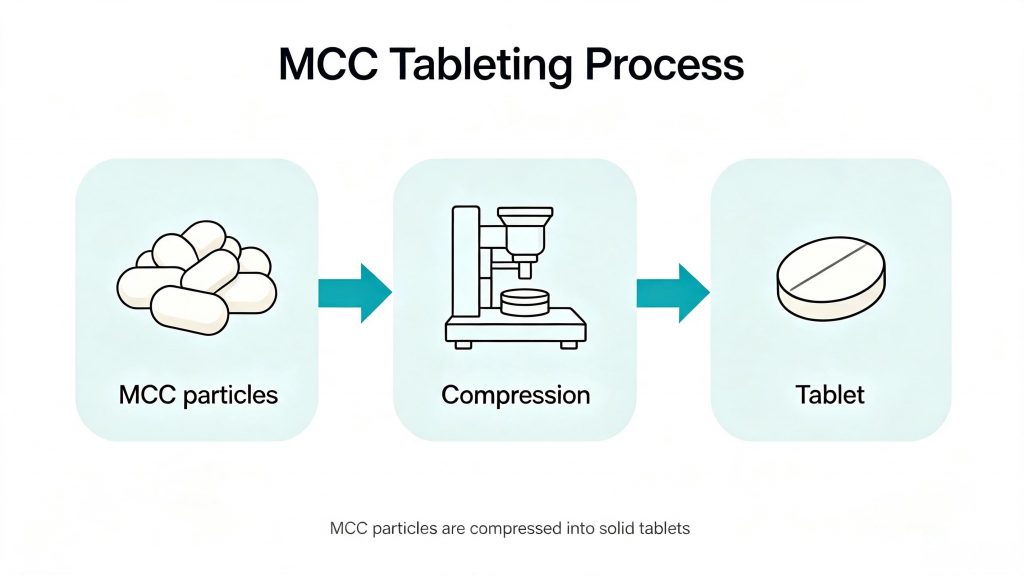
Among all cellulose-based excipients, MCC has become one of the most widely used ingredients in modern tablet manufacturing. It is a purified, partially depolymerized cellulose derived from high-quality plant cellulose and is internationally recognized as Microcrystalline Cellulose (E460(i)).
Direct compression performance explains much of MCC’s popularity. Direct compression eliminates wet granulation and reduces manufacturing complexity, but it only works when the excipient offers excellent flowability, strong compactibility, and good deformation behavior. MCC meets all three requirements because its particles undergo plastic deformation under pressure, creating strong interparticle bonding. The result is higher tablet hardness, lower friability, improved production efficiency, and fewer manufacturing steps overall.
Multifunctionality further sets MCC apart. Where many excipients perform a single job, MCC simultaneously acts as a diluent, dry binder, compression aid, and flow-improvement component — which simplifies formulation design considerably. A typical immediate-release tablet, for example, might combine MCC as the primary filler, croscarmellose sodium as the disintegrant, and magnesium stearate as the lubricant. This straightforward combination remains one of the most widely adopted systems in the industry.
Because different tablet sizes, API loadings, compression speeds, and dissolution targets call for different powder characteristics, manufacturers select among several MCC grades — low-moisture grades for moisture-sensitive formulations, high-density grades for high-speed compression, and fine-particle grades for capsule filling.
Beyond powder MCC, Colloidal Microcrystalline Cellulose (MCC Gel) — typically a functionalized system combining microcrystalline cellulose with sodium carboxymethyl cellulose (CMC-Na) — creates a three-dimensional gel network once hydrated. This structure makes it exceptionally effective for stabilizing oral suspensions, where sedimentation, particle aggregation, and poor redispersibility are common problems. By increasing viscosity, preventing particle settling, and maintaining uniform distribution, MCC Gel supports oral suspensions, pediatric medicines, nutraceutical liquids, and mineral suspensions alike. It also improves mouthfeel and physical stability, which matters most when a formulation contains insoluble APIs, minerals, or herbal extracts.
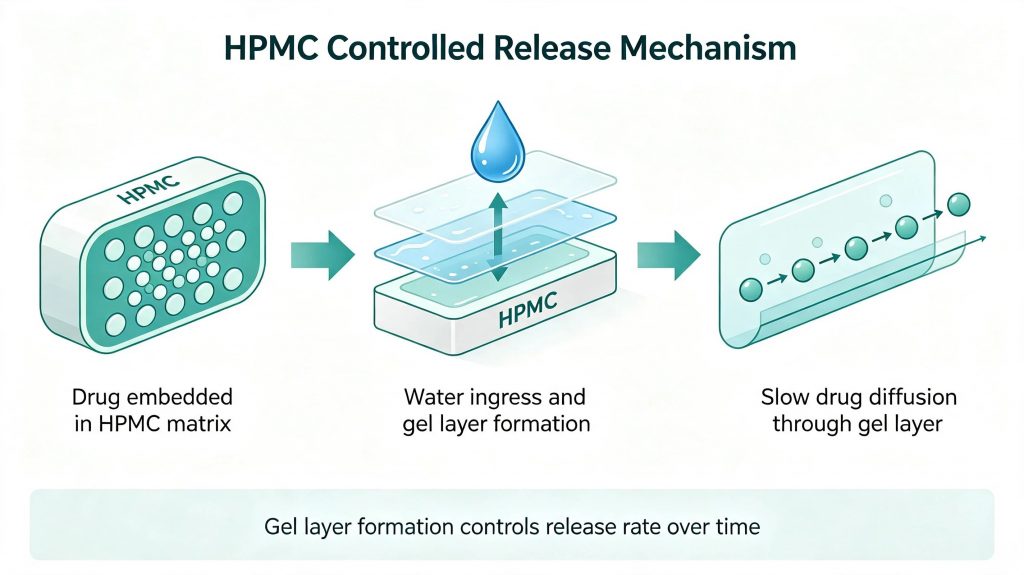
HPMC is another cellulose-derived excipient that formulators consider essential, largely because of its film-forming ability, safety profile, chemical stability, and controlled-release performance.
Tablet film coating is HPMC’s most familiar application. It produces a transparent, well-adhered, flexible film that stays compatible with pigments and plasticizers, while also improving tablet appearance, moisture protection, swallowing comfort, and product identification.
Controlled-release matrix tablets rely on a different property entirely: once HPMC contacts gastrointestinal fluids, it forms a hydrated gel layer that governs water penetration, API diffusion, and drug release rate. Because different viscosity grades hydrate at different speeds, formulators choose low-viscosity HPMC for film coating and immediate-release work, medium-viscosity grades for sustained-release matrices, and high-viscosity grades for extended-release systems.
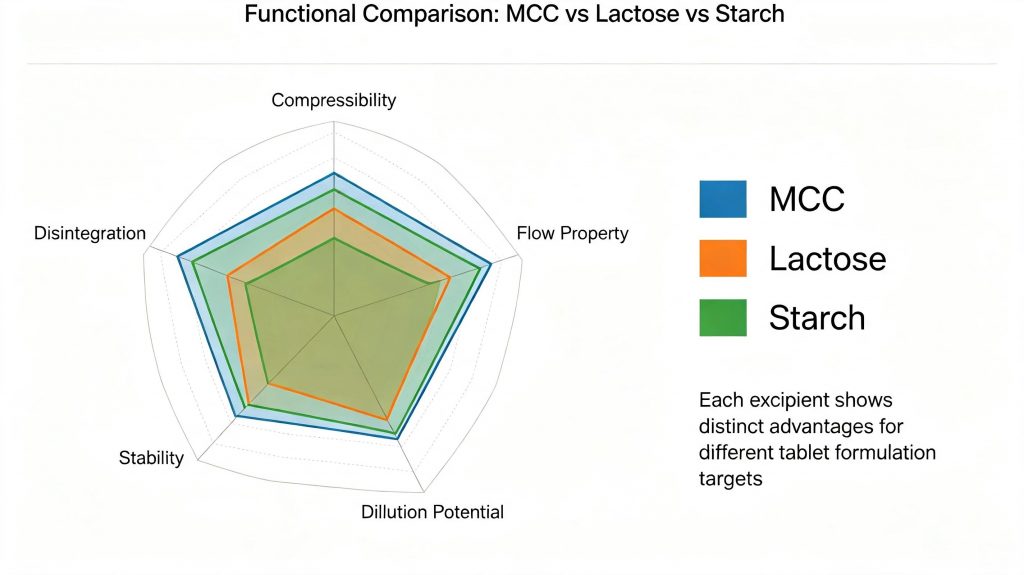
Choosing the right filler has an outsized effect on tablet quality, so it helps to compare the three most common options side by side.
| Feature | MCC | Lactose | Starch |
|---|---|---|---|
| Direct Compression | Excellent | Good | Limited |
| Binding Ability | Excellent | Moderate | Moderate |
| Tablet Hardness | High | Medium | Medium |
| Moisture Sensitivity | Low | Medium | Medium |
| Multifunctionality | High | Low | Medium |
MCC generally wins out when manufacturers need direct compression, high tablet strength, low API compressibility support, low-moisture excipients, or maximum production efficiency. Lactose remains a reasonable choice when cost efficiency matters and API compatibility is already confirmed, though it is less suitable for lactose-restricted applications or moisture-sensitive APIs. Starch still has a place in traditional formulations, but its more limited direct-compression performance makes it less competitive for modern, high-speed manufacturing lines.
| Application | Recommended Excipient | Why It Is Used |
|---|---|---|
| Immediate-release tablets | MCC | Excellent compression and binding |
| Extended-release tablets | HPMC | Controls drug release through gel formation |
| Oral suspensions | MCC Gel | Improves suspension stability |
| Capsule filling | MCC | Good flow and filling performance |
| Wet granulation | PVP | Strong wet binding capability |
| Tablet coating | HPMC | Excellent film-forming properties |
Different dosage forms require different excipient strategies. Selecting the correct material according to application requirements is essential for formulation success.
Because each dosage form places different demands on a formulation, excipient selection changes accordingly.
Tablets, the most common dosage form, typically combine a filler (MCC or lactose), a binder (MCC, PVP, or HPMC), a disintegrant (croscarmellose sodium), and a lubricant (magnesium stearate) — a system that balances hardness, disintegration speed, and manufacturability.
Capsules demand excellent powder flow above all else. MCC, lactose, starch, and silicon dioxide all appear frequently in capsule formulations, and manufacturers favor MCC specifically because it provides strong filling performance, low segregation risk, and excellent compatibility with a wide range of APIs.
Oral liquids require an entirely different skill set: suspension stabilization, viscosity control, and texture improvement rather than compressibility. MCC Gel, sodium CMC, HPMC, and xanthan gum are the standard tools for keeping insoluble ingredients evenly dispersed and easy to redisperse before each dose.
Selecting suitable excipients is one of the most consequential steps in formulation development, since the right choice supports manufacturing efficiency, drug stability, patient safety, regulatory compliance, and consistent batch production all at once.
Before choosing any excipient, manufacturers need to evaluate the API’s solubility, compressibility, and stability. Poorly soluble APIs often require solubilizing agents, polymer-based systems, or surface-active excipients to improve wetting and dissolution. APIs with weak compression characteristics benefit from excipients like MCC that boost tablet hardness and mechanical strength. And APIs sensitive to moisture, temperature, pH, or oxidation call for excipients — such as low-moisture MCC grades — that minimize the risk of degradation.
The same API can require entirely different excipient systems depending on how it will be manufactured.
Every excipient must comply with recognized pharmacopeial standards — USP/NF, EP, JP, BP, and applicable FDA requirements. Before finalizing any excipient, manufacturers should review the Certificate of Analysis (COA), Safety Data Sheet (SDS), Technical Data Sheet (TDS), and relevant GMP documentation to confirm the material meets both technical and regulatory expectations.
Many formulation problems trace back not to the API itself, but to an excipient system that wasn’t properly matched to the challenge at hand.
Poor tablet compressibility — a frequent issue with APIs that flow or bind weakly — often shows up as low hardness, high friability, cracking, or capping, especially at high compression speeds. MCC addresses this directly: its particles undergo plastic deformation and rearrange favorably under pressure, producing tablets with higher hardness, lower friability, and better handling stability.
Poor powder flowability affects tablet weight consistency, production speed, and content uniformity, and usually stems from particle size distribution, bulk density, moisture content, or particle shape. Formulators typically respond by selecting an MCC grade with higher bulk density for high-speed compression or capsule filling, or by adding flow enhancers such as colloidal silicon dioxide or talc to reduce particle friction.
Slow tablet disintegration delays drug release and can reduce dissolution and therapeutic consistency. Croscarmellose sodium, crospovidone, and sodium starch glycolate each solve this problem through rapid water absorption, swelling, or capillary action — though the level used must be optimized carefully, since excessive disintegrant can weaken the tablet.
Uncontrolled drug release is the fourth common challenge, particularly for once-daily or extended-release medicines. Hydrophilic polymers like HPMC solve it by absorbing water, hydrating, and forming a gel layer that regulates diffusion — allowing formulators to design sustained-release tablets, matrix systems, and other modified-release formulations with predictable behavior.
Because excipients directly influence drug product performance, they must meet strict quality standards, and a reliable supplier should always provide complete technical documentation to back that up.
A Certificate of Analysis (COA) confirms product identification, batch number, physical properties, chemical specifications, microbial limits, heavy metal testing, and moisture content for each lot. A Technical Data Sheet (TDS) details product characteristics, recommended applications, storage conditions, and processing guidance. A Safety Data Sheet (SDS) covers handling requirements, storage safety, transportation requirements, and potential hazards. Finally, professional excipient manufacturers should demonstrate compliance with USP/NF, EP, JP, and BP standards, along with GMP-certified manufacturing systems.
Excipient consistency is critical for pharmaceutical manufacturers, since even small variations can affect tablet hardness, dissolution profile, production efficiency, and stability results. Consequently, buyers should evaluate potential suppliers on manufacturing experience, technical support capability, and supply chain stability. Experienced manufacturers maintain tighter control over raw materials, production processes, and batch consistency. Strong technical support goes beyond selling raw material — it includes formulation recommendations, application guidance, sample evaluation, and troubleshooting assistance. And because pharmaceutical production depends on continuity, a stable, reliable supply chain is non-negotiable for long-term partnerships.
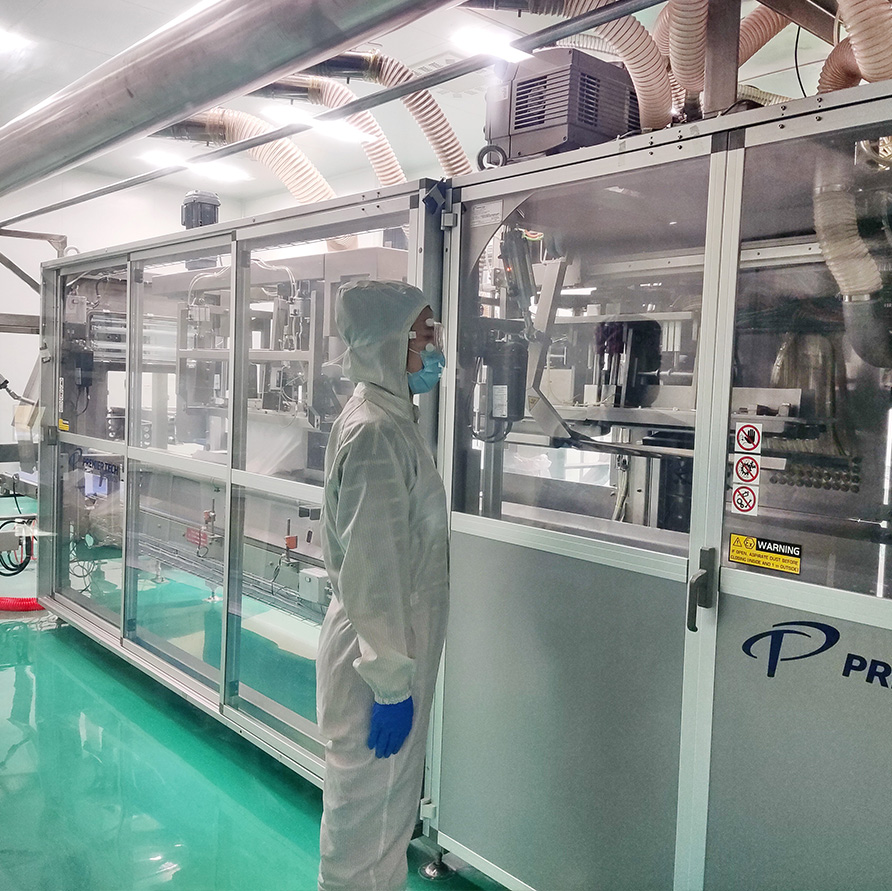
Selecting a pharmaceutical excipient supplier is not only about purchasing raw materials. It is about choosing a long-term technical partner who understands formulation requirements, quality standards, and pharmaceutical manufacturing challenges.
As a cellulose excipient manufacturer, ACTA specializes in pharmaceutical-grade cellulose solutions, including:
Our cellulose-based excipients are developed to support pharmaceutical and nutraceutical manufacturers in applications such as:
A reliable pharmaceutical excipient manufacturer should provide:
Pharmaceutical formulations require excellent batch-to-batch consistency.
Important quality factors include:
Professional excipient suppliers should support customers with:
International pharmaceutical manufacturers require suppliers with:
By working with an experienced cellulose excipient manufacturer, pharmaceutical companies can reduce formulation risks and accelerate product development.
Choosing a pharmaceutical excipient supplier requires more than comparing product prices.
A reliable manufacturer should provide:
ACTA specializes in cellulose-based pharmaceutical excipients, including:
Our excipients support pharmaceutical manufacturers in:
With experience in cellulose-based materials, ACTA helps customers evaluate suitable excipient solutions according to:
Purchasing decisions should weigh both technical and commercial factors.
Product grade matters first: pharmaceutical-grade MCC, used in tablets, capsules, and nutraceuticals, requires high purity, controlled particle size, and consistent compressibility, while food-grade cellulose serves different stabilization and texture applications. Choosing the correct grade ensures both compliance and formulation performance.
Packaging and storage deserve equal attention. Pharmaceutical excipients typically need moisture-resistant packaging, clean storage conditions, and batch traceability, commonly supplied in 20 kg or 25 kg bags or customized packaging, with humidity, temperature, and shelf life all factored into storage planning.
Sample testing before bulk purchase rounds out the buying process. Before committing to a commercial order, pharmaceutical companies should review technical documents, test laboratory samples, run a pilot-scale batch, confirm performance, and only then proceed to commercial supply — a sequence that minimizes the risk of costly production problems later.
Because different excipients can serve similar functions, understanding their relative strengths helps manufacturers choose confidently.
MCC vs PVP for binding: choose MCC when direct compression or dry processing fits the process, and choose PVP when wet granulation demands strong wet binding.
HPMC vs Ethylcellulose for controlled release: HPMC, a hydrophilic polymer, works through gel formation and suits extended-release tablets and matrix systems, whereas ethylcellulose, a hydrophobic polymer, controls release through a diffusion barrier and is typically used in coating systems.
Pharmaceutical Excipient Application Experience
During direct compression tablet development, pharmaceutical manufacturers often need to balance:
Microcrystalline Cellulose (MCC) is commonly selected as a multifunctional excipient because it provides:
A typical direct compression system may combine:
| Ingredient | Function |
|---|---|
| MCC | Filler and dry binder |
| Croscarmellose Sodium | Disintegration improvement |
| Magnesium Stearate | Lubrication |
The optimized excipient system can help manufacturers achieve:
✓ More consistent tablet compression
✓ Improved tablet strength
✓ Better production stability
✓ Reliable manufacturing performance
Liquid pharmaceutical formulations containing insoluble ingredients may experience:
Colloidal MCC (MCC Gel) creates a three-dimensional network structure that improves:
MCC Gel can support:
✓ Better suspension stability
✓ Improved product appearance
✓ More consistent dosing performance
Pharmaceutical excipients are inactive ingredients added to drug formulations to improve manufacturing, stability, drug release, and patient acceptance.
The most common excipients include Microcrystalline Cellulose (MCC), lactose, HPMC, croscarmellose sodium, PVP, magnesium stearate, and various starch derivatives.
MCC delivers excellent compressibility, strong binding ability, superior direct compression performance, and improved tablet strength, making it one of the most important excipients in modern tablet manufacturing.
In many formulations, yes — MCC’s superior compression properties often make it a suitable substitute. However, the final decision still depends on API characteristics, dissolution requirements, and the manufacturing process in use.
HPMC is mainly used for film coating, controlled-release tablets, matrix systems, and capsule applications, with different viscosity grades selected to match specific formulation needs.
MCC, co-processed MCC, direct-compression lactose, crospovidone, and magnesium stearate all perform well in direct compression systems.
Selection depends on API compatibility, dosage form, manufacturing technology, regulatory requirements, and the desired drug release profile — evaluated through compatibility studies, dissolution testing, and pilot-scale trials.
Pharmaceutical excipients are inactive ingredients used to improve drug formulation performance, including stability, manufacturing, drug release, and patient acceptance.
Microcrystalline Cellulose (MCC) is one of the most widely used direct compression excipients because of its excellent compressibility and binding properties.
MCC is mainly used as a filler, dry binder, and compression aid in tablets and capsules.
HPMC is commonly used for film coating, controlled-release tablets, and matrix drug delivery systems.
Colloidal MCC (MCC Gel) is used to improve suspension stability, viscosity control, and physical consistency in liquid formulations.
Many formulation setbacks trace back to a handful of avoidable mistakes rather than to the API itself.
Choosing based only on price. The lowest-cost excipient rarely turns out to be the most economical choice once production rejection rates rise, formulation development stretches out, and additional processing costs pile up. A slightly more expensive but higher-performing excipient often pays for itself many times over during scale-up.
Ignoring manufacturing process compatibility. An excipient that performs beautifully in wet granulation may behave poorly in direct compression, and vice versa. Formulators should always match excipient properties to the manufacturing process first, then confirm that combination against the final dosage form requirements — not the other way around.
Skipping pilot testing. Even a well-established, widely used excipient should still be validated in the actual formulation before commercial production begins. The safest path moves from sample, to laboratory test, to pilot trial, and only then to commercial production. Skipping any of these steps increases the risk of costly surprises once manufacturing scales up.
Traditional excipients usually deliver one primary function, but pharmaceutical development increasingly favors co-processed excipients — combinations of two or more excipients physically engineered together, rather than simply mixed, to achieve improved flowability, compressibility, and compactibility. Co-processed MCC systems, for instance, improve tablet manufacturing through better powder flow and reduced compression variability, while also cutting down the number of individual raw materials a formulator has to source, test, and manage.
Looking ahead, three trends continue to shape the excipient landscape. First, direct compression technology keeps growing because it improves manufacturing efficiency, controls cost, and scales more easily than granulation-based processes — sustaining strong demand for high-performance excipients such as MCC. Second, plant-based and clean-label excipients are gaining ground, as pharmaceutical and nutraceutical companies increasingly prefer renewable, sustainably sourced materials; cellulose derivatives benefit directly from this shift since cellulose is renewable, widely available, and globally accepted. Third, advanced drug delivery systems demand more sophisticated excipients for controlled release, targeted delivery, and improved bioavailability, a role that functional polymers like HPMC are well positioned to continue playing.
Pharmaceutical excipients may not produce a therapeutic effect on their own, but they determine nearly everything else about how a medicine performs — from tablet hardness and disintegration speed to shelf stability and patient acceptance. Microcrystalline Cellulose (MCC) remains the standard for direct compression tablets, HPMC continues to lead controlled-release and coating applications, and Colloidal MCC (MCC Gel) provides reliable suspension stabilization for liquid formulations. Together, these cellulose-based excipients give manufacturers a dependable foundation for building safer, more efficient, and higher-performing drug products.
For pharmaceutical manufacturers evaluating excipient partners, the ideal supplier offers consistent pharmaceutical-grade quality, complete technical documentation, regulatory support, application expertise, and reliable long-term supply capability. Understanding excipient functions, formulation requirements, and selection principles ultimately empowers pharmaceutical companies to bring better products to market faster and with less risk.
Choosing the correct pharmaceutical excipient can directly influence formulation performance, manufacturing efficiency, and product quality.
ACTA provides cellulose-based pharmaceutical excipient solutions, including:
✓ Pharmaceutical Grade Microcrystalline Cellulose (MCC)
✓ Colloidal MCC (MCC Gel)
✓ Pharmaceutical Grade HPMC
✓ Sodium CMC
Our technical team can support:
✓ MCC grade selection
✓ Direct compression formulation evaluation
✓ HPMC viscosity recommendation
✓ Sample testing support
✓ Technical documentation review
