

A practical, evidence-based guide to choosing HPMC grades and the right HPMC supplier, for manufacturers, importers, distributors, and purchasing managers sourcing hydroxypropyl methylcellulose (HPMC).
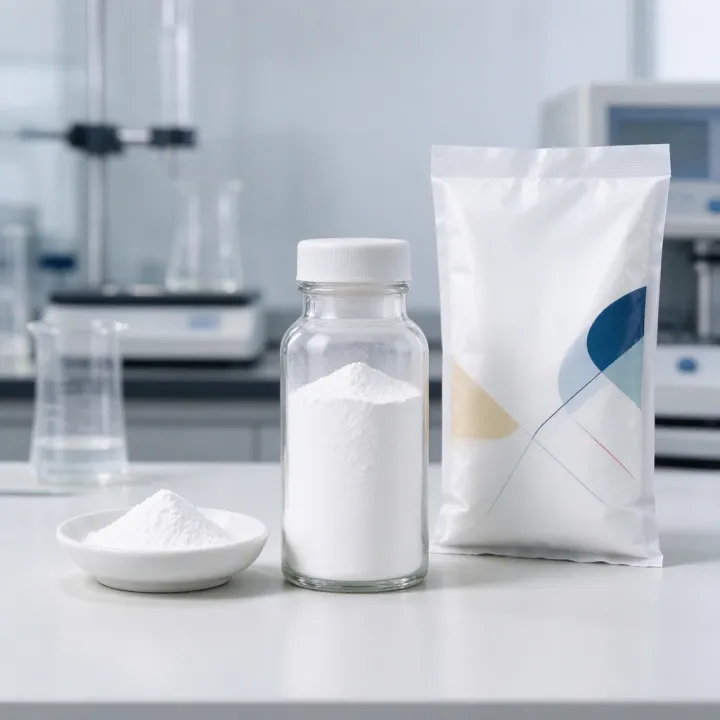
Choosing the right HPMC grades and the right HPMC supplier is an important decision for manufacturers, importers, distributors, and purchasing managers who work with cellulose ethers. To that end, this HPMC supplier guide explains how to evaluate suppliers, compare HPMC grades, verify quality documents, test samples, and request a competitive quotation, so that you can decide on evidence instead of price alone.
Hydroxypropyl methylcellulose (HPMC), also known as hypromellose, is a non-ionic cellulose ether used in a range of construction, pharmaceutical, food, personal care, and industrial formulations. However, its functional properties depend on the grade, polymer characteristics, formulation, and processing conditions.
In particular, HPMC grades are not interchangeable. They differ in viscosity, substitution characteristics, dissolution behavior, gelation temperature, and moisture content, and a grade developed for construction should never be assumed suitable for food or pharmaceutical use. Therefore, the real challenge is not finding the lowest quotation; rather, it is finding a supplier that offers the appropriate grade, clear specifications, reliable documents, consistent batches, and dependable commercial support.
In fact, an unsuitable grade can cost more than it saves: inconsistent viscosity, difficult processing, extra formulation trials, and uncertain batch consistency all add cost. By contrast, a supplier with clear technical documents and a structured sample-evaluation process reduces that uncertainty before you commit to a large order. Accordingly, the chapters below follow the real purchasing sequence: select the grade, check the documents, evaluate the supplier, compare prices, test samples, manage risk, and plan long-term supply.
The level of verification should match the intended application, purchase size, and quality or regulatory risks.
The question this chapter answers: which candidate grades should I evaluate?
Selecting HPMC grades is one of the most important steps in supplier evaluation. Even when two HPMC grades share a chemical name, their performance can differ. Define your technical requirements first, and only then compare quotations.
The first question is not “What viscosity do you offer?” but rather “What must the HPMC do in my formulation?” For example, a tile adhesive maker may prioritize water retention, workability, and open time. By contrast, a pharmaceutical formulator may focus on viscosity under specified conditions, polymer characteristics, and dissolution behavior. Similarly, a food manufacturer must confirm suitability for the intended use, while a personal care formulator weighs thickening, compatibility, appearance, and stability. However, these are starting points, not universal rules. Therefore, a good HPMC supplier discusses your application and helps identify candidate grades, but the final choice rests on documents and testing.

Caption:Compare HPMC grades under consistent solution concentration, temperature, and test conditions
Viscosity is the figure buyers compare first, yet it never describes performance completely. In fact, HPMC solutions are non-Newtonian under many practical conditions, so apparent viscosity depends on shear conditions, solution concentration, temperature, preparation procedure, hydration, and equipment. As a result, two suppliers can report different values for similar products.
Therefore, before you compare grades, always confirm the solution concentration, test temperature, and measurement method behind the number. For example, a quotation that states “10,000 mPa·s” without these three items is incomplete. (Chapter 3.4 explains how to read typical values versus acceptance limits, and Chapter 8 explains how to verify viscosity yourself.)
Does higher viscosity always mean better performance? No. On the one hand, a higher-viscosity grade can deliver stronger thickening or a particular water-retention profile; on the other hand, excessive viscosity can make dispersion, mixing, pumping, or application harder. Therefore, do not choose a grade because a competitor uses a higher number or because a supplier calls it “more powerful.” Instead, choose the grade that delivers the required result reliably.
In addition, temperature matters in another way. HPMC solutions are fluid when cool but form reversible gels when heated, and the gelation temperature depends on grade, concentration, and formulation. Therefore, if your process involves heat, ask the supplier for gelation information and test under your real process temperatures.
| Technical factor | What buyers should verify | Purchasing implication |
|---|---|---|
| Viscosity | Concentration, temperature, method, specification range | Decides whether quotations are genuinely comparable |
| Substitution characteristics | Applicable specification and test data | May affect grade characteristics and formulation behavior |
| Hydration and dispersion | Preparation procedure and application test results | Helps identify processing differences |
| Moisture content | Agreed limit and test method | Supports incoming quality checks |
| Particle size | Distribution or agreed requirement, where relevant | Can influence handling and dispersion |
| Batch consistency | COA and comparison with approved criteria | Helps manage repeat-order risk |
| Application performance | Results under representative formulation conditions | Decides whether the grade suits actual use |
Treat this table as a screening checklist, not a universal specification. If you lack a real test method or product data, state a verification requirement instead of inventing a limit.
If you are unsure which grade to buy, give the supplier enough information to respond meaningfully: the application and finished-product type, the viscosity range and test conditions (if known), any existing grade or benchmark, the main performance requirements, processing constraints, quality or regulatory requirements, and estimated sample and purchase volumes. For example, a tile adhesive manufacturer should say whether the goal is better water retention, workability, or open time. That said, a recommendation never replaces formulation testing, because you remain responsible for confirming performance in your own process.
Need Help Identifying an HPMC Grade?
Share your application, target performance, current product specification if available, and estimated quantity with ACTA. These details can help start a discussion about candidate grades and the technical information needed for evaluation. Final grade selection should be based on the current product specification and testing under your intended application conditions.

Caption: Review the TDS, batch-specific COA, and applicable SDS before approving an HPMC supplier.
The question this chapter answers: Are the documents complete, consistent, and fit for my application?
Review more than the product name and quoted viscosity, because specifications and documents establish what you are buying and whether the supplied material meets the agreed requirements. In addition, construction, food, and pharmaceutical grades differ in intended use and compliance obligations. Therefore, evaluate each grade according to its application.
First, request the TDS. A useful TDS identifies the grade and gives properties, intended application, and test conditions. Depending on the product, review viscosity (range, units, and the conditions from Chapter 2.2), appearance, moisture content, pH, particle size, substitution characteristics, solubility and dissolution behavior, and packaging, storage, and shelf life.
Next, before you compare two suppliers, check that their documents describe equivalent products under comparable conditions. If values differ, clarify whether the cause is a real product difference, a different method, or a different specification basis.
Need HPMC Technical Information?
Tell us the product grade or viscosity range you are evaluating, together with your intended application. Contact ACTA to discuss the current TDS and the supporting documents available for the specific product. Please confirm all mandatory specifications and documentation requirements before approving a grade.
A COA reports test results for an identified batch or lot. Check the product identification, batch number, test parameters, results against the agreed specification, test methods, and consistency with other documents. If a critical parameter is missing, ask for another appropriate record. A COA reports one batch; it does not prove that future batches will match, and it does not replace your incoming inspection where inspection is required.
The SDS covers safe handling, storage, transportation, and emergency management. Obtain the applicable SDS and review the sections relevant to your operations. It does not prove a viscosity specification, a food-grade requirement, or a pharmaceutical standard.
A grade name is convenient, but it is not a specification. In particular, a nominal viscosity value may not show the full acceptable range, the test conditions, or other parameters your application requires. Likewise, a typical value describes a representative result and does not guarantee every batch, whereas an acceptance limit defines the boundary for conformity. Therefore, before you order, clarify which figures are guaranteed requirements and which are for reference, and put the critical limits in your purchasing specification. To organize this, separate three groups: critical parameters that must be met, supporting parameters for characterization, and application performance criteria that you evaluate through testing.
Food grade. The words “food grade” alone never prove compliance. Confirm the exact grade, the intended uses the documents support, the applicable specification and methods, and the compliance documents for your destination market. Regulations differ and change, so verify current requirements with regulatory sources or qualified professionals.
Pharmaceutical grade. Pharmaceutical use may require compliance with a pharmacopoeial monograph, defined test methods, impurity requirements, and documentation controls. A “pharmaceutical” label does not automatically satisfy every pharmacopoeia or customer qualification requirement. Establish the applicable specification, required documents, and any audits, change-control procedures, or quality agreements before approval.
Construction grade. The TDS and COA matter, but application performance matters just as much. Water retention, workability, consistency, open time, and compatibility cannot always be predicted from viscosity alone. Define performance targets, test candidates in your own formulation, and set acceptance criteria before the trial begins.
A food, pharmaceutical, or construction designation must always be verified for the specific product and its documents. It cannot be inferred from a product name or a viscosity range.
For food applications, buyers should verify the applicable authorization, specifications, and conditions of use in the destination market. See the European Commission’s information on EU food additive regulations for further guidance.
For pharmaceutical applications, buyers should identify the applicable pharmacopoeial requirements and verify the specific grade against the relevant monograph and customer specifications. The USP–NF Hypromellose monograph is one reference to consult when USP–NF requirements apply.When sourcing HPMC for food applications in the EU, verify the applicable legal requirements and specifications for E 464, including any relevant amendments to the food additive regulations.
The following example is illustrative and does not describe a real transaction. A buyer receives a TDS and a COA for a mid-viscosity grade.
| Check | TDS says | COA says | Verdict |
|---|---|---|---|
| Product identity | Grade X | Grade X | Consistent |
| Viscosity range | 5,000–10,000 mPa·s, 2% solution, 20°C | 7,800 mPa·s, conditions not stated | Ask for the COA test conditions |
| Moisture | Limit stated, method stated | Result stated, method not stated | Ask for the method |
| Batch number | Not applicable | Lot number present | Match it to the shipping label later |
| Intended use | General industrial | Not stated | Confirm suitability for the buyer’s application separately |
The buyer does not reject the product. The buyer writes down the two missing items, asks the supplier to supply them in writing, and keeps the corrected COA with the approval record. That is the whole discipline: find the gap, name it, close it in writing.
ACTA’s certificates page lists the documents it can provide for its cellulose products: COA, TDS, SDS/MSDS, Halal certificate, BRC certification statement, allergen declaration, heavy metals testing report, microbiological analysis report, and a non-GMO declaration where applicable. Which of these exist for a specific HPMC grade must be confirmed for that grade, so ask for the exact documents you need when you request the TDS. For the incoming-inspection and dispute procedure after delivery, see Chapter 12.1.
The question this chapter answers: is this supplier worth approving?
Buyers meet direct manufacturers, trading companies, distributors, and export-oriented suppliers. Although each model has advantages, the best choice depends on your technical requirements, order volume, documentation needs, and supply-chain strategy. In any case, the business model alone proves nothing about quality, so evaluate the actual capabilities, documents, and commercial arrangements behind each quotation.
A good HPMC supplier states its role plainly, and it may offer production information, technical coordination, production planning, and traceability from batch to production record. However, buying direct does not automatically deliver the lowest total cost, the shortest lead time, or the best product. Meanwhile, a trading or export supplier can simplify communication through one contact, offer sourcing flexibility, and coordinate export documents and logistics.
Above all, transparency is the key: ask who manufactures the product, which company issues the invoice, how quality is verified, and who handles problems. Likewise, do not assume a trader owns a factory, and do not reject an export supplier merely because it does not manufacture.
| Evaluation factor | Direct manufacturer | Trading or export supplier |
|---|---|---|
| Manufacturing access | May offer direct factory communication | Depends on its relationship with the manufacturer |
| Product range | Depends on the manufacturer’s portfolio | May offer products from multiple sources |
| Technical support | May provide production-specific knowledge | Depends on expertise and manufacturer coordination |
| Quality documentation | Should provide product and batch documents | Should obtain and verify documents for the supplied product |
| Traceability | Depends on factory systems and batch records | Depends on document control and manufacturer coordination |
| Commercial responsibility | Defined by the sales contract | Defined by the contract and the parties involved |
However, this comparison is not a ranking. Because capabilities vary widely between individual companies, request evidence for the criteria that matter to you.
In practice, a good supplier states its role plainly. For example, ACTA’s facility page says that ACTA works with selected manufacturing partners and communicates with them to keep products within agreed technical requirements, which is the kind of disclosure to look for. Regardless of the model a supplier uses, ask it to explain who is responsible for specifications, documents, and complaints.
Check quality-system claims against documents, too. If a supplier or its manufacturing partner holds a certification, request the details and verify the issuing organization, validity period, scope, and site. A quality management certificate does not prove that every product meets every specification, and it never proves food-grade or pharmaceutical-grade compliance.
A quotation or a sample alone cannot approve a supplier. For recurring demand, qualification tests whether a supplier meets technical, commercial, documentation, and delivery requirements consistently, and its depth should match the risk of your application.
Record the outcome as approved, conditionally approved, or not approved, and tie it to a specific product and use, never to everything the company sells. Requalify after a major product change, a significant quality incident, or a change of manufacturing source.
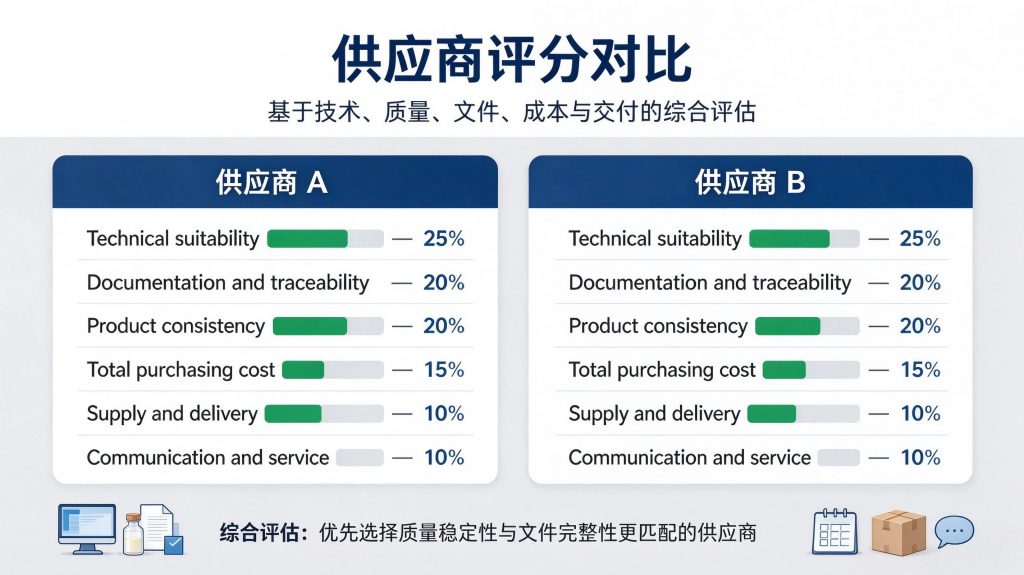
Caption:Evaluate technical suitability, documentation, consistency, delivery, and total purchasing cost before selecting a supplier.
| Category | Suggested weight | What to assess |
|---|---|---|
| Technical suitability | 25 | Grade match, viscosity specification, application performance, sample results |
| Documentation and traceability | 20 | TDS, COA, product identification, compliance documents |
| Product consistency | 20 | Conformity with agreed specifications and repeat-order evidence |
| Total purchasing cost | 15 | Price, packaging, freight, inspection, other costs |
| Supply and delivery | 10 | Availability, lead time, logistics, delivery commitments |
| Communication and service | 10 | Response quality, technical clarification, problem handling |
This scorecard supports new-supplier qualification. The weights are a suggested internal framework, not an industry standard: regulated applications may weight documentation more heavily, while high-volume buyers may emphasize consistency and delivered cost. Apply it to evidence, not promises, and keep mandatory requirements separate from weighted scores, so that a supplier that fails a critical requirement cannot pass because it scores well elsewhere.
The following illustrative example is not a real transaction. A purchasing manager compares two HPMC offers.
| Evaluation factor | Supplier A | Supplier B |
|---|---|---|
| Product identity | Needs confirmation | Clearly specified |
| Viscosity test conditions | Incomplete | Documented |
| Sample evaluation | Not completed | Completed against agreed criteria |
| Delivery quotation | FOB | CIF |
| Quality documents | Some items pending | Documents reviewed |
| Next action | Request clarification | Verify remaining commercial conditions |
The table alone cannot show which supplier is better. The buyer must complete the missing information, adjust both quotations to a comparable commercial basis, and then decide using sample performance and mandatory requirements. Supplier A may well be competitive, and Supplier B’s higher CIF price may include freight that Supplier A excludes. Only verified, equivalent evidence settles the question.
The general grade-selection process in Chapter 2 is similar across industries, but each application has its own technical, quality, and regulatory requirements. The sections below highlight the additional factors buyers should confirm for each intended use.
In dry-mix formulations based on cement, gypsum, and other mineral materials, HPMC can contribute to water retention, workability, consistency, and application performance, depending on the grade, dosage, formulation, mixing procedure, and environment.
When you request a quotation, provide the product type, target viscosity range, performance requirements, volume, packaging, and destination. If the supplier proposes an alternative grade, ask which technical differences justify it, and evaluate it before you change an approved formulation. Some mortar and putty formulators also compare HPMC with HEMC, which ACTA lists on its HEMC page for tile adhesive and mortar use.
Pharmaceutical purchasing is document-driven, so confirm these items before you approve a supplier:
Food manufacturers may use HPMC for thickening, stabilization, film formation, or texture modification. Performance depends on concentration, processing, ingredient interactions, and temperature-related behavior. Confirm first that the product suits the intended use and complies with target-market requirements, then define the functional outcome, such as a texture or processing target. In beverages, HPMC is sometimes combined with colloidal MCC to improve suspension; ACTA’s colloidal MCC page covers that product. As the buyer, you remain responsible for confirming that the ingredient and its use comply with the rules for the finished food product.
In selected gels, lotions, and water-based systems, HPMC may serve as a thickener or film former. Assess viscosity development at the intended concentration, hydration and dispersion, texture, compatibility, storage stability, and appearance, because a grade that thickens water well may behave differently in a formulation containing salts, surfactants, or solvents. For other industrial uses, define the function, concentration and processing conditions, temperature, pH, compatibility considerations, and the tests that decide acceptance, and run small-scale tests before larger commitments.
| Application | Key technical questions | Important purchasing considerations |
|---|---|---|
| Tile adhesive and dry-mix mortar | What viscosity and application performance are required? | Batch consistency, packaging, volume, schedule |
| Wall putty and gypsum products | Which workability and water-retention characteristics are needed? | Formulation compatibility and repeat-order consistency |
| Pharmaceutical | Which grade and specifications apply? | Documentation, traceability, change control, qualification |
| Food | Which requirements apply to the use and market? | Product identification, supporting documents, formulation testing |
| Personal care | What viscosity, texture, and compatibility are needed? | Stability evaluation, documentation, formulation suitability |
| Other industrial | What function must the material deliver? | Technical evaluation, supply reliability, total cost |
This table does not replace a complete technical specification, but it helps you identify the questions to resolve before you request or approve a product.
Choosing an HPMC supplier involves more than comparing unit prices. Buyers also need to confirm grade suitability, viscosity specifications, supporting documents, sample evaluation, and supply arrangements before committing to a bulk order.
Qingdao ACTA Biotechnology Co., Ltd. supplies cellulose derivatives, including HPMC, HEMC, CMC, and MCC. For buyers evaluating HPMC, ACTA can discuss application requirements, candidate viscosity grades, available technical documentation, and sample evaluation for the specific product under consideration.
To make a meaningful comparison, start with your application, target viscosity and test conditions, current grade if available, estimated quantity, and destination market. ACTA’s current product documentation and commercial offer can then be reviewed against those requirements.
The points below set out what ACTA states publicly, so you can check each one before you send an inquiry.
| ACTA HPMC grade | Viscosity specification | What buyers should confirm |
|---|---|---|
| ACTA-C10 | 1,000–2,000 mPa·s at 2% solution | Test temperature and method, whether the range is typical or guaranteed, intended application |
| ACTA-C20 | 5,000–10,000 mPa·s at 2% solution | Test temperature and method, whether the range is typical or guaranteed, intended application |
| ACTA-C30 | 15,000–30,000 mPa·s at 2% solution | Test temperature and method, whether the range is typical or guaranteed, intended application |
The viscosity ranges above are for preliminary grade identification only. They are not assigned to any specific application, and unless the current TDS states that a range is a guaranteed acceptance specification, treat it as nominal. Confirm the current product specification, test method, intended application, and applicable documentation before approval. Final suitability should be established through document review and testing under your intended conditions.
| What you already know | Next step |
|---|---|
| A specific HPMC grade | Check the current TDS against your requirements, including test conditions |
| A target viscosity, but not the grade | Send the viscosity requirement and its test conditions, and ask for candidate grades |
| Only the application | Send the application, formulation type, and target performance |
| You are replacing a current supplier | Send the current product’s specification or a benchmark sample for comparison |
| You are ready for bulk purchasing | Complete sample evaluation, document review, and commercial confirmation first |
This is a decision aid, not a promise that ACTA offers a confirmed grade for every application. Product suitability, document availability, pricing, and delivery arrangements must be confirmed for the specific product and transaction.
Ready to Compare HPMC Options? Request a Sample, TDS, and Quotation from ACTA
Tell ACTA your application, target viscosity and test conditions, current grade if available, estimated quantity, and destination. ACTA can then review candidate grades, the current TDS and supporting documents, sample availability, and a quotation for the specific product. Product suitability, document availability, pricing, and delivery arrangements will need to be confirmed for the proposed product and order.
The question this chapter answers: what will this offer really cost me?
Price matters, especially for importers, distributors, and manufacturers who buy regularly. Comparing quotations takes more than looking at the price per kilogram or metric ton, because suppliers quote different grades, specifications, packaging, delivery terms, and quantities, so the lowest figure may not be the lowest total cost.
At a basic level:
Total Purchasing Cost = Product Cost + Applicable Logistics Costs + Import and Handling Costs + Other Relevant Charges
Compare quotations using the same currency, quantity, destination, delivery basis, and cost scope, and avoid counting freight, insurance, or other charges twice when they are already included in the quoted price.
Logistics and import costs may include international freight, cargo insurance, customs duties and import taxes, clearance and port charges, inland transport, inspection and testing, and bank or currency-conversion fees. Formulation manufacturers should also count the testing, process adjustments, and production problems tied to unsuitable material. For example, Supplier A may offer a lower unit price but exclude shipping that Supplier B includes; after you align the cost scopes, Supplier B may match or beat Supplier A. Calculate from actual quotation details, and ask each supplier to state the currency, named delivery point, Incoterm, validity period, and included or excluded charges. If a supplier quotes CIF, confirm the destination port and exact scope, since CIF does not necessarily cover every expense to your warehouse.
A much lower quotation does not automatically signal a problem, since sourcing, inventory, quantity, and packaging can all explain it. Still, verify the grade, the viscosity specification, the quantity and delivery basis, the supplier’s identity, the documents, the payment terms, and the delivery commitments before you approve. Never accept a quotation solely because it shows the lowest number.
The most sustainable savings come from improving the purchasing process, not from squeezing the unit price.
For each proposed saving, ask four questions: What cost is being reduced? What new cost or risk might appear? Does the change preserve technical and quality performance? How will we measure the result? Actual prices, discounts, grades, payment arrangements, and schedules always require confirmation for each order.
The question this chapter answers: what must my RFQ contain so that offers are comparable?
A price quote is useful only when it refers to a clearly identified product and defined purchasing conditions. If you ask for a general price, suppliers answer with different grades, specifications, quantities, packaging, and delivery terms, and direct comparison then leads to wrong decisions. A structured request for quotation (RFQ) yields comparable offers and shortens the process.
A useful RFQ includes the application; the required grade or the supplier’s proposed grade; mandatory technical specifications; required documents (TDS, COA, SDS, others); quantities for sample, trial, initial bulk, and recurring demand; packaging; destination; delivery window; trade term (EXW, FOB, CIF, or another agreed term); and payment preference.
State the target viscosity together with the concentration, temperature, and test method, where known. If these conditions are not specified, ask the supplier to state them in the quotation so that competing offers can be compared on a consistent basis.
If the exact grade is unknown, supply the application and performance goals, and treat any recommendation as a starting point for evaluation.
A professional quotation lists the product name and grade, the specification or TDS reference, unit price and currency, MOQ, price basis and Incoterm, packaging details, lead time, validity, payment terms, available documents, sample availability and costs, and any extra charges. A line reading only “USD per metric ton” is hard to evaluate.
Place every quotation in one comparison table with these rows for each supplier: grade, viscosity specification and conditions, documents (available or pending), unit price and currency, quoted quantity, packaging, Incoterm and named place, confirmed lead time, payment terms, sample status, technical suitability, estimated total cost, and outstanding questions. Fill it with actual quotations, not estimates. Do not rank suppliers by price until the offers are technically and commercially comparable, and request clarification when a critical item is missing instead of assuming it is included.
Replace the bracketed fields with your actual requirements.
Subject: Request for Quotation — HPMC for [Application]
Dear Sales Team,
We are looking for a reliable HPMC supplier for our application, and we would appreciate your quotation and technical information. Our preliminary requirements are:
Please provide your recommended grade and current TDS; a quotation stating grade, unit price, currency, and delivery term; available COA and SDS; MOQ and packaging details; lead time; payment terms and quotation validity; and the sample procedure. If our viscosity requirement lacks detail, please state the measurement conditions of your proposed grade so that we can evaluate the offer fairly.
Thank you for your assistance. We look forward to your reply.
Best regards, [Name] | [Company] | [Country] | [Email / Telephone]
Request an HPMC Quotation from ACTA
To help us review your requirements, please provide your intended application, required grade or target viscosity, estimated order quantity, destination port, preferred delivery terms, and any mandatory technical or documentation requirements. If the exact grade is not yet confirmed, you can provide your application and target performance instead. Product suitability, available documents, pricing, and delivery arrangements will need to be confirmed for the proposed product and order.

Caption:Evaluate HPMC samples under defined test conditions before approving bulk purchases.
The question this chapter answers: does this sample pass, and how do I know?
Requesting a sample is an important step, yet a sample that merely looks acceptable proves little. A structured evaluation reduces technical uncertainty before a large order and lets you compare suppliers through measurable results. This is the most detailed testing chapter in the guide; other chapters refer back to it.
Different applications need different criteria. A construction manufacturer may test water retention, workability, open time, and consistency. A pharmaceutical manufacturer may evaluate viscosity, dissolution behavior, and compatibility. A food manufacturer may add permitted-use and regulatory documentation. Before testing, answer five questions: What application is the HPMC for? Which properties must meet requirements? Which test method and conditions apply? What acceptance criteria decide a pass? Which approved product serves as the benchmark?
Ask the supplier for the product name and grade, the sample batch or lot, the current TDS, the relevant COA, the SDS, recommended preparation and testing instructions, and the packaging weight. When you test several samples at once, assign each an internal reference number and record the supplier, grade, receipt date, batch, and test status, so that you can always trace a result to its sample. Then check that the packaging is intact, the label is readable, and the sample matches the description, and record any sign of moisture, contamination, or damage. Appearance alone cannot establish quality, so treat inspection only as a first filter.
Document the factors that affect results: product grade, solution concentration, water and preparation procedure, temperature, calibrated instrument, measurement settings, hydration time, test method, and reporting unit. Two products with the same nominal viscosity may still behave differently in an application. If your result differs significantly from the declared specification, repeat the test under controlled conditions and discuss the findings with the supplier before you decide.
Record whether the powder disperses according to the procedure, whether lumps or fish-eyes form, how easily it enters the system, whether the solution looks uniform, and whether viscosity develops as expected. To start, use the supplier’s preparation procedure as a starting point, and then adapt it to your application. At the same time, do not call a product defective because of an unsuitable method; likewise, do not dismiss repeated problems under a correct method. Finally, when problems occur, document water temperature, mixing equipment and sequence, addition rate, concentration, and hydration time.
Laboratory specifications cannot replace testing in the intended formulation, so reproduce actual conditions as closely as practical.
Whenever possible, test the candidate against an HPMC already approved in production, using the same formulation, preparation, and methods. Record results instead of relying on memory, repeat critical tests, and set the acceptance requirement before you review results; otherwise you may unconsciously favor the supplier whose price you prefer.
Distinguish critical requirements from performance preferences, so that qualification stays objective.
A successful sample shows how one tested material performed under specific conditions. However, bulk production may involve a different lot, so agree on how identity, traceability, quality testing, and release documents will work. Depending on the agreement, request a COA for each lot, clear batch identification, confirmation that the grade matches the approved sample, defined acceptance limits, retention samples where appropriate, and a procedure for nonconforming material. In addition, for larger or recurring purchases, place a controlled trial order first and judge it by the same criteria.
First, review the test procedure: sample identity, concentration, preparation sequence, instrument settings, and conditions, and then repeat the test under control. If the issue persists, send the supplier a concise report with the grade and sample ID, method and conditions, expected and observed results, supporting photos or records, and the clarification you request. Then, decide among additional testing, a different grade, or rejection. Above all, never approve a sample that misses a critical requirement just to protect a schedule. Finally, a supplier’s response to a technical problem also reveals its service quality.
Before bulk ordering, confirm three things. First, technical suitability: the material meets specifications and application requirements. Second, quality traceability: that is, the sample, documents, and future shipments link through identification and records. Third, commercial readiness: the supplier can meet quantity, packaging, schedule, documentation, and terms.
Copy this table into your own lab notebook or quality system and complete one per sample.
| Field | Entry |
|---|---|
| Supplier and product grade | |
| Sample batch or lot | |
| Internal sample reference | |
| Date received / test date | |
| Packaging condition on receipt | |
| Solution concentration | |
| Water and preparation procedure | |
| Test temperature | |
| Test method and equipment (with calibration status) | |
| Observed viscosity (with repeat results) | |
| Dispersion and hydration observations | |
| Application-specific test results | |
| Acceptance criteria (set before testing) | |
| Documents reviewed (TDS / COA / SDS / other) | |
| Decision: pass / conditional pass / fail | |
| Comments and follow-up actions |
ACTA’s contact page states that samples are available for evaluation. Confirm the sample quantity, batch identification, and shipping arrangement for the specific grade when you request it.
The question this chapter answers: which warning signs should pause a deal, and how do I verify each one?
Spot warning signs early and you avoid wasted samples, production delays, and disputes. Each red flag below comes with a way to verify it; the mistakes that follow show how buyers create the same problems themselves.
1. Vague grade description
“HPMC, high viscosity” is not enough to identify a grade.
Verify: Request a current TDS, ask for the missing parameters, and confirm the exact grade before requesting samples.
2. TDS, COA, and label conflict
Different grades, conflicting names, or incompatible viscosity ranges cast doubt on product identity. Some are clerical errors, but unresolved ones are risky.
Verify: Ask for an explanation and corrected documents, and keep the final approved versions.
3. Viscosity test conditions not stated
This is the most common gap.
Verify: Get the concentration, temperature, and method in writing. If the supplier cannot provide them, treat the figure as indicative only and run your own comparison (Chapter 8).
4. Essential documents refused
For food and pharmaceutical uses, a generic “food grade” or “pharmaceutical grade” statement is not enough.
Verify: Prepare a document checklist and ask which documents come with the quotation, the sample, and the shipment.
5. Evasive on technical questions
Warning signs include inconsistent answers to the same question, or promising that one grade fits every application.
Verify: Ask several specific questions and judge the clarity and consistency of the answers.
6. Unclear role in the supply chain
Neither manufacturer nor trader status guarantees quality.
Verify: Ask the supplier to state its role and who is responsible for specifications, documents, and complaints.
7. Price far below comparable offers
Low prices can be legitimate, but check the grade, excluded costs, quantity, packaging, and freight or insurance.
Verify: Request a revised quotation that states the full commercial scope.
8. “Immediate availability” without details
Verify: Ask whether the grade is in stock, when the lead time starts, whether it covers the full quantity, and whether the date is for dispatch or arrival. Then request a written schedule.
9. No explanation of bulk quality control
“Every batch is perfect” is not a documented control.
Verify: Ask how the grade is identified, what is checked before shipment, and how batch numbers link to documents.
10. Pressure to pay before details are confirmed
Advance payment is not inherently a problem. The concern is when the grade, documents, or schedule are unresolved, the beneficiary does not match the contracting party, or bank details change.
Verify: Check the pro forma invoice and milestones, and confirm any bank-detail change through an independently established channel.
Classify findings into three levels. Critical issues (product-identity discrepancy, a missed mandatory specification, missing required documents, unverified payment details) pause the transaction until resolved. Issues needing clarification (incomplete technical answers, uncertain lead times, correctable document discrepancies) call for a written request and a recorded resolution. Improvement opportunities (slow routine replies, limited packaging flexibility) can be monitored over time. When you raise a concern, state the specific issue and ask for evidence, and avoid accusations before the facts are known.
Not every warning sign should disqualify a supplier. Do not approve one, however, until the critical technical, quality, and commercial questions have been answered.
The question this chapter answers: which easily overlooked questions should I ask before I order?
Buyers often focus on grade, viscosity, and price. These matter, yet they rarely settle whether a product will perform in your formulation. Chapters 2, 3, and 8 explain the principles; the questions below cover the details that buyers most often overlook.
The question this chapter answers: can this international order be executed correctly, from contract to receiving?
Finding a supplier is only the start. International buyers also need confirmed terms, accurate documents, coordinated shipping, and an agreed receiving procedure. This chapter follows an order from inquiry to delivery.
1. Submit a complete RFQ
Use the Chapter 7 checklist. If you don’t know the grade, describe the application.
2. Review the technical offer
Check product identification, specifications, documents, and sample availability. Ask for the technical basis of any alternative grade.
3. Confirm the commercial quotation
Verify unit price and currency, quantity, packaging, MOQ, Incoterm and named place, payment terms, validity, schedule, and extra charges.
4. Evaluate a sample
Follow Chapter 8 and document the approved specification.
5. Confirm the PO and pro forma invoice
The PO records your requirements; the PI summarizes the seller’s proposal and payment details. Check that parties, product, quantity, price, packaging, delivery terms, payment conditions, and schedule all agree.
6. Verify payment instructions
Confirm that beneficiary details match the agreement. Independently verify any unexpected bank-detail change with an established contact. Do not rely on a new email account requesting an urgent transfer.
7. Coordinate preparation and shipment
Confirm packaging, labeling, schedule, inspection arrangements, and responsibility for transport and insurance. FOB and CIF allocate responsibilities differently, so confirm the named port and the Incoterm rules.
8. Review shipping documents
Depending on the shipment: commercial invoice, packing list, bill of lading or other transport document, COA, SDS, and Certificate of Origin. Check that descriptions, quantities, and packaging details agree across all records.
9. Track delivery and prepare to receive
Schedule the warehouse and unloading. On arrival, inspect for incorrect identification, quantity differences, damaged packaging, missing documents, and signs of moisture.
10. Complete incoming-quality checks
Review the COA, check batch identification, and test selected parameters per your procedures. If the product misses an agreed requirement, preserve records and send the supplier the evidence (see Chapter 12.4).
11. Evaluate the transaction
Record conformity, document accuracy, delivery performance, communication, and discrepancy handling. These records guide repeat orders.
A clear purchasing agreement connects technical requirements with commercial obligations. Document the exact product and grade (with the approved specification and TDS), quantity, unit price, currency, and total value, the Incoterm and named place or port, the payment method and schedule, and the conditions for shipment. In addition, for recurring purchases, document the inspection arrangements, the process for handling suspected nonconformities, the applicable test method for technical disputes, and the procedures for changes, cancellations, and delays. Confirm every change in writing. However, the right terms depend on the transaction and the applicable law, so treat this as general purchasing guidance, not legal advice.
Technical documents (Chapter 3) establish product identity and quality requirements, whereas international shipping documents support the transaction, transportation, and import process. Therefore, before placing an order, identify the documents required for the intended application and destination market, and confirm who will issue and provide each one. Because import, labeling, and product-use requirements vary by destination and application, confirm current requirements with the relevant authorities or a qualified customs or regulatory professional rather than relying solely on a supplier’s general statement.
First, confirm the packaging type and nominal net weight, the suitability of outer packaging, palletization, labeling and batch identification, and export packaging before ordering, and agree on neutral packaging or private labeling in writing. Next, protect the material from moisture: keep packaging intact, follow the supplier’s storage instructions, and record the condition of any package damaged in transit before you assess whether the material remains suitable. In the warehouse, record product and batch identification at receiving, separate questionable material until assessed, and apply a documented stock-rotation procedure. Finally, take exact storage conditions and shelf life from the current product documentation.
First, give the supplier the correct destination, and clarify whether the quotation rests on an export port, a destination port, or another named location. Likewise, confirm customs classification and import requirements with customs authorities or a qualified customs broker, because the same classification or document set does not apply in every country. Then, calculate landed cost on the basis described in Chapter 6.2. Moreover, shipping schedules are estimates that transport capacity, port operations, and customs processing can disrupt, so distinguish supplier preparation time, scheduled departure, transit, customs clearance, and final delivery. Finally, for production-critical materials, consider inventory or a backup source, and prepare the receiving team before the goods arrive.
The question this chapter answers: Does an approved supplier stay qualified over time?
Supplier qualification (Chapter 4) evaluates whether a supplier should be approved. By contrast, ongoing monitoring evaluates whether an approved supplier continues to meet expectations. Moreover, a material that meets your specification today must also be available when production needs replenishment. Finally, a long relationship does not replace independent quality checks, but it can reduce repeated qualification work when it rests on measurable performance.
First, before repeat orders, agree the exact grade and the parameters that decide acceptance, record them in your purchasing system, and cite them in every order. Likewise, before recurring purchases begin, agree which documents you review, which parameters you check, and whether you test every batch or follow a sampling plan.
For each delivery, confirm the product name and grade, check labels and batch identification, review the COA, compare results with the approved specification, run incoming tests where required, and record deviations and the decision. In addition, distinguish normal variation within specification from genuine nonconformity, and watch application-performance trends as well, since repeated changes in processing behavior may justify investigation even when each result stays within limits.
Furthermore, agree in advance what happens when the supplier’s COA and your results differ: review the method, check sample handling, repeat the test under agreed conditions, and arrange additional analysis when justified. Above all, never change a specification informally; instead, if either side proposes a change, assess whether further testing or approval is needed.
Share a demand forecast covering monthly or quarterly consumption, expected order quantities, seasonal changes, target inventory, lead time, and shipment windows. However, treat it as planning information, not a firm commitment, unless both parties agree otherwise, and distinguish a forecast, a confirmed purchase order, and a binding supply commitment.
Also, be precise about lead time. For instance, one quotation may mean preparation time, while another means time before shipment, and neither equals arrival at your warehouse. Therefore, ask how long preparation takes, when the lead time begins, whether it includes packaging and inspection, and how the supplier communicates delays. Similarly, available stock can shorten fulfillment, yet stock does not prove that the material is the correct approved grade or batch.
Finally, no single safety-stock quantity suits every buyer. Instead, the right level depends on consumption variability, lead time, supply uncertainty, storage capacity, and the cost of a stockout. For example, a factory that uses about 20 metric tons per month with roughly one month of replenishment lead time expects about 20 metric tons of demand during that period, and then adds safety stock according to real demand fluctuation and delivery uncertainty.
Avoid unnecessary grade changes, because similar viscosity descriptions do not guarantee identical behavior. If a supplier proposes a substitute because of supply constraints, ask for the technical information needed to evaluate it. Qualify a backup supplier before a shortage occurs by confirming technical suitability, specification compliance, documents, trial results, quantity capability, and commercial terms; naming a second source is not the same as having a usable alternative. Define which supplier changes need prior notification and approval, including changes to specifications, manufacturing source or location, test method, packaging, and lead time.
Define how you report a problem, what evidence you provide, how the supplier investigates, and how the outcome is documented. A report should include the grade and order reference, batch or lot, quantity affected, a description of the problem, test results and conditions, the comparison with the specification, supporting photos or records, and the action requested. Possible outcomes include additional testing, clarification, replacement, credit, or another agreed resolution. If the same issue recurs, apply corrective action: describe the problem, identify the affected batch, investigate the cause, agree measures with an owner and date, and check effectiveness. Stay evidence-based, and avoid assuming that every problem originates with either party.
| Performance category | Example measurement | Review frequency |
|---|---|---|
| Quality compliance | Share of received lots meeting agreed requirements | Each lot; summarize periodically |
| Documentation | Completeness and accuracy of documents | Each shipment |
| Delivery | Performance against confirmed milestones | Each order |
| Communication | Responsiveness and clarity on key issues | Ongoing |
| Complaint handling | Investigation quality and timeliness | After each complaint |
| Commercial performance | Price and total cost versus alternatives | Periodically |
| Supply continuity | Ability to support confirmed demand | Monthly or quarterly |
Keep mandatory requirements separate from weighted scores: a supplier that repeatedly fails a critical specification should not stay approved on the strength of price and communication. If critical problems remain unresolved, reassess approval status and consider qualified alternatives.
The question this chapter answers: Something went wrong. What is the likely cause, and what do I do next?
A product may look suitable on paper yet behave differently under your conditions. Differences in test methods, preparation, formulation, storage, and processing often explain this. Define the problem and gather evidence before deciding whether the cause lies with the product, the test, or the application. The pattern is always the same: find the likely causes, retest under controlled conditions, then agree corrective action.
1. Viscosity does not match the expected value
Likely causes: Different method, instrument, concentration, temperature, hydration procedure, spindle or speed; gap between nominal grade and real limits.
Retest and action: Obtain the supplier’s method, repeat under agreed conditions, verify the instrument, and compare with the approved specification.
2. COA does not match your test result
Likely causes: Different sample, method, equipment calibration, preparation, units, or rounding.
Retest and action: Confirm both parties tested the same batch, compare methods, then agree further testing, such as a retained sample or an independent laboratory.
3. HPMC dissolves or hydrates slowly
Likely causes: Addition rate, water temperature, addition order, powder going in too quickly.
Retest and action: Confirm the recommended procedure and compare the approved sample with current material under the same procedure. More mixing does not always help.
4. Lumps form during mixing
Likely causes: Addition rate, powder distribution, equipment and circulation, water temperature, solids concentration, ingredient compatibility.
Retest and action: Change one variable at a time. If the problem persists under a validated procedure, send the supplier your records.
5. Sample performs well, bulk production does not
Likely causes: Scale effects on mixing equipment, sequence, temperature control, duration.
Retest and action: Record sample grade and batch, define key performance indicators, and run a pilot or production-scale trial.
6. Different batches give different results
Likely causes: Real batch variation, test or preparation differences, storage conditions.
Retest and action: Collect batch numbers, COAs, test conditions, and application data. An acceptable COA does not remove the need to investigate a reproducible application problem.
7. Performance changes after storage
Likely causes: Packaging damage, moisture exposure, storage duration, shelf-life status.
Retest and action: Check packaging and storage records, and compare with a properly stored reference sample where available.
8. Works in one formulation but not another
Likely causes: Dosage, other ingredients, mixing sequence, temperature, processing time.
Retest and action: Examine these before changing suppliers. The earlier approval may not predict the new formulation.
9. Grade meets specification but is unsuitable
Likely causes: Original performance requirements were not captured in the specification.
Retest and action: Review the requirements, share them with the supplier, and support any grade change with a new sample or trial.
10. Delays or incomplete documents disrupt production
Likely causes: Unconfirmed lead time, unclear shipment responsibilities, missing customs documents.
Retest and action: Confirm responsibilities in writing, request milestone updates, and keep justified safety stock.
Send the following:
Above all, investigate before you replace the supplier. Replacing it may leave the real cause untouched.
Use this as a quick final check before you approve an HPMC supplier.The question this chapter answers: what do I confirm one last time before I place the order?
Use this as a quick final check. The reasoning behind each item is in the chapter noted.
Technical suitability (Chapters 2, 8)
Documentation and quality (Chapters 3, 12)
Supplier capability (Chapters 4, 9)
Commercial conditions (Chapters 6, 7, 11)
Long-term supply (Chapter 12)
Nine questions to answer before the first order: What exact grade do we need? Which specifications are mandatory? How will we verify them? Which documents must the supplier provide? Have we evaluated the product enough for the intended use? What is the total purchasing cost under the proposed terms? When will the goods be available and delivered? How will we handle discrepancies or delays? Can the supplier support our expected future demand? If several answers remain open, resolve them before you make an irreversible commitment.
A useful HPMC quotation starts with a clear application, an identifiable product requirement, and defined purchasing conditions. Contact Qingdao ACTA Biotechnology Co., Ltd. using the option that best matches your current requirements.
Please provide:
Please describe:
With this information, the ACTA team can discuss candidate grades, available technical documentation, sample evaluation, and quotation details. Any proposed grade should be reviewed against the current product specification and evaluated under the intended application conditions.
Request an HPMC Quotation from ACTA
To help us review your requirements, please provide your intended application, required grade or target viscosity, estimated order quantity, destination port, preferred delivery terms, and any mandatory technical or documentation requirements. If the exact grade is not yet confirmed, you can provide your application and target performance instead.
You can also reach ACTA by email at wangpengfei@actabiotechnology.com, or by phone or WhatsApp at +86 182 6365 3583. ACTA states that it typically replies within 24 hours. Product suitability, available documents, pricing, and delivery arrangements will need to be confirmed for the proposed product and order.
This guide provides general purchasing information and does not replace legal, regulatory, or application-specific professional advice. Confirm product suitability, specifications, documentation, pricing, and delivery conditions for each transaction.
