

Last updated: September 2026
Written by Richard Wang, International Sales & Technical Content, Qingdao ACTA Biotechnology Co., Ltd.
Technical Review: Alice Meng about Ice Cream Stabilizers guide
This Ice Cream Stabilizers Guide explains how stabilizers affect ice crystal growth, texture, melt behavior, processing, dosage, and storage stability in frozen desserts. Ice cream looks simple, but water, fat, milk proteins, sugars, air, minerals, and stabilizers interact throughout freezing, hardening, distribution, and storage. A formulation that performs well right after production may still develop large ice crystals, excessive melt, shrinkage, or a rough texture in storage.
Therefore, formulators should evaluate ice cream stabilizers together with the base formulation, freezing process, and storage conditions. Rather than simply thickening the mix, a well-designed stabilizer system helps control the behavior of water and the continuous phase. No single stabilizer solves every problem, though: the right choice depends on the base, total solids, fat, protein, sugar system, freezing conditions, overrun, storage temperature, and target texture.
Quick Answer
Ice cream stabilizers are functional ingredients used to improve the structure, texture, melt behavior, and storage stability of frozen desserts. Common options include CMC, modified starch, MCC-based systems, xanthan gum, guar gum, carrageenan, locust bean gum, and blended systems. For commercial development, evaluate stabilizer type → dosage → hydration → freezing process → storage stability → sensory performance, rather than selecting on viscosity alone.
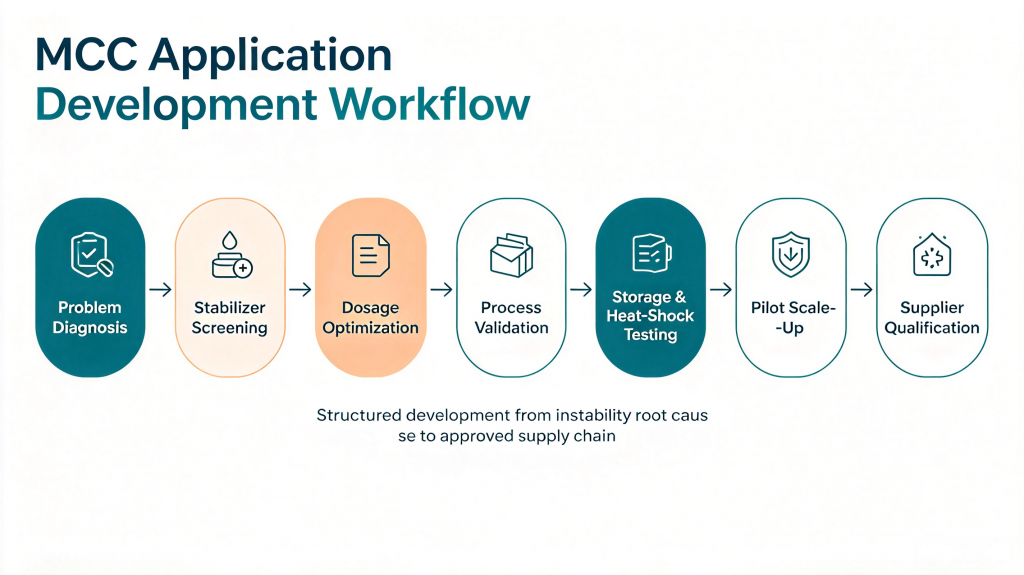
Title:Ice Cream Stabilizer Development Framework
Problem diagnosis → Stabilizer screening → Dosage optimization → Processing validation → Storage / heat-shock testing → Pilot scale-up → Supplier qualification
This Ice Cream Stabilizers Guide follows that development sequence, from initial problem diagnosis through supplier qualification.
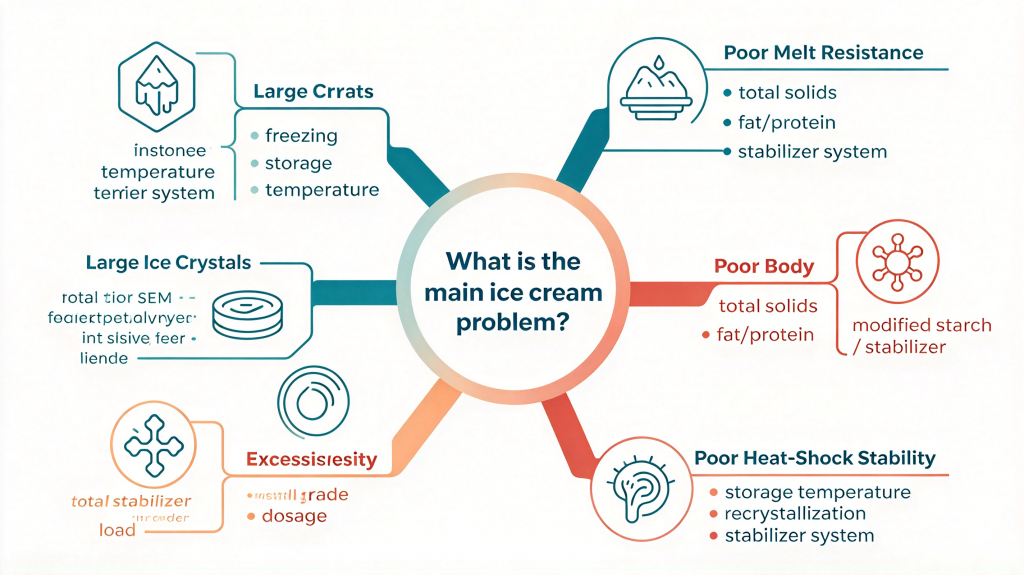
Title:Ice Cream Stabilizer Selection Decision Tree Caption:A troubleshooting framework for selecting a stabilizer system based on the main formulation problem.
| Ice Cream Problem | What Happens | Potential Stabilizer Role |
|---|---|---|
| Large ice crystals | Water migrates and crystals grow | Water management / structure |
| Rapid melting | Weak continuous phase | Improve body and melt resistance |
| Coarse texture | Poor control of water phase | Improve texture |
| Whey-off / serum separation | Weak water-binding system | Water management |
| Shrinkage | Structural instability | Support frozen matrix |
| Poor body | Low structural development | Texture and viscosity support |
| Heat-shock damage | Temperature fluctuation causes recrystallization | Help limit water mobility |
| Excessive viscosity | Too much stabilizer | Reduce or rebalance system |
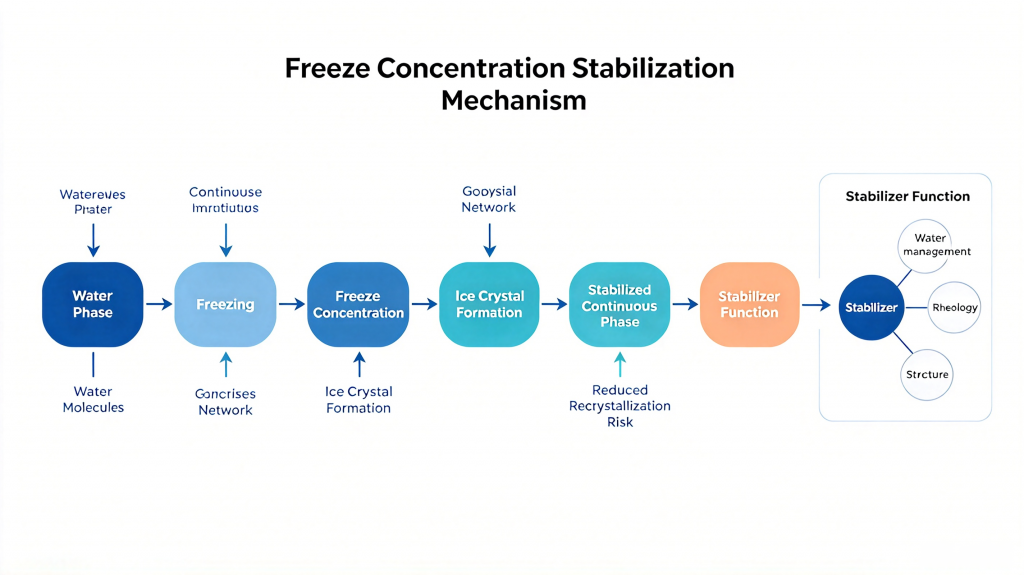
Title:How Ice Cream Stabilizers Affect the Frozen System Caption:Simplified view of water-phase concentration and stabilizer functionality during freezing.
Many ice cream stabilizers are hydrocolloid or polymeric ingredients that interact with water and the continuous phase of the product. They add no sweetness, fat, or flavor; they help control the physical behavior of the formulation.
This Ice Cream Stabilizers Guide focuses on this interaction because stabilizer performance depends on what happens to the unfrozen phase during freezing and storage. During production, part of the water freezes into ice crystals while the remaining unfrozen phase becomes increasingly concentrated with sugars, proteins, minerals, and other components. A stabilizer influences this unfrozen phase by increasing water binding and modifying its rheology, which contributes to smoother texture, better body, improved melt resistance, and more consistent storage stability. Poor homogenization, incorrect freezing conditions, an unbalanced sugar system, or repeated temperature abuse can still produce poor ice cream even when the stabilizer system is appropriate.
Stability mechanism: water phase → freezing → concentration of unfrozen phase → ice-crystal formation → storage and temperature fluctuations → potential recrystallization.
Stabilizer vs emulsifier. Stabilizers primarily manage water, viscosity, structure, and physical stability. Emulsifiers primarily influence the fat-water interface, fat destabilization, whipping properties, and air-cell structure, so adding more stabilizer will not fix a problem caused by fat destabilization or the emulsifier system.
Ice crystal growth. For an Ice Cream Stabilizers Guide, ice crystal control deserves particular attention because crystal size has a direct influence on perceived texture. Its effects can involve changes in the freeze-concentrated continuous phase, rheology, water mobility, and interactions with other formulation components, and these effects may help reduce ice recrystallization under appropriate formulation and storage conditions. Reported results vary with formulation and test conditions.
Melting behavior. Two ice creams with similar hardness after freezing can behave very differently at room temperature. Fat, protein, emulsification, overrun, and storage history all affect melt behavior, so formulators should consider these factors alongside the stabilizer system when interpreting melt tests.
Body and mouthfeel. Enough body makes ice cream feel creamy and cohesive, but more stabilizer does not automatically improve it. Excess can make the product gummy, sticky, elastic, or difficult to process.
Heat shock and storage stability. During transportation and retail handling, the product may go through cold storage → partial warming → refreezing → crystal growth, commonly called heat shock. A well-designed stabilizer system can reduce the impact but cannot offset severe temperature abuse.
This Ice Cream Stabilizers Guide compares the main stabilizer options by function rather than simply by viscosity.Different hydrocolloids produce different rheological and sensory effects, so the practical task is matching a stabilizer system to the formulation problem.
| Stabilizer | Main Functional Role |
|---|---|
| CMC | Water management / viscosity |
| Guar gum | Viscosity / body |
| Xanthan | Rheology |
| Locust bean gum (LBG) | Body / structure |
| Carrageenan | Structure / protein interaction |
| Gellan | Gel / suspension (specialty use) |
| Modified starch | Body / creaminess |
| MCC | Suspension / structure |
| Blended systems | Combined functionality |
This is a screening map, not a ranking.
These materials belong to the food ingredient and food additive system, and permitted use depends on the target market, food category, and maximum level. Confirm regulatory status for your market and product category before formulating. The following sections of this Ice Cream Stabilizers Guide focus on how these ingredients behave in practical formulation rather than treating them simply as viscosity modifiers.
microcrystalline cellulose can be evaluated as part of a stabilizer system when the formulation needs additional structure, body, or suspension-related functionality. MCC can contribute through dispersed-particle structure and suspension rather than relying primarily on increasing the viscosity of the water phase. It can also provide network-like functionality, depending on grade, concentration, dispersion, and the surrounding formulation.
| MCC | CMC | |
|---|---|---|
| Primary mechanism | Dispersed-particle structure / suspension (grade- and process-dependent) | Water-soluble thickening |
| Main contribution | Structure, body, particulate stabilization | Viscosity, water binding, melt control |
| Works well alongside | CMC (as colloidal MCC) | MCC, guar, LBG, modified starch |
MCC should not be evaluated as a one-for-one replacement for CMC. CMC is a water-soluble polymer used mainly for viscosity and water management, while MCC can contribute particle-based structure, suspension, and body. When both functions are needed, a colloidal MCC system can combine them, with final dosage and performance established through formulation trials rather than substitution by weight.
| MCC | CMC | Modified Starch |
|---|---|---|
| Particle structure | Water-soluble thickening | Body & creaminess |
| Suspension | Water management | Texture |
| Body | Rheology | Fullness |
Title:MCC vs CMC vs Modified Starch in Ice Cream Caption:Functional comparison of MCC, CMC, and modified starch in ice cream formulations.
MCC may be relevant when the formulation needs suspension or particulate stabilization on top of water-phase viscosity control, for example with cocoa, nut pieces, fruit particles, or mineral fortification that requires improved physical distribution and stability.
Colloidal MCC . A colloidal MCC system combines MCC with CMC. MCC can contribute dispersed-particle structure and network-like functionality, while CMC contributes water management and rheological control. For the colloidal MCC system discussed here, MCC is combined with CMC to provide complementary structure, suspension, and rheological functionality.Performance depends on the MCC grade, CMC level, total solids, fat content, and target sensory profile, so the complete system needs to be evaluated; raising one component does not automatically improve stability.
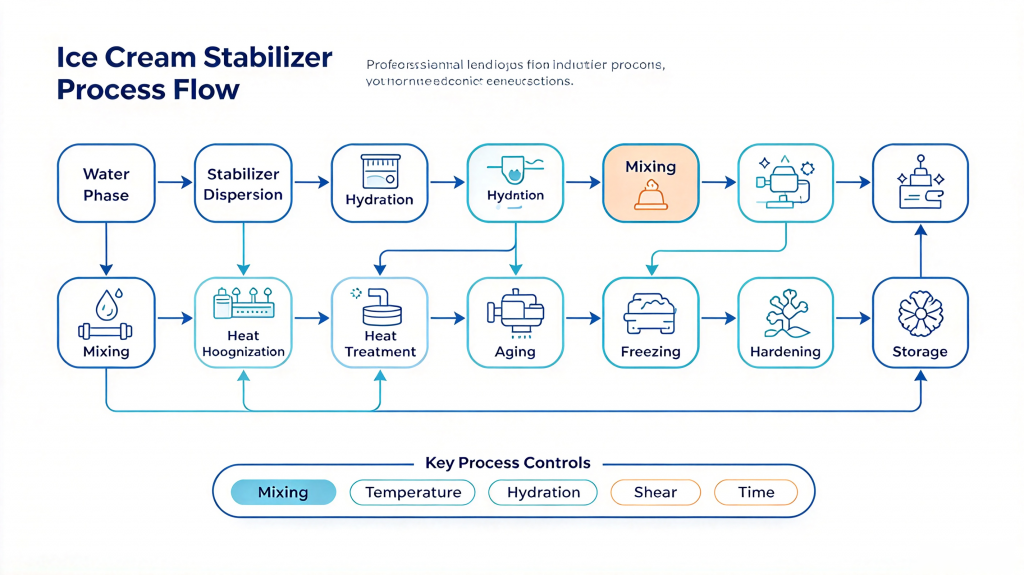
Title:Ice Cream Stabilizer Processing Flow Caption:Processing sequence showing stabilizer dispersion, hydration, homogenization, aging, freezing, and storage.
This section covers how the individual ingredients actually differ. Mechanisms differ even when all are called hydrocolloids
CMC is a water-soluble polymer commonly used for water management and viscosity control, and it can contribute to physical stability during storage.
Guar gum builds substantial viscosity at low concentration and adds water binding and body.
Xanthan gum has a strong rheological effect at low dosage, with a distinctive mouthfeel that becomes less clean if overused.
Carrageenan behaves differently from the others because its performance depends on interactions with proteins and minerals, so it should be judged in the specific dairy or non-dairy system.
Modified starch contributes body, texture, and creaminess, and is often useful in reduced-fat formulations.
Locust bean gum (LBG) contributes to water management and body and is frequently paired with other hydrocolloids.
| Stabilizer | Potential Contribution | Main Development Consideration |
|---|---|---|
| CMC | Body, melt resistance, serum control | Excess may create gummy texture |
| Guar gum | Creaminess, body | Viscosity can rise rapidly |
| Xanthan gum | Suspension and structure | Distinct rheological mouthfeel |
| Carrageenan | Serum control, protein interaction | Strongly formulation-dependent |
| Modified starch | Creaminess, fullness | May not address suspension issues |
| LBG | Body, creaminess, texture | Hydration and processing matter |
When comparing two systems, evaluate mix viscosity, hydration behavior, overrun, melt resistance, texture, ice crystal perception, storage stability, and cost per metric ton of finished product together.
A single hydrocolloid can sometimes provide the required functionality. Blends become worth evaluating when one ingredient cannot cover every function without excessive viscosity, and each component then needs a defined role.
| Combination | What Each Ingredient Contributes | Main Point to Watch |
|---|---|---|
| CMC + MCC | CMC: viscosity and water management; MCC: suspension and particulate stabilization | Optimum ratio is formulation-specific |
| Colloidal MCC / MCC Gel | MCC with CMC for suspension, structure, and body | Relevant with particulates, plant-based solids, cocoa, or mineral fortification |
| CMC + guar gum | CMC manages water; guar adds thickening and body | Excessive viscosity if both are raised together |
| CMC + modified starch | CMC manages water; starch adds body and fullness | Useful when hydrocolloid viscosity alone creates an undesirable mouthfeel |
| MCC + modified starch | MCC: suspension and structure; starch: body and creaminess | Relevant for reduced-fat, plant-based, or particulate products |
| Guar + LBG | Combined body and texture | Heavy or gummy mouthfeel if the network becomes too strong |
| Xanthan in a blend | Adds rheology at low dosage | Small changes can noticeably shift mouthfeel |
CMC + guar + xanthan does not behave as three independent ingredients, so total hydrocolloid load matters. When adding a function, reduce an overlapping one and retest the complete system. Chasing the highest possible viscosity can yield a product that is technically stable but commercially unattractive.
| Blend Symptom | Likely Cause | What to Check First |
|---|---|---|
| Overly thick | Redundant functionality, excessive hydration, or shear history | Confirm processing and actual dosage, measure each component’s contribution, retest the frozen product |
| Weak | Under-dosed component, incomplete hydration, or missing suspension function | Verify dispersion and hydration before raising total dosage |
A new stabilizer should be added only when its intended function is clear. Before adding another stabilizer, define the function it is expected to provide. Record that function alongside the grade and dosage used during trials. This becomes useful during scale-up and later supplier qualification.
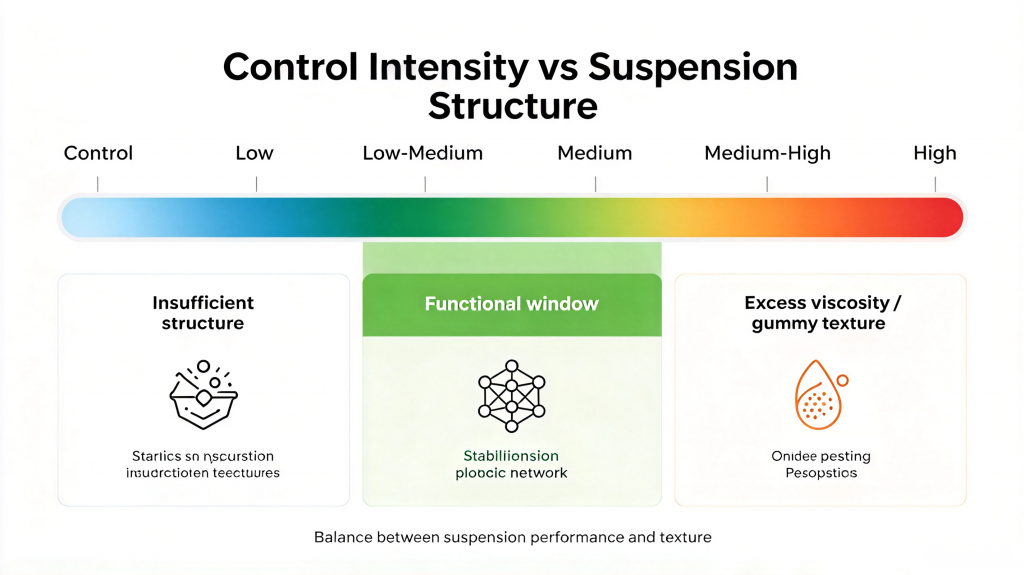
Title:Ice Cream Stabilizer Dosage Optimization Caption:Screening stabilizer dosage to identify the functional range before commercial formulation.
As this Ice Cream Stabilizers Guide shows, dosage should be optimized against the complete formulation rather than selected from a generic percentage range..In development work, the useful dosage is usually the lowest level that meets the texture and storage requirements without creating an undesirable mouthfeel. Published dosages are screening references, not commercial guarantees.
One of the most important formulation questions addressed in this Ice Cream Stabilizers Guide is dosage. Too little stabilizer may give weak body, poor melt resistance, or excessive ice crystal growth; too much can cause excessive viscosity, gummy texture, or difficult processing.
| Variable | How It Connects to Dosage |
|---|---|
| Hydration | Incomplete hydration can make a stabilizer look under-dosed; once hydration improves, the same dosage may become excessive |
| Shear | Laboratory high shear and commercial lower shear can make the same dosage behave differently |
| Temperature | Addition, hydration, heating, and cooling profiles change how much functionality is delivered |
| Total solids | Low-solids formulations may need additional structural support, but the right level still depends on sugar, fat, protein, and processing |
| Sugar | Sugar affects freezing point and hardness, so a sugar reduction can look like a stabilizer problem |
| Fat | Reduced fat may need system-level rebalancing, not simply more hydrocolloid |
| Protein | Dairy and plant proteins interact with hydrocolloids differently, so dosage does not transfer automatically |
| Overrun | A system that works at one overrun may behave differently at another |
Revalidate the same grade whenever the base formulation changes.
Establish a control, choose one candidate system, and test low, medium, and high dosage with the rest of the formulation held constant.
| Trial | Stabilizer Level | Main Observation |
|---|---|---|
| Control | 0% | Baseline |
| A | Low | Initial functional response |
| B | Low–medium | Body and stability |
| C | Medium | Structure and melt |
| D | Medium–high | Viscosity trade-off |
| E | High | Check for over-stabilization |
The actual low, medium, and high levels should come from the supplier’s recommended screening range and the formulation’s total stabilizer load; they are not universal dosage categories.
Change stabilizer type and dosage in separate steps: compare types at a fixed dosage first, select the promising system, then optimize dosage, and finally the complete formulation.
| Too Low | Too High | |
|---|---|---|
| Texture | Weak body, larger ice crystals | Gummy, elastic, heavy mouthfeel |
| Melt / serum | Rapid melting, serum separation | Reduced flavor release, poor melt behavior |
| Processing | Poor storage texture | Difficult pumping, difficult air incorporation |
These symptoms do not prove dosage is the cause: slow freezing can also produce large ice crystals, and fat content and overrun influence melt. Diagnose the whole system first.
Viscosity is not the final answer
| Formula | Viscosity | Ice Crystal Control | Melt Resistance | Sensory |
|---|---|---|---|---|
| A | Low | Moderate | Moderate | Smooth |
| B | Medium | Good | Good | Creamy |
| C | High | Good | Good | Gummy |
For a smooth and creamy target, Formula C would not be selected despite its higher viscosity.
About each candidate, identify a practical functional window (below it, structure is insufficient; within it, performance is acceptable; above it, texture becomes undesirable) and define the acceptance criteria before testing, so the standard cannot shift after the results are known. About colloidal MCC / MCC Gel, optimize the MCC-to-CMC ratio as well as total dosage.
The same stabilizer can perform differently when mixing sequence, temperature, shear, or hydration time changes, so the stabilizer and the process are best evaluated as one system under controlled ice cream processing conditions.
Most stabilizers are used at low concentrations, so small dispersion problems have a large effect. If added too quickly, the powder surface can hydrate rapidly while the interior remains dry, increasing the risk of lump formation.. A typical process framework is: water phase → stabilizer dispersion → hydration → sugar and dry ingredients → fat/protein phase → homogenization → heat treatment → aging → freezing. It is a framework, not a fixed recipe. Grade comparisons need identical processing: Grade A mixed for 10 minutes under high shear against Grade B mixed for 2 minutes under low agitation measures grade plus process, not grade alone.
“3,000 rpm” says little, because the result also depends on impeller diameter, mixer geometry, batch volume, and power input. Tip speed can be estimated with:
Tip speed = π × impeller diameter × rpm / 60
When the impeller diameter is in meters, the result is in meters per second. Tip speed is useful for comparing mixing conditions, but it still does not fully describe mixing performance, because impeller geometry, power input, batch geometry, and fluid properties also affect dispersion and hydration. When transferring from laboratory to pilot or commercial production, record these along with hydration time. Dispersion distributes the stabilizer through the liquid; hydration lets it develop its functional properties.
Homogenization cannot correct lumps that have already formed, so dispersion comes first. Heat treatment can change protein interactions and stabilizer functionality, so evaluate under the heat treatment used in the final product. Aging lets the formulation reach a more stable physical state. Recording viscosity and appearance before heating, after heating, after aging, after freezing, and after storage shows where instability actually develops.
During freezing the unfrozen phase becomes progressively more concentrated while air is incorporated, so a mix that looks stable beforehand may still yield coarse crystals, rapid meltdown, or poor scoopability.
| Variable | What to Record | Why It Matters |
|---|---|---|
| Mixing | Time / equipment / speed | Powder dispersion |
| Hydration | Time / temperature | Hydrocolloid functionality |
| Heating | Temperature / holding time | Hydration and ingredient interactions |
| Homogenization | Pressure / passes | Fat dispersion |
| Aging | Time / temperature | Stabilizer and fat development |
| Freezing | Draw temperature / time | Ice formation and overrun |
| Storage | Temperature / duration | Long-term stability |
Troubleshooting order: powder incorporation → hydration → mix viscosity → homogenization → freezing conditions → storage → only then reconsider grade, dosage, or combination.
During development, record the stabilizer together with the formulation and process conditions used in the trial. Otherwise, a change in mixing, hydration, or freezing can easily be mistaken for a difference between grades.
| Test | What It Shows |
|---|---|
| Mix viscosity | Baseline hydrocolloid development after full hydration |
| Overrun | Air incorporation; must be controlled when comparing stabilizers |
| Hardness | Related to but distinct from scoopability |
| Melt rate | How quickly structure is lost; not the same as melt quality |
| Ice crystal size | Sensitive to temperature history and difficult to evaluate consistently |
| Heat-shock response | Behavior after controlled temperature cycling, not just constant storage |
| Serum separation | Water-binding adequacy of the continuous phase |
| Suspension | For MCC / colloidal MCC systems, whether particulates or fortification stay evenly distributed |
| Sensory | Blind, consistent-scale evaluation of the frozen product, not the liquid mix |
A useful Ice Cream Stabilizers Guide should not stop at formulation; performance also needs to be measured in the finished product. Ice crystal measurement depends on sampling, temperature history, and test conditions, so results are comparable only under consistent methods.
Defining acceptance criteria before testing turns the trial into a qualification against predefined targets rather than an informal comparison.For commercial development, the approach described in this Ice Cream Stabilizers Guide should therefore look beyond mix viscosity and evaluate the finished frozen product under controlled storage conditions.
| Parameter | Acceptance Criteria |
|---|---|
| Mix viscosity | Defined target range |
| Overrun | Within the predefined target range |
| Melt rate | Compared with the control |
| Ice crystal perception | No unacceptable coarseness |
| Sensory | Meets internal panel target |
| Storage | No unacceptable deterioration over the test period |
An example early-development schedule is Day 0, Day 7, Day 14, and Day 30, extended according to the intended shelf life.
| Parameter | Day 0 | Day 7 | Day 14 | Day 30 |
|---|---|---|---|---|
| Appearance | ✓ | ✓ | ✓ | ✓ |
| Hardness | ✓ | ✓ | ✓ | ✓ |
| Melt behavior | ✓ | ✓ | ✓ | ✓ |
| Ice crystal perception | ✓ | ✓ | ✓ | ✓ |
| Sensory | — | ✓ | ✓ | ✓ |
Run a controlled temperature-fluctuation study alongside constant storage, since a product can hold up under constant conditions and still deteriorate under repeated temperature abuse. Accelerated testing does not exactly predict commercial shelf life.
Does it disperse and hydrate correctly? → Does it process correctly? → Does it improve the frozen product? — Does the improvement survive storage? → Is the performance commercially repeatable?
Stability does not end when the product leaves the freezer. After laboratory screening, repeat the selected system at pilot scale and then in commercial production. Record any changes in viscosity, overrun, melt behavior, and storage performance at each stage.
Price per kilogram is only part of the calculation. A more useful metric is cost per metric ton of finished product:
Cost per kg of finished product = stabilizer price per kg × dosage fraction
For example, a stabilizer at $4/kg used at 0.25% costs $4 × 0.0025 = $0.01/kg, or $10 per metric ton.
| Supplier | Price | Dosage | Cost / Metric Ton Finished Product |
|---|---|---|---|
| A | $3/kg | 0.50% | $15 |
| B | $4/kg | 0.25% | $10 |
| C | $5/kg | 0.20% | $10 |
These figures are illustrative. Supplier A has the lowest price per kilogram but the highest cost contribution at the selected dosage. For blends, calculate the total stabilizer system.
For procurement, calculate the cost at the dosage actually required to reach the target performance. Include freight, packaging, waste, and rejected batches when the difference between suppliers is small. That includes freight, packaging, waste, rejected batches, and customer complaints, since a slightly more expensive stabilizer that allows a lower dosage and more consistent production can carry better overall economic value.
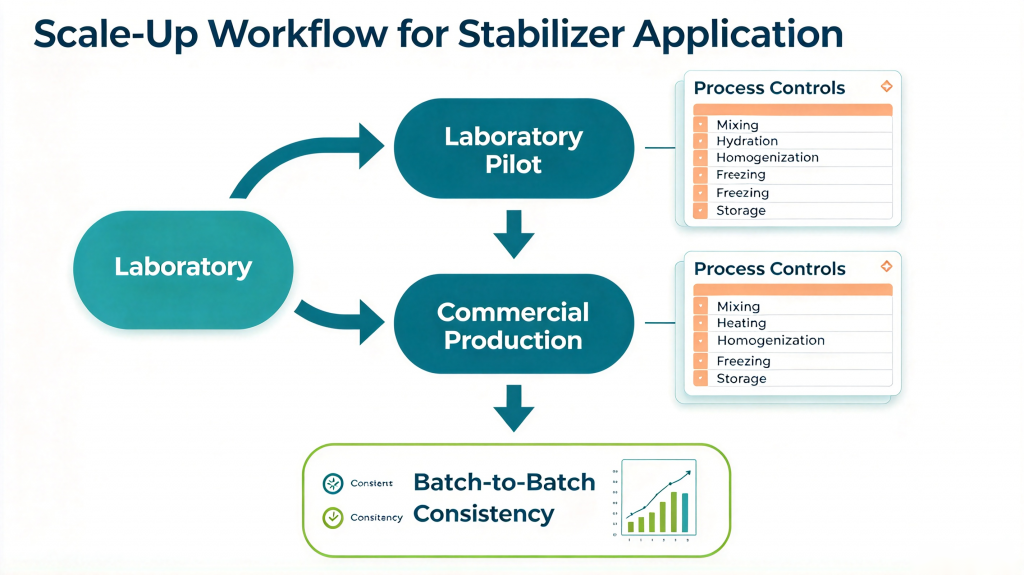
Title:Ice Cream Stabilizer Scale-Up and Troubleshooting Caption:Key process variables to compare when transferring an ice cream stabilizer system from laboratory to commercial production.
Mixing, hydration, heating, homogenization, freezing, and storage can all change at scale even when nominal equipment settings look similar, so a stabilizer that works in the laboratory can behave differently in production.
| Commercial Symptom | Likely Cause | First Step |
|---|---|---|
| Lower viscosity than the lab mix | Incomplete hydration, lower effective shear, shorter hydration time | Compare the process before increasing dosage |
| Excessive viscosity | Excessive hydration, longer holding time, ingredient variation | Diagnose before reformulating |
| Poor suspension at production scale | Particle size, dispersion, or holding time; for MCC/colloidal MCC, confirm the colloidal structure actually developed | Compare mixing and holding conditions against the lab |
| Gummy texture after scale-up | Higher effective hydration or process-related viscosity increase | Compare the commercial mix against the lab mix |
| Poor overrun | Stabilizer, but also freezer conditions, emulsifier, or fat | Investigate overrun as a system property |
| Good mix, poor finished product | Stabilizer evaluated only at the liquid-mix stage | Validate the frozen, stored product |
Establish critical process parameters and a reference production batch before scale-up, and monitor the first several commercial batches closely. If the grade and process are changed at the same time, it becomes difficult to identify which change caused the production result. If a supplier needs to help troubleshoot, send the formulation, the lab and plant process conditions, recent COAs, and a clear description of how the commercial result differs from the laboratory result.
| Product Type | Main Formulation Consideration | Typical Stabilizer Focus |
|---|---|---|
| Standard dairy ice cream | Fat and milk solids already provide body | Balance melt behavior and ice crystal control |
| High-fat / premium | Fat contributes substantial structure | Evaluate viscosity, melt behavior, and sensory balance rather than assuming more stabilizer is needed |
| Low-fat / economy | Removing fat also removes structure | Additional body support may be required; modified starch is one option to evaluate alongside the complete system |
| Plant-based (oat, soy, pea, coconut, almond) | Protein, oil, and solids behave differently from dairy | Screen each protein source separately |
| High-protein | Protein interacts with hydrocolloids and heat treatment | Careful grade and dosage screening |
| Reduced-sugar | Sugar affects freezing point, not just sweetness | Whole-formulation adjustment |
| Fruit / particulate-containing | Particles need to stay suspended | Suspension-focused systems such as colloidal MCC |
| Chocolate / nut-based | Particles need strong suspension support | Evaluate suspension separately from viscosity |
| Mineral-fortified | Minerals can interact with protein and stabilizer | Check mineral compatibility |
| Soft serve | Dispensing temperature and behavior are critical | Must work at serving temperature, not only frozen storage |
| Frozen yogurt | Different protein and acidity profile | Evaluate hydrocolloid–protein interaction at the product’s pH |
| Sorbet / water-based desserts | No dairy fat or protein to provide body | Stabilizer contribution to body and ice-crystal control is proportionally larger |
A system that works for oat will not necessarily work for pea or almond. For plant-based systems, see our guide to plant-based beverage stabilizers.
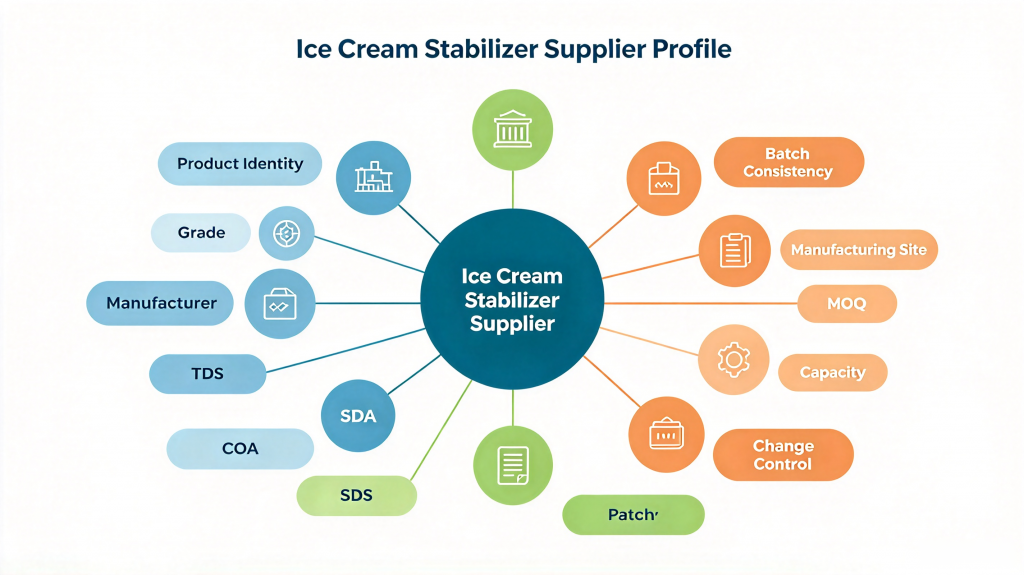
Title:Ice Cream Stabilizer Supplier Qualification Checklist Caption:Key documentation and supply-chain checks before approving an ice cream stabilizer supplier.Supplier qualification is the final step in turning the technical recommendations in this Ice Cream Stabilizers Guide into a reproducible commercial system.
A good laboratory trial can still fail commercially if the supplier cannot deliver the same material every time, which matters even more for blends.Supplier review should cover the manufacturing site, grade identity, specifications, batch documentation, and change-control procedure.
| Qualification Item | What to Ask | Why It Matters |
|---|---|---|
| Product identity | Single ingredient / colloidal system / premixed blend | Prevents material mismatch |
| Exact grade identity | Is the quoted grade the same grade used in the sample and the commercial shipment? | Prevents substitution between samples, quotations, and production material |
| Manufacturer vs trading company | Who actually produces the material | Clarifies traceability, documentation, and change control |
| TDS, COA, SDS | Specifications, batch results, safety data | Review together; a specification range is not a batch’s typical value |
| Sample COA | COA for the exact sample batch | Connects the trial to commercial material |
| Batch consistency | Review three or more consecutive COAs where practical | Helps assess normal batch-to-batch variability |
| Manufacturing site | Actual production location; in-house vs repacked blends | Supports traceability |
| MOQ and capacity | Standard MOQ, monthly supply capacity | Supports procurement planning |
| Change control | Material and process change notification | Protects the formula |
A successful laboratory sample is only the beginning. Before commercial approval, confirm that production material matches the evaluated sample in grade, specification, and manufacturing site, since a blend can drift out of balance even when each component still meets its own specification. Record the exact stabilizer identity, grade, and supplier once the formula works. When a stability complaint occurs, compare COA, solids, dosage, hydration, and processing between good and problem batches; the cause often lies in process variation rather than the ingredient.
reluctance to provide a sample-specific COA, no clear answer about the manufacturing site, or a grade recommendation based only on the product name rather than your formulation details.
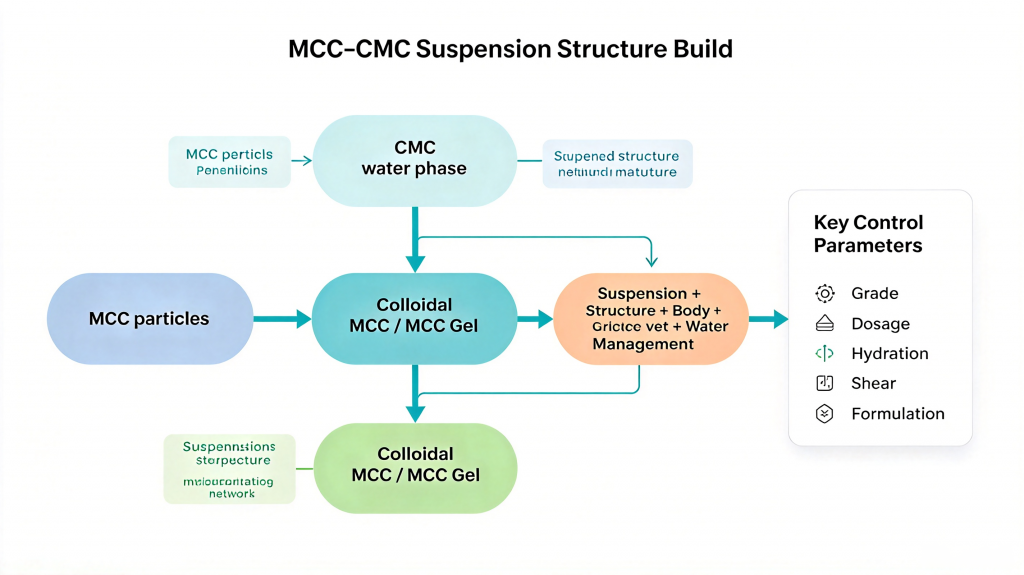
Title:MCC + CMC Stabilizer System for Ice Cream Caption:MCC contributes dispersed-particle structure while CMC contributes water management and rheological control.
ACTA supplies MCC, colloidal MCC / MCC Gel , CMC, and modified starch for food applications, with candidate grades evaluated according to formulation and processing requirements. For ice cream development, this can include colloidal MCC systems or MCC + CMC combinations, depending on the formulation requirements. Customers should confirm the final grade and dosage through their own formulation and process rather than relying on a general product description.
ACTA can provide:
For R&D teams: send your ice cream base, total solids, fat level, current stabilizer system, processing conditions, and main stability problem for an initial screening discussion.
For procurement teams: once a candidate grade is identified, request the TDS, sample COA, packaging information, MOQ, and quotation together.
| Parameter | Record Before Trial / RFQ |
|---|---|
| Total solids | ___ % |
| Fat | ___ % |
| Sugar system | ___ |
| Protein source and level | ___ |
| Current stabilizer system | ___ |
| Current dosage | ___ % |
| Homogenization conditions | ___ |
| Heat treatment | ___ |
| Freezing / draw temperature | ___ |
| Overrun target | ___ |
| Storage temperature | ___ |
| Main failure | ___ |
| Target monthly volume | ___ |
| Replacement or new system? | ___ |
Providing this information before requesting samples helps suppliers recommend more relevant candidate grades and reduces unnecessary trial cycles. If homogenization, freezing conditions, or storage temperature drive the problem, those need attention too; a stabilizer is not always the whole solution.
What do ice cream stabilizers do?
They help control water behavior, ice crystal growth, body, texture, melt resistance, and storage stability.
How much stabilizer should I use in ice cream?
There is no universal dosage. Screen low, medium, and high levels in your own formulation.
What is the difference between MCC and CMC in ice cream?
MCC can contribute dispersed-particle structure and suspension; CMC is water-soluble and mainly manages viscosity and water binding. Many colloidal MCC systems combine both.
Can colloidal MCC replace CMC in ice cream?
Not automatically. Colloidal MCC already contains CMC, so replacing standalone CMC changes the total stabilizer profile and should be re-screened rather than substituted one-for-one.
Should I use a single stabilizer or a blend?
A single ingredient can be enough if it meets every requirement at an acceptable dosage. A blend is worth evaluating when one hydrocolloid cannot provide every function without excessive viscosity.
Why does my ice cream still get icy after adding a stabilizer?
Common causes include poor dispersion, insufficient hydration, weak homogenization, and temperature fluctuation in storage, not only insufficient dosage.
Why did a stabilizer work in the lab but not in production?
Scale-up changes mixing, hydration, and freezing even when nominal settings look the same. Compare the process step by step before changing the formulation.
How do I qualify an ice cream stabilizer supplier?
Compare technical performance, batch consistency, documentation, application support, and change control, not price per kilogram alone.
A successful ice cream stabilizer system depends on more than the ingredient itself. Grade selection, dosage, dispersion, hydration, homogenization, freezing conditions, storage temperature, and supplier consistency all affect the final result.For commercial development, the selected system should be confirmed through laboratory testing, pilot production, and commercial validation.
Qingdao ACTA Biotechnology Co., Ltd. supplies MCC, colloidal MCC / MCC Gel, CMC, and modified starch for food applications. We can support candidate grade screening, samples, TDS, sample COA, packaging information, MOQ, and quotation.
Send us:
Optional: draw temperature, overrun target, aging time, storage temperature.
Always confirm the final stabilizer system, dosage, and process through your own formulation, sensory evaluation, and shelf-life validation.
