

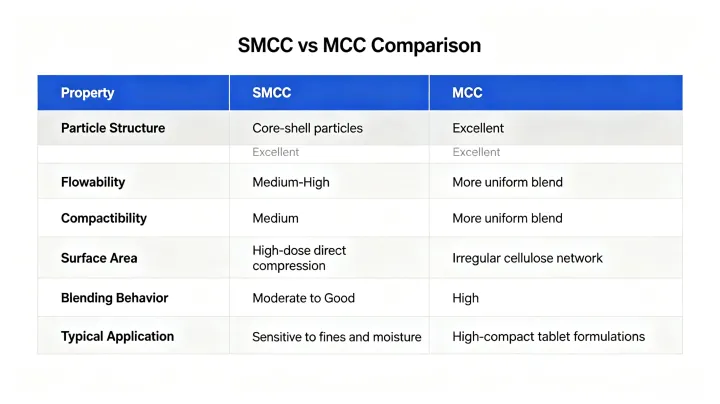
SMCC vs MCC is an important consideration for pharmaceutical manufacturers selecting direct compression excipients for tablet manufacturing. Choosing between these two cellulose-based excipients can directly influence tablet hardness, powder flowability, compression speed, production efficiency, and manufacturing cost.
Many manufacturers select Microcrystalline Cellulose (MCC) because of its excellent binding ability and proven compression performance. However, as tablet production becomes faster and formulations become more complex, challenges such as poor powder flow, inconsistent die filling, blend segregation, and compression instability may appear.
This creates an important formulation question:
Should manufacturers continue using traditional MCC, or choose Silicified Microcrystalline Cellulose (SMCC) for improved manufacturing performance?
This guide compares SMCC vs MCC in terms of composition, tablet hardness, powder flowability, compression performance, applications, and selection criteria to help pharmaceutical manufacturers choose the right direct compression excipient.
SMCC, also known as Silicified Microcrystalline Cellulose, and MCC are not simply competing excipients. Both provide excellent compression properties, but they solve different formulation challenges.. Both provide excellent compression properties, but they solve different formulation challenges. MCC remains a preferred choice when strong binding and tablet hardness are the main priorities, while SMCC provides additional advantages in powder flow, processing consistency, and high-speed tablet manufacturing.
This guide compares SMCC vs MCC as direct compression excipients, covering composition, compression performance, tablet hardness, powder flow, and selection criteria.
| Feature | MCC | SMCC |
|---|---|---|
| Full Name | Microcrystalline Cellulose | Silicified Microcrystalline Cellulose |
| Feature | MCC | SMCC |
|---|---|---|
| Full Name | Microcrystalline Cellulose | Silicified Microcrystalline Cellulose |
| Composition | Purified cellulose | MCC + colloidal silicon dioxide |
| Main Function | Binder and compression aid | Binder + flow enhancer |
| Compression Performance | Excellent | Excellent |
| Tablet Hardness | Excellent | Excellent |
| Powder Flowability | Good | Improved |
| Die Filling | Good | Better |
| High-Speed Tableting | Suitable | Highly suitable |
| Manufacturing Robustness | Good | Higher |
| Cost | Lower | Higher |
| Best Application | Standard direct compression tablets | Complex formulations and high-speed production |
Selecting the right cellulose excipient depends on API properties, tablet weight, compression speed, target hardness, and manufacturing conditions.
ACTA technical team can help evaluate:
Suitable MCC grade selection
SMCC suitability assessment
Direct compression optimization
Technical document support
Send your formulation requirements and receive professional excipient recommendations.
MCC is usually preferred when tablet hardness and binding performance are the main priorities, while SMCC is often selected when improved powder flow and manufacturing efficiency are required.
| Requirement | Recommended Excipient |
| Strong binding | MCC |
| High tablet hardness | MCC PH101 |
| Balanced performance | MCC PH102 |
| Better flowability | SMCC |
| High-speed production | SMCC |
Our technical team can recommend suitable cellulose excipients based on your API characteristics, tablet requirements, and compression process. [Request technical support from ACTA →]
Tablet performance depends on more than compression force alone — excipient selection, product consistency, and technical support from the supplier all play an equally important role in commercial tablet manufacturing.
As a cellulose-based pharmaceutical excipient manufacturer, ACTA provides pharmaceutical-grade MCC including MCC PH101, PH102, and PH301 for direct compression applications, supporting pharmaceutical and nutraceutical manufacturers worldwide:
✓ MCC grade selection ✓ MCC PH101, PH102, and PH301 recommendations, together with SMCC specification evaluation based on formulation requirements. ✓ Direct compression formulation evaluation ✓ Compression performance optimization ✓ COA, TDS, SDS, and regulatory document support ✓ Sample testing assistance
For manufacturers comparing SMCC vs MCC, selecting the right excipient requires weighing several technical factors together, including API characteristics, tablet hardness requirements, production speed, powder flow needs, lubricant concentration, and final dosage form performance. A reliable pharmaceutical excipient supplier should therefore offer not only consistent material quality but also the technical guidance manufacturers need to achieve stable tablet production.
Microcrystalline Cellulose (MCC) ranks among the most widely used pharmaceutical excipients in modern tablet manufacturing, particularly in direct compression formulations. Because pharmacopeial monographs such as the United States Pharmacopeia (USP) define its quality standards, MCC enjoys broad regulatory acceptance across global markets.
MCC is a purified, partially depolymerized cellulose derived from high-quality cellulose raw materials. Manufacturers rely on it as a multifunctional excipient because it delivers excellent compressibility, strong dry binding capability, good chemical stability, high compatibility with active pharmaceutical ingredients (APIs), and improved tablet mechanical strength — all in a single ingredient.
Unlike traditional binders that mainly rely on adhesive forces, MCC strengthens tablets through its unique physical behavior during compression. When compression pressure is applied, MCC particles undergo plastic deformation, which lets them form larger contact areas and stronger interparticle bonding networks. This compression behavior explains why MCC remains a preferred excipient for immediate-release tablets, nutraceutical tablets, vitamin and mineral tablets, and broader oral solid dosage formulations.
SMCC (Silicified Microcrystalline Cellulose) is a co-processed pharmaceutical excipient created by combining Microcrystalline Cellulose with Colloidal Silicon Dioxide (CSD).As a Silicified Microcrystalline Cellulose-based direct compression excipient, SMCC combines the compactibility of MCC with improved powder flow characteristics. Unlike standard MCC, which consists mainly of purified cellulose particles, SMCC introduces a small amount of colloidal silicon dioxide into the MCC structure to enhance specific processing characteristics — namely powder flowability, handling performance, mixing uniformity, and direct compression efficiency.
Because SMCC retains MCC’s excellent compression properties while adding these flow-related benefits, it becomes a valuable option for manufacturers facing poor powder flow, inconsistent die filling, high-speed tablet production demands, or complex formulations containing multiple ingredients. In modern pharmaceutical manufacturing, tablets increasingly need to achieve more than mechanical strength alone — they must also support stable manufacturing performance, consistent tablet weight, reliable production efficiency, and fewer processing problems. SMCC was developed precisely to help formulators meet these broader goals.
The SMCC vs MCC comparison table below summarizes how these two direct compression excipients compare across the factors that matter most in tablet production.
| Comparison Factor | MCC | SMCC |
| Material type | Cellulose-based excipient | Co-processed cellulose excipient |
| Main components | Microcrystalline cellulose | MCC + colloidal silicon dioxide |
| Primary function | Binder and compression aid | Binder plus flow enhancer |
| Compression performance | Excellent | Excellent |
| Plastic deformation | Strong | Strong |
| Powder flowability | Good | Improved |
| Die filling performance | Good | Better |
| High-speed compression | Suitable | Highly suitable |
| Formulation robustness | Good | Higher |
| Cost level | More economical | Usually higher |
MCC’s performance stems mainly from its porous particle structure, plastic deformation ability, strong hydrogen bonding, and excellent compactibility — during compression, its particles deform and create strong bonding networks throughout the tablet. SMCC, by contrast, contains both microcrystalline cellulose and colloidal silicon dioxide. The silica component doesn’t replace MCC’s compression function; instead, it enhances powder movement, flow characteristics, and processing stability. In simple terms, MCC focuses on compression performance, while SMCC combines that same compression performance with improved powder handling.
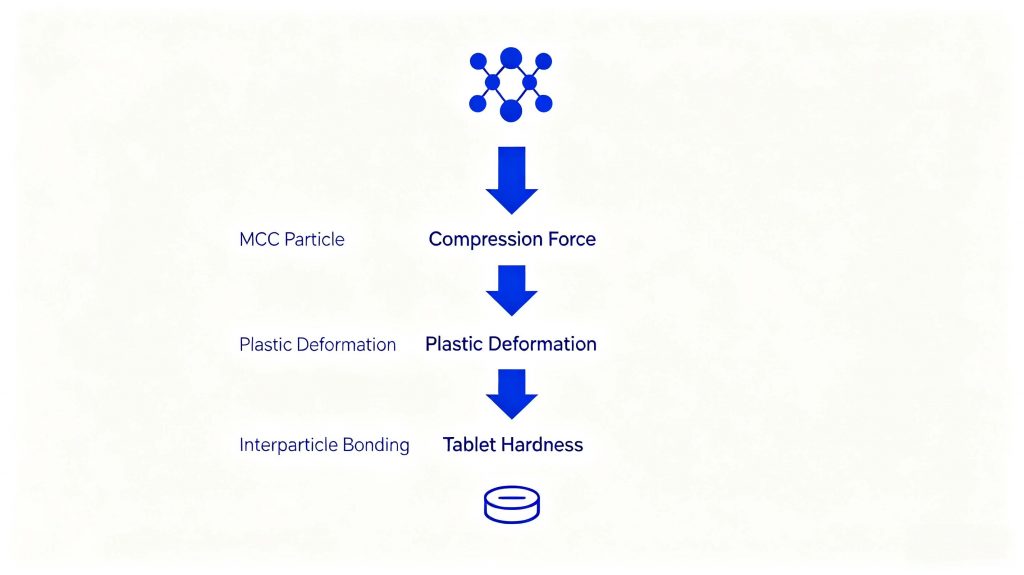
Both MCC and SMCC uSMCC generally maintains MCC’s excellent compression properties while improving powder flow characteristics and processing consistency.
Powder flow is where SMCC distinguishes itself most clearly. MCC generally offers acceptable flowability, but its porous structure and strong intermolecular interactions can limit flow in certain formulations, especially as production speed increases or when multiple powders are blended together. SMCC addresses this limitation directly: the colloidal silicon dioxide reduces particle-to-particle friction, which improves powder feeding, produces more consistent die filling, and supports greater production stability.The improved flow performance of Silicified Microcrystalline Cellulose makes it especially useful for formulations requiring consistent powder feeding and reliable die filling.
Many formulators ask whether SMCC produces harder tablets than MCC. The honest answer is not necessarily. MCC improves hardness through plastic deformation, increased contact area, and interparticle bonding, resulting in high tensile strength, good mechanical stability, and low friability. SMCC maintains these same advantages because its MCC component still performs the same deformation and bonding functions. Its real benefit isn’t necessarily stronger tablets — it’s more consistent compression performance under challenging manufacturing conditions such as high-speed tablet presses, poor-flowing formulations, or complex powder blends.
Because SMCC improves powder feeding and die filling consistency, it tends to deliver better manufacturing efficiency on high-speed rotary presses and in large-scale commercial production. MCC, meanwhile, remains highly efficient for simpler, cost-sensitive formulations where powder flow isn’t a limiting factor. Consequently, the “more efficient” choice depends entirely on the production environment rather than on the excipient alone.
Cost remains a practical consideration alongside technical performance. MCC generally carries a lower raw material cost, wide availability, and a long pharmaceutical application history, which makes it the more economical choice for straightforward, cost-sensitive formulations. SMCC, because it requires additional co-processing with colloidal silicon dioxide, usually costs more per kilogram.
However, the real comparison shouldn’t stop at raw material price. Manufacturers should weigh the total cost of manufacturing — including production efficiency, tablet rejection rate, machine downtime, and process optimization effort — against the purchase price. A slightly more expensive excipient can still lower overall costs if it reduces production interruptions, cuts trial-and-error time, or improves batch consistency on a high-speed line. For that reason, cost-conscious manufacturers should evaluate SMCC’s flow benefits against MCC’s lower price point in the context of their specific production environment, rather than defaulting to whichever material looks cheaper on paper.
In the SMCC vs MCC comparison, cost remains a practical consideration alongside technical performance.
Understanding how MCC strengthens tablets helps explain why it remains foundational to direct compression, even as SMCC gains popularity. Tablet compression isn’t simply the act of applying pressure to powder — it involves particle rearrangement, particle deformation, interparticle bonding, and tablet consolidation, and MCC performs strongly at each stage.
Step 1: Particle Rearrangement. At the start of compression, powder particles move and rearrange to fill empty spaces within the powder bed. Because MCC particles have a porous structure, they pack efficiently and deform readily, which helps create a more uniform tablet matrix from the outset.
Step 2: Plastic Deformation. This is the most important mechanism behind MCC’s binding ability. As compression force increases, MCC particles deform rather than immediately fracture, so their contact area grows and stronger bonding points form throughout the tablet. As a result, MCC produces tablets with higher tensile strength, better mechanical resistance, and improved structural integrity — a controlled deformation behavior that sets it apart from brittle excipients that mainly break apart under pressure.
Step 3: Formation of Interparticle Bonds. After deformation, MCC particles establish strong connections with neighboring particles. These bonds ultimately determine hardness, friability, durability, and handling performance, though the final result still depends on MCC grade selection, particle size distribution, compression pressure, formulation composition, and lubricant level. Consequently, choosing the right MCC grade becomes essential for achieving the desired tablet hardness.
MCC improves tablet hardness through plastic deformation, particle bonding, and compactibility — and because SMCC contains the same MCC backbone, it inherits this hardness-improving mechanism as well.
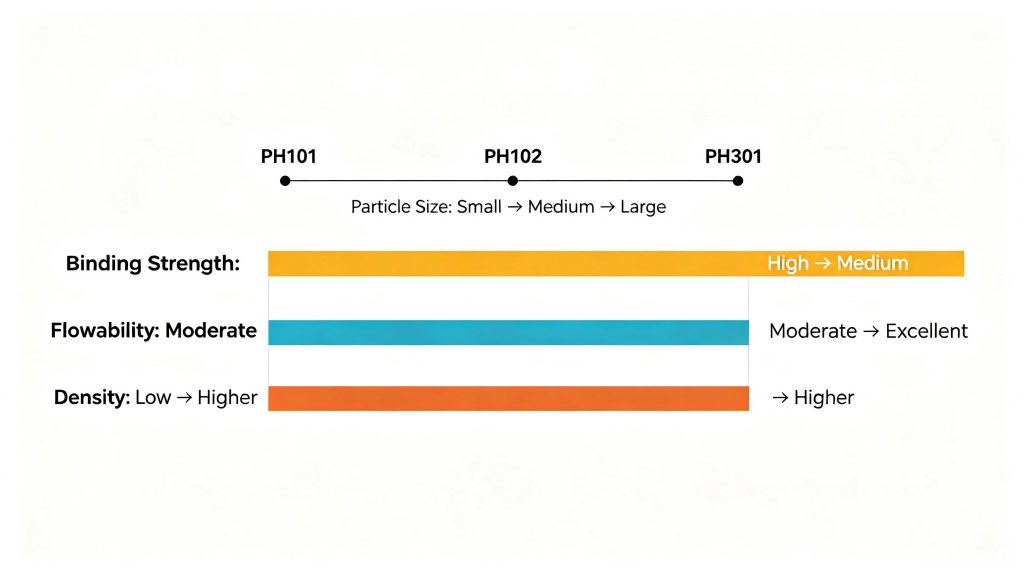
Not every MCC grade behaves the same way, since particle size and bulk density shift the balance between binding strength and powder flow. Selecting the correct grade therefore has a direct impact on tablet hardness, flowability, and production efficiency.
| Grade | Main Advantage | Typical Application |
| MCC PH101 | Strong binding | Hard tablets, low-dose formulations |
| MCC PH102 | Balanced flow and compression | Direct compression, high-speed production |
| MCC PH301 | Higher density | High-dose formulations, improved powder handling |
MCC PH101 has a smaller particle size than PH102, which gives it excellent compactibility and strong binding performance. Formulators typically reach for it in low-dose tablets, formulations that demand strong binding, and small-tablet production where maximum hardness matters most.
MCC PH102 stands out as one of the most widely used grades for direct compression. Compared with PH101, it offers a larger particle size, better flowability, and improved powder handling — a combination that delivers good compressibility, better flow performance, and suitability for high-speed tablet production. For many commercial manufacturers, PH102 strikes the best balance between tablet hardness, powder flow, and manufacturing efficiency.
MCC PH301 is a higher-density grade built for applications that need improved flow, higher bulk density, and better die filling performance. Manufacturers often consider it when powder handling and production efficiency become the primary formulation challenge.
Different MCC grades provide different balances between binding strength, flowability, and bulk density.
ACTA can support:
PH101 selection
MCC PH102 evaluation
MCC PH301 recommendation
Sample testing before commercial production
Request technical evaluation today.
Contact ACTA for sample evaluation and formulation guidance tailored to your tablet requirements.
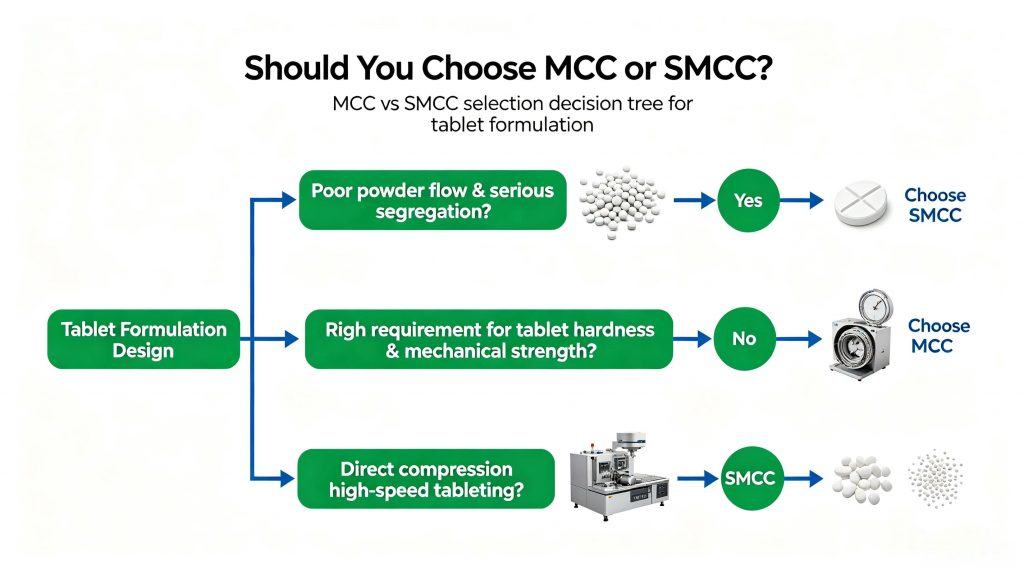
Because different tablet types create different manufacturing demands, the right excipient choice often shifts depending on the application.
Immediate-release tablets need good hardness, fast disintegration, stable production, and reliable content uniformity. MCC excels here because its plastic deformation forms a strong tablet matrix with low friability and reliable mechanical stability — making it a natural fit for analgesic tablets, vitamin tablets, mineral supplements, and generic immediate-release products. SMCC becomes advantageous instead when the formulation faces additional processing challenges, such as poor powder flow, high-speed production, or multiple ingredients with different particle characteristics, since it improves powder feeding and die filling consistency.
When an active ingredient makes up a large percentage of tablet weight, the excipient system must compensate for poor API compressibility, poor flow, or low binding ability. MCC provides compression support, binding ability, and tablet integrity, though additional optimization may be needed if the API itself flows poorly. SMCC often helps more in these situations by improving powder movement, blend uniformity, and production stability at commercial scale.
The nutraceutical industry increasingly relies on direct compression excipients, since many natural ingredients — plant extracts, botanical powders, high-dose nutrients — have inherently poor flowability and compressibility. MCC remains popular here thanks to its strong binding, good tablet hardness, and clean cellulose-based labeling, making it common in multivitamin tablets, calcium tablets, and botanical supplements. For large production volumes with complex ingredient blends or difficult-to-flow powders, however, SMCC can provide better overall processing behavior.
Modern pharmaceutical production increasingly relies on high-speed rotary tablet presses, where poor die filling, weight variation, and compression instability become real risks. MCC performs well in many high-speed applications, though manufacturers may need to optimize particle size, lubricant concentration, and compression parameters to get there. SMCC, since it was specifically developed to improve processing characteristics, tends to deliver better powder flow, more consistent feeding, and improved manufacturing robustness right out of the gate — making it an attractive option for manufacturers focused on maximizing production efficiency.
Selecting the correct direct compression excipient supplier is essential for achieving consistent tablet quality and stable manufacturing performance. — choosing a reliable pharmaceutical excipient supplier matters just as much for long-term manufacturing success. Because excipient quality and consistency directly affect tablet performance and regulatory compliance, pharmaceutical companies typically hold their MCC and SMCC suppliers to standards outlined by organizations such as the FDA’s pharmaceutical quality guidance and industry bodies like the International Pharmaceutical Excipients Council (IPEC).
A qualified direct compression excipient supplier should provide:
✓ Consistent product quality across batches, including particle size control and moisture control ✓ Complete technical documentation — COA, TDS, SDS, and regulatory information ✓ Technical application support for MCC grade selection, SMCC suitability evaluation, and formulation optimization ✓ Sample testing support before commercial purchasing ✓ Stable, reliable global supply capability
For global pharmaceutical manufacturers, supplier capability isn’t just about product supply — it’s about establishing long-term technical cooperation that reduces development risk and shortens formulation timelines.
Before purchasing either excipient, pharmaceutical manufacturers should confirm the following points.Manufacturers should confirm pharmaceutical grade MCC availability, pharmacopeial compliance, and batch-to-batch consistency before purchasing.
Before Purchasing MCC or SMCC, Check:
✓ Pharmaceutical-grade availability and the specific grade required (PH101, PH102, PH301, or a specific SMCC specification) ✓ USP/EP pharmacopeial compliance ✓ Complete COA, TDS, and SDS documentation ✓ Batch-to-batch consistency and quality testing history ✓ Technical support availability for formulation troubleshooting ✓ Export experience and supply reliability for your target market
Confirming these points upfront helps manufacturers avoid compression problems, production downtime, and higher rejection rates down the line — issues that often cost far more than any savings from choosing the cheapest available material.
Even experienced formulators can fall into a few predictable traps when choosing between these two excipients.
Choosing only based on price. Selecting an excipient purely on raw material cost overlooks the bigger picture. The lowest-cost material may not deliver the lowest total manufacturing cost if it causes compression problems, production downtime, or higher rejection rates. A better approach weighs material cost together with manufacturing efficiency and product quality.
Assuming SMCC always produces stronger tablets. SMCC isn’t simply a “stronger version” of MCC — its main advantage is improved processing performance, not automatically higher hardness. The best choice still depends on which specific formulation challenge needs solving.
Ignoring API characteristics. The same excipient can perform very differently depending on the API’s compressibility, particle size, dose level, and flow properties. Because of this, excipient selection should always include formulation-specific evaluation rather than a one-size-fits-all assumption.
Selecting a grade without testing. Even seasoned formulation teams typically run laboratory compression trials, evaluate tablet properties, and confirm stability before finalizing a commercial-scale selection. Skipping this step increases the risk of costly rework later in development.
A nutraceutical manufacturer producing high-dose tablets experienced several production difficulties:
The formulation team compared traditional MCC-based direct compression systems with SMCC.
Because the main limitation was powder handling rather than compression ability, SMCC was selected to improve powder movement and manufacturing consistency.
After optimization, the manufacturer achieved:
Improved powder feeding consistency
More stable compression performance
Better production reliability
Reduced formulation adjustment requirements
MCC and SMCC are not interchangeable solutions. The correct choice depends on the main formulation challenge:
Silicified Microcrystalline Cellulose (SMCC) is a co-processed pharmaceutical excipient made from MCC and colloidal silicon dioxide.
The main difference lies in composition and processing performance. MCC is a purified cellulose excipient valued for its excellent compactibility, strong binding ability, and plastic deformation characteristics. SMCC is a co-processed excipient that combines MCC with colloidal silicon dioxide, and that addition improves powder flow, handling characteristics, and manufacturing consistency. In short: MCC delivers excellent compression and binding performance, while SMCC delivers that same performance plus improved powder flow.
Not universally — each excels in different situations. MCC’s strong plastic deformation makes it ideal when maximum binding strength is the priority, while SMCC’s improved flow and processing stability make it more attractive when production consistency and flow performance matter most. The right choice always depends on API properties, tablet formulation, compression equipment, and overall manufacturing requirements.
Both can produce tablets with excellent hardness, since SMCC’s MCC component still provides the plastic deformation and bonding that drives tablet strength. If maximum binding strength is required, MCC may be preferred; if production consistency alongside good hardness is the priority, SMCC often provides the better overall package.
Yes, SMCC can replace MCC in many direct compression formulations, but the switch shouldn’t rely on ingredient similarity alone. Manufacturers should evaluate tablet hardness, friability, disintegration time, dissolution performance, powder flow, and compression behavior through laboratory compression trials and pilot-scale testing before finalizing the change, since a formulation optimized for MCC may need adjustment when switched to SMCC.
MCC PH102 is one of the most commonly selected grades for direct compression because it balances flowability and compression performance so effectively. MCC PH101 suits formulations that need maximum binding strength, while MCC PH301 works well when powder flow and bulk density become the limiting factors.
Yes — MCC performs well in many high-speed applications, particularly when manufacturers optimize particle size, lubricant concentration, and compression parameters. That said, SMCC often provides an easier path to high-speed consistency, since it was specifically developed to improve powder flow and feeding stability.
Evaluate potential suppliers on manufacturing experience, batch-to-batch consistency, complete technical documentation (COA, TDS, SDS), sample testing support, technical communication quality, and production capacity for long-term supply. A supplier who can support formulation troubleshooting — not just ship material — adds significantly more value over time.
Pharmaceutical grade MCC is available through established cellulose excipient manufacturers such as ACTA, which supplies MCC PH101, PH102, and PH301, along with SMCC evaluation support, complete regulatory documentation, and sample testing assistance for pharmaceutical and nutraceutical manufacturers worldwide.
Both MCC and SMCC are widely used direct compression excipients, but the ideal choice depends on formulation requirements.
Pharmaceutical grade MCC is widely used in tablet manufacturing because of its excellent compression performance and regulatory acceptance.
SMCC is mainly used as a direct compression excipient when manufacturers need both MCC’s compression properties and improved powder flow characteristics.
SMCC can replace MCC in many direct compression formulations, but compatibility should be confirmed through compression testing and formulation evaluation.
SMCC maintains the compression benefits of MCC, but its main advantage is improved powder flow and manufacturing consistency rather than automatically producing harder tablets.
MCC PH102 is one of the most widely used grades because it provides a balanced combination of compressibility and flowability.
Yes. SMCC is often selected for high-speed tablet manufacturing because improved powder flow can support more consistent die filling and production stability.
The pharmaceutical industry continues to shift toward more efficient manufacturing technologies, and direct compression sits at the center of that shift because it cuts processing steps, lowers production complexity, and reduces manufacturing time compared with wet granulation. As formulations grow more complex — with higher API loading, multiple functional ingredients, and tighter production schedules — manufacturers increasingly need excipients that offer more than basic filling and binding.
Cellulose-based excipients remain central to this trend thanks to their broad pharmacopeial acceptance, functional versatility, and long-established safety profile. MCC continues to anchor this category because of its excellent compression properties and reliable tablet performance, while co-processed excipients like SMCC represent the next step in excipient development, combining multiple functional advantages — compression, binding, and flow — into a single material. Together, MCC and SMCC will likely keep playing complementary roles in tablet manufacturing rather than one fully displacing the other.
Both SMCC and MCC play important roles as direct compression excipients in modern pharmaceutical tablet manufacturing, and neither one universally outperforms the other. Silicified Microcrystalline Cellulose (SMCC) provides manufacturers with an alternative direct compression solution by combining MCC compression performance with enhanced powder flow.
The best decision ultimately depends on the formulation challenge at hand: choose MCC when compression performance and binding strength drive the formulation, and choose SMCC when powder flow, production efficiency, and process robustness become the priority. By understanding these differences, pharmaceutical manufacturers can select the excipient system that delivers better tablets, more stable production, and higher manufacturing efficiency.Choosing the right direct compression excipient requires balancing compression performance, powder flow, production efficiency, and formulation requirements.Selecting a reliable pharmaceutical grade MCC supplier can help manufacturers achieve consistent tablet performance and long-term production stability.
Available Support:
Pharmaceutical-grade samples
COA / TDS / SDS documentation
Direct compression recommendation
MCC grade selection support
Global export assistance
Contact ACTA technical team for your formulation evaluation.
