

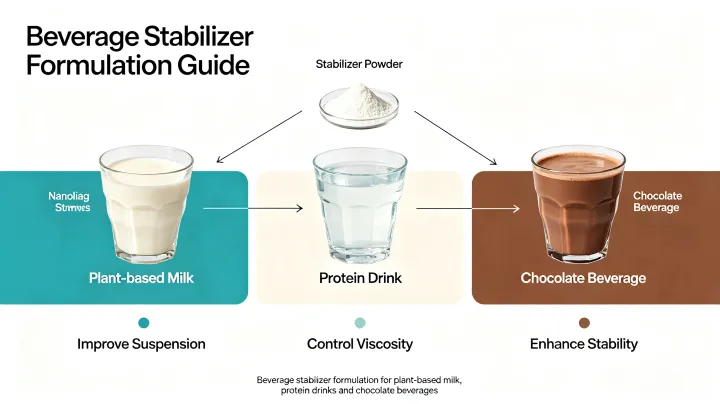
Beverage stabilizer formulation is the process of selecting and optimizing functional ingredients to control sedimentation, particle aggregation, phase separation, viscosity, and physical stability in liquid beverages.
A successful beverage stabilizer formulation must address the actual cause of instability rather than simply increase viscosity. Particle size, density differences, protein interactions, processing conditions, water chemistry, and storage conditions can all influence the final stability of a beverage.
Why do beverages develop sediment, floating particles, cream separation, or an unstable appearance even when the formulation looked perfect in the laboratory? The answer is rarely “not enough stabilizer.” The real cause may be particle size, protein aggregation, poor hydration, water chemistry, homogenization, pH, ionic strength, or simply an incompatible stabilizer system for that particular beverage.
Quick answer: Beverage stabilizers maintain uniformity by controlling particle sedimentation, aggregation, viscosity, water distribution, and phase separation. MCC, colloidal MCC/MCC Gel, CMC, xanthan gum, pectin, carrageenan, and modified starch each play different roles depending on the beverage system. The right choice depends on particle size, protein and fat content, pH, ionic strength, processing conditions, target viscosity, and shelf-life requirements — which is why real application testing, not a specification sheet, ultimately decides what works.
A beverage stabilizer is a functional ingredient used to maintain the physical uniformity of a beverage by controlling sedimentation, phase separation, particle aggregation, viscosity, water distribution, and emulsion stability. Rather than acting as a single mechanism, a stabilizer typically influences several of these factors at once, which is why formulators evaluate it as part of a complete system rather than as an isolated additive.
A beverage stabilizer does the following:
Beverage stabilizers are part of the broader category of food stabilizer systems used to control suspension, viscosity, emulsion stability, texture, and physical stability. See our food stabilizers guide for a broader overview of stabilizer functions and ingredient selection.
Instability is a broad word, and different beverages fail for different reasons. Manufacturers typically encounter one or more of the following mechanisms:
Diagnosing which mechanism is actually occurring always comes before selecting a corrective ingredient. Raising CMC dosage will not fix poor cocoa dispersion, and increasing viscosity will not resolve protein aggregation during heating — it only delays the symptom. A beverage can also fail for reasons that have nothing to do with the stabilizer itself: incorrect powder addition sequence, insufficient hydration time, water hardness, or a homogenization step that never adequately reduced particle size. Because several of these causes can produce the same visible symptom — a bottom layer, a floating cap, or a cloudy separation — tracing the beverage back through its processing steps is usually faster than guessing at the formula.
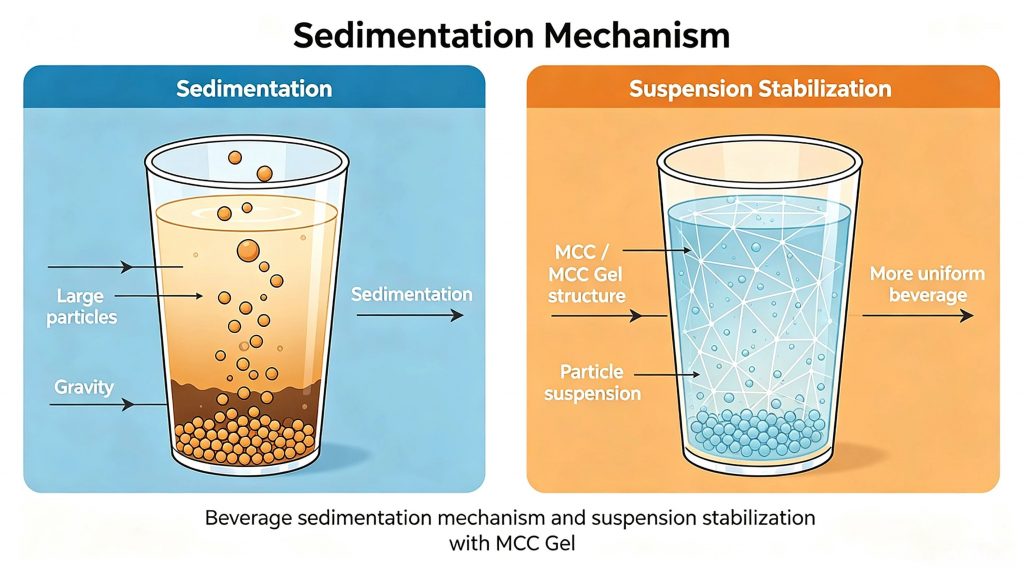
The Role of Stokes’ Law in Beverage Sedimentation

r = particle radius ρp = particle density ρf = fluid density η = continuous-phase viscosity
Stokes’ law is a useful conceptual model for understanding sedimentation, but real beverage systems are more complex because particles are often irregular, concentrated, aggregated, or non-spherical.
Sedimentation occurs when suspended particles are sufficiently dense and large that gravitational forces overcome the resistance provided by the continuous phase. A beverage stabilizer reduces sedimentation by acting on one or more of these levers:
Because these mechanisms operate differently, no single stabilizer addresses every beverage equally well — which is why the type of stabilizer matters as much as the dosage.
When the primary formulation challenge is keeping insoluble particles uniformly dispersed, it is useful to evaluate the system specifically from a suspension perspective. Our guide to food suspension agents explains how different ingredients can contribute to particle suspension and physical stability.
Understanding these mechanisms is essential when developing a beverage stabilizer formulation, because the same stabilizer may perform differently depending on particle size, density, pH, ionic strength, and processing conditions.
| Stabilizer | Primary Function | Suspension | Viscosity | Typical Beverage Applications |
|---|---|---|---|---|
| MCC | Suspension structure | High | Low–Moderate | Dairy, chocolate, plant-based |
| MCC Gel (Colloidal MCC) | Suspension + stabilization | High | Controlled | Plant-based, protein, cocoa |
| CMC | Thickening + water binding | Moderate–High | Moderate–High | Dairy, beverages, sauces |
| Xanthan Gum | Rheology + suspension | High | High | Functional drinks, sauces |
| Pectin | Stabilization + texture | Moderate | Moderate | Fruit beverages |
| Carrageenan | Protein/dairy stabilization | High in suitable systems | Moderate | Dairy, chocolate |
| Modified Starch | Body + stabilization | Moderate | Moderate–High | Dairy, nutritional drinks |
MCC (microcrystalline cellulose) provides insoluble structural particles that build a weak suspending network. Colloidal MCC / MCC Gel pairs MCC with a supporting cellulose component such as sodium CMC, combining structural suspension with dispersion support — a fundamentally different approach than simply thickening the liquid. CMC alone contributes water binding and moderate thickening, useful where some viscosity is acceptable. Xanthan gum delivers strong suspension through pseudoplastic rheology but can push viscosity and mouthfeel further than some beverages want. Pectin and carrageenan suit acidic fruit systems and dairy/protein systems respectively, while modified starch adds body in nutritional and dairy beverages. Regulatory status for these ingredients — including permitted use levels — is defined by bodies such as the FDA, EFSA, and the Codex Alimentarius/JECFA framework, and formulators exporting internationally should confirm current limits for their target markets.
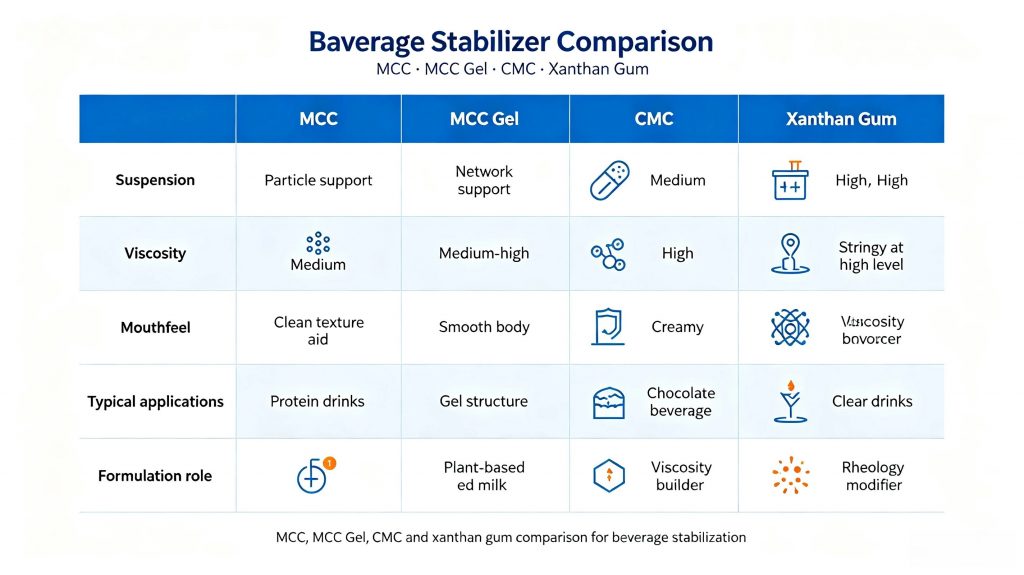
The most common formulation question isn’t “which stabilizer is strongest” — it’s “why choose MCC Gel instead of CMC or xanthan?” Each ingredient solves a genuinely different problem.
| Property | MCC Gel | CMC | Xanthan |
|---|---|---|---|
| Suspension support | Excellent in suitable systems | Good | Excellent |
| Viscosity contribution | Controlled | Moderate–High depending on grade | Often noticeable |
| Mouthfeel | Smooth/structured depending on system | Can increase body | Can become gum-like at high use levels |
| Insoluble particle suspension | Strong candidate | Good | Strong |
| Plant-based beverages | Strong candidate | Strong | Application-dependent |
| Cocoa beverages | Strong candidate | Good | Good |
| Formulation flexibility | High | High | High |
| Need for application testing | Yes | Yes | Yes |
For a broader view across the full stabilizer category, the table below summarizes the primary mechanism, best-fit use case, and main practical limitation for each type:
| Stabilizer | Main Mechanism | Best Use | Main Limitation |
|---|---|---|---|
| MCC | Structural suspension | Insoluble particles | Requires proper dispersion |
| MCC Gel | Structural suspension + supporting cellulose | Beverage suspension | Grade/process dependent |
| CMC | Viscosity + water binding | Body and moderate suspension | Can increase viscosity |
| Xanthan | Strong rheology | Low-dose thickening/suspension | Can feel gummy |
| Pectin | Acid-system stabilization | Fruit beverages | pH dependent |
| Carrageenan | Protein/dairy stabilization | Dairy/protein drinks | System dependent |
| Modified Starch | Body/texture | Nutritional/dairy | Can feel starchy |
MCC Gel and xanthan gum can provide very different rheological and sensory profiles. If you are comparing these two systems for a specific beverage application, our detailed guide to MCC Gel vs xanthan gum provides a more focused comparison.
These ranges are starting points for laboratory screening, not universal commercial-use levels.
| Application | Initial Screening Range* |
|---|---|
| Plant-based milk | 0.20–0.50% |
| Protein beverages | 0.20–0.50% |
| Dairy beverages | 0.30–0.80% |
| Chocolate beverages | 0.20–0.60% |
| Fruit beverages | 0.10–0.50% |
| Functional beverages | 0.20–0.50% |
*These are formulation-development starting ranges rather than universal specifications. Final dosage depends on the beverage matrix, particle characteristics, processing conditions, target viscosity, and the specific grade selected.
The ideal formulation is rarely the one with the highest concentration. A typical dosage-response pattern illustrates why a lower-but-sufficient dosage usually wins commercially:
| Dosage | Suspension | Viscosity | Sensory | Cost |
|---|---|---|---|---|
| 0.10% | Poor | Low | Excellent | Low |
| 0.20% | Improved | Low | Good | Low |
| 0.30% | Acceptable | Moderate | Good | Moderate |
| 0.40% | Excellent | Higher | Acceptable | Higher |
| 0.50% | Excellent | Too high | Less desirable | High |
In this example, 0.30% likely beats 0.50% commercially: it already delivers acceptable suspension while keeping viscosity, sensory quality, and cost in a more favorable range. Balance stability, rheology, sensory quality, processing ease, and cost together — never optimize one factor in isolation.
The objective of beverage stabilizer formulation is not to maximize stabilizer concentration. Instead, the formulation should identify the lowest practical dosage that provides the required suspension, stability, processing performance, and sensory profile.
Most sedimentation problems respond to a predictable sequence of fixes, applied roughly in this order before increasing stabilizer dosage:
Working through this sequence before reaching for a higher dosage usually resolves sedimentation faster, and almost always more cheaply, than simply adding more stabilizer.A systematic beverage stabilizer formulation process should therefore begin with particle and process diagnosis before changing stabilizer dosage.
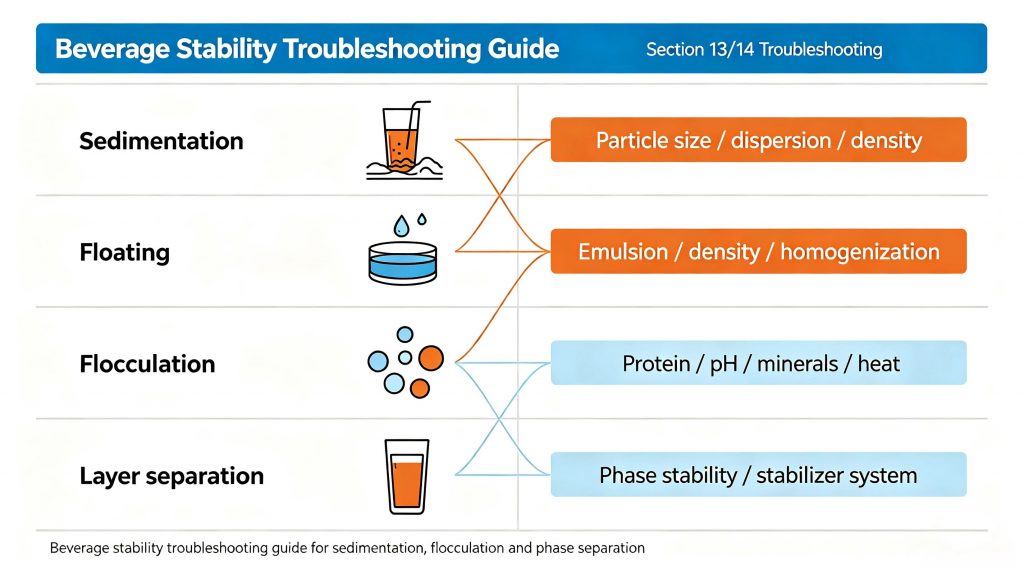
| Symptom | Likely Mechanism | First Investigation |
|---|---|---|
| Bottom sediment | Particle settling | Particle size/dispersion |
| Floating layer | Emulsion/particle density | Oil phase/homogenization |
| Flocculation | Protein or particle aggregation | pH/heat/minerals |
| Layer separation | Phase instability | Emulsion/stabilizer system |
| Thick but still settling | Wrong stabilization mechanism | Suspension structure |
A simple decision sequence keeps screening objective:
Effective beverage stabilizer formulation depends on matching the stabilizer mechanism to the specific instability rather than selecting an ingredient based only on viscosity.
| Beverage Type | Main Stability Challenge | Stabilizers to Screen |
|---|---|---|
| Plant-based milk | Fiber/protein/oil instability | MCC Gel, CMC |
| Protein beverage | Protein aggregation + sedimentation | MCC Gel, CMC, system-specific hydrocolloids |
| Chocolate beverage | Cocoa sedimentation | MCC Gel, CMC |
| Fruit beverage | Pulp suspension + acidity | Pectin, CMC, cellulose-based systems |
| Dairy beverage | Protein/mineral interactions | Carrageenan, CMC, starch, MCC-based systems |
| High-fiber beverage | High insoluble solids | MCC Gel, CMC |
Oat, soy, pea, and almond beverages combine protein, insoluble solids, oil, starch, and minerals, making stabilization more complex than simple thickening. MCC Gel and CMC are strong candidates to screen when sedimentation and phase stability are concerns.
Whey, casein, soy, pea, and blended proteins respond differently to pH, heat, minerals, and storage. Before changing the stabilizer, determine whether visible particles come from insoluble ingredients or newly formed protein aggregates.
Cocoa particles can settle because of differences in particle size, density, and dispersion. Instead of simply increasing viscosity, improve cocoa dispersion first and then optimize the suspension stabilizer and dosage.
Fruit beverages containing pulp require systems that remain effective under acidic conditions. Pectin, CMC, and selected cellulose-based stabilizers can be evaluated depending on pH, pulp concentration, texture, and processing conditions.
Higher fiber levels increase particle concentration, hydration demand, and sedimentation risk. Optimizing fiber particle size, hydration, water availability, and stabilizer dosage can often provide better results than simply increasing viscosity.
Dairy systems involve protein, minerals, and fat in addition to suspended particles. Carrageenan, modified starch, CMC, and cellulose-based systems may be considered depending on the formulation, while calcium and other mineral levels should be evaluated as formulation variables.
Ready-to-drink teas, sports drinks, fortified waters, and similar products may contain vitamins, botanicals, or fine particles while requiring a light mouthfeel. Lower-viscosity stabilizer systems and carefully optimized dosages are often worth screening against both suspension performance and sensory acceptance.
MCC can be particularly useful in beverage systems where insoluble particles need suspension support without relying entirely on high bulk viscosity. For a more detailed discussion of its applications, dosage considerations, and formulation examples, see our guide to MCC in beverages.
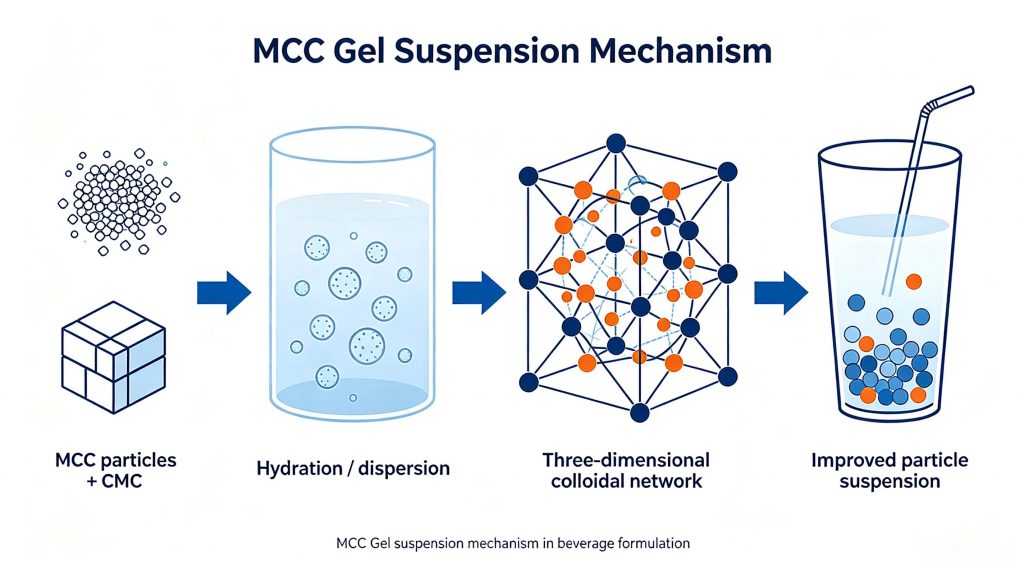
A stabilizer can never be separated from the process used to incorporate it. For MCC Gel and other powdered stabilizers:
Treat these figures as development guidance rather than universal specifications — different grades and equipment can require noticeably different conditions.Actual shear requirements depend on equipment geometry, batch size, powder addition rate, solids content, and product grade.
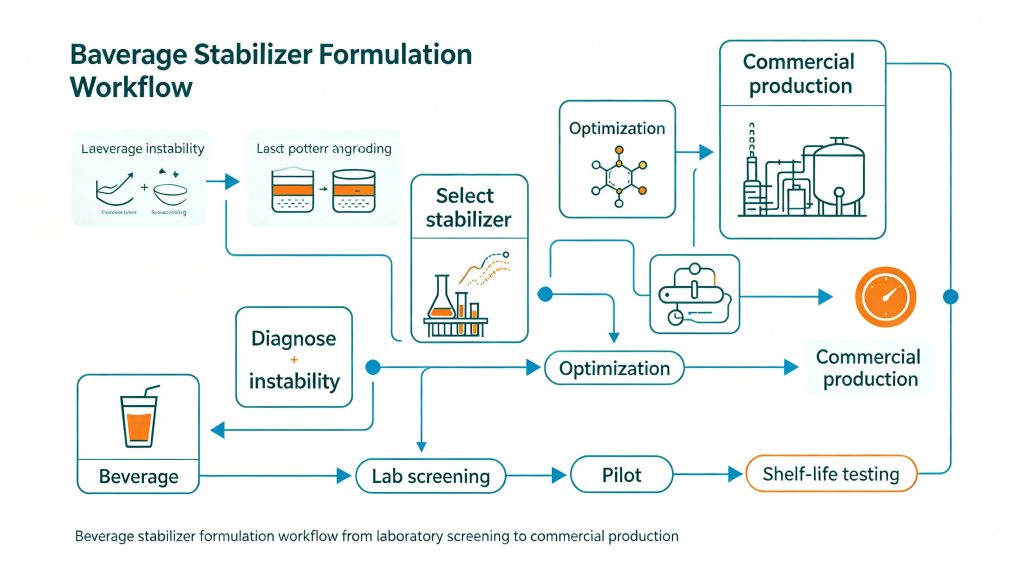
A well-run development project follows a defined sequence: define the beverage → diagnose the instability mechanism → shortlist candidate stabilizers → run controlled laboratory screening → optimize formulation and process together → validate at pilot scale → confirm shelf-life and commercial performance → qualify the supplier and raw material.
Skipping steps creates rework. Purchasing a large volume of stabilizer before determining whether the real culprit is particle size, protein aggregation, or inadequate homogenization can waste budget without ever solving the underlying problem.
During laboratory screening, hold every variable constant except the one being tested — same beverage base, particle concentration, processing temperature, mixing, homogenization, and storage conditions. Changing several variables at once (dosage, shear, hydration time) makes it impossible to know which one actually caused an improvement. Once a promising range is identified, a design-of-experiments approach can explore how variables interact.
Laboratory success does not guarantee commercial success. At bench scale, mixing tends to be efficient and consistent; at commercial scale, manufacturers frequently encounter powder lump formation, longer hydration times, different shear distribution, and different heat-transfer behavior. Pilot production should reproduce the intended commercial process as closely as possible — powder feeding, mixing sequence, hydration, heat treatment, homogenization, holding time, filling, and packaging — because a formulation that only works once isn’t commercially robust.
This beverage stabilizer formulation workflow helps development teams move from laboratory screening to pilot production with clearer formulation and process controls.
A beverage stabilizer that works at 500 mL laboratory scale may behave differently at 5,000 L or 50,000 L production scale, since mixing efficiency, shear distribution, heat transfer, and hydration time rarely translate one-to-one between a bench beaker and a commercial tank. Formulators moving from lab to plant should re-verify — not simply assume — that suspension performance, viscosity, and sensory quality hold up once equipment, batch size, and operator handling change.
A commercial beverage needs measurable Critical Quality Attributes (CQAs) — appearance, pH, viscosity, sedimentation, redispersibility, particle distribution, protein stability, emulsion stability, taste, mouthfeel, color, and shelf-life performance. Instead of saying “the beverage looks stable,” a team can state that it remains within approved sedimentation, viscosity, and sensory limits throughout the specified storage period.
| Parameter | Question |
|---|---|
| Sedimentation | Does the particle settle? |
| Viscosity | Is the beverage within target range? |
| Mouthfeel | Does it feel natural? |
| Pourability | Does it pour normally? |
| Appearance | Does it remain visually homogeneous? |
| Redispersibility | Does gentle shaking restore uniformity? |
Alongside CQAs, define Critical Process Parameters (CPPs) — stabilizer addition rate, mixing speed and time, hydration time, processing temperature, homogenization pressure, holding time, and cooling conditions — and monitor them continuously to reduce batch-to-batch variation.
Water quality deserves special attention: hardness, calcium, magnesium, total dissolved solids, and ionic strength can meaningfully influence hydrocolloid and cellulose-based systems. A formula developed with laboratory water may behave differently once production switches to a different water source, which matters most for manufacturers running multiple facilities.
During commercial scale-up, a successful beverage stabilizer formulation must remain robust against normal variations in raw materials, water quality, processing conditions, and production equipment.
A beverage can look stable immediately after production and still develop sedimentation, floating particles, phase separation, or viscosity changes during storage. For this reason, beverage suspension stability should be evaluated using standardized tests rather than visual observation alone.
A practical beverage suspension stability test should combine physical observation, redispersibility, rheological measurements, particle-size analysis, accelerated screening, and real-time storage testing.
Sedimentation is one of the most direct indicators of suspension performance.
Depending on the beverage system, monitor:
For example, a beverage containing cocoa, insoluble plant particles, minerals, or high-fiber ingredients can gradually form a compact layer at the bottom of the container.
A useful approach is to record the appearance at defined intervals, such as immediately after production and during storage. Photographs taken under consistent lighting and viewing conditions can also make comparisons between formulations more objective.
However, sediment height alone does not always tell the complete story. A formulation may produce a small amount of loose sediment that is easily redispersed, while another may produce a similar sediment height that becomes hard-packed and difficult to restore.
Therefore, sedimentation should be evaluated together with redispersibility.
Redispersibility measures how easily a beverage can return to a visually uniform state after particles have settled.
A simple laboratory protocol can standardize the number of:
The important point is not to assume a universal pass/fail number. Different beverage formats, package sizes, particle loads, and target applications require different test conditions.
Instead, define a repeatable internal method and ask:
How many inversions or shaking cycles are required to restore visual uniformity?
You can also record whether the sediment is:
This information can be particularly valuable when comparing MCC Gel, CMC, xanthan gum, pectin, modified starch, or combined stabilizer systems.
Viscosity should be measured under clearly defined conditions because viscosity values are highly dependent on the test method.
For meaningful formulation comparisons, control variables such as:
should remain consistent.
A formulation with higher viscosity is not automatically a better suspension system. Excessive viscosity can negatively affect pouring, drinking quality, mouthfeel, processing, and consumer acceptance.
The objective is usually to achieve sufficient suspension performance without creating unnecessary bulk viscosity.
Particle size can provide useful information about the physical basis of suspension stability.
If suitable laboratory equipment is available, measure parameters such as:
Smaller particles generally have a lower settling velocity under otherwise comparable conditions. However, particle size should not be considered independently from particle density, aggregation, continuous-phase rheology, and the structure created by the stabilizer system.
Particle-size testing is therefore most useful when combined with formulation and process information.
For beverages where visual uniformity is important, turbidity or other optical measurements can provide an additional quantitative indicator.
Depending on the beverage, optical measurements may help detect:
Optical measurements are particularly useful when visual inspection becomes subjective or when relatively small changes need to be compared between multiple formulations.
The appropriate measurement method depends on beverage color, opacity, particle concentration, container geometry, and the available laboratory equipment.
Accelerated testing can help formulation teams compare candidate stabilizer systems more quickly.
For example, centrifugation can be used as a screening tool, particularly when the objective is to identify formulations that are clearly more prone to separation or sedimentation.
However:
Centrifugation should be treated as a screening tool, not as a direct prediction of real shelf life.
The forces applied during accelerated testing can be very different from those experienced during normal storage. Therefore, a formulation that performs well in an accelerated test should still be evaluated under actual storage conditions.
Ultimately, the most important test is real-time storage under the intended commercial conditions.
Depending on the product, evaluate samples at defined intervals throughout the target shelf life and monitor:
Testing should reflect the actual commercial product as closely as possible, including the intended processing conditions, package, fill volume, storage temperature, and expected distribution environment.
A practical beverage development program can therefore follow this sequence:
Laboratory screening
↓
Sedimentation + redispersibility evaluation
↓
Viscosity and particle-size measurement
↓
Accelerated screening where appropriate
↓
Pilot-scale production
↓
Real-time storage testing
↓
Target shelf-life validation
This approach helps separate short-term formulation performance from genuine long-term stability.
The goal is not simply to find the beverage with the highest viscosity or the lowest initial sediment. The goal is to identify a stabilizer system that provides the required suspension performance, sensory profile, processability, and storage stability under realistic commercial conditions.
A beverage may appear stable during a short laboratory check but still develop sediment or separation weeks later. A reliable formulation should therefore be evaluated over a storage period that represents its intended shelf life.
| Problem | Possible Cause | First Investigation |
|---|---|---|
| Rapid sedimentation | Large particles | Particle size and dispersion |
| Slow sedimentation | Insufficient structure | Stabilizer screening |
| Compact sediment | Poor particle stabilization | Dispersion and formulation |
| Excessive viscosity | Dosage too high | Reduce or optimize dosage |
| Poor mouthfeel | Rheology imbalance | Grade and blend evaluation |
| Separation after heating | Protein or thermal instability | Heat-process investigation |
| Floating layer | Emulsion instability | Fat and emulsion system |
| Batch variation | Raw material or process variation | Batch and process review |
| Different factory results | Process differences | Compare equipment and conditions |
| Poor redispersibility | Compact sediment or network | Particle and stabilizer system |
Persistent sedimentation does not always mean that the stabilizer dosage is too low. Large or dense particles may settle quickly, while poor dispersion, incorrect addition sequence, pH, minerals, or ionic strength can prevent the stabilizer from performing effectively.
When increasing the dosage makes the beverage too thick, consider reducing concentration, changing the stabilizer grade, improving dispersion, or combining complementary stabilizers rather than simply adding more of the same ingredient.
Heat treatment can affect protein structure, mineral interactions, and hydrocolloid behavior simultaneously. Comparing unheated, pasteurized, and UHT-treated samples can help determine whether the main problem originates from the thermal process or the formulation itself.
If one batch or production site shows more sediment than another, investigate raw materials, lot numbers, COAs, mixing conditions, water hardness, processing equipment, and operating parameters before assuming the stabilizer is responsible.
A robust formulation should tolerate a reasonable operating window rather than depend on one extremely precise production condition.
The most effective troubleshooting approach is to identify the underlying instability mechanism first and then adjust the formulation or process accordingly. Increasing stabilizer dosage should be only one option—not the default solution.
Problem. A chocolate protein beverage — 10–15% protein, cocoa powder, mineral fortification, UHT-processed, 12-month target shelf life — developed visible sediment after 30 days of storage, despite using CMC at 0.25%. Viscosity was acceptable, but suspension performance fell short.
Trial design. In this development example, the team ran a controlled comparison against the original formula:
| Trial | Stabilizer | Dosage |
|---|---|---|
| Control | CMC | 0.25% |
| A | MCC Gel | 0.20% |
| B | MCC Gel | 0.30% |
| C | MCC Gel | 0.40% |
Evaluation. Each trial was assessed for sedimentation, viscosity, redispersibility, sensory quality, and 30-day storage performance, with all other variables — beverage base, homogenization, heat treatment — held constant.
Outcome. Trial B (MCC Gel at 0.30%) delivered acceptable suspension with viscosity and sensory scores still in an acceptable range, and was selected for further pilot-scale validation. This is a development example, not a universal recommendation — the appropriate dosage and grade for any specific beverage should always be confirmed through direct application testing.
Supplier qualification goes well beyond price and MOQ — and well beyond a single sample order. Most beverage manufacturers move through a longer commercial path: sample → trial → approval → purchase order → container-volume supply → long-term production. A supplier worth qualifying should be evaluated against that entire path, not just the first sample shipment. Evaluate product consistency, food-grade documentation (TDS and COA), technical support and dosage guidance, sample availability, lead time, production capacity, and supply continuity. A generic “suitable for beverages” claim isn’t useful for serious formulation work — a stronger supplier can explain which beverage categories have actually been evaluated, typical starting concentrations, and recommended dispersion procedures for your specific application.
A simple weighted scorecard keeps the comparison objective rather than price-driven:
| Category | Weight |
|---|---|
| Product consistency | 20% |
| Application performance | 20% |
| Technical support | 15% |
| Price | 15% |
| Documentation | 10% |
| Lead time | 5% |
| Capacity | 5% |
| Communication | 5% |
| Supply reliability | 5% |
Two suppliers can both offer “food-grade MCC” on paper while performing very differently in the actual beverage, due to differences in raw materials, degree of substitution, particle-size distribution, and quality control. Blind, anonymized application testing — comparing suppliers under identical beverage, dosage, and process conditions — frequently reveals differences that specifications alone can’t predict. Optimize performance first, then dosage range, then true cost-in-use; choosing the cheapest raw material before confirming performance often leads to excessive dosage and higher total cost. For critical ingredients, qualifying a second supplier in advance — never introduced directly into production without proper qualification — reduces supply-chain risk.
There’s no single best stabilizer — the right choice depends on the instability mechanism, pH, protein content, target viscosity, and processing conditions. MCC Gel, CMC, and xanthan gum each suit different situations.
MCC, colloidal MCC/MCC Gel, CMC, and xanthan gum are the most common suspension-oriented systems, often selected based on particle type, density, and target viscosity.
MCC Gel provides structural suspension for insoluble particles — cocoa, plant protein, fiber, minerals — while helping control viscosity so the beverage doesn’t become unnecessarily thick.
Yes, particularly where moderate thickening is acceptable alongside suspension support; CMC also contributes water binding and can be combined with MCC or MCC Gel.
MCC alone provides insoluble structural particles, while MCC Gel (colloidal MCC) pairs MCC with a supporting cellulose component such as CMC to combine structural suspension with dispersion support.
Sometimes. MCC Gel tends to deliver suspension with more controlled viscosity, while xanthan often provides stronger suspension but a heavier mouthfeel at higher use levels — the right choice depends on application testing.
Initial screening typically starts around 0.10–0.80%, depending on the beverage category; final dosage should always be confirmed through controlled testing in the actual formulation.
Treat it as a multiphase system — evaluate particle size, homogenization, and stabilizer selection (often MCC Gel and/or CMC) together rather than adjusting one variable in isolation.
Improve cocoa dispersion and particle size first, then screen suspension stabilizers such as MCC Gel, rather than simply raising viscosity.
Share the beverage type, pH, target viscosity, protein and fat content, insoluble solids, processing conditions, storage conditions, current stabilizer and dosage, and the specific stability problem.
A thickener primarily raises viscosity, while a beverage stabilizer manages a broader set of behaviors — suspension, aggregation, water distribution, and phase separation — often while keeping viscosity in a specific target range rather than simply raising it.
Start by identifying the dominant instability mechanism — insoluble grain or fiber particles, protein aggregation, or oil separation — then screen candidates such as MCC Gel and/or CMC against the actual formulation rather than a generic plant-based benchmark.
There’s no universal answer, but MCC Gel is frequently screened for cocoa suspension because it can support particle suspension without pushing viscosity as high as some alternatives; the final choice should be confirmed through direct testing in the beverage.
Yes, MCC Gel is a common candidate for protein beverages, particularly where the formulator wants suspension support without excessive viscosity — but compatibility with the specific protein type, pH, and heat treatment should be verified through testing.
Focus on particle size reduction, improved dispersion, and homogenization before raising stabilizer dosage — see Section 7. Selecting a structural suspension system like MCC or MCC Gel, rather than a purely viscosity-driven thickener, also helps decouple suspension from viscosity.
Common causes include poor particle dispersion, incorrect addition sequence, insufficient hydration time, inadequate homogenization, water chemistry (hardness or mineral content), pH incompatibility, and — less often than assumed — simply too low a dosage.
A successful beverage stabilization strategy never begins and ends with picking a single hydrocolloid. It starts with understanding the beverage, continues through diagnosing the true instability mechanism, selecting appropriate functional ingredients, optimizing dosage and processing together, and validating the formulation at both pilot and commercial scale. Across MCC, colloidal MCC, MCC Gel, CMC, xanthan gum, pectin, carrageenan, and modified starch, one principle matters more than any other: optimize the complete beverage system, not a single ingredient in isolation. The most successful formulation is rarely the one with the highest viscosity or the lowest ingredient price — it’s the one that balances suspension stability, rheology, sensory quality, processability, shelf life, and cost-in-use together.
If you are developing a plant-based milk, protein beverage, chocolate drink, nutritional beverage, or other suspension-based product, ACTA can help you evaluate MCC, MCC Gel, CMC, and suitable stabilizer systems based on your actual formulation.
ACTA supplies MCC, colloidal MCC/MCC Gel, and CMC for food and beverage applications, with technical documentation and application support for manufacturers evaluating suspension and stabilization systems. Depending on your beverage matrix, we can support screening based on beverage type, pH, protein content, insoluble solids, processing conditions, target viscosity, and stability requirements.
To recommend a suitable MCC, MCC Gel, or CMC grade, send us:
ACTA can recommend suitable MCC, MCC Gel, or CMC grades for laboratory screening and provide TDS, COA, sample quantities, and application guidance.If you are looking for a broader overview of stabilizer functions, ingredient options, and beverage applications, see our guide to beverage stabilizers.
Richard Wang specializes in cellulose-based food ingredients, beverage stabilization systems, MCC, MCC Gel, CMC, and formulation support for food and beverage manufacturers.
