

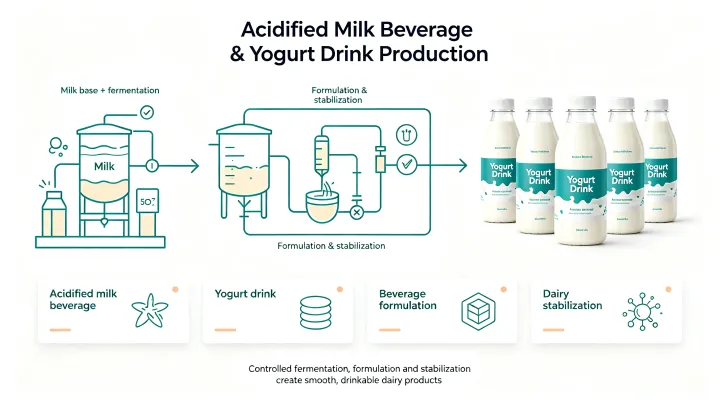
CMC for Acidified Milk Drinks Stabilization
Acidified milk drinks — including drinkable yogurt, fermented milk beverages, fruit-yogurt drinks, cocoa milk beverages, and protein-rich dairy drinks — present some of the most difficult stabilization challenges in beverage formulation. When milk protein encounters a lower pH, its structure changes, which can increase the risk of sedimentation, serum separation, and inconsistent viscosity. A beverage may look stable immediately after processing but develop sediment, serum separation, or viscosity changes during storage, making formulation and scale-up more challenging.
This is where CMC can play an important role in the stabilization system, particularly when formulators need to control viscosity, suspend particles, and manage water within the formulation. Sodium carboxymethyl cellulose (CMC) ranks among the most widely used stabilizers in this category because it can modify viscosity, support suspension, and improve water management within the same formulation.
However, CMC does not work in isolation. The protein system, pH profile, processing sequence, and selected CMC grade all influence its performance. This guide takes an application-first approach: it explains why acidified milk drinks lose stability, how CMC functions in the beverage, how to select a suitable dosage and grade, how to process CMC correctly, how to troubleshoot common failures, and how to qualify a reliable CMC supplier for commercial production.
Quick Answer: What Does CMC Do in Acidified Milk Drinks?
CMC can contribute to viscosity control, particle suspension, water management, and texture modification in acidified milk drinks. Its effectiveness depends on the CMC grade, dosage, pH, protein system, processing conditions, and any other stabilizers in the formulation.Typical laboratory screening range: approximately 0.10–0.50% may be evaluated for selected formulations. The final dosage should always be established through application testing in the actual beverage.
Milk protein, primarily casein, carries a negative charge at neutral pH and remains well dispersed in the continuous phase. As formulators introduce acid through fermentation or direct acidification, the pH gradually approaches the isoelectric point of casein. At this point, the protein loses much of its charge and becomes far more prone to aggregation.
This mechanism explains most of the instability seen in acidified milk drinks:
A single stability failure rarely has a single cause. Before adjusting the formulation, the development team should first identify what is actually happening in the beverage — particles settling, protein aggregating, or water separating from the protein network. This diagnostic step, covered in detail later in this guide, saves significant development time.
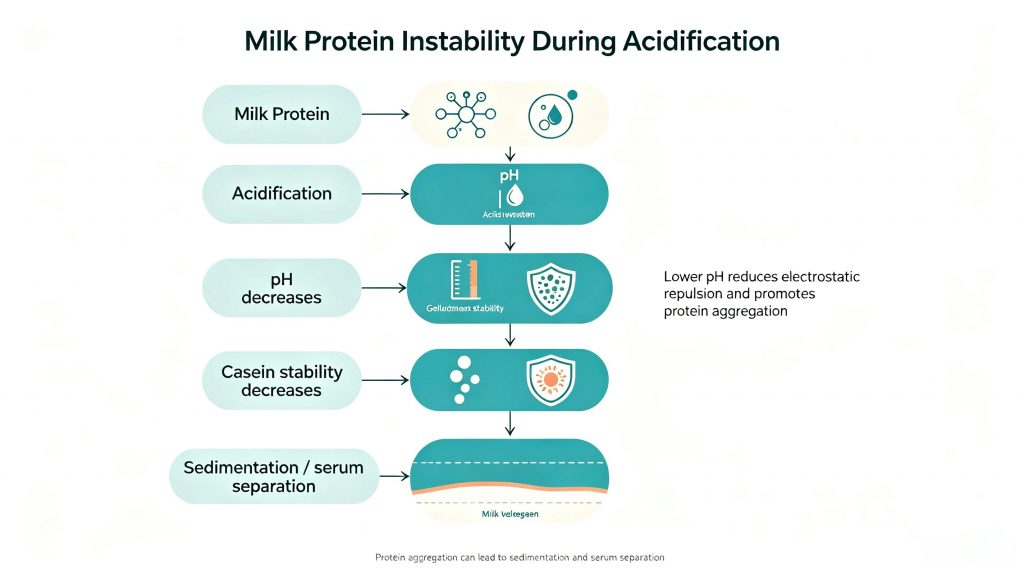
Title:Casein Stability and pH in Acidified Milk Drinks
Caption:Acidification can change casein interactions and increase the risk of aggregation, sedimentation, or serum separation.
CMC is a cellulose derivative produced by chemically modifying cellulose with sodium carboxymethyl groups. In beverage applications, CMC performs three interconnected roles: it increases continuous-phase viscosity, it helps suspend fine particles and destabilized protein fragments, and it improves water-binding capacity within the beverage matrix.For regulatory and food-additive specifications, manufacturers should also check the applicable food-additive standards and specifications for their target market.
Depending on the CMC grade and formulation conditions, CMC may contribute to the stabilization of dispersed protein or particulate matter while also modifying the rheology of the continuous phase. This is one reason CMC is evaluated across a wide range of dairy and beverage stabilization systems — not because of a single fixed mechanism, but because the outcome depends on the interaction between CMC’s molecular characteristics (degree of substitution, molecular weight, viscosity grade), the protein concentration, the ionic environment, and the pH of the specific beverage.
CMC should not be treated as a universal fix. Its effectiveness depends on:
Selecting CMC therefore requires evaluating the complete beverage system rather than the ingredient alone. In particular, CMC is less likely to resolve instability caused primarily by uncontrolled pH, severe protein aggregation, poor acid dispersion, inadequate heat treatment, or incompatible ingredient interactions — these root causes should be addressed directly rather than masked with additional stabilizer.The technical performance of CMC should be evaluated separately from regulatory compliance. Food manufacturers should confirm the applicable specifications and permitted uses in each target market.
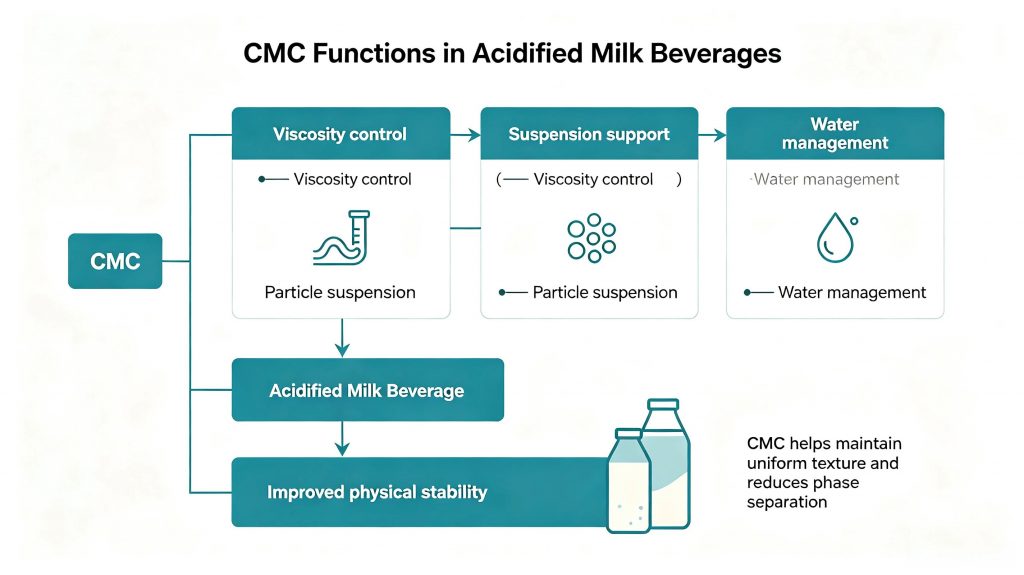
Title:CMC Stabilization Mechanism in Acidified Milk Beverages
No single CMC dosage works for every acidified milk drink. Formulators should treat dosage as a screening variable and optimize it for the specific beverage matrix rather than rely on a generic recommendation.
For initial laboratory trials, formulators can evaluate a staged low-to-moderate screening range in selected formulations, starting with lower concentrations and increasing the level as shown below:
| CMC Level | Purpose of Screening |
|---|---|
| 0.10% | Low-level starting point |
| 0.20% | Compare viscosity and physical stability |
| 0.30% | Evaluate the effect of increased CMC concentration |
| 0.40% | Evaluate higher rheological contribution |
| 0.50% | Upper screening point for selected systems |
Because different beverage categories place different demands on the stabilizer, it also helps to match the screening range to the product type — these are illustrative development starting points, not fixed commercial recommendations:
| Beverage Type | Main Priority | Illustrative Screening Range |
|---|---|---|
| Drinkable yogurt | Smooth texture, reduced serum separation | 0.10–0.30% |
| Fruit-yogurt beverage | Particle suspension, fruit distribution | 0.20–0.40% |
| Cocoa acidified milk drink | Cocoa suspension, smoothness | 0.20–0.50% |
| High-protein acidified beverage | Protein stability, heat-process compatibility | 0.20–0.40% |
| Fiber-enriched dairy beverage | Fiber suspension, hydration | 0.20–0.50% |
More CMC does not automatically translate into better performance. Beyond a certain concentration, additional CMC mainly adds thickness and cost without a proportional stability benefit. The correct commercial objective is not the highest dosage that produces acceptable stability, but the lowest dosage that reliably meets both the stability and sensory targets. If a formulation achieves the required stability and mouthfeel at 0.30%, it may be preferable to a higher dosage such as 0.50%, particularly when the additional viscosity and ingredient cost do not provide a meaningful performance benefit.
Because pH governs protein behavior, it also influences CMC performance. As the pH drops toward the isoelectric point of casein, protein particles become increasingly prone to aggregation, so the stabilizer system must provide stronger support to keep the beverage uniform.
The acidification method matters as much as the CMC grade itself. In fermented milk drinks, starter cultures produce acid gradually, allowing the protein structure to develop progressively and more predictably. Key variables include the starter culture, fermentation temperature and time, target pH, and post-fermentation shear. In directly acidified milk drinks, formulators add acid externally, making the addition rate and mixing efficiency critical. If the process adds acid too quickly or distributes it poorly, localized zones of low pH can form and trigger premature protein aggregation before the rest of the batch reaches the target acidity. Formulators should therefore introduce acid gradually and distribute it uniformly, regardless of the acidification method.
In some formulations, formulators can pre-hydrate CMC before significant acidification to make dispersion and viscosity development easier to control. However, no single addition sequence works for every system. Formulators should validate the optimal sequence for the specific protein system, CMC grade, and processing equipment, while also considering factors such as fat content and target texture, as discussed in Section 6.
There is no single “best” stabilizer for acidified milk drinks. Each hydrocolloid addresses a different part of the stability problem, so the more useful question is which mechanism matches the beverage’s actual instability.
| Stabilizer | Main Contribution | Key Consideration |
|---|---|---|
| CMC | Viscosity, suspension, water management | Grade and dosage strongly affect mouthfeel |
| Pectin | Support for protein stability in acidic dairy systems | Widely evaluated in drinkable yogurt systems |
| Carrageenan | Protein interaction, structure, suspension | Excess can create an undesirable texture |
| Xanthan gum | Strong viscosity and suspension | Can produce a heavier, more structured mouthfeel |
| Modified starch | Body, texture, water management | May increase overall fullness of the beverage |
Pectin is widely evaluated in drinkable yogurt and other acidified dairy systems because certain pectin types can help stabilize proteins under acidic conditions. CMC, meanwhile, can help control viscosity, suspend particles, and manage water within the formulation. Formulators often evaluate CMC and pectin together rather than use them as substitutes. Under suitable acidic conditions, pectin can contribute to protein stabilization, while CMC can control viscosity, suspend additional particles such as fruit pulp or cocoa, and support water management. The specific pectin type, CMC grade, and beverage system determine how these functions work together, so formulators should confirm the combination through formulation trials rather than rely on assumptions.
Carrageenan can help formulators build a stronger structural network, but excessive levels can create a gelled or overly thick sensation. Xanthan gum provides strong suspension performance, but excessive use can also create a heavy mouthfeel. Modified starch can add body and support water management, although it does not replace CMC’s suspension contribution on its own.
Many manufacturers use combination stabilizer systems rather than rely on a single hydrocolloid for acidified milk drinks. Formulators should confirm the appropriate combination and ratio through actual formulation trials because ingredient interactions can produce different results from those suggested by a data sheet alone.
Many commercial acidified milk drinks rely on a combination system rather than a single hydrocolloid. Beverage stabilization systems should be selected according to the product’s protein, particle, pH, and processing requirements.
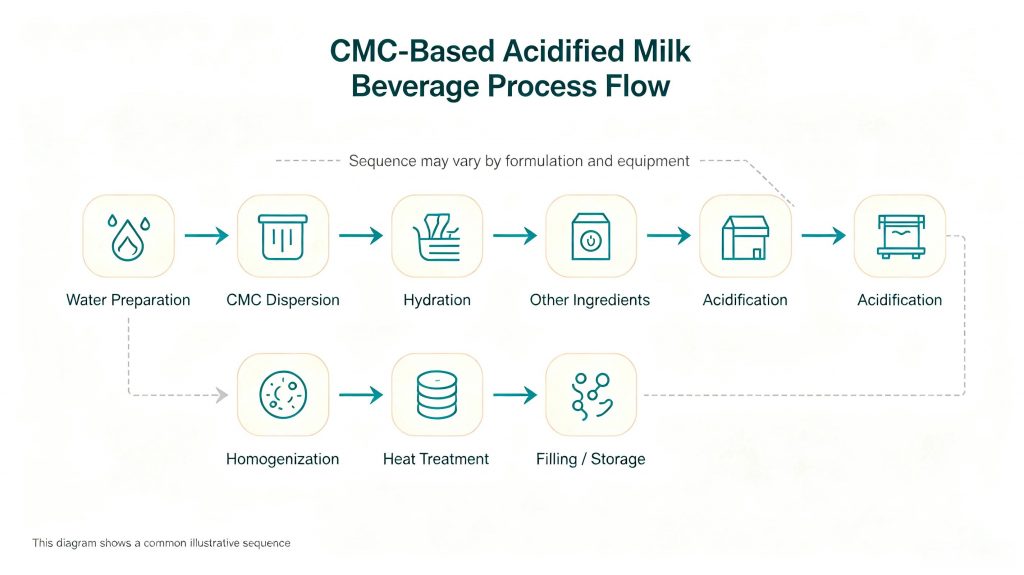
Selecting the right CMC grade is only half of the formulation process. Even a suitable food-grade CMC can underperform if it is not properly dispersed, hydrated, and incorporated. The practical objective is complete dispersion, sufficient hydration, uniform distribution, stable viscosity, good protein compatibility, and acceptable sensory properties.
Water quality can influence hydrocolloid performance, since dissolved minerals and ions affect hydration. Keep water quality consistent between trials, and pay attention to hardness, mineral content, temperature, pH, and total dissolved solids. If laboratory water differs substantially from production water, a formulation that performs well on the bench may behave differently during scale-up.
CMC should never enter the liquid as a large concentrated mass, because this causes lump formation. A common approach premixes CMC with part of the sugar before adding the dry blend gradually into an agitated water phase. Controlled direct addition into a sufficiently agitated water phase can also work, depending on mixing equipment, batch size, CMC grade, and addition rate.
Hydration time depends on CMC grade, particle size, temperature, concentration, and water composition. For comparative trials, the team should hold addition rate, agitation, temperature, and hydration time constant — otherwise, a comparison between two CMC concentrations may actually reflect a difference in hydration conditions rather than dosage.
is often useful at lower CMC concentrations, using sugar, milk powder, or another dry beverage ingredient as a carrier. The premixing ratio must be validated experimentally, since poor mixing can leave local concentrations of CMC high enough to still form lumps.
When a formulation contains milk powder, milk protein concentrate, whey protein, sugar, and fiber, the high solids content can slow CMC hydration because less free water remains available. One practical strategy involves hydrating CMC before the formulation reaches its highest solids concentration. However, formulators should validate this approach against the actual production process rather than treat it as a universal rule.
Homogenization plays an important role when the beverage contains fat, but formulators should not use it as a substitute for CMC. Homogenization controls the dispersed fat phase, while CMC modifies the continuous phase and supports particle suspension. Many acidified milk drinks benefit from using both technologies together. The optimal CMC addition sequence relative to homogenization — before, during, or after the process — depends on the CMC grade, protein system, fat content, and target texture. Formulators should therefore compare alternative processing sequences during product development.
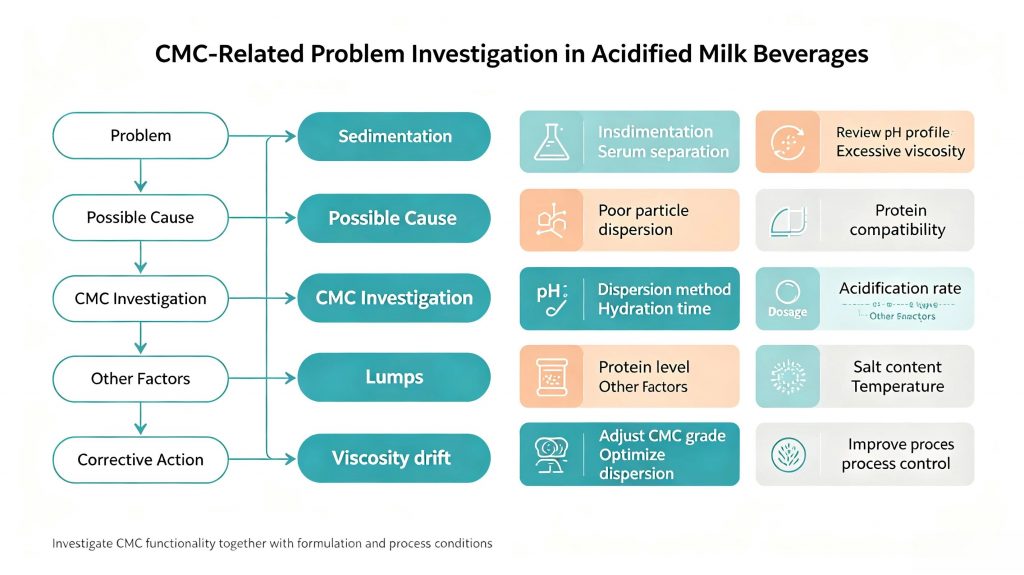
Title:CMC Troubleshooting for Acidified Milk Drinks
Even a technically sound formulation can produce inconsistent results if processing goes wrong. The following logic applies to the most common issues.
CMC lumps typically result from adding CMC too quickly, insufficient agitation, poor dry premixing, or inadequate hydration. Slowing the addition rate, improving dispersion, using a suitable dry carrier, and allowing sufficient hydration time usually resolves the issue.
Lower-than-expected viscosity should first prompt a check of the actual CMC addition level, since dosage errors are more common than material defects. If the dosage is correct, the team should verify the CMC batch, hydration time, temperature, mixing conditions, and the viscosity test method before concluding that the raw material is at fault.
Higher-than-expected viscosity often results from excessive dosage, an unintentionally higher-viscosity grade, interaction with another hydrocolloid, or extended hydration. Comparing a lower-viscosity CMC grade or reducing concentration is usually more effective than abandoning CMC altogether.
The following matrix helps direct the investigation toward the right variable rather than defaulting to a dosage change:
| Observed Problem | Likely Cause | CMC-Related Investigation | Other Factors to Check |
|---|---|---|---|
| Heavy sediment | Insufficient suspension support | Optimize CMC level/grade if appropriate | Particle size, density, homogenization |
| Serum separation | Weak water retention / unstable protein | Test CMC contribution | Protein, pH, fermentation |
| Protein flocculation | Protein instability | Evaluate CMC compatibility | pH, minerals, heat treatment |
| Excessive viscosity | Too much polymer | Lower dosage / change grade | Other hydrocolloids, solids |
| Thin beverage | Insufficient structure | Increase/optimize CMC | Total solids, protein |
| CMC lumps | Poor dispersion | Improve hydration process | Mixing equipment, powder addition |
| Floating particles | Poor wetting/distribution | Evaluate suspension support | Particle properties, emulsification |
| Inconsistent batches | Process variation | Standardize CMC addition | Water, mixing, raw materials |
Before Increasing CMC Dosage, Ask One Question:
What is actually settling — particles, protein aggregates, or clear serum?
IIf insoluble particles such as cocoa, fruit, or fiber are the cause, the investigation should focus on particle size, wetting, dispersion, and continuous-phase viscosity. For a broader discussion of these mechanisms, see our guide to suspension stabilizers in beverages. If protein aggregates are settling instead, the root cause is more likely pH, protein source, heat treatment, or the acidification process, and CMC alone is unlikely to resolve it.For beverages containing difficult-to-suspend particles, colloidal MCC may also be evaluated as part of a broader stabilization system, depending on the formulation.
Serum separation is often more complex, since a clear layer can develop from pH drift, protein type, fermentation conditions, or storage temperature — not from the stabilizer system alone. A formulation that looks stable after 24 hours may separate after several weeks, so storage testing at the intended distribution temperature remains essential.
For a systematic approach, formulators can use a simple decision tree: first identify what is separating — particles, protein, or clear serum; then confirm that the CMC has fully hydrated; evaluate whether the viscosity is too low, too high, or appropriate; check whether processing factors such as homogenization, acidification, or heat treatment contribute to the instability; and finally confirm storage stability before approving the formulation. This structured sequence helps formulators troubleshoot more efficiently than repeatedly adjusting CMC dosage without controlling the other variables.
Similar suspension challenges can also occur in non-dairy or particulate beverages, where MCC for cloud stability may be relevant depending on the formulation.
The following scenarios reflect questions that come up repeatedly during acidified milk drink development.
Possible causes include protein instability, insufficient hydration, low continuous-phase viscosity, storage temperature, or interaction with other ingredients. A practical evaluation checks the pH at Day 0 and at the end of storage, compares CMC concentration, tests one lower- and one higher-viscosity grade side by side, checks protein and particle sediment separately, and confirms the result under the intended storage conditions rather than relying only on accelerated testing.
The instinct to remove or drastically cut the stabilizer is usually not the best first move, since some structure is still needed to hold the improved stability. A more useful approach compares CMC grades at a lower dosage, or trials a lower-viscosity grade that can still deliver adequate suspension without the excess body.
This is one of the most common — and most frustrating — gaps in scale-up. Common causes include mixing intensity, powder addition rate, hydration time, water hardness, homogenization conditions, batch size, and processing temperature. Because laboratory-scale beakers and production tanks rarely share the same shear profile or addition dynamics, a formulation that hydrates fully in two liters may not hydrate fully in twenty thousand liters unless the addition rate and mixing time are re-validated at the production scale. For this reason, scale-up validation should reproduce the key mixing, hydration, and thermal conditions of the commercial process as closely as practical.
CMC grade selection is a distinct decision from dosage, and it deserves its own evaluation rather than being treated as an afterthought once a dosage is chosen. CMC viscosity grade selection should consider viscosity grade, the viscosity specification and test method used to define it, hydration speed, particle size, degree of substitution, target dosage, pH tolerance, protein compatibility, and the desired sensory profile. The viscosity test method matters because a viscosity value is only meaningful alongside the concentration, temperature, and shear conditions under which it was measured — two grades with the same stated viscosity can still behave differently if tested under different conditions.Choosing the right CMC for Acidified Milk Drinks requires evaluating viscosity grade, dosage, processing conditions, and the target beverage texture together.
As a general starting point for grade direction — not a fixed rule — the following table can help narrow the initial screening:
| Formulation Need | Initial Grade Direction |
|---|---|
| Light mouthfeel | Lower-viscosity grade |
| Moderate suspension | Medium-viscosity grade |
| Higher particle load | Medium/high-viscosity grade |
| High-solids system | Test hydration and viscosity together |
| Strong viscosity contribution at low dosage | Higher-viscosity grade |
A higher-viscosity grade is not automatically the better choice. It can allow a lower use level, which may help with cost-in-use, but it can also increase the risk of an overly thick or heavy mouthfeel if the dosage is not adjusted downward accordingly. The only reliable way to confirm which direction fits a specific beverage is to compare at least two grades side by side under identical processing conditions.
How do I choose a CMC viscosity grade for beverages? Start by defining the target mouthfeel, suspension requirement, solids level, and processing conditions. Lower-viscosity grades may be easier to control in lighter beverages, while higher-viscosity grades may be useful where a stronger rheological contribution is required at a lower dosage. Final selection should be confirmed through side-by-side application testing.
A laboratory formulation should never move directly into commercial production. Scale-up introduces differences in mixing, powder addition, hydration, heat transfer, homogenization, and acidification that can change the outcome. A dependable sequence moves from laboratory screening, to grade selection, to dosage optimization, to a pilot batch, to process adjustment, to a full storage study, and finally to commercial validation.
Shelf-life testing should track appearance, sediment, serum separation, viscosity, pH, and sensory characteristics at intervals such as Day 0, 7, 14, and 28, extended according to the intended shelf life. Record the storage condition alongside each observation — for example, refrigerated storage at the intended distribution temperature — since the same formulation can behave differently under different storage conditions:
| Parameter | Day 0 | Day 7 | Day 14 | Day 28 |
|---|---|---|---|---|
| pH | ✓ | ✓ | ✓ | ✓ |
| Viscosity | ✓ | ✓ | ✓ | ✓ |
| Serum separation | ✓ | ✓ | ✓ | ✓ |
| Sedimentation | ✓ | ✓ | ✓ | ✓ |
| Appearance | ✓ | ✓ | ✓ | ✓ |
| Sensory | ✓ | ✓ | ✓ | ✓ |
Storage temperature should reflect real distribution conditions — refrigerated stability should be the primary reference for chilled products, and additional stress testing may be appropriate if temperature excursions are possible during transport.
Stability performance is only one part of a commercial decision. Two CMC grades that provide similar stability can differ significantly in dosage requirement, so comparing price per kilogram alone can be misleading.
The more useful metric is CMC cost per ton of finished beverage:
CMC cost per ton = CMC dosage (%) × 10 × CMC price per kg
Illustrative example: at a CMC price of US$2.80/kg and a dosage of 0.25%, the ingredient requirement is 2.5 kg per metric ton, producing a cost of US$7.00 per ton. If a second CMC grade costs more per kilogram — say US$3.20/kg — but performs effectively at only 0.15% in this hypothetical case, the requirement drops to 1.5 kg per ton, producing a lower cost of US$4.80 per ton. In this illustrative scenario, the higher-priced material is the lower-cost solution — but the actual dosage required by any specific grade must be confirmed through testing, not assumed from price alone.
The real commercial objective should be the minimum total formulation cost at acceptable product performance, including raw material cost, processing cost, and quality risk — not simply the lowest price per kilogram.
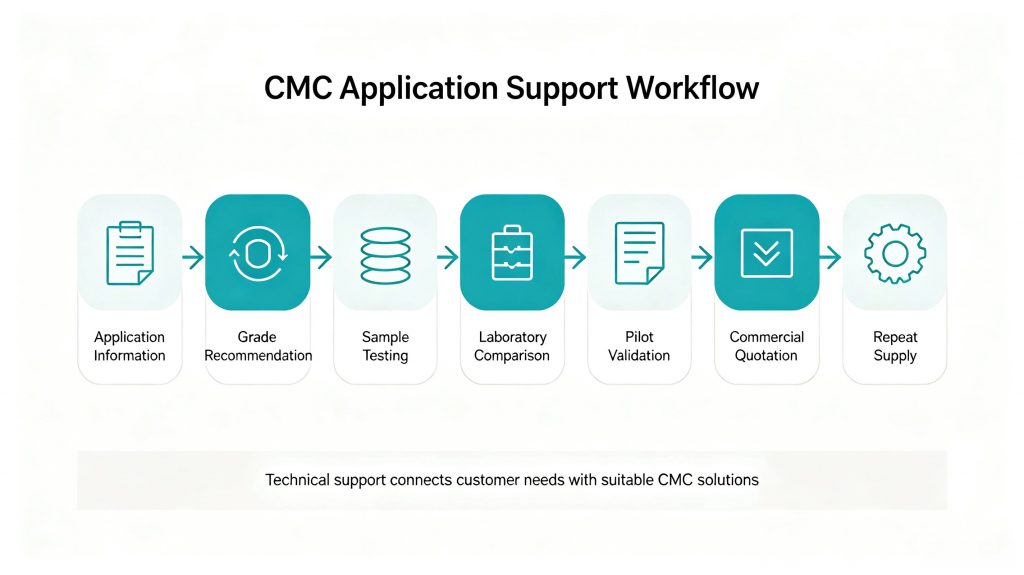
Title:CMC Supplier Qualification Process
Selecting CMC should begin with the beverage’s stability problem rather than a supplier’s catalog. Providing real formulation details — beverage type, target pH, protein content, total solids, current stabilizer system, target viscosity, main stability issue, and estimated consumption — leads to a far more relevant grade recommendation than a generic price request.
At ACTA, customers can share their target beverage type, pH, protein level, current stabilizer system, and stability problem so that suitable CMC grades can be shortlisted for laboratory evaluation. Where needed, customers can compare different CMC viscosity grades side by side rather than testing only one material.
A practical supplier evaluation can generally move through the following sequence: sample selection, laboratory screening, grade comparison, pilot validation, commercial quotation, and repeat supply. Working through this sequence before committing to a single grade helps confirm both technical fit and commercial terms ahead of full-scale production.For products intended for the U.S. market, buyers should also verify that the ingredient and its intended use comply with applicable FDA food regulations.
Before approving a CMC supplier, buyers should confirm several key factors. On the technical side, they should check the available viscosity grades, viscosity test method, degree of substitution, moisture and purity specifications, and microbiological limits. On the application side, they should ask whether the supplier has tested the grade in dairy or acidic beverages. On the commercial side, they should confirm MOQ, packaging, lead time, and production capacity. A complete technical package should include a Technical Data Sheet (TDS), Certificate of Analysis (COA), Safety Data Sheet (SDS), and appropriate food-grade or regulatory documentation for the destination market.
Raw-material consistency affects finished-product consistency, so supplier reliability can matter as much as the initial quotation. A supplier offering a competitive price but inconsistent batches can create higher costs during commercial production through reformulation, additional testing, and customer complaints. Application testing — not the specification sheet alone — remains the most reliable way to confirm how a CMC grade will perform in a specific beverage, since two materials meeting the same viscosity specification can still hydrate, suspend, and taste differently once they enter the real formulation.For European-market applications, buyers should independently verify applicable food-additive requirements and permitted uses through the relevant regulatory framework.
CMC modifies viscosity, supports suspension stability, improves water management, and adjusts beverage texture. Formulators should evaluate its effectiveness within the complete beverage system because formulation and processing conditions influence its performance.
There is no universal dosage. Formulators can evaluate a laboratory screening range of roughly 0.10–0.50% in selected formulations, but they should establish the final concentration through application testing in the actual beverage.
CMC can help reduce sedimentation by increasing continuous-phase viscosity and supporting suspension. However, particle size, density, protein aggregation, or poor dispersion can also cause sedimentation, so formulators should identify the actual cause first.
CMC can contribute to water management and physical stability, but protein structure, pH, fermentation, and processing conditions frequently contribute to serum separation. Formulators should therefore evaluate CMC as one part of the complete stabilization system.
Not necessarily. A higher-viscosity grade may help formulators achieve the target viscosity at a lower dosage, but excessive viscosity can negatively affect mouthfeel and drinkability. Formulators should choose the grade according to the target texture rather than the highest viscosity number on the data sheet.
Yes, formulators frequently evaluate this combination. In acidified dairy systems, pectin may contribute to protein stabilization under suitable conditions, while CMC contributes to viscosity, suspension, and water management. Formulators should confirm the appropriate balance through formulation trials.
Start with the application requirements — target viscosity, pH, protein system, solids, particle load, and processing conditions — and then compare suitable CMC grades through controlled laboratory testing. Do not select a grade based on viscosity number alone.
No. Use the TDS to qualify product specifications, but conduct application testing to confirm performance in the target beverage. Two materials can meet the same specification
If you are developing a drinkable yogurt, fermented milk beverage, fruit-yogurt drink, cocoa milk beverage, protein-rich dairy drink, or another acidified milk product, ACTA can help you evaluate suitable CMC grades based on your formulation and processing conditions.
To get started, please share these four items: beverage type, target pH, main stability problem, and your current CMC grade or TDS, if available. Additional formulation details — such as protein level, current dosage, target viscosity, and estimated monthly consumption — can help us narrow the options further, but you do not need to provide them for an initial response.
With this information, our technical team can help shortlist suitable CMC grades and, where relevant, a complementary stabilizer for laboratory screening. You can then confirm the final grade and dosage through application testing.
Already using CMC from another supplier? Send us the current product’s TDS, viscosity specification, and dosage, along with your main formulation problem. We can use this as a starting point for grade comparison and sample evaluation.
Request a CMC Sample or Technical Quotation
CMC for Acidified Milk Drinks is not simply a question of adding more thickener. It can contribute to viscosity control, particle suspension, and water management within a beverage system, but it works alongside — not in place of — the protein chemistry, pH, and processing conditions that actually govern stability.
What determines the outcome in practice is the combination of grade, dosage, pH, protein system, processing sequence, and storage conditions, evaluated together rather than adjusted one at a time. The best CMC for a given beverage is not the highest-viscosity or lowest-priced grade; it is the grade that delivers the required stability, texture, and consistency at an acceptable cost-in-use for that specific formulation.
If you are currently developing an acidified milk drink, sending your beverage type, target pH, protein level, current stabilizer system, and main stability problem — along with your current CMC TDS if you have one — will allow a much more relevant grade recommendation and sample selection.
