

CMC uses in pharmaceuticals are especially important in tablet manufacturing, where it functions as a reliable binde .Carboxymethyl cellulose (CMC) is one of the most widely used excipients in modern drug formulation.
CMC uses in pharmaceuticals include tablet binding, suspension stabilization, ophthalmic lubrication, and controlled drug delivery systems.
Due to its chemical stability and versatility, CMC uses in pharmaceuticals have expanded across solid, liquid, and semi-solid dosage forms worldwide.
Carboxymethyl cellulose (CMC) is used in pharmaceuticals as a binder, stabilizer, viscosity modifier, lubricant, and controlled-release matrix agent.
Core CMC pharmaceutical uses include: binding active ingredients in tablet formulations (1%–5%), stabilizing API suspensions in oral liquid medicines, lubricating the ocular surface in artificial tear products (0.5%–1.0%), thickening topical creams and gels, and forming swellable gel matrices for extended-release drug delivery. Pharmaceutical-grade CMC complies with USP-NF and Ph. Eur. monograph specifications and is listed in all major international pharmacopeias as an accepted excipient.Carboxymethyl cellulose is a water-soluble cellulose derivative widely used across industries. See more details on carboxymethyl cellulose.
Pharmaceutical formulation is a discipline of precision. Every excipient in a drug product — every binder, stabilizer, thickener, and coating agent — must perform its function consistently across thousands of production batches, across two-year shelf lives, and across the temperature, humidity, and pH variations that real-world drug storage involves.
Sodium carboxymethyl cellulose has earned its position as one of the most widely used pharmaceutical excipients globally not through marketing, but through a combination of properties that very few water-soluble polymers can match at commercial scale:
CMC does not react with the vast majority of active pharmaceutical ingredients (APIs). Unlike some excipients that form insoluble complexes with cationic drugs or degrade sensitive APIs through oxidative pathways, CMC’s ether linkages are chemically stable and do not initiate unwanted reactions in formulation matrices.
Predictable, tunable viscosity: CMC solution viscosity is a direct, reproducible function of polymer concentration and molecular weight. Formulators can specify and reliably achieve a target viscosity by selecting the appropriate commercial grade — a level of predictability that natural gums, which vary by harvest and processing conditions, cannot always provide.
Broad compatibility: CMC is compatible with most commonly used pharmaceutical excipients — other cellulose derivatives, starch derivatives, sugar-based binders, most APIs, antioxidants, and preservative systems. It works in both aqueous and alcohol-water mixed solvent systems.
CMC is an official excipient in the United States Pharmacopeia-National Formulary (USP-NF), the European Pharmacopoeia (Ph. Eur.), the British Pharmacopoeia (BP), the Japanese Pharmacopoeia (JP), and the Indian Pharmacopoeia (IP). This global acceptance simplifies regulatory submissions and eliminates the need for novel excipient justification in most markets.
Established safety record: CMC has been used in pharmaceutical products for over 70 years. Its safety profile is supported by decades of human exposure data, animal toxicology studies, and regulatory review by FDA, EMA, and JECFA.
Understanding where and how CMC is used across pharmaceutical dosage forms requires understanding the chemistry that makes it work — and the specific ways in which that chemistry is exploited differently in each application.
👉 For product specifications and pharmaceutical-grade supply, visit our Carboxymethyl Cellulose Product Page.
CMC is also widely used in food systems. For a broader overview, see our guide on
CMC uses in food.
Not all CMC is interchangeable in pharmaceutical applications. Pharmaceutical-grade CMC differs from food-grade and industrial-grade material in ways that directly affect formulation performance and regulatory compliance.
DS describes the average number of hydroxyl groups per glucose unit that have been substituted with carboxymethyl (-CH₂COONa) groups. The maximum is 3.0; pharmaceutical grades typically range from DS 0.65 to DS 1.45.
DS has three critical consequences for pharmaceutical formulators:
Water solubility: CMC with DS below approximately 0.4 is not fully water-soluble and is unsuitable for pharmaceutical liquid applications. Above DS 0.65, solubility is adequate for most uses. Higher DS grades (0.9–1.45) offer superior solubility under challenging conditions — low temperature, high ionic strength, and low pH.
Acid stability: The carboxymethyl groups on CMC exist as sodium salts at neutral pH (pKa ~4.3). Below pH 4, they begin to protonate, reducing the polymer’s charge and causing partial collapse of the chain — which means reduced viscosity and potentially reduced solubility. Higher DS means more carboxymethyl groups, so the polymer maintains more of its charge at a given acidic pH. For suspensions of APIs with acidic pH profiles or for gastric-pH stability, higher DS grades are strongly preferred.
Compatibility with cationic APIs: CMC’s anionic charge creates the risk of ionic interaction with positively charged APIs, potentially forming insoluble complexes that reduce bioavailability or alter release kinetics. This must be assessed during preformulation compatibility screening for any cationic drug (amines, quaternary ammonium compounds). Where incompatibility exists, lower DS grades or alternative excipients should be evaluated.
Molecular weight determines solution viscosity — the single most practically important CMC parameter for most pharmaceutical applications. Commercial pharmaceutical CMC is supplied in multiple viscosity grades, characterized by the viscosity of a standardized 1% or 2% aqueous solution at 25°C:
| Viscosity Grade | 1% Solution Viscosity (mPa·s) | Pharmaceutical Applications |
|---|---|---|
| Low | 25–100 | Tablet binder (direct compression), film coating solutions |
| Medium-low | 100–400 | Tablet binder (wet granulation), coating suspensions |
| Medium | 400–1,500 | Oral suspension stabilizer, syrup thickener |
| High | 1,500–4,000 | Topical gels, concentrated oral suspensions |
| Very high | > 4,000 | Extended-release matrix tablets, specialized topicals |
The critical formulator rule: Using a grade that is one level too high in viscosity is more damaging than using one that is slightly too low. An overly viscous grade causes processing problems, unacceptable texture, and potential safety issues in injectables. Always bracket your target with trials of adjacent grades.
The pharmacopeia monographs for CMC (USP-NF “Carmellose Sodium”; Ph. Eur. “Carmellose Sodium”) specify limits that are significantly tighter than food-grade specifications:
| Parameter | Food Grade (Typical) | Pharmaceutical Grade (USP/Ph. Eur.) |
|---|---|---|
| Assay (sodium CMC content) | ≥ 99.0% | 99.5%–102.0% (on dry basis) |
| Heavy metals | ≤ 20 ppm | ≤ 10 ppm (by specific element) |
| Arsenic | Not typically specified | ≤ 1 ppm |
| Chloride content | ≤ 1.0% | ≤ 0.40% |
| Microbial limits | Standard food limits | TAMC ≤ 1,000 CFU/g; TYMC ≤ 100 CFU/g |
| Residual solvents | Not tested | Must comply with ICH Q3C guidelines |
Regulatory consequence: Using food-grade CMC in a pharmaceutical formulation without pharmacopeia-grade testing and documentation creates a regulatory filing weakness that may require supplementary justification or trigger queries from regulatory reviewers. Always specify and document pharmaceutical grade.

Tablets are the most common solid oral dosage form globally. Every conventional tablet contains a binder — an excipient whose purpose is to create cohesion between the other tablet components (API, fillers, disintegrants, lubricants) so that they form a mechanically stable compact that can be manufactured, packaged, transported, and handled without crumbling, while still disintegrating appropriately in the gastrointestinal tract after ingestion.
CMC is one of the most effective and widely used binders in both of the primary tablet manufacturing processes.
CMC uses in pharmaceuticals are most clearly demonstrated in tablet manufacturing, where it acts as a reliable binder in both wet granulation and direct compression processes. Wet granulation is the traditional tablet manufacturing process. API and excipient powders are combined, then wetted with a binder solution or paste to form granules that are dried and compressed into tablets. CMC is used in wet granulation in two forms:
As a binder solution (most common): CMC is dissolved in water to make a 2%–8% solution that is sprayed or poured onto the powder blend during granulation. The CMC solution wets the powder mass, promotes particle agglomeration, and — as the granules dry — the dried CMC acts as a solid bridge between particles, providing the cohesive strength that gives granules their mechanical integrity.
At this stage, the key performance parameters are:
Typical CMC concentration in wet granulation binder solution: 2%–6%
Typical CMC content in final tablet formulation: 2%–5%
Direct compression — mixing all tablet ingredients and compressing them directly without granulation — has grown significantly as manufacturing technology has improved. It is faster, less expensive, and eliminates the heat and moisture of wet granulation, making it suitable for moisture-sensitive or thermally labile APIs.
In direct compression, CMC functions as a dry binder — its binding action is activated by the compression forces rather than by moisture. Low-viscosity CMC grades are preferred here because they flow well in powder blends and distribute uniformly under the mechanical forces of tablet compression.
Key performance considerations in direct compression:
Typical CMC content in direct compression formulations: 1%–3%
| Formulation Factor | Grade Recommendation |
|---|---|
| Wet granulation, standard | Medium-low viscosity (100–400 mPa·s at 1%), DS 0.75–0.90 |
| Wet granulation, high-API loading | Medium viscosity (400–1,500 mPa·s at 1%) for stronger granule matrix |
| Direct compression | Low viscosity (25–100 mPa·s at 1%), controlled particle size for flowability |
| API with low compressibility | Higher CMC concentration (3%–5%) to compensate |
| Immediate-release target | Confirm disintegration time does not exceed specification at upper CMC dose |
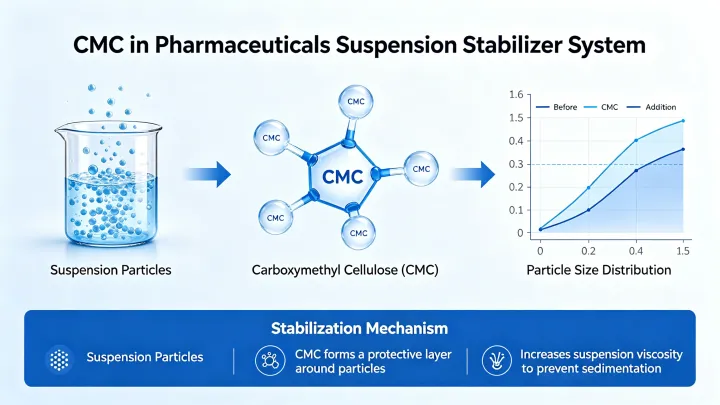
Oral suspensionAmong the most critical CMC uses in pharmaceuticals is its role as a suspension stabilizer in oral liquid formulations.They are pharmaceutical liquids in which an insoluble or poorly water-soluble API is dispersed throughout an aqueous continuous phase. They are critical dosage forms for pediatric medicines, geriatric patients who cannot swallow tablets, and APIs with bioavailability advantages in suspension over solid dosage forms.
The central challenge of any oral suspension is dosing accuracy: every teaspoon or milliliter the patient measures must contain the same amount of API as every other. If the API settles unevenly, the first doses from a bottle may be sub-therapeutic and the last doses potentially toxic. CMC’s role in oral suspension is to prevent this from happening.
CMC stabilizes oral suspensions through three mechanisms that operate simultaneously:
Viscosity enhancement (primary mechanism): CMC increases the viscosity of the continuous aqueous phase. According to Stokes’ Law, the terminal velocity of a settling particle is:
v = (2r²)(ρ_p − ρ_f)g / (9η)
Where r is particle radius, ρ_p and ρ_f are particle and fluid densities, g is gravitational acceleration, and η is fluid viscosity. Increasing η (continuous phase viscosity with CMC) directly decreases settling velocity proportionally — doubling the viscosity halves the settling rate.
Electrostatic stabilization (critical for charged APIs): CMC is an anionic polymer. When it adsorbs onto positively charged API particle surfaces, it introduces a negative surface charge that creates electrostatic repulsion between particles, preventing aggregation. Aggregated particles settle far faster than individual particles (as aggregates, r in Stokes’ equation increases dramatically). CMC’s ability to prevent aggregation is therefore as important as its viscosity contribution.
Thixotropic behavior (shelf stability vs. patient usability): At higher concentrations, CMC contributes mild thixotropy — the suspension gels slightly at rest (resisting settling) but flows under the shear of shaking and pouring. This balance is essential: the suspension must be stable during shelf storage and simultaneously easy to resuspend with a few shakes before dosing.
| Suspension Type | Recommended CMC Grade | Typical Concentration |
|---|---|---|
| Light suspension (fine, low-density API) | Medium viscosity | 0.5%–1.0% |
| Standard suspension (moderate API density) | Medium-high viscosity | 0.5%–1.5% |
| Dense suspension (high-density API, coarse particles) | High viscosity | 1.0%–2.0% |
| Pediatric suspension (must be easy to shake and dose) | Medium viscosity | 0.5%–1.0% |

For suspensions with long shelf-life requirements (18–24 months) or high-density API particles, CMC’s viscosity-based mechanism alone may be insufficient. Particles will eventually overcome the viscosity barrier, particularly if the product experiences temperature cycling during distribution.
In these cases, formulators combine CMC with colloidal microcrystalline cellulose (colloidal MCC) — a co-processed cellulose system that builds a three-dimensional physical network, physically immobilizing API particles rather than simply slowing their descent.
The combination works synergistically:
This CMC + colloidal MCC combination is the industry standard for pediatric antibiotic suspensions, antifungal oral liquids, and other high-stability oral suspension products globally.
👉 Learn more about colloidal MCC and its suspension stabilization mechanism: Cellulose Stabilizers for Pharmaceutical Applications
pH management: Most oral suspensions have a pH of 3.5–7.0. For pH below 4.0, select higher DS CMC (DS ≥ 0.9) to maintain viscosity performance as protonation of carboxymethyl groups increases. Always measure viscosity at the final formulation pH, not in water.
Preservative compatibility: Common oral suspension preservatives — methylparaben, propylparaben, sodium benzoate — are compatible with CMC. However, benzalkonium chloride (a cationic preservative) may interact with anionic CMC. Conduct compatibility testing if benzalkonium chloride is required.
Sweetener and flavoring compatibility: Sucrose, sorbitol, glycerin, and most artificial sweeteners are compatible with CMC. High sucrose concentrations (>40%) will increase solution density and affect settling kinetics — reformulate Stokes’ Law calculations accordingly.
Homogenization: For fine-particle suspensions, high-shear homogenization after CMC dispersion improves API particle size uniformity, reduces particle size distribution width, and improves settling stability. Document the homogenization step in the manufacturing process and treat it as a critical process parameter.
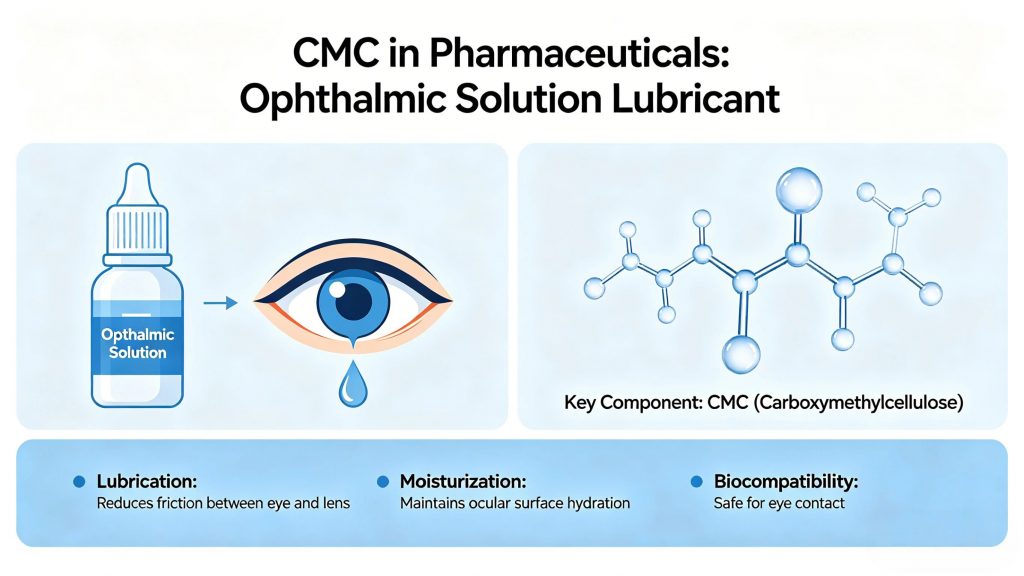
In ophthalmic formulations, CMC uses in pharmaceuticals focus on lubrication and moisture retention.The ophthalmic application of CMC is one of the most direct-to-patient pharmaceutical uses — millions of people use CMC-containing artificial tear products daily for dry eye disease, contact lens discomfort, and post-surgical ocular lubrication.
The natural tear film consists of three layers: a lipid outer layer (preventing evaporation), an aqueous middle layer (containing electrolytes, proteins, and mucins), and a mucin-gel inner layer (enabling the tear film to adhere to the ocular surface). In dry eye disease, the mucin layer is depleted or dysfunctional, resulting in unstable tear film, rapid evaporation, and ocular surface exposure.
CMC mimics the rheological behavior of mucin — the mucoadhesive glycoprotein that forms the inner tear film layer — through two mechanisms:
Viscoelastic lubrication: CMC solutions exhibit shear-thinning behavior similar to natural tears. During the blink (high shear), viscosity decreases and the CMC solution spreads easily across the corneal surface. Between blinks (low shear), viscosity increases, and the CMC solution remains on the ocular surface longer than a purely Newtonian fluid would. This viscoelastic behavior prolongs residence time and lubrication duration.
Mucoadhesion: CMC’s hydroxyl and carboxyl groups form hydrogen bonds with the glycocalyx of corneal epithelial cells, increasing the residence time of the lubricant on the ocular surface. This is the same chemical affinity that allows CMC to bond with cellulose fibers in paper manufacturing — exploited here for therapeutic benefit.
| Product Category | CMC Concentration | Target Patient |
|---|---|---|
| Standard lubricating drops (OTC) | 0.5% | Mild-to-moderate dry eye, contact lens wear |
| Advanced lubricating drops | 1.0% | Moderate-to-severe dry eye |
| Ophthalmic gel (nighttime use) | 0.5%–1.0% + carbomer | Severe dry eye, nocturnal exposure |
Ophthalmic formulations have significantly stricter requirements than oral or topical pharmaceutical products:
Sterility: All ophthalmic products must be sterile. CMC-containing solutions are terminally sterilized by filtration (0.22 μm membrane filter) — CMC at typical ophthalmic concentrations passes through 0.22 μm filters without significant filter loading, which is an important processing advantage over higher-molecular-weight polymers.
Osmolality: Ophthalmic formulations must be isotonic (approximately 290 mOsm/kg) to avoid corneal damage. CMC contributes marginally to osmolality at typical use concentrations; osmolality is primarily adjusted with sodium chloride.
pH: The formulation must be buffered to pH 6.5–7.5 to match the natural tear film pH and avoid corneal irritation. CMC is stable in this range and does not require pH adjustment for its own stability.
Preservative considerations: Multi-dose ophthalmic CMC products require preservatives — typically benzalkonium chloride (BAK) at 0.01%. However, BAK causes cytotoxic effects on corneal epithelium with chronic use. The pharmaceutical industry has moved substantially toward preservative-free unit-dose ophthalmic CMC products for patients requiring frequent dosing (more than 4 times per day).
Particle count: Injectable-standard particle count limits apply to ophthalmic solutions. CMC must be pharmaceutical grade with controlled particle size to meet these limits.
In topical pharmaceutical formulations, CMC uses focus on delivering appropriate rheological behavior, skin feel, and compatibility with the active ingredient — all within a formulation that remains stable across its intended shelf life and storage conditions.
Aqueous gels are among the most cosmetically elegant topical vehicles — they apply cleanly, absorb without residue, and are well-accepted by patients for chronic use applications including antifungal treatments, anti-inflammatory gels, and acne preparations.
High-viscosity CMC at 2%–6% forms stable aqueous gels with:
Formulation note: CMC gels can show some syneresis (water separation) under temperature stress if concentration is too low or if the gel contains high concentrations of electrolytes. For formulations that must demonstrate freeze-thaw stability, validate across at least three freeze-thaw cycles and adjust CMC grade or concentration as needed.
In oil-in-water (O/W) cream formulations, CMC serves as an aqueous phase thickener and emulsion stabilizer. It is typically used at 0.5%–2.0% in combination with primary emulsifiers (cetearyl alcohol, polysorbates, or PEG-based emulsifiers) to:
CMC is particularly valuable in low-fat or reduced-emollient topical formulations where the reduced oil phase would otherwise produce an unacceptably thin, watery texture.
A specialized but important pharmaceutical application: CMC is used as the absorbent gelling material in hydrofiber wound dressings. When a CMC-based wound dressing contacts wound exudate, the CMC fibers absorb fluid and form a cohesive gel that:
Products in this category contain CMC at very high concentrations (often 100% of the fiber composition) in a fibrous form specifically engineered for wound contact.

Another important area of CMC uses in pharmaceuticals is controlled-release drug delivery, where it forms hydrophilic matrix systems for extended drug release.The pharmaceutical industry’s pursuit of controlled-release dosage forms is driven by two goals: improving therapeutic outcomes by maintaining drug concentration within the therapeutic window over extended periods, and improving patient adherence through once-daily dosing.
CMC plays two distinct roles in controlled-release systems.
When high-molecular-weight, high-concentration CMC (typically 15%–40% of tablet weight) is used in tablet formulations, it creates a hydrophilic matrix — a three-dimensional polymer network that controls drug release through combined mechanisms:
Swelling: Upon contact with gastrointestinal fluid, CMC absorbs water rapidly and swells to form a hydrogel layer on the tablet surface. This gel layer acts as a diffusion barrier, slowing the rate at which drug molecules reach the tablet-solution interface.
Erosion: As the outer gel layer slowly erodes into the gastrointestinal fluid, fresh polymer surface is exposed. The drug release rate is determined by the interplay between diffusion through the gel layer and erosion of the gel layer — parameters that can be tuned by adjusting CMC grade (molecular weight), concentration, and tablet geometry.
Drug diffusion: For freely water-soluble drugs, diffusion through the swollen gel matrix is the rate-limiting step. For poorly water-soluble drugs, erosion of the matrix may dominate drug release.
Typical release profile: CMC hydrophilic matrix tablets can sustain drug release over 8–24 hours depending on CMC grade, concentration, and formulation design. This approach is simpler and less expensive than reservoir-based controlled-release systems and does not require precise coating thickness control.
Drugs commonly formulated with CMC hydrophilic matrix: Metformin extended-release, antihypertensive agents, pain management drugs requiring sustained analgesic coverage.
In injectable depot formulations and implantable systems (outside standard oral use), CMC has been used to create high-viscosity vehicles that slow API diffusion from the injection site, providing localized sustained release. This application is more specialized and requires higher-purity CMC with tightly controlled viscosity.
Formulators selecting excipients for new pharmaceutical products must evaluate CMC against available alternatives. Understanding where CMC excels and where it does not is essential for optimal formulation design.
HPMC is the most commonly compared alternative to CMC in pharmaceutical applications. Both are water-soluble cellulose ethers with overlapping utility, but they differ in important ways.
| Property | CMC | HPMC |
|---|---|---|
| Water solubility | Cold water soluble | Cold water soluble (most grades) |
| Thermal gelation | No | Yes (gels on heating, dissolves on cooling) |
| Anionic charge | Yes | No (non-ionic) |
| Tablet binding (wet granulation) | Excellent | Good |
| Tablet binding (direct compression) | Good | Good |
| Film coating | Limited | Excellent — primary film-forming agent |
| Controlled-release matrix | Good | Excellent — industry standard (Methocel) |
| Oral suspension stabilization | Excellent | Good |
| Ophthalmic lubricant | Excellent (primary use) | Good |
| Compatibility with cationic APIs | Risk of complex formation | No charge; safer for cationic APIs |
| Pharmacopeia listing | USP/Ph. Eur./JP | USP/Ph. Eur./JP |
Decision guide:
MCC (Avicel PH grades) is one of the most widely used pharmaceutical excipients, but it serves fundamentally different functions from CMC.
| Property | CMC | MCC |
|---|---|---|
| Water solubility | Fully water-soluble | Insoluble |
| Physical form in use | Solution / gel | Powder (remains particulate) |
| Primary function | Binder, viscosity agent, stabilizer | Binder, filler, disintegrant |
| Tablet applications | Binder (wet or dry) | Binder, diluent — direct compression specialist |
| Liquid applications | Oral suspensions, gels, ophthalmic | Not applicable (insoluble) |
| Colloidal MCC | — | Colloidal MCC (co-processed with CMC) for suspension |
They are complementary, not interchangeable. For solid dosage forms, MCC is typically the preferred binder/filler; CMC is used when specific binding properties or processing advantages are required. For liquid dosage forms, CMC is the active functional ingredient; MCC powder is not applicable.
PVP (Povidone) is a synthetic polymer widely used as a tablet binder, particularly in wet granulation.
| Property | CMC | PVP |
|---|---|---|
| Origin | Plant-based cellulose | Synthetic petroleum-derived |
| Clean label / natural positioning | Yes | No |
| Binding efficiency | High | High |
| Solution hygroscopicity | Moderate | High (very hygroscopic) |
| Tablet hardness at equal concentration | Good | Comparable |
| Oral suspension use | Yes | Limited |
| Regulatory history | Established | Established |
| Cost | Moderate | Moderate to higher |
CMC’s advantage over PVP: Natural origin (increasingly relevant for clean label pharmaceutical positioning), lower hygroscopicity (important for moisture-sensitive APIs and tropical climate storage), and broader utility across multiple dosage forms.
Pharmaceutical formulation errors with CMC are often more consequential than food formulation errors — they can result in failed regulatory submissions, clinical trial failures, or post-market quality problems. These are the most common and most preventable.
What happens: The formulation performs acceptably in early development, but regulatory reviewers query the excipient documentation. The product cannot be submitted without pharmacopeia-compliant testing.
Solution: Always specify pharmaceutical-grade CMC from the outset of development. Request a Certificate of Analysis confirming compliance with USP-NF or Ph. Eur. monograph for every production lot. Obtain a Drug Master File (DMF) or certificate of suitability (CEP) from the supplier for regulatory filings.
What happens: A cationic API forms an insoluble complex with anionic CMC during formulation development, reducing dissolved drug concentration and potentially altering bioavailability.
Solution: CMC-API compatibility screening should be a standard step in preformulation for any API with a positive charge at physiological pH. Mix CMC solution (1%–2%) with drug solution at the intended formulation ratio and observe for turbidity, precipitation, or viscosity changes at 25°C and 40°C over 24–48 hours. Where incompatibility is confirmed, evaluate HPMC (non-ionic) or alternative binder systems.
What happens: Suspension passes 4-week accelerated stability testing but fails at the 6-month real-time checkpoint. Investigation reveals that the CMC grade used was marginal for the particle density and size of the API.
Solution: For long-shelf-life suspensions (18–24 months), do not rely on accelerated stability alone. Run real-time stability in parallel from the start of development. Evaluate higher-viscosity CMC grades and consider combination with colloidal MCC for structural network support. Test settling rate by measuring sedimentation height at 24h, 48h, 1 week, and 4 weeks before finalizing formulation.
What happens: The final suspension or gel contains undissolved CMC aggregates (visible as white specks or as viscosity inconsistency between batches), failing in-process visual inspection or uniformity testing.
Solution: Establish a validated dispersion procedure as part of the manufacturing process:
What happens: Benzalkonium chloride (commonly required in ophthalmic and multi-dose oral suspensions) interacts with anionic CMC, reducing preservative efficacy below the levels required to pass Antimicrobial Effectiveness Testing (AET) per USP <51> or Ph. Eur. 5.1.3.
Solution: Always include antimicrobial effectiveness testing with the complete formulation (CMC + preservative + all other ingredients) at the intended preservative concentration. If benzalkonium chloride is required, test at multiple concentrations and evaluate whether elevated concentrations or alternative co-preservatives are needed to achieve required efficacy.
What happens: A supplier switch during commercial manufacturing introduces a different CMC grade (different viscosity or DS) that nominally meets the broad quality specification. Product consistency changes, and investigation requires extensive re-testing and regulatory notification.
Solution: Specify commercial grade designation (not just “pharmaceutical-grade CMC”) in the Drug Product manufacturing instructions and in the regulatory filing. Establish a viscosity range (e.g., 800–1,200 mPa·s at 1%) as a tighter internal specification beyond the pharmacopeia limits. Require re-qualification testing for any change in CMC supplier or grade.
CMC is an official excipient in all major international pharmacopeias:
| Pharmacopeia | Monograph Name | Key Specifications |
|---|---|---|
| USP-NF (United States) | Carmellose Sodium | Assay, viscosity, DS, chloride, heavy metals, microbial limits |
| Ph. Eur. (Europe) | Carmellose Sodium | Same parameters; specific limits may differ slightly |
| BP (British Pharmacopoeia) | Carmellose Sodium | Aligned with Ph. Eur. |
| JP (Japanese Pharmacopoeia) | Carmellose Sodium | Local testing methodology |
| IP (Indian Pharmacopoeia) | Carmellose Sodium | Aligned with BP/Ph. Eur. |
CMC is FDA GRAS-listed and has been reviewed and accepted by the EMA without restrictions for pharmaceutical excipient use. The Inactive Ingredient Database (IID) of the FDA lists CMC in multiple approved drug product applications at specific maximum concentrations by dosage form, providing important reference ranges for new drug applications.
CMC is listed in the FDA excipient database. According to the FDA Inactive Ingredient Database,
CMC is widely used in approved drug formulations.
JECFA has established an ADI of 0–25 mg/kg body weight/day for CMC based on chronic toxicity studies. No carcinogenicity, mutagenicity, reproductive toxicity, or developmental toxicity has been identified in studies conducted to support regulatory submissions.
For pharmaceutical use, CMC must comply with:
Sourcing decisions for pharmaceutical-grade CMC require evaluation criteria that go significantly beyond price per kilogram. Regulatory risk, supply chain reliability, and technical support capability are equally or more important.
| Document | Purpose |
|---|---|
| Drug Master File (DMF) or CEP | Required for regulatory filings in US/EU markets; confirms supplier is known to authorities |
| Certificate of Analysis (CoA) per lot | Confirms each specific production lot meets all pharmacopeia specifications |
| Pharmacopeia Compliance Statement | Explicit statement of compliance with USP-NF and/or Ph. Eur. monograph |
| ICH Q3C Residual Solvent Declaration | Confirms solvent residues within acceptable limits |
| GMP Certification | Confirms manufacturing under pharmaceutical-grade Good Manufacturing Practice |
| Microbial Testing Certificate | Third-party verification of microbial limits for each lot |
| Allergen and Cross-Contamination Declaration | Required for formulation master file documentation |
| Stability Data | Supplier data supporting stated shelf life; enables formulation shelf-life assumptions |
A reliable pharmaceutical CMC supplier should operate under:
For pharmaceutical-grade CMC procurement, technical support is not optional — it is a procurement criterion. Expect and require:
We supply pharmaceutical-grade CMC compliant with USP-NF and Ph. Eur. specifications, with full DMF support, GMP certification, and dedicated technical formulation guidance for drug product developers.
👉 Request a sample, DMF reference, or technical consultation: Carboxymethyl Cellulose Pharmaceutical Grade
CMC pharmaceutical uses span all major dosage form categories: as a binder in tablet manufacturing (wet granulation and direct compression, 1%–5%); as a viscosity agent and API stabilizer in oral liquid suspensions (0.5%–2.0%); as a viscoelastic lubricant and mucoadhesive agent in ophthalmic artificial tear formulations (0.5%–1.0%); as a thickener and texture agent in topical creams, gels, and ointments (0.5%–6.0%); and as a hydrophilic matrix former for controlled drug release in extended-release tablets (15%–40%).
Yes. Pharmaceutical-grade CMC complies with USP-NF and Ph. Eur. monograph specifications and is listed as an accepted excipient in all major international pharmacopeias. It is not absorbed by the human body, is chemically inert with most APIs, and has an established safety profile supported by JECFA, FDA, and EMA review. No carcinogenicity, mutagenicity, or reproductive toxicity has been identified.The safety of CMC has also been evaluated by the European Food Safety Authority (EFSA),
confirming its safety as an approved additive (E466).
In wet granulation, CMC binder solutions are typically prepared at 2%–6% and result in 2%–5% CMC in the final tablet. In direct compression, 1%–3% CMC is typical. The optimal concentration must be determined through formulation trials balancing tablet hardness, friability, and disintegration time against the API’s own compressibility and the tablet’s intended release profile.
CMC is generally preferred for oral suspension stabilization (due to its electrostatic stabilization mechanism), standard tablet binding in wet granulation, and ophthalmic lubricant formulations. HPMC is generally preferred for tablet film coating, controlled-release hydrophilic matrix tablets (where the industry has more extensive clinical history with HPMC), and formulations where the API is cationic and CMC compatibility is uncertain. Both are established, pharmacopeia-listed excipients with strong safety records.
The most common concentrations are 0.5% for standard lubricating drops (OTC, mild-to-moderate dry eye) and 1.0% for advanced lubricating drops targeting moderate-to-severe dry eye conditions. At these concentrations, CMC provides viscoelastic lubrication that mimics the mucin layer of natural tears, with mucoadhesion that extends residence time on the ocular surface.
Yes. At concentrations of 15%–40% of tablet weight, high-molecular-weight CMC forms a hydrophilic gel matrix that swells in gastrointestinal fluid and controls drug release through a combination of diffusion through the gel layer and erosion of the matrix. This approach can sustain drug release over 8–24 hours, depending on CMC grade, concentration, and tablet geometry. The mechanism is well-characterized and the approach has regulatory precedent in multiple approved extended-release drug products.
Carboxymethyl cellulose (CMC) serves several critical functions in pharmaceutical formulations, and understanding CMC uses in pharmaceuticals begins with its role as a tablet binder. This is one of the most foundational CMC uses in pharmaceuticals: it improves cohesion and ensures uniform API distribution in both wet granulation (2%–5%) and direct compression (1%–3%) processes. Among the most clinically significant CMC uses in pharmaceuticals is its application in oral suspensions, where CMC increases continuous phase viscosity and provides electrostatic stabilization of API particles, preventing sedimentation and ensuring consistent dosing from first use to last.
Ophthalmic formulations represent another high-value category of CMC uses in pharmaceuticals — at 0.5%–1.0%, CMC acts as a viscoelastic lubricant that mimics the mucin layer of natural tears, making it the active ingredient in most artificial tear products for dry eye treatment. Topical creams and gels further illustrate the breadth of CMC uses in pharmaceuticals: CMC functions as a thickener and water-retention agent, contributing smooth texture and broad API compatibility across dermatological applications. Perhaps the most technically sophisticated of all CMC uses in pharmaceuticals is its role in controlled-release drug delivery — at concentrations of 15%–40% of tablet weight, high-molecular-weight CMC forms a hydrophilic matrix that swells in gastrointestinal fluid and controls drug diffusion, sustaining therapeutic drug levels over 8–24 hours. Across every one of these CMC uses in pharmaceuticals, the same properties make it the preferred choice: chemical inertness with most APIs, listing in all major pharmacopeias (USP-NF, Ph. Eur., JP), and a well-established global safety profile supported by FDA, EMA, and JECFA review.
CMC pharmaceutical uses encompass the full breadth of modern drug formulation — from the tablet that a patient swallows with water, to the eye drop that relieves dry eye discomfort, to the oral suspension that delivers an antibiotic to a child, to the extended-release matrix that maintains a therapeutic drug level throughout the day.
What unites these diverse applications is CMC’s combination of properties that pharmaceutical formulators rely on most: chemical inertness across a wide range of APIs, predictable and tunable viscosity, broad pharmacopeia listing and regulatory acceptance, established safety profile, and compatibility with both aqueous and mixed-solvent pharmaceutical systems.
For formulators working across solid, liquid, and semisolid dosage forms, CMC deserves a position in the standard formulation toolkit — not as a last resort, but as a first-consideration excipient whose mechanisms, grade options, and limitations are understood deeply enough to exploit fully.
For pharmaceutical procurement teams, sourcing decisions should prioritize pharmacopeia compliance documentation, DMF availability, GMP certification, and technical support capability alongside competitive pricing. The cost of a formulation failure attributable to an inadequately specified CMC grade will always exceed the cost of sourcing correctly from the start.
👉 Source pharmaceutical-grade CMC with full USP/Ph. Eur. compliance, DMF support, and technical formulation guidance:
View product specifications and request samples →
Authority References:
Related Reading: