

By Richard Wang | Technical Review by Alice Meng | Last Updated November 2026 about HPMC E50 Uses
HPMC E50 uses mainly involve controlling viscosity and stabilizing suspensions in pharmaceutical formulations. Manufacturers typically offer HPMC E50 grades with a nominal viscosity of approximately 50 mPa·s, which formulators use as thickeners and suspension stabilizers in oral liquid formulations. Selected manufacturers also supply specific HPMC E50 grades for PVC suspension polymerization, where the polymer acts as a protective colloid and dispersing stabilizer.
However, the E50 designation alone does not establish the substitution type, pharmaceutical suitability or industrial performance of a product. Buyers should verify viscosity test conditions, substitution characteristics, quality standards and manufacturer-specific application data before purchasing.
This guide explains HPMC E50 uses, key properties, pharmaceutical and industrial applications, differences between E5, E15, E50 and K-series grades, and the documents buyers should check when evaluating a supplier.
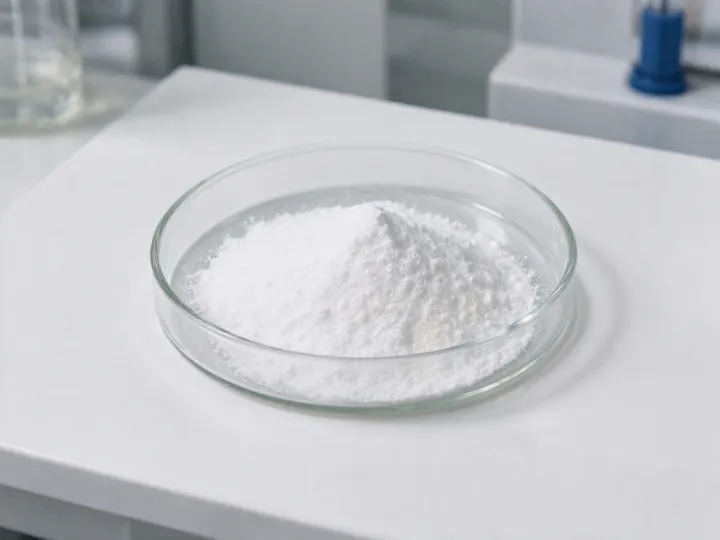
Caption:HPMC E50 is a viscosity grade of hydroxypropyl methylcellulose used in selected pharmaceutical and industrial formulations.
Understanding HPMC E50 uses starts with its viscosity and substitution type, since the E50 designation alone does not establish the product’s full technical characteristics.
Where it works best.
Where it needs caution. Tablet film coating and wet granulation generally start with lower-viscosity grades such as E5 or E15. Hard capsule manufacturing commonly uses specifically developed capsule grades.
Where it does not fit. It does not replace high-viscosity K-series matrix polymers, and it does not replace 50,000 mPa·s construction-grade HPMC.
What to verify. Viscosity test conditions, substitution type, quality standard, TDS and batch COA.
Need Help Selecting HPMC E50?
Share your intended application and target viscosity with ACTA. We can help review your technical requirements and discuss suitable HPMC options, documentation and quotation conditions.
| HPMC grade | Typical nominal viscosity | Main application direction |
|---|---|---|
| E5 | About 5 mPa·s | Tablet film coating, selected binder applications |
| E15 | About 15 mPa·s | Film coating, wet granulation binder |
| E50 | About 50 mPa·s | Selected pharmaceutical suspensions; PVC use for specific manufacturer grades |
| E100 | Supplier-defined | Verify the actual viscosity specification |
| K4M | About 4,000 mPa·s | Extended-release matrix systems |
| K15M | About 15,000 mPa·s | Extended-release matrix systems |
These are common commercial nominal values, not universal grade standards. Confirm the actual specification with each manufacturer.
HPMC E50, also called hydroxypropyl methylcellulose E50 or hypromellose E50, is a non-ionic, water-soluble cellulose ether. Its most distinctive contribution is viscosity control and suspension support. Like other HPMC grades, it can also form films and act as a binder, although suitability for those functions depends on the system.
Compared with E5 and E15, E50 produces a thicker solution at the same concentration, so it suits formulations that need more viscosity or better particle suspension. Viscosity is only one selection criterion.
Manufacturers produce HPMC by reacting cellulose with methyl chloride and propylene oxide under alkaline conditions. This partially substitutes the hydroxyl groups on the cellulose backbone with methoxy and hydroxypropoxy groups. These groups give the polymer its water solubility and shape its hydration, thermal gelation and film-forming behavior. Manufacturers differentiate HPMC grades by methoxy content, hydroxypropoxy content and viscosity.
Many pharmaceutical HPMC E-series products, including commercially available E50 grades, are supplied as hypromellose type 2910. However, E50 and 2910 describe different characteristics: E50 identifies a commercial viscosity grade, while 2910 identifies the substitution type. The E50 designation alone does not establish whether a product is hypromellose 2910, so buyers should confirm the substitution type in the manufacturer’s current TDS and COA.
Type 2910 is commonly associated with approximately 28–30% methoxy content and 7–12% hydroxypropoxy content. These ranges describe the typical characteristics of the type and are not universal specifications for every HPMC E50 product. By comparison, type 2208 carries lower methoxy substitution (roughly 22%) and includes the high-viscosity K-series grades used in extended-release matrices. In some manufacturers’ naming systems the letter E points to type 2910 and K to type 2208, but naming conventions vary.
| Term | What it represents |
|---|---|
| E50 | Commercial viscosity grade |
| 2910 | Hypromellose substitution type |
| 2208 | Hypromellose substitution type |
| 9004-65-3 | General CAS number for HPMC; the HPMC E50 CAS number does not identify a grade or substitution type |
Because HPMC is non-ionic, it is generally less sensitive to ionic interactions than anionic cellulose derivatives such as sodium CMC. However, electrolytes, salts, pH, temperature and other formulation components can still influence its hydration, viscosity and thermal gelation behavior. Compatibility should therefore be evaluated in the actual formulation.
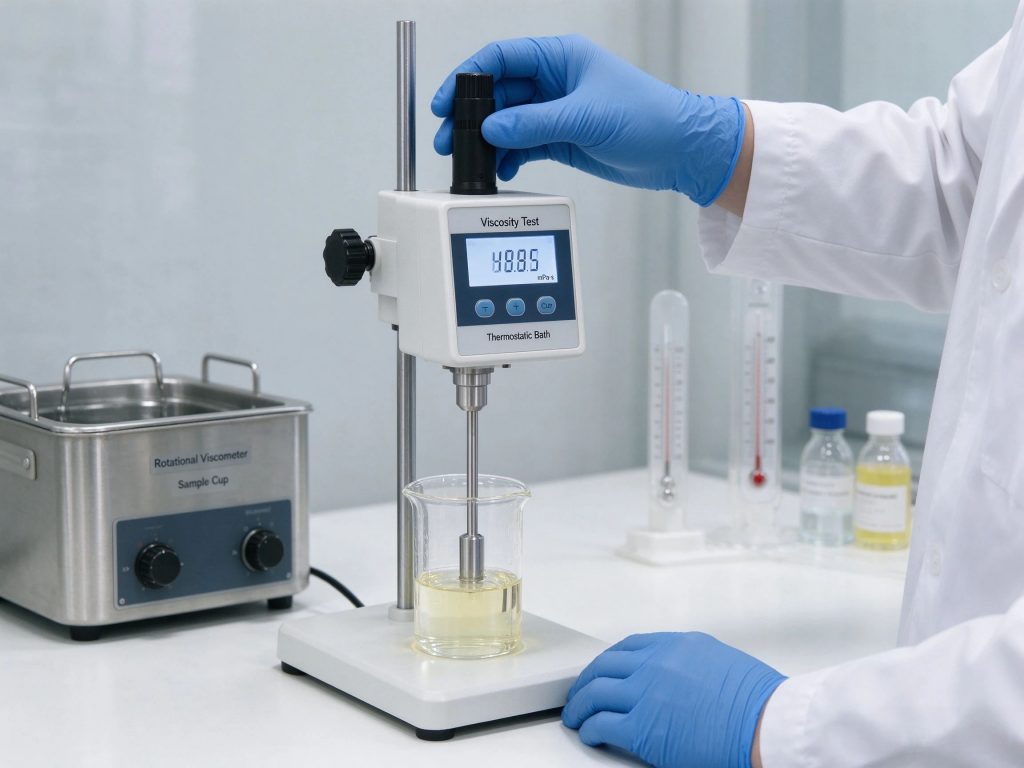
Caption: HPMC viscosity results depend on test concentration, temperature, preparation method and measurement conditions.
Viscosity is one of the key factors affecting HPMC E50 uses in different formulations, so the nominal number alone is not enough without clearly defined test conditions. ACTA states its HPMC viscosity range (3 to over 200,000 mPa·s) as measured in a 2% aqueous solution at 20°C. Other suppliers may define their own conditions. Before comparing products, confirm the following in the manufacturer’s current TDS.
A nominal value of 50 mPa·s does not establish equivalence if two products are tested under different conditions. If two suppliers both quote E50, but one tests a 2% solution and the other uses a different concentration or method, you cannot compare their viscosity results directly. For dynamic viscosity, 1 mPa·s is numerically equivalent to 1 cP, but the test conditions must still match.
Viscosity sets thickening power, slows particle settling in suspensions and shapes the flow of liquid products. Higher viscosity does not automatically mean better performance, because excessive viscosity can increase mixing resistance, complicate pumping, slow dissolution and interfere with coating operations.
HPMC E50 has a relatively low viscosity compared with high-viscosity K-series HPMC products such as K4M and K15M. However, it has a higher nominal viscosity than E5 and E15 in comparable manufacturer grade systems. Buyers should not treat the nominal viscosity of 50 mPa·s as a universal acceptance specification. Instead, they should check the manufacturer’s grade specification and verify the actual viscosity range using the stated test method.
Suppliers generally ship HPMC E50 as a white to off-white, odorless powder or granules. The material absorbs moisture, so packaging and storage directly affect quality.
The following table summarizes representative characteristics of HPMC E50 products. The substitution ranges apply to hypromellose type 2910 where specified. They should not be interpreted as universal specifications for every HPMC E50 product.
| Property | Typical Characteristics |
|---|---|
| Product name | Hydroxypropyl Methylcellulose E50 |
| Synonyms | HPMC E50, Hypromellose E50 |
| CAS number | 9004-65-3 |
| Appearance | White to off-white powder or granules |
| Chemical nature | Non-ionic cellulose ether |
| Substitution type | Manufacturer-dependent; 2910 is common in certain pharmaceutical product ranges and must be verified |
| Typical methoxy range for hypromellose 2910 | Commonly 28–30%; verify against the applicable monograph and manufacturer specification |
| Typical hydroxypropoxy range for hypromellose 2910 | Commonly 7–12%; verify against the applicable monograph and manufacturer specification |
| Representative commercial grade value | Nominal viscosity of approximately 50 mPa·s (see section 1.2) |
| Cold-water solubility | Dissolves to form a colloidal solution |
| Hot-water behavior | Disperses in hot water but does not readily dissolve; hydrates and dissolves upon cooling |
| Main functions | Thickening and suspension stabilization, film formation and binding (application-dependent) |
These are representative characteristics only. Actual specifications vary by manufacturer, so request a batch-specific COA.
HPMC is practically insoluble in hot water, where it disperses rather than dissolves. As the temperature falls, the polymer gradually hydrates and forms a colloidal solution. In cold water, HPMC can also dissolve, but direct addition without adequate dispersion may cause lumps because the outer layer of each particle hydrates before water penetrates the center. Formulators usually choose one of two methods.
Proper solution preparation is an important consideration when evaluating HPMC E50 uses, because incomplete dispersion or hydration can affect the viscosity and consistency of the final formulation.
Dispersing powder in hot water and cooling it does not by itself guarantee a uniform solution. Follow the product’s recommended dissolution method, and control mixing speed, addition rate, water quality, temperature and hydration time so that preparation stays reproducible.
HPMC solutions stay fluid at low temperatures but form a reversible gel when heated. This is the opposite of gelatin and most natural gums, which gel on cooling. The gelation temperature is not a universal constant. It usually falls between about 50°C and 90°C, depending on grade, concentration, salts and other ingredients.
HPMC also forms continuous, flexible films once water evaporates. Film performance depends on substitution type and viscosity grade, polymer concentration and coating solids, plasticizer selection and level, drying conditions, and compatibility with other ingredients and equipment.
These thermal and film-forming characteristics help determine which HPMC E50 uses are practical under specific processing and formulation conditions.
| Material | Main Functional Characteristics | Typical Application Areas |
|---|---|---|
| HPMC E50 | Viscosity control, suspension stabilization | Pharmaceutical suspensions, selected food and industrial systems |
| HPMC E5 | Lower-viscosity film formation and binding | Tablet film coating, hard capsule development (selected) |
| HPC | Film formation, binding, thermoplastic behavior | Tablets, coatings, extrusion |
| HEMC | Water retention, thickening, rheology | Construction and industrial |
| CMC | Anionic thickening and water binding | Food, pharmaceuticals, industrial |
CMC and HPMC both raise viscosity, yet their ionic character and ingredient interactions differ. CMC is anionic and sensitive to electrolytes, divalent cations and low pH, while HPMC is non-ionic and gels reversibly on heating. If you are comparing the two, our CMC supplier guide explains how sodium carboxymethyl cellulose is specified and purchased. HPC and HPMC both form films, but their solubility and thermal behavior are not identical. Choose the polymer by formulation requirement, not by price or viscosity alone, and confirm compatibility in the laboratory.
Understanding these differences is essential when comparing HPMC E50 uses with other cellulose ethers for pharmaceutical, food and industrial applications.
Caption: HPMC can modify liquid viscosity and support suspension stability, depending on grade characteristics and formulation design.
HPMC is among the most extensively characterized pharmaceutical excipients, with monographs in the USP, EP, JP and ChP. Individual viscosity grades, however, are not interchangeable. Viscosity largely decides which dosage form a grade serves.
| Viscosity level | Typical pharmaceutical use |
|---|---|
| Low (about 3–15 mPa·s) | Aqueous film-coating solutions and selected binder applications. |
| Moderate (E50 region) | Suspensions and liquids that need added viscosity |
| High (about 4,000 mPa·s and above) | Hydrophilic sustained-release matrices |
Source: general grade-selection guidance, including ACTA’s HPMC viscosity guidance. Confirm the application of any specific product with its manufacturer.
This table is a starting framework, not a universal rule. E50 is not a universal excipient, and its suitability depends on the dosage form, formulation, manufacturing process and pharmacopoeial requirements.
Among pharmaceutical HPMC E50 uses, suspension stabilization is a key application and one of the main reasons buyers evaluate this grade for oral liquid formulations.A pharmaceutical suspension disperses finely divided, poorly soluble API particles in a liquid. Because those particles settle under gravity, poor physical stability leads to non-uniform dosing and redispersion problems.
HPMC E50 addresses this challenge by raising the viscosity of the continuous aqueous phase. Stokes’ law explains the principle for ideal spherical particles under dilute, laminar conditions. $$v=\frac{2r^2(\rho_p-\rho_f)g}{9\eta}$$
Here v is the settling velocity, r the particle radius, ρp and ρf the particle and fluid densities, g gravitational acceleration, and η the continuous-phase viscosity. Under these simplified conditions, higher viscosity reduces settling velocity. Real suspensions show non-Newtonian behavior and particle interactions, so Stokes’ law gives a concept and not a prediction.
The objective is not necessarily to eliminate sedimentation. A well-designed suspension maintains acceptable physical stability while allowing settled particles to redisperse easily with gentle shaking.
In practice, HPMC E50 can help slow particle sedimentation during storage and contribute to the physical stability of oral suspensions. Its effect on redispersibility, however, depends on particle characteristics, formulation composition and the overall suspension system. Formulators should evaluate sedimentation volume, sediment structure and redispersibility through appropriate stability testing.
Viscosity alone does not guarantee stability. When you evaluate E50 in a suspension, test the following.
Buyers who source a suspension stabilizer often compare HPMC E50 with sodium CMC and colloidal MCC, because each controls settling in a different way. The table below is a selection framework for first screening.
| Comparison | HPMC E50 | Sodium CMC | Colloidal MCC |
|---|---|---|---|
| Chemical nature | Non-ionic cellulose ether | Anionic cellulose ether | Cellulose-based colloidal network, often MCC/CMC-based |
| Main function | Thickening and suspension support | Thickening, stabilization | Suspension stabilization and structural network |
| Main formulation approach | Increase continuous-phase viscosity | Increase viscosity and water binding | Build a structured colloidal network |
| Ionic interactions | Relatively low | More sensitive to electrolytes and other factors | Depends on the specific formulation |
| Key evaluation | Viscosity and redispersibility | Viscosity and electrolyte compatibility | Dispersion, activation and network stability |
| Typical selection consideration | When a defined HPMC viscosity grade is required | When soluble thickening is needed | When suspension structure and particle stabilization are required |
This is not an absolute performance ranking, so confirm actual results through formulation testing. If your formulation requires both viscosity control and suspension stability, it may be worth comparing HPMC E50, sodium CMC and colloidal MCC in parallel rather than assuming that one polymer can replace the others. ACTA supplies all three, so you can ask for them to be reviewed in one inquiry. For the structural-network option, see our colloidal MCC stabilizer.
Selected HPMC E50 uses in oral liquids include viscosity modification and suspension support, particularly when the formulation requires additional viscosity or improved physical stability. The term “oral liquid” covers solutions, suspensions and syrups, which have different requirements. For a clear, low-viscosity solution, a lower-viscosity grade or another excipient may be more appropriate.
Sugar content, salts, preservatives, other polymers and the API all influence final viscosity. During development, check polymer hydration, viscosity under storage conditions, API compatibility, microbiological quality, shelf-life stability and dose measurement.
Formulators must conduct application-specific tests when evaluating HPMC E50 uses in tablet coating, although pharmaceutical manufacturers widely use HPMC as a film-forming polymer in coating formulations.
For conventional immediate-release film coating, formulators often prefer lower-viscosity HPMC grades such as E5 or E15 because these grades help them prepare coating solutions with manageable viscosity at practical concentrations. This allows operators to achieve effective spraying, good atomization and uniform film formation.
Formulators may also consider HPMC E50 for selected coating formulations when its viscosity and film-forming properties meet their process requirements. However, they must evaluate its suitability based on the coating solution concentration, spray conditions, equipment and desired film characteristics.
Selection guidance: For routine immediate-release tablet coating, E5 or E15 may be more practical starting points. Consider E50 only when its solution viscosity and processing behavior are appropriate for the specific coating system.
HPMC E50 uses in wet granulation depend on binder-solution viscosity, polymer characteristics and the processing requirements of the formulation.
However, the viscosity of the selected HPMC grade affects binder solution preparation and processing. Compared with lower-viscosity grades such as E5 and E15, E50 may produce a more viscous solution at the same concentration. This can influence liquid distribution, spraying behavior and granule formation.
For this reason, E50 is not automatically the most efficient choice for conventional wet granulation. Lower-viscosity grades may be easier to handle when a relatively low-viscosity binder solution is required.
Selection guidance: E50 can be evaluated as a wet granulation binder when its viscosity is compatible with the formulation and manufacturing process. For routine binder applications requiring easier solution handling, E5 or E15 may be more suitable starting grades.
HPMC is used in the pharmaceutical capsule industry, particularly in the production of vegetarian or plant-based capsule shells. However, capsule-shell manufacturing requires carefully controlled polymer properties, including film formation, gelation behavior and mechanical performance.
Not every pharmaceutical HPMC grade is designed for capsule-shell production. Although HPMC E50 has film-forming properties, its nominal viscosity alone does not establish that it is suitable for manufacturing hard capsule shells.
HPMC may also be used as an excipient in certain capsule formulations, depending on its function in the formulation. This is a different application from using HPMC as the primary material for the capsule shell.
Selection guidance: Do not select HPMC E50 for hard capsule-shell production based only on its viscosity designation. Capsule manufacturers should use grades specifically developed and qualified for capsule-shell manufacturing.
HPMC is widely used in hydrophilic matrix systems for controlled drug release. After contact with aqueous media, HPMC hydrates and forms a gel layer around the dosage form. This hydrated layer can act as a barrier to drug diffusion and influence the release profile.
However, the viscosity grade plays an important role in matrix performance. Higher-viscosity HPMC grades, such as K4M and K15M, are commonly considered for hydrophilic matrix formulations because they can provide stronger gel structures and help control drug release.
HPMC E50 has a much lower nominal viscosity than these high-viscosity matrix grades. Therefore, it should not be treated as a direct substitute for K4M or K15M in conventional sustained-release matrix tablets.
Selection guidance: E50 may be evaluated in selected formulations or as part of a multi-polymer system, but high-viscosity HPMC grades are generally more established starting points for conventional hydrophilic matrix controlled-release applications.
The suitability of HPMC E50 depends on the intended pharmaceutical application, formulation requirements and the specific grade supplied. Its nominal viscosity of approximately 50 mPa·s does not, by itself, establish suitability for tablet coating, wet granulation, capsule manufacturing or controlled-release formulations.A practical assessment of pharmaceutical HPMC E50 uses should consider not only nominal viscosity but also dosage-form requirements, excipient compatibility and manufacturing conditions.
Before selecting HPMC E50 for a pharmaceutical project, buyers and formulation developers should evaluate the following factors:
Confirm the HPMC substitution type, such as 2910 or 2208. Different substitution types have different methoxy and hydroxypropoxy contents and may show different hydration, thermal gelation and formulation behavior.
2. Viscosity and Test Conditions
Check the viscosity specification, test concentration, temperature and measurement method. A nominal E50 designation should not be treated as a universal acceptance range across all manufacturers.
Confirm whether the product meets the required pharmacopoeial or customer specifications, such as USP–NF, Ph. Eur., JP or applicable national standards. The actual compliance status should be supported by the manufacturer’s documentation.
Evaluate the properties relevant to the intended use. For example:
Request the current Technical Data Sheet (TDS), Certificate of Analysis (COA) and other applicable quality documents. Confirm that the product specification and documentation correspond to the actual manufacturing grade being offered.
Where HPMC E50 is being considered for a new pharmaceutical application, conduct formulation and process evaluations using the intended raw materials, concentrations and manufacturing conditions. For regulated pharmaceutical products, the final excipient selection should follow the customer’s quality system and applicable regulatory requirements.
Overall conclusion: HPMC E50 is a medium-viscosity HPMC grade that may be suitable for selected pharmaceutical applications, particularly where its viscosity and functional properties match the formulation requirements. It should not automatically replace lower-viscosity grades used for coating or granulation, or higher-viscosity grades used in conventional controlled-release matrices. The correct choice depends on the application, substitution type, product specification and demonstrated formulation performance.
HPMC E50 also reaches beyond pharmaceuticals, but one rule applies. Do not stretch the grade beyond what its viscosity and documentation support. General HPMC functionality and the performance of a specific E50 grade are not the same thing.
Food-related HPMC E50 uses may include viscosity modification and stabilization in selected food systems, but these general HPMC functions should not automatically be attributed to every E50 grade. Food applications depend on the product’s food-grade status, viscosity characteristics, substitution type and compatibility with the formulation.
Selected E50 products may be evaluated in food systems where their viscosity and thermal behavior are suitable. However, application suitability should be confirmed through manufacturer documentation, regulatory review and trials in the finished product.
Examples of food systems where a food-grade HPMC product may be evaluated include sauces, plant-based and protein beverages, and dairy drinks. These are potential formulation areas, not established applications for every E50 grade, and HPMC is usually one component of a broader stabilizer system. Beverage stability also depends on particle size, homogenization, protein interactions and mineral content, so evaluate viscosity, sedimentation, heat-treatment stability (including UHT where relevant), mouthfeel and shelf life in your finished product. For related products, see ACTA’s beverage stabilizers and food thickeners.
Pharmaceutical, food and industrial HPMC are not interchangeable. Food manufacturers should buy material specifically manufactured and documented for food use. Three things must not be confused.
Food-grade suitability must be confirmed through the product’s own documents and the destination market’s regulations. Pharmacopoeial compliance alone does not establish it.
Before purchasing, review product identity and substitution type, viscosity specification and method, methoxy and hydroxypropoxy content, loss on drying, pH, residue on ignition, heavy metals, batch COA and food-grade documentation. For export, check the food-additive rules in force in the destination market. Examples include Commission Regulation (EU) No 231/2012, as amended, for the EU and 21 CFR 172.874 for the United States. A reliable supplier identifies the exact grade and supplies supporting documents instead of making a general “food grade” claim. The applicable requirements and permitted uses should be checked against the current regulations of the destination market.
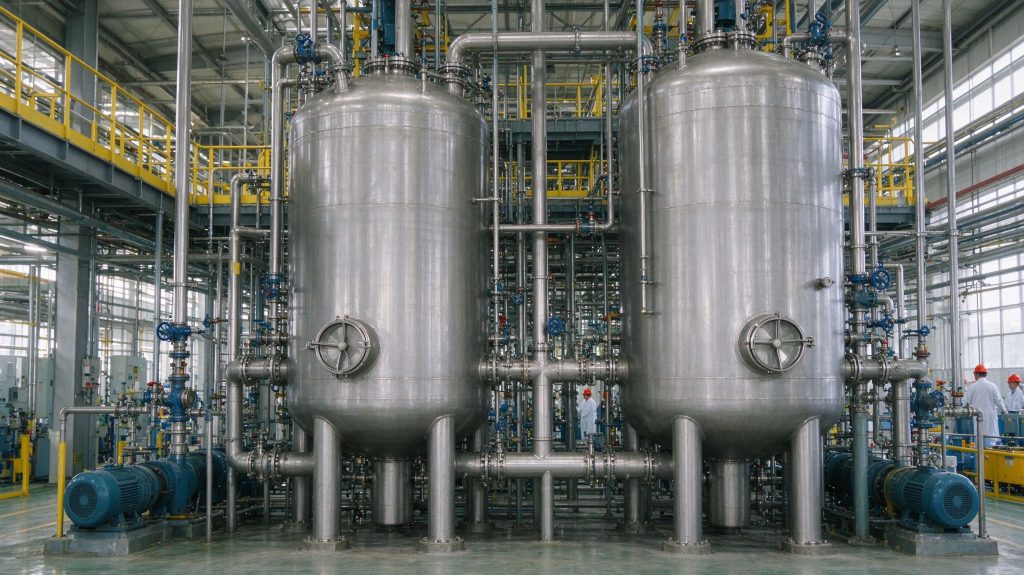
Caption: Selected HPMC grades are used as protective colloids in PVC suspension polymerization. Grade suitability should be confirmed with the manufacturer.
Industrial HPMC E50 uses include selected PVC suspension polymerization applications, where certain manufacturer-specific grades are marketed as protective colloids and dispersing stabilizers.In this process, the polymer helps stabilize vinyl chloride monomer droplets in the aqueous system and influences the formation of PVC resin particles.
Although both pharmaceutical and PVC-related products may carry an E50 viscosity designation, their intended applications and quality requirements can differ significantly. A pharmaceutical HPMC E50 should not automatically be considered suitable for PVC suspension polymerization, and a PVC-grade product should not be assumed to meet pharmaceutical requirements. Buyers should qualify the product according to its intended application, substitution characteristics, quality specifications and process-performance data.
The stabilizer system affects particle size distribution, porosity, bulk density and the processing characteristics of the resulting PVC resin. The contribution of a specific HPMC grade must be assessed together with the other stabilizers and the actual polymerization conditions. This is a manufacturer-specific application, not a claim for all HPMC E50 products.
What Should PVC Manufacturers Check When Buying HPMC E50?
The first five items are product specifications you can request from the supplier. Items 6 and 7 are evaluation results of your whole PVC production system, not product parameters that HPMC alone determines. Item 8 should be checked across several batch COAs. Request the manufacturer’s recommended viscosity range, substitution characteristics, dissolution behavior and relevant polymerization test data. A nominal E50 viscosity value alone is not sufficient to qualify a product for PVC suspension polymerization.
Buyers sometimes confuse HPMC E50 with construction-grade HPMC because both carry the HPMC name. Their viscosity levels are very different.
Mortar, tile adhesive and wall putty need grades selected against the high-viscosity specification of the specific product, so do not substitute one for the other on the HPMC name alone.
E5, E15 and E50 share the same general polymer identity, yet their viscosity and formulation behavior differ. The key question is not which grade has the highest viscosity but which grade delivers the required function, processing performance and quality. This section compares the key differences. The reasons behind each pharmaceutical use are explained in section 2, and detailed E5 and E15 applications are covered in their own guides.
The main difference is nominal viscosity, about 5 mPa·s for E5 and about 50 mPa·s for E50. At the same concentration and under comparable conditions, E5 gives the lower-viscosity solution, which affects solution preparation, handling and the polymer amount needed to reach a target viscosity. For a closer look at the lower-viscosity grade, see our guide to HPMC E5 uses.
| Comparison | HPMC E5 | HPMC E50 |
|---|---|---|
| Nominal viscosity | About 5 mPa·s | About 50 mPa·s |
| Substitution type | Manufacturer-dependent; verify in the TDS | Manufacturer-dependent; verify in the TDS |
| Typical application emphasis | Coating solutions and other low-viscosity systems | Suspensions and liquids that need added viscosity |
| Solution viscosity | Lower | Higher |
E15 offers about 15 mPa·s, so the nominal order is E5 < E15 < E50. That order ranks viscosity and not quality. Our guide to HPMC E15 uses covers the intermediate grade in more detail.
| Parameter | HPMC E15 | HPMC E50 |
|---|---|---|
| Nominal viscosity | About 15 mPa·s | About 50 mPa·s |
| Substitution type | Manufacturer-dependent; verify in the TDS | Manufacturer-dependent; verify in the TDS |
| Solution viscosity at equal concentration | Lower | Higher |
| Typical application emphasis | Coating and binder solutions | Suspensions and liquids that need added viscosity |
| Main selection factor | Moderate viscosity need | Higher viscosity need |
Practical selection: If your formulation requires a lower-viscosity solution for coating or wet granulation, evaluate E5 or E15 first. If your objective is to increase the viscosity of an aqueous suspension, E50 may be a more relevant candidate. These are starting points rather than universal rules; confirm the exact grade and application data with the manufacturer.
Some suppliers use E100 for a grade more viscous than E50, but grade names and viscosity specifications vary between manufacturers. If a supplier defines E100 as nominal 100 mPa·s, it generally produces a more viscous solution than E50 under comparable test conditions. A higher-viscosity grade may reach a target viscosity at lower polymer concentration, but that does not make it more efficient or economical in every case.
Unlike a standardized pharmacopoeial designation, E100 should be treated as a supplier-specific commercial grade name unless the manufacturer provides a clearly defined viscosity specification and test method.
This is one of the most important distinctions in pharmaceutical HPMC purchasing. HPMC E50 and high-viscosity K-series grades serve different formulation purposes. E50 is primarily evaluated for viscosity modification and suspension stabilization, whereas K4M and K15M are commonly used to form hydrated gel matrices for extended-release applications. Their differences involve not only nominal viscosity but also gel-layer formation, swelling, erosion and drug-release behavior. E50 should not be treated as a direct substitute for K4M or K15M. Any proposed substitution requires development work, including dissolution testing.
Representative Grade Names and Common Commercial Conventions
| Grade | Typical Commercial Association (Verify with Manufacturer) | Approximate Nominal Viscosity |
|---|---|---|
| HPMC E5 | 2910 | 5 mPa·s |
| HPMC E15 | 2910 | 15 mPa·s |
| HPMC E50 | 2910 | 50 mPa·s |
| HPMC K4M | 2208 | 4,000 mPa·s |
| HPMC K15M | 2208 | 15,000 mPa·s |
These are common commercial naming conventions, not universal product specifications. Always confirm the substitution type and viscosity range in the manufacturer’s current documentation.
Comparing HPMC E50 uses with other viscosity grades helps buyers select suitable products based on their formulation requirements rather than the commercial grade name alone.
| If your main requirement is… | Start by evaluating… |
|---|---|
| Increasing viscosity and reducing sedimentation in oral suspensions | HPMC E50 |
| Preparing lower-viscosity coating solutions | Low-viscosity grades such as E5 or E15 |
| Wet granulation binder performance | Manufacturer-recommended low-viscosity grades |
| Hard capsule shell manufacturing | Capsule-specific HPMC grades |
| Extended-release matrix formation | Suitable high-viscosity K-series grades |
For food and industrial uses, see sections 3.2 to 3.4.
No universal HPMC E50 dosage exists. The right level depends on the application, target viscosity, polymer grade, other ingredients (salts, sugars, proteins, starches, surfactants, polymers) and processing conditions (equipment, hydration time, temperature, order of addition), so establish the concentration through laboratory testing and not by copying a figure from a general article.For formulation developers, understanding the relationship between concentration and viscosity is important when assessing HPMC E50 uses in different liquid systems.
Prepare several small batches at different concentrations, then evaluate dispersion and hydration, viscosity, appearance, compatibility, storage stability and finished-product performance. Pharmaceutical products additionally require appropriate development, quality and regulatory evaluation. More polymer does not always mean a better product, so aim for the lowest level that consistently delivers the required functionality.
A reliable HPMC E50 supplier takes more than a competitive price. Buyers should weigh technical specifications, batch consistency, documentation, supply capability and fit with the intended application. Define a clear technical specification before you order, and confirm that the supplier can meet it consistently.
This section answers one question: which specifications should you define before buying? Use the table below as a purchasing checklist. It is not a universal specification or a replacement for the manufacturer’s approved HPMC E50 technical data sheet (TDS). Section 1.2 explains what the viscosity figures mean.
The nominal value of approximately 50 mPa·s is a commercial grade reference, not a universal pharmacopoeial acceptance limit. The actual viscosity range, test concentration, temperature, instrument and sample preparation procedure must be defined by the selected manufacturer’s specification.
| Parameter | Purchasing requirement |
|---|---|
| Commercial grade | HPMC E50 |
| Nominal viscosity | Approximately 50 mPa·s |
| Acceptance range | As specified in the approved TDS |
| Test concentration | Manufacturer-defined |
| Test temperature | Manufacturer-defined |
| Test method | Manufacturer-defined |
| Substitution type | Confirm 2910 or other required type |
Loss on drying, pH, residue on ignition and microbiological quality are checked on the COA (section 5.2).
This section answers one question: do the actual test results for this batch meet the agreed specification? The Certificate of Analysis reports results for one production batch. When you review an E50 COA, check the following.
For regular purchasing, reviewing several recent batch COAs is more informative than checking a single batch, because consistent results show whether the supplier can maintain the agreed specification over repeat orders.
Illustrative COA comparison. The table below is an illustrative example, not real customer or supplier test results.
| Parameter | Supplier A | Supplier B |
|---|---|---|
| Product grade | E50 | E50 |
| Nominal viscosity | 50 mPa·s | 50 mPa·s |
| Test concentration | 2% | 2% |
| Test temperature | 20°C | 20°C |
| Substitution type | Confirmed 2910 | Not confirmed |
| Batch traceability | Available | Incomplete |
Even when two products have the same nominal viscosity, buyers should not consider them equivalent until their substitution characteristics, specifications and application suitability have been verified.
This section answers a different question: does the product meet the requirements of my industry and target market? Quality requirements differ across industries, so specify the standard you actually need.
Pharmacopoeial compliance is only one part of pharmaceutical excipient qualification. The suitability of a specific HPMC E50 product also depends on the intended dosage form, applicable regulatory requirements, supplier qualification and formulation performance.
Which documents to request depends on the application.
| Application | Important documents |
|---|---|
| Pharmaceutical suspension | TDS, COA, applicable USP/Ph. Eur./JP documentation, SDS, DMF support letter where required |
| Food applications | Food-grade declaration, applicable additive specifications, COA, SDS |
| PVC polymerization | TDS, COA, SDS, application-specific performance data |
This section answers the question: how do you state your requirements in a comparable way? State the required grade and standard in the RFQ. Instead of requesting “HPMC E50,” specify the substitution type, viscosity range and applicable pharmacopoeial requirement.
| Buyer Requirement | Information to Specify |
|---|---|
| Product | HPMC E50 |
| Viscosity | Nominal 50 mPa·s and the acceptable range |
| Test conditions | Solution concentration, temperature and test method |
| Substitution | 2910 or other required type |
| Application | Pharmaceutical suspension, PVC suspension polymerization or other |
| Quality standard | USP-NF, Ph. Eur., food-grade or other |
| Documents | TDS, batch COA, SDS and other required certificates |
Suppliers generally ship HPMC powder in sealed packaging to protect it from moisture and contamination. Buyers should inspect the moisture-resistant inner packaging, suitable outer bags or cartons, clear product and batch identification, verified net weight and export-ready palletization. Store the material in a cool, dry and clean environment. Keep the original packaging sealed until use and reseal every opened package. Always follow the manufacturer’s storage instructions and stated shelf life. Consult the SDS for guidance on dust control, protective equipment and spill management.
Buyers should also assess storage and handling conditions when evaluating HPMC E50 uses, because moisture exposure can affect powder handling and subsequent solution preparation.
This section answers a third question: can this supplier deliver the same specification reliably over time? Evaluating HPMC E50 uses and supplier capabilities helps buyers confirm whether the offered grade, technical documentation and supply arrangements match the intended application.
| Evaluation Item | What Buyers Should Verify |
|---|---|
| Supplier type | Whether the supplier is a manufacturer, distributor, agent or trader |
| Production source | Which manufacturer produces the material, and whether the source is stable |
| Batch traceability | Whether production batches can be traced from COA to packaging and shipment |
| Supply consistency | Whether the same specification can be supplied repeatedly, with stable lead times |
| Grade coverage | Whether the supplier offers a full viscosity range and can discuss custom requirements |
| Samples and technical support | Availability of samples for laboratory evaluation and follow-up technical support |
| Export capability | Export documentation experience, including support for applicable REACH requirements and relevant EU import documentation. |
| Commercial terms | Whether quotations use the same price basis (EXW, FOB, CFR or CIF), minimum order quantity, lead time, payment and delivery terms |
A qualified supplier should be able to explain the differences among E5, E15, E50, E100 and higher-viscosity grades, as well as 2910 versus 2208, and should be open about its production source and quality management arrangements. To compare available grades, browse ACTA’s HPMC products.
HPMC E50 price depends on the manufacturer, substitution type, viscosity specification, quality standard, application grade, order quantity and delivery terms. When comparing quotations, buyers should first confirm that both products meet the same technical and documentation requirements. A lower price does not necessarily indicate better value if the product requires additional testing or fails to meet the intended application requirements.
When two suppliers quote HPMC E50 at a similar price and nominal viscosity, do not assume that their products are equivalent. Compare them in the following order:
A slightly lower quotation may not represent better value if the product requires additional formulation adjustments or fails to meet the buyer’s quality requirements.
Common Purchasing Mistakes When Sourcing HPMC E50
To receive a technically relevant quotation, buyers should provide more than the product name. HPMC E50 products may differ in substitution characteristics, viscosity specifications, intended application and quality documentation.
When contacting a supplier, prepare the following information:
| Information | What to Provide |
|---|---|
| Intended application | Pharmaceutical suspension, PVC polymerization, food or other use |
| Required viscosity | Approximately 50 mPa·s or a specified acceptance range |
| Substitution type | 2910, 2208 or another required type |
| Quality standard | USP-NF, Ph. Eur., food-grade or industrial specification |
| Required documents | TDS, batch COA, SDS and applicable certificates |
| Estimated quantity | Sample, trial order or regular purchasing volume |
| Destination | Country or destination port |
| Packaging preference | Standard packaging or specific export requirements |
If you do not yet have a complete technical specification, start by sharing your intended application and current product TDS. A qualified supplier can then help identify the information that needs to be confirmed before sampling or ordering.
Request an HPMC E50 quotation from ACTA with your application, target viscosity, estimated quantity and destination.
Suppliers generally ship HPMC powder in sealed packaging to protect it from moisture and contamination. Buyers should check the moisture-resistant inner packaging, suitable outer bags or cartons, clear product and batch identification, verified net weight and appropriate palletization for export. Store the material in a cool, dry and clean environment, keep the original packaging sealed until use, and reseal any opened packages. Always follow the manufacturer’s storage instructions and stated shelf life, and consult the SDS for guidance on dust control, protective equipment and spill management.
Buyers should also consider storage and handling conditions when evaluating HPMC E50 uses, particularly because moisture exposure can affect powder handling and subsequent solution preparation.
Qingdao ACTA Biotechnology Co., Ltd. focuses on cellulose-based ingredients, including HPMC, HEMC, CMC, microcrystalline cellulose and colloidal MCC. Our HPMC range covers viscosity grades from 3 mPa·s to over 200,000 mPa·s (2% aqueous solution at 20°C), in food, pharmaceutical and construction grades.
For HPMC E50 inquiries, we focus on technical specification matching and product sourcing rather than recommending a grade based on its commercial name alone.
Our support includes:
Our objective is to help buyers reduce grade mismatch, improve specification clarity and establish a more reliable purchasing process.
Whether you need HPMC E50 for pharmaceutical oral suspensions or a manufacturer-specific grade for industrial applications, ACTA can review your target viscosity, substitution requirements, intended use and documentation needs before discussing suitable sourcing options.
Send ACTA your intended application, target viscosity, substitution type, required quality standard and estimated quantity. We will review your requirements and discuss suitable product options and quotation conditions.
Tell us your intended application, target viscosity, substitution type and required quality standard.
ACTA can help review your technical requirements, check available product documentation and discuss suitable HPMC E50 sourcing options.
For a quotation, please also include your estimated quantity, destination country and packaging requirements.
Contact ACTA for Technical Support and a Quotation
HPMC E50 is a commercial viscosity grade of hydroxypropyl methylcellulose with a nominal viscosity of about 50 mPa·s in certain manufacturers’ grade systems. Its most direct pharmaceutical role is as a suspension thickener and stabilizer.
The nominal viscosity is about 50 mPa·s. The acceptance range and test conditions depend on the manufacturer, so confirm them in the supplier’s TDS (see section 1.2).
HPMC commonly uses CAS number 9004-65-3. It identifies the general substance and does not establish the viscosity grade or substitution type.
Not necessarily. E50 is a viscosity grade, while 2910 is a substitution type. Some E50 products are marketed as hypromellose 2910, so confirm the substitution type in the manufacturer’s documentation (see section 1.1).
The main difference is nominal viscosity, about 5 mPa·s for E5 and about 50 mPa·s for E50 under comparable conditions. See section 4.1 for details.
E15 is about 15 mPa·s and E50 about 50 mPa·s. Higher viscosity does not make E50 more suitable for every application. See section 4.2.
E50 is not the usual first choice for tablet film coating or wet granulation and does not replace K4M or K15M in extended-release matrices. Other uses need application-specific evaluation (see sections 2.4 to 2.7).
Only when the specific product is manufactured and documented for food use and meets the regulations of the destination market. Not every HPMC E50 product qualifies, so verify food-grade documents first (see section 3.2).
Certain manufacturer-specific E50 grades are used as protective colloids in PVC suspension polymerization, but a pharmaceutical or food-grade E50 is not automatically suitable. See section 3.3.
Request the TDS, batch-specific COA, SDS and any pharmacopoeial or food-grade documents your application requires. See sections 5.2 and 5.3 for the full list.
Pharmaceutical formulators mainly use HPMC E50 to modify viscosity and stabilize suspensions in selected oral liquid formulations. Depending on the specific grade and formulation requirements, they may also evaluate HPMC E50 for tablet coating or wet granulation. However, formulators often choose lower-viscosity grades such as E5 and E15 as more practical starting points for these applications. They should not use HPMC E50 as a direct replacement for high-viscosity K-series grades in conventional extended-release matrix systems.
HPMC E50 is a relatively low-viscosity hypromellose grade with a nominal viscosity of approximately 50 mPa·s in certain manufacturers’ grade systems. Its most direct pharmaceutical application is suspension stabilization, while its suitability for food, industrial and other pharmaceutical applications depends on the specific product specification and intended use.
Before purchasing HPMC E50, confirm that the product matches your intended application, viscosity requirements, substitution type and quality standards, and evaluate the polymer in your actual formulation rather than relying on the commercial grade name alone.
If you are sourcing HPMC E50 for a pharmaceutical, food or industrial application, contact ACTA with your target specifications and estimated quantity to discuss suitable product options and quotation conditions.
Supplier product information
Pharmacopoeial standards and regulations
Reference works and academic literature
For any product you plan to buy, rely on the manufacturer’s current TDS and batch COA rather than on general references.
