

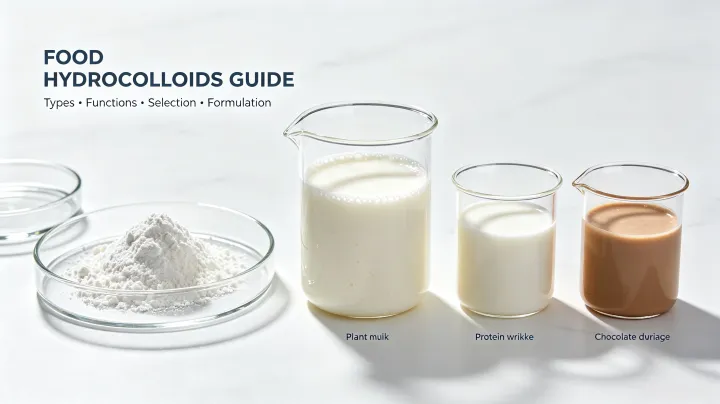
Food products rarely consist of water plus one or two ingredients. Most modern formulations are complex, multiphase systems that combine proteins, starches, oils, minerals, fibers, sugars, acids, and flavor compounds. Because these components constantly interact, keeping them physically stable is one of the toughest challenges a food manufacturer faces — and that challenge is exactly why this food hydrocolloids guide exists.For food manufacturers, the right hydrocolloid is not simply the ingredient with the highest viscosity — it is the one that delivers the required stability, texture, processing tolerance, and cost-in-use in the finished product.This Food Hydrocolloids Guide explains how manufacturers can evaluate hydrocolloid types, functionality, dosage, processing and application performance.
A beverage may throw sediment after a few weeks on the shelf. A sauce may thin out or split into layers. A yogurt may release whey. An ice cream may develop gritty ice crystals. A gluten-free loaf may collapse and dry out within a day. None of these problems disappear simply by adding more of a single ingredient, which is precisely where food hydrocolloids earn their place in the formulation toolkit.
This guide walks through what food hydrocolloids are, how they work at a structural level, how to select and dose them, how MCC, CMC, HPMC, and MCC Gel compare, and how to evaluate a supplier — so that you can move from ingredient names to a working, commercially reliable formulation. For food manufacturers, the challenge is rarely finding a hydrocolloid that works in the laboratory — it’s finding a grade that stays consistent through processing, storage, scale-up, and commercial production.
Food hydrocolloids are hydrophilic polymers — mostly polysaccharides, plus a handful of proteins such as gelatin — that interact strongly with water and change the physical properties of a food system. Because they hydrate, swell, dissolve, or build a network depending on their chemistry and their environment, they can deliver a wide range of functional outcomes: increased viscosity, gel formation, particle suspension, emulsion support, water binding, reduced syneresis, freeze-thaw stability, texture modification, and film formation.
The same hydrocolloid can behave very differently from one product to the next. Concentration, pH, ionic strength, temperature, shear, and the presence of proteins or other polymers all shift the outcome, so two ingredients that both get labeled “thickeners” can still produce dramatically different mouthfeel, suspension performance, and processing behavior. That’s why this food hydrocolloids guide keeps circling back to one core question: not “which hydrocolloid is strongest?” but “which hydrocolloid solves this specific formulation problem?”
Consider a plant-based beverage: it may carry protein, oil, insoluble fiber, minerals, and flavor compounds all at once. Or picture a sauce containing water, oil, starch, spices, protein, and suspended solids. Ice cream layers water, fat, protein, sugar, minerals, and air together. In every case, the formulator must manage how these components interact physically — and hydrocolloids are one of the primary tools available for that job. Because they sit at the interface between water and everything else in the formula, they influence not just how a product looks on day one, but how it performs through processing, storage, and the moment a consumer opens the package.
Need help selecting a food hydrocolloid? Send us your application, pH, solids content, protein level, current stabilizer, and main stability problem. We can help identify suitable grades for laboratory screening.
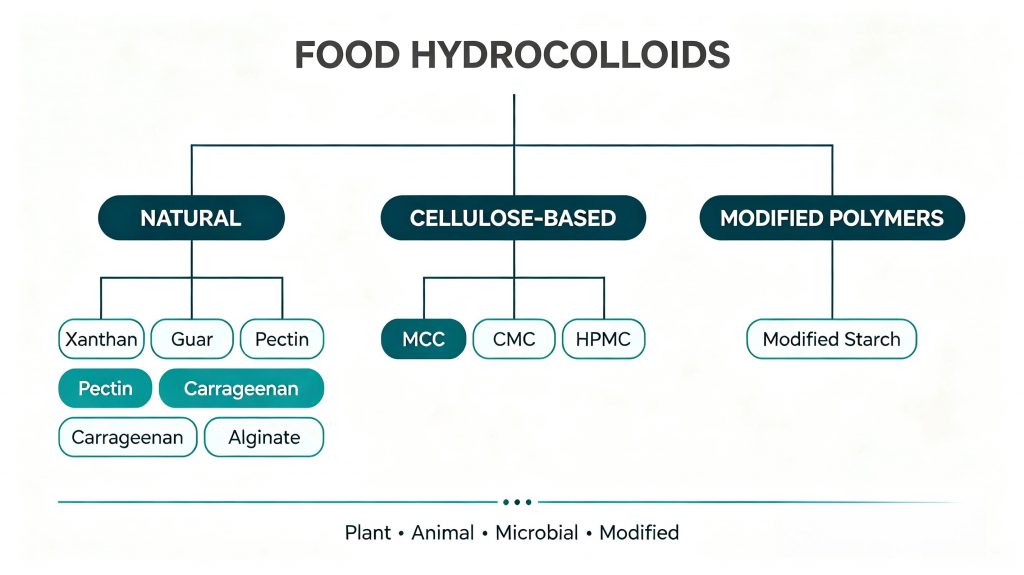
Caption:Major food hydrocolloid groups include natural gums, cellulose-based ingredients and modified polymers.
Rather than leading with where a hydrocolloid comes from, it’s more useful to lead with what it actually does — since that’s the question a formulator with a suspension or viscosity problem is really asking.In this Food Hydrocolloids Guide, natural gums, cellulose-based ingredients and modified polymers are compared according to their practical formulation roles.
| Hydrocolloid | Main Function | Common Applications | Typical Source |
|---|---|---|---|
| Pectin | Gelation, stabilization | Jams, beverages, dairy | Fruit / plant |
| Carrageenan | Gelation, suspension, stabilization | Dairy, desserts, plant-based drinks | Seaweed |
| Agar | Strong gelation | Desserts, confectionery | Seaweed |
| Alginate | Ionic gelation, thickening | Beverages, structured foods | Seaweed |
| Xanthan gum | Thickening, shear-thinning, suspension | Sauces, dressings, beverages | Microbial fermentation |
| Guar gum | Thickening, water binding | Dairy, sauces, bakery | Plant seed |
| Locust bean gum | Thickening, gel synergy | Ice cream, dairy, desserts | Carob seed |
| CMC | Thickening, water control, stabilization | Beverages, sauces, bakery | Cellulose derivative |
| MCC / Colloidal MCC | Suspension, structure, texture | Beverages, dairy alternatives | Cellulose |
| HPMC | Thickening, film formation, thermal gelation | Bakery, coatings, specialty foods | Cellulose derivative |
| Modified starch | Thickening, texture, stability | Sauces, dairy, frozen foods | Starch derivative |
| Gelatin | Gelation, texture | Confectionery, desserts | Animal protein |
Colloidal MCC, commonly referred to as MCC Gel.This table is useful for initial screening, but source alone never determines performance. Every serious food hydrocolloid selection process starts from the physical problem that needs solving, not from which name sounds strongest on a spec sheet.

Caption:Hydrocolloid systems can modify the continuous phase and help reduce particle movement and sedimentation.
Thickening is the most familiar hydrocolloid function. As hydrated polymer chains occupy space and interact with water, they resist flow, which improves body, pourability, and sauce cling. However, higher viscosity does not automatically mean a better product; a beverage that becomes overly thick may stay physically stable while failing every sensory test that matters. Consequently, a good formulation balances stability, viscosity, texture, processability, and sensory acceptance together. For a deeper look at this specific function, see our guide to food thickeners.
Some hydrocolloids build structured gels once specific conditions are met — cooling, a particular ion concentration, a pH shift, or interaction with sugar or protein. Pectin, carrageenan, agar, alginate, and gelatin each create distinct gel architectures, so “gel strength” should never be treated as a universal property.
Suspension keeps insoluble particles — cocoa, fruit pulp, plant fiber, minerals — dispersed evenly through a liquid. Because performance depends on particle size, density, dispersion quality, and the stabilizer’s own microstructure, simply increasing gum dosage rarely fixes sedimentation on its own. See our dedicated page on food suspension agents for a closer look at this function.
Hydrocolloids can reinforce emulsion stability by raising continuous-phase viscosity and interacting with dispersed droplets. That said, a hydrocolloid is not automatically a substitute for a true emulsifier; formulators still need to think about emulsifier choice, homogenization, and droplet size as a connected system.
By binding or immobilizing water, hydrocolloids influence moisture retention, syneresis, freeze-thaw behavior, and shelf stability — especially important whenever manufacturers reduce fat, sugar, or total solids.
Two formulations can register nearly identical viscosity readings and still feel completely different in the mouth. Creaminess, smoothness, stickiness, elasticity, and body all depend on more than a single number, which is exactly why a viscosity spec alone should never drive hydrocolloid selection.
Understanding food hydrocolloids at a mechanistic level makes ingredient selection far less of a guessing game. At a simplified structural level, hydrocolloid functionality develops through a predictable sequence:
1. Hydration — water molecules attach to the polymer surface and begin penetrating the particle.
↓
2. Polymer chain expansion — the polymer swells as water penetrates further, uncoiling and extending its chains through the surrounding liquid.
↓
3. Water immobilization — expanded chains trap and slow the movement of free water molecules around them.
↓
4. Network formation — depending on concentration and chemistry, chains begin overlapping, entangling, or cross-linking with each other, ions, or proteins.
↓
5. Yield stress development — once the network is dense enough, the system resists movement until a threshold force is applied.
↓
6. Particle stabilization — the resulting structure limits the gravitational movement of suspended particles, supporting long-term physical stability.
This sequence explains why poor dispersion or incomplete hydration — not the ingredient itself — is so often the real cause of a “failed” hydrocolloid trial. If Step 1 or Step 2 is interrupted, none of the later steps can happen correctly, no matter how suitable the ingredient is on paper.
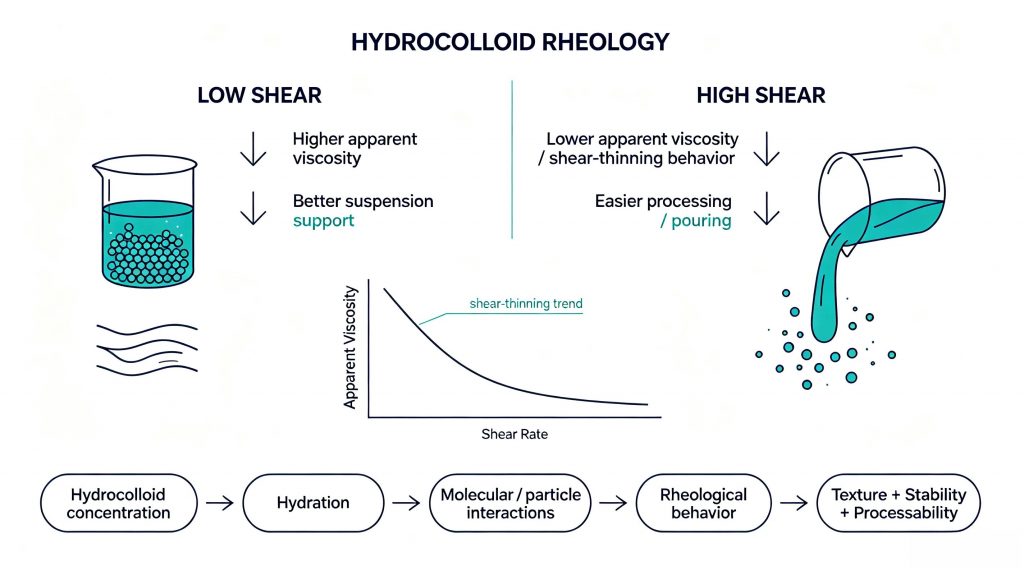
Caption:Rheological behavior influences suspension stability, texture and processing performance in food systems.
Rheology is where a food hydrocolloids guide earns its keep, because one of the most common formulation mistakes is treating viscosity as the complete picture. It isn’t. A hydrocolloid system can show Newtonian behavior, shear-thinning behavior, yield stress, thixotropy, or viscoelasticity — and two products with identical viscosity at one test condition can behave completely differently during pumping, pouring, or drinking.
Apparent viscosity describes how thick a fluid appears under a specific shear rate — it is not a fixed property, since most hydrocolloid systems are non-Newtonian and their apparent viscosity changes as shear changes. Shear-thinning systems, for example, appear structured at rest yet flow more easily once shear is applied, which supports suspension during storage while still allowing easy pumping and pouring. Thixotropy adds a time dimension: structure that breaks down under shear gradually rebuilds once the shear stops, which is useful in sauces and dressings that need to look thick on the shelf but still pour smoothly.
For more advanced formulation work, oscillatory rheology introduces two further concepts: storage modulus (G′), which reflects the elastic, structure-retaining component of a system, and loss modulus (G″), which reflects the viscous, energy-dissipating component. Comparing G′ and G″ helps researchers judge whether a hydrocolloid system behaves more like a flowing liquid, a weakly structured suspension, or a true gel — information a single viscosity reading simply cannot provide. In practice, formulators aim for a rheological profile that matches how the product will actually be used, not for maximum structural strength.
Hydrocolloids rarely act alone. Their performance shifts because of interactions with proteins, minerals, salts, sugars, acids, starch, oils, and even other hydrocolloids — and these interactions can help or hurt the formulation. Protein-containing systems are particularly complex: changes in pH, temperature, ionic strength, or protein concentration can all alter aggregation behavior. If a beverage develops particles after UHT treatment, simply raising the stabilizer dosage rarely solves the problem when the real driver is protein aggregation rather than insufficient viscosity. Mineral interactions matter just as much, especially in fortified beverages and dairy, where calcium and magnesium levels should be treated as active formulation variables rather than fixed background parameters.
These terms overlap but aren’t identical, and untangling them is one of the most useful things a food hydrocolloids guide can do.
Food hydrocolloid describes a class of hydrophilic polymers defined by their physical and chemical behavior — it’s a material category.
Food stabilizer, thickener, suspending agent, and gelling agent describe functional roles — what an ingredient does in a formulation.
A hydrocolloid can therefore function as:
But the reverse isn’t always true: not every food stabilizer is a hydrocolloid — some stabilization systems rely on emulsifiers, minerals, or processing steps instead. See our dedicated page on food stabilizers for a closer look at that broader category. This distinction reframes the buying question from “which stabilizer should I purchase?” to the more useful “what instability am I trying to control, and which mechanism actually addresses it?”
This is one of the most practical sections in this food hydrocolloids guide: for research, formulation, and purchasing teams who need a fast reference, the table below summarizes the typical functional contribution of common hydrocolloids — not a fixed ranking, since actual performance always shifts with particle size, pH, ionic strength, dosage, and processing.This Food Hydrocolloids Guide does not treat hydrocolloid dosage as a fixed number, because the optimum level depends on the food matrix, processing conditions and target performance.
| Hydrocolloid | Main Function | Typical Functional Contribution | Best For |
|---|---|---|---|
| Xanthan Gum | Thickening | High suspension support and strong shear-thinning at low dosage | Shear-thinning sauces & suspension |
| CMC | Thickening / water control | Moderate–high viscosity building and reliable water control | Beverage viscosity & water management |
| MCC | Structure / suspension | Strong structural suspension potential once properly dispersed | Insoluble particle suspension |
| MCC Gel (Colloidal MCC) | Suspension / stabilization | Strong suspension-system potential in insoluble-particle formulations | Plant milk, protein drinks, chocolate beverages |
| Pectin | Gelation / stabilization | Strong gelling potential, particularly with sugar, calcium, and acid | Fruit-based gelled systems |
| Carrageenan | Gel / suspension | Strong gel and suspension potential, especially with dairy proteins | Dairy gelation & suspension |
| HPMC | Thickening / film / thermal gel | Thickening plus thermal gelation and film-forming potential (grade-dependent) | Bakery & specialty foods |
| Guar Gum | Thickening | High water-binding and viscosity-building potential | Dairy & sauce water binding |
Performance is application-dependent and should be confirmed through formulation trials.Treat this matrix as a screening starting point rather than a final formulation recommendation — actual performance always depends on the complete food matrix and processing conditions.
A reliable selection process starts with the application, not the ingredient name.
There is no universal dosage that fits every food. The right level depends on hydrocolloid type, grade, food matrix, pH, solids content, processing conditions, target texture, and required shelf life. A practical approach screens a low, medium, and high concentration side by side: the low level shows the minimum functional response, the medium level identifies balanced performance, and the high level reveals whether extra viscosity or cost is actually justified. Because higher dosage can trigger excessive viscosity, poor mouthfeel, slower hydration, and higher ingredient cost, the real objective is always optimization rather than maximization.
Combining hydrocolloids is one of the most useful formulation strategies available, since different polymers often contribute complementary functions — one for viscosity, another for suspension, a third for gel structure. As a result, a blend can outperform simply raising the dosage of a single ingredient, often while lowering the total amount used, improving processing, and tightening rheological control. That said, blending must be validated experimentally rather than assumed, because some combinations create excessive viscosity, incompatibility, or unwanted gelation instead of synergy.
Beverages set an especially demanding bar because consumers expect low viscosity, a smooth mouthfeel, no visible sediment, and easy pouring, all while the product must stay stable for months.
Hydrocolloids for Plant-Based Milk: Oat, soy, pea, and almond beverages often carry proteins, insoluble particles, oils, starch, and minerals together, so the stabilization strategy needs to address several mechanisms at once — which is why MCC Gel, CMC, and selected gums are frequently screened side by side. For a deeper dive, see MCC in beverages.
Hydrocolloids for Protein Drinks: Protein beverages can suffer from protein aggregation, sedimentation, heat instability, and phase separation. Before adjusting dosage, it’s worth confirming whether visible particles come from the original ingredient or from processing-induced aggregation, since the fix differs completely depending on the answer. See our application notes on MCC in protein drinks.
Hydrocolloids for Chocolate Beverages: Cocoa particles settle because they’re denser than the surrounding liquid. Rather than simply raising viscosity — which can make the drink unpleasantly heavy — a better approach improves cocoa dispersion first, evaluates particle size, then screens suspension systems and validates storage stability. Our MCC Gel vs. xanthan gum comparison covers this suspension trade-off in more detail.
Hydrocolloids for Fruit Beverages: Products containing pulp need systems compatible with the product’s acidity and particle load, so pectin, CMC, and selected cellulose-based systems are typically evaluated together, depending on pH and desired texture.
Dairy systems are chemically complex because protein, minerals, fat, sugar, and water interact continuously. Hydrocolloids here typically manage viscosity, texture, whey separation, suspension, water migration, and ice crystal growth. In yogurt, hydrocolloids help control texture and syneresis, but the right choice always depends on protein concentration, solids, fermentation conditions, and storage.
Ice cream requires control over ice crystal formation, melting, body, and air structure simultaneously. Combinations of locust bean gum, guar gum, and carrageenan are frequently evaluated together, and the best system is never simply the one producing the highest pre-freeze viscosity — it’s the one that delivers the right structure throughout freezing, storage, and eating.
Sauces and dressings typically need thickening, suspension, emulsion stability, pourability, and shear stability all at once. Xanthan gum is a common choice when suspension and shear-thinning behavior matter, while CMC and modified starch contribute thickening and body. The right combination depends on oil content, pH, salt, and whether the process runs hot or cold.
In bakery systems, hydrocolloids influence water distribution, dough handling, gas retention, crumb structure, and staling — a role that becomes especially important in gluten-free products, where formulators lean on hydrocolloids to rebuild the structural network that gluten would normally provide.
The rise of plant-based foods has pushed hydrocolloid systems to work harder than ever. Plant proteins behave differently from dairy proteins, and plant-based formulations often add fiber, starch, oil, and plant particles into the mix, which creates challenges around sedimentation, creaming, protein aggregation, and mouthfeel. Never treat a plant-based food as a straightforward dairy replacement — the protein source, mineral system, oil phase, and heat process usually all need to be reconsidered from the ground up.
Looking for MCC, MCC Gel, CMC or HPMC for a food application you’re currently developing? Request a sample, TDS, COA, or quotation — contact details are provided in Section 29.
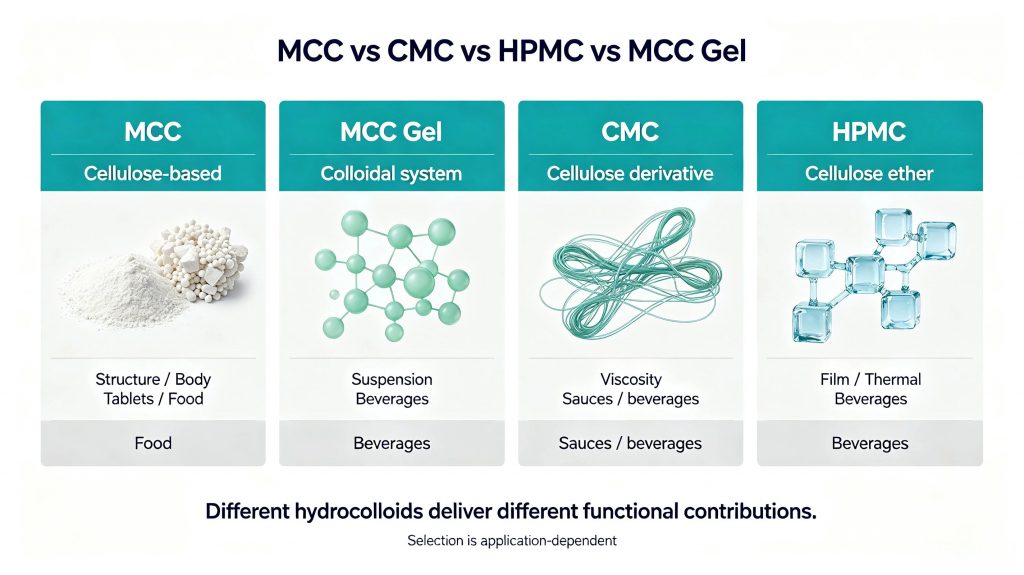
Caption:MCC, MCC Gel, CMC and HPMC provide different functional contributions and should be selected according to the food matrix and processing requirements.
Cellulose-based ingredients deserve special attention because they cover such a wide functional range across beverage, dairy, sauce, and bakery systems. Rather than ranking them, the goal here is to clarify when each one is a good candidate to screen.
The table below offers a starting point for laboratory screening — not a universal recipe.
| Step | Suggested Starting Condition |
|---|---|
| Water temperature | 5–60 °C |
| High-shear mixing | 3,000–5,000 rpm |
| Mixing time | 5–10 minutes |
| Hydration / resting | 15–30 minutes |
| Final homogenization | Application-dependent |
These conditions are starting points for laboratory screening only. Actual dispersion conditions should always be optimized according to your equipment, formulation composition, and target application. Actual shear requirements may also vary with impeller geometry, batch volume, solids content, and equipment design, so an rpm value from one mixer does not necessarily translate to the same shear rate on another. The final dispersion sequence should be confirmed against the specific commercial grade and finished-product matrix.
This comparison section rounds out the food hydrocolloids guide with direct, side-by-side answers to the questions formulators search for most often.
Xanthan delivers strong shear-thinning behavior and suspension at low dosage, making it a common pick for sauces and dressings. CMC offers more predictable, straightforward viscosity building and water control, and it often costs less per percentage point of thickening. Choose xanthan when shear-dependent flow matters most; choose CMC when simpler viscosity and water management are the priority.
CMC modifies the continuous phase directly through dissolution, while MCC contributes structure through insoluble particles dispersed within the liquid. It is generally the better fit for straightforward viscosity or water-binding needs; MCC becomes more relevant once insoluble particle suspension is the real challenge.
Plain MCC alone can be difficult to disperse uniformly at low concentrations. Colloidal MCC (MCC Gel) addresses this by pre-combining MCC with a dispersing agent such as CMC, producing a more reliable, ready-to-use suspension system — which is why colloidal MCC/MCC Gel is often evaluated instead of plain MCC when commercial beverage suspension is required.
Both can stabilize beverages, but through different mechanisms. MCC Gel builds a structured, particle-based suspension network, while xanthan relies on hydrated polymer chains and strong shear-thinning rheology. It can support suspension while maintaining a relatively light viscosity profile in some beverage systems, which may be advantageous when a lighter mouthfeel is desired.
Pectin is chosen primarily for gelation, especially in fruit-associated products where pH, sugar, and calcium drive its performance. CMC, by contrast, is chosen for viscosity and water management rather than gel formation. The two rarely compete directly — they solve different problems.
Guar delivers strong water binding and body at a relatively low cost but lacks the pronounced shear-thinning behavior of xanthan. Xanthan is often preferred where pourability under shear matters more than raw viscosity. Many sauce and dressing formulations combine both to balance body with flow.
HPMC brings thermal gelation and film-forming ability that CMC does not offer, making it more relevant to bakery and specialty applications where heat-triggered structure matters. CMC remains the simpler, more cost-effective choice for straightforward thickening and water control in beverages and sauces.
A hydrocolloid that performs beautifully in the lab can still fail during commercial production, simply because processing changes the physical environment. Addition sequence, mixing intensity, hydration time, temperature, shear, and holding time all matter. Some hydrocolloids hydrate quickly at the surface and lump if added incorrectly, resulting in incomplete hydration, uneven viscosity, and batch-to-batch variation — which is exactly why addition sequence deserves treatment as a critical process parameter, not an afterthought. Ingredients such as sugar, salt, and proteins also compete for available water, meaning the same hydrocolloid concentration can behave differently across two otherwise similar formulations.
A useful evaluation program measures more than one property:
A high laboratory viscosity reading means little on its own; the system that stays functional throughout the intended commercial shelf life is the one that actually matters.
Viscosity too high usually traces back to excessive dosage, the wrong grade, incomplete hydration followed by continued thickening, or unexpected polymer interactions — so reducing concentration, switching grades, or improving hydration typically solves it faster than reformulating from scratch.
Sedimentation continues even after adding stabilizer? Resist the urge to simply add more. Investigate particle size, density, dispersion, hydration, and the stabilizer’s actual mechanism first, because a thick beverage can still sediment if particles are poorly dispersed.
Separation after heating points toward protein stability, pH, mineral concentration, or hydrocolloid compatibility — so compare samples before and after thermal processing to isolate the cause.
Batch-to-batch variation often comes down to raw-material lot differences, moisture, viscosity grade, water quality, or mixing time rather than the hydrocolloid itself.
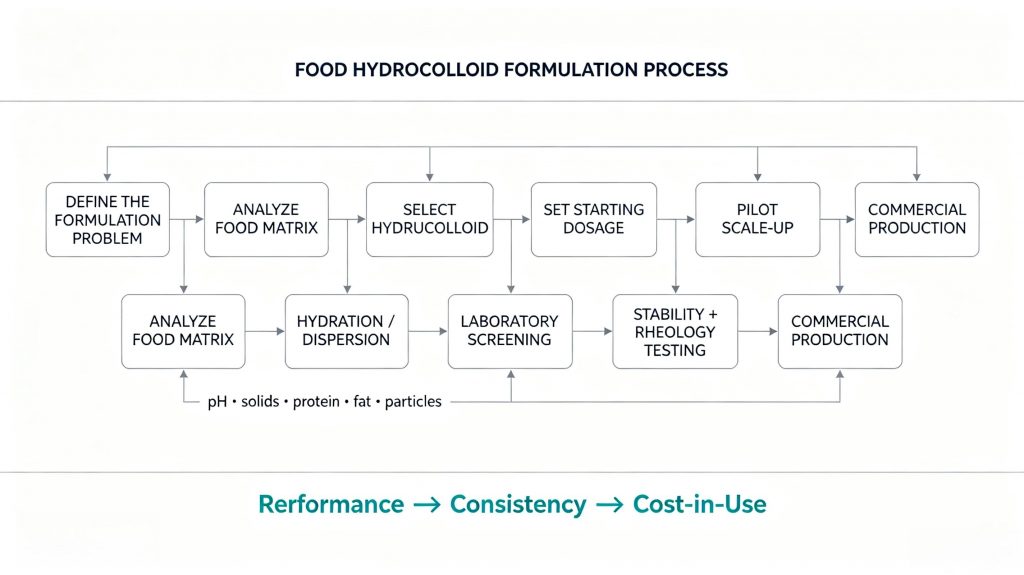
Caption:A structured formulation workflow helps food manufacturers move from ingredient selection to commercial-scale production.The selection framework presented in this Food Hydrocolloids Guide is designed to help formulators move from laboratory screening to scale-up.
This food hydrocolloids guide closes with the practical workflow that ties everything above together: define the product, identify the physical problem, analyze food chemistry, select candidate hydrocolloids, establish laboratory dosage ranges, optimize combinations, evaluate sensory properties, test processing stability, run a pilot production, and finally validate shelf life. This structured approach consistently outperforms picking an ingredient off a generic application chart and jumping straight to commercial production.
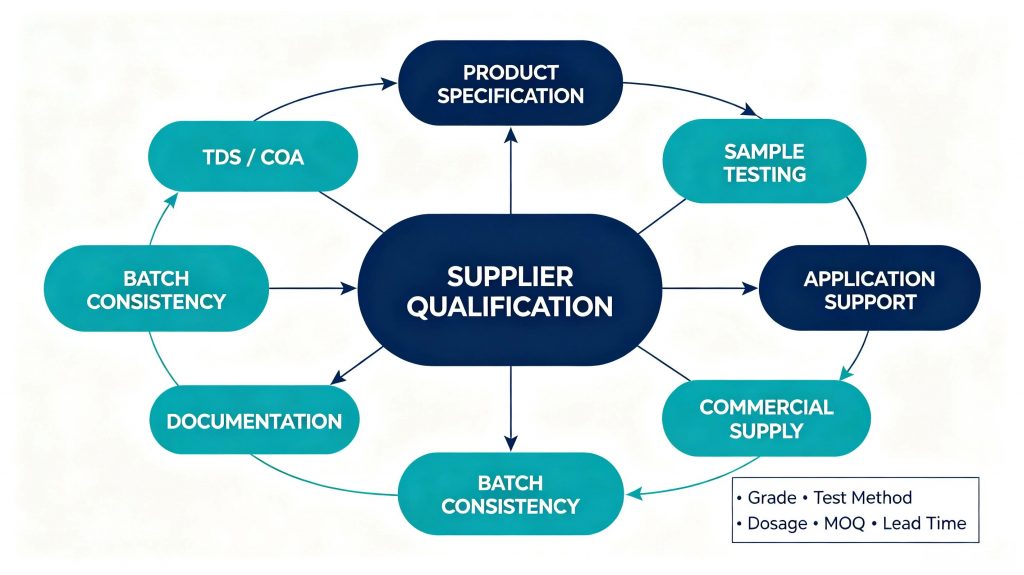
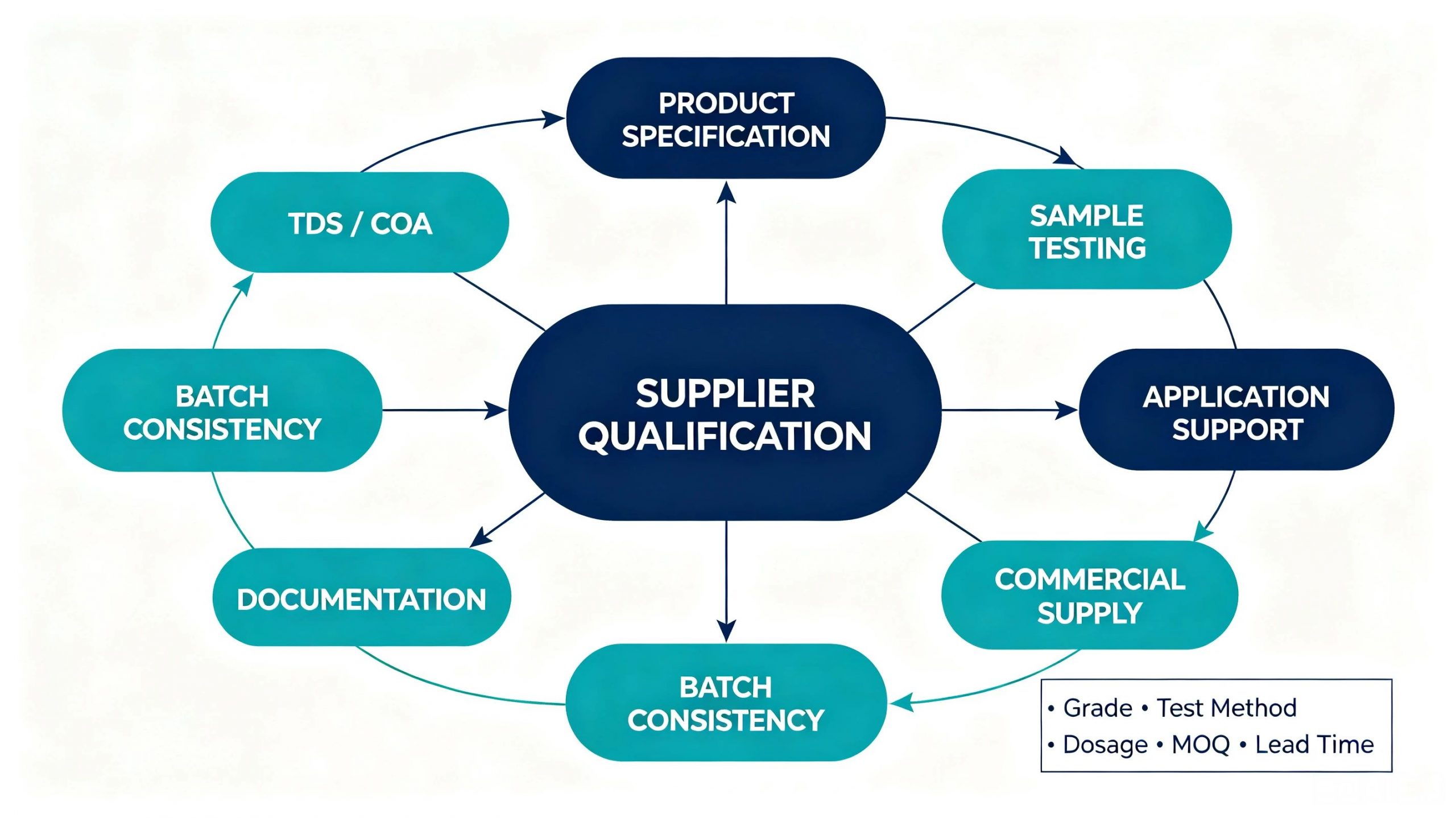
Caption:Supplier qualification should evaluate specification, batch consistency, application performance, documentation and commercial supply capability.
For commercial production, ingredient price is only one piece of the puzzle. A dependable food hydrocolloid supplier should offer consistent viscosity, moisture, and purity across batches, along with complete technical documentation — TDS, COA, SDS, allergen information, and relevant food-safety or religious certifications. Just as important, the supplier should be able to discuss grade selection, dosage screening, dispersion, and troubleshooting rather than simply quoting a price. Finally, evaluate supply capability: sample availability, MOQ, lead time, packaging, and export experience. A low-cost hydrocolloid that repeatedly causes formulation or production problems almost always ends up more expensive than a slightly pricier ingredient backed by reliable technical support.
Do not compare suppliers on price alone. Compare the same grade under the same test method, specification, dosage, packaging, Incoterm, MOQ, lead time, and technical support conditions — otherwise the comparison is not really apples-to-apples.A practical Food Hydrocolloids Guide should also address supplier qualification, grade consistency, technical documentation and cost-in-use.
Before purchasing, it’s worth putting these questions directly to your food hydrocolloid manufacturer or supplier:
A supplier who can answer these clearly — rather than replying only with a price — is far more likely to save you development time later.
A common purchasing mistake is comparing hydrocolloids purely by price per kilogram. Consider two options: Ingredient A costs $3/kg but requires a 1.0% dosage, while Ingredient B costs $5/kg but only needs 0.3%.
Cost-in-use = Ingredient price × Effective dosage
Even though Ingredient B costs more per kilogram, it actually costs half as much once it’s in the finished product — a clear reminder that a higher price per kilogram does not mean a higher formulation cost. Beyond that basic calculation, experienced procurement and R&D teams also weigh batch consistency, supply reliability, technical support, documentation, and lead time. In practice, the lowest purchase price rarely equals the lowest total formulation cost, especially once you account for wasted trial batches, delayed launches, or rework caused by an unreliable ingredient.
Food hydrocolloids are regulated differently depending on the market and the specific application, so manufacturers should always verify current requirements for their target country, food category, and intended use level before finalizing a formulation. Useful reference frameworks typically include national food regulations, the FDA‘s food additive status list, EFSA‘s food additives guidance, and the Codex Alimentarius international framework, though regulatory responsibility ultimately rests with the manufacturer placing the finished product on the market.
For B2B purchasing, buyers should request appropriate documentation from every supplier — a Technical Data Sheet, product specification, Certificate of Analysis, Safety Data Sheet where applicable, allergen information, and any relevant food-grade, Halal, or Kosher certification. A supplier that can provide this package quickly and completely makes qualification significantly faster and reduces risk during scale-up.
This FAQ closes out the food hydrocolloids guide with the questions manufacturers and buyers ask most frequently.
Food hydrocolloids are hydrophilic polymers — mainly polysaccharides and some proteins — that interact with water and modify the physical properties of food systems.
There isn’t a universal answer — selection depends on particle load, pH, protein, minerals, fat, processing, and target mouthfeel, which is why this food hydrocolloids guide emphasizes screening over assumption.
MCC, MCC Gel, xanthan gum, and CMC are the most commonly evaluated candidates for suspension, but the right choice depends on particle size, density, and the surrounding food matrix.
MCC provides structure through insoluble particles suspended in the liquid, while CMC modifies the continuous phase directly by dissolving and binding water. They solve related but different problems.
Yes — colloidal systems built for suspension and stabilization commonly combine the two, with the exact ratio depending on the formulation.
MCC Gel, CMC, and selected gum blends are the most frequently screened candidates, since plant-based milk typically needs suspension, emulsion support, and texture control simultaneously.
Compare viscosity, particle characteristics, purity, and hydration behavior against your specific application — a generic ingredient name is rarely enough information to make a confident choice.
There’s no universal dosage; the right concentration depends on the hydrocolloid, grade, food matrix, and processing conditions, so dosage screening across low, medium, and high levels is essential.
Heat changes protein structure, mineral interactions, and hydration behavior, so the complete process should be evaluated rather than testing the hydrocolloid only before heat treatment.
At minimum, request a TDS, COA, SDS where applicable, allergen information, and any relevant food-safety or religious certification before committing to a commercial order.
Yes — reputable suppliers typically provide laboratory samples so you can screen a grade in your own formulation before committing to a commercial quantity.
A technically capable supplier should be able to support dosage screening, dispersion guidance, and troubleshooting alongside the sample, rather than simply shipping product with no application input.
Richard Wang Technical Sales Engineer, Qingdao ACTA Biotechnology Co., Ltd.Published: September 9, 2026
Richard works with food and pharmaceutical ingredient applications, focusing on cellulose-based functional ingredients. His work covers:
Full author profile: About Richard Wang — replace with your site’s actual, verified author-page URL before publishing.
Technical Review: This article is based on technical information, formulation principles, and general application experience. Specific dosage, processing conditions, and regulatory requirements should always be validated for each product and target market before commercialization.
Food hydrocolloids are powerful formulation tools, but they are not interchangeable. Pectin, carrageenan, xanthan gum, guar gum, locust bean gum, alginate, CMC, MCC, MCC Gel, HPMC, gelatin, and modified starch each behave differently, and the right choice always depends on the food matrix and the specific physical problem that needs solving. The most reliable path forward — the core message of this entire food hydrocolloids guide — runs from problem to mechanism to candidate hydrocolloids to dosage screening to processing optimization to stability validation and, finally, to scale-up.
Choosing a hydrocolloid from a specification sheet alone can lead to unnecessary trial and error. Wherever you are in your development process, there’s a low-friction way to move forward:
Qingdao ACTA Biotechnology Co., Ltd. is a food hydrocolloid supplier and cellulose hydrocolloid manufacturer offering MCC, colloidal MCC/MCC Gel, CMC, HPMC, and related functional ingredients for food and beverage applications. We help evaluate suitable grades, provide technical documentation and samples, and support laboratory formulation screening before commercial production.
