

Plant-Based Beverage Stabilizer is essential formulation tools for controlling sedimentation, creaming, viscosity, texture, and physical stability in oat milk, soy milk, almond milk, pea-protein beverages, and other plant-based drinks. A suitable stabilizer system can help maintain particle suspension, improve mouthfeel, and support physical stability throughout processing and storage.Food additives can serve technological functions such as improving texture, consistency and physical stability, although the regulatory status and permitted use of an ingredient depend on the target market.
This guide explains how manufacturers can evaluate a plant-based beverage stabilizer by function rather than by name. In particular, it covers stabilizer selection by beverage type, troubleshooting sedimentation and creaming, building combination systems, dosage and processing, stability testing, supplier qualification, formulation compatibility, quality control documentation, and a practical R&D worksheet. Together, these topics provide a structured approach to stabilizer evaluation from initial formulation screening through commercial qualification.
About this guide: This technical guide is intended for R&D, formulation, procurement, and quality teams developing plant-based beverages. Rather than providing universal dosage specifications, the recommendations are presented as formulation-screening principles. Therefore, final ingredient selection, dosage, and processing conditions should be validated in the target beverage matrix. In addition, formulation performance can vary with beverage composition, processing conditions, and storage requirements.
Author: ACTA Technical Team.
Technical Reviewer: ACTA Technical Team — Food Hydrocolloids & Beverage Applications.
Last Updated: September 2026.
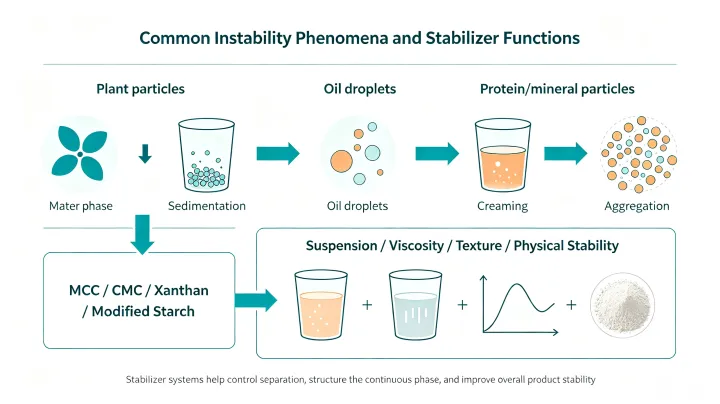
Plant-based beverages contain complex mixtures of proteins, oils, minerals, fibers and insoluble particles. Keeping these components physically stable through processing, storage and shelf life is the core job of a plant-based beverage stabilizer.
| Formulation Problem | What Manufacturers Observe | Stabilization Objective |
|---|---|---|
| Sedimentation | Solids settle at the bottom | Maintain particle suspension |
| Creaming | Oil or fat rises to the surface | Improve emulsion stability |
| Phase separation | Visible layers develop | Maintain system uniformity |
| Excessive viscosity | Beverage pours too slowly | Control rheology |
| Thin body | Beverage feels watery | Increase body and texture |
| Grittiness | Particles remain noticeable | Improve dispersion and mouthfeel |
| Poor storage stability | Product changes during shelf life | Maintain stability over time |
he first formulation question should not be “which stabilizer should we use?” Instead, it should be “what exactly is failing in the beverage?” In practice, a viscosity-building gum, a suspension system, and an emulsion stabilizer solve different problems. Therefore, using the wrong type of stabilizer can move a formulation further from its sensory target rather than closer to it.
| Ingredient | Primary Functional Role |
|---|---|
| Colloidal MCC, commonly used in MCC Gel-type beverage stabilization systems | Particle suspension and structured stability |
| Microcrystalline cellulose (MCC) | Structure and texture (not automatically equivalent to colloidal MCC) |
| CMC | Viscosity, water binding, water-phase stability |
| Xanthan gum | Viscosity and shear-thinning rheology |
| Modified starch | Body, texture and formulation structure |
| Gellan gum | Low-level structured suspension |
Standard MCC does not automatically deliver the same beverage functionality as a colloidal MCC system — the two should be evaluated separately rather than treated as interchangeable. This same suspension mechanism also underlies related applications such as MCC for Cloud Stability; for a broader view of hydrocolloid ingredients used across food and beverage systems, see the Food Hydrocolloids Guide.
| Variable | Why It Matters |
|---|---|
| Protein type and concentration | Affects aggregation, sedimentation, viscosity and mouthfeel |
| Oil and fat content | Creates creaming/phase-separation risk; may require emulsification as well as suspension |
| Particle size | Larger or denser particles settle faster and may aggregate |
| pH and acidity | Influences protein interactions and hydrocolloid behavior — test at finished-product pH |
| Ionic strength and minerals | Calcium, phosphate and salts can change hydrocolloid and protein behavior |
| Processing conditions | Mixing, hydration, homogenization and heat treatment shape the final structure |
| Storage conditions | Day-0 stability does not guarantee shelf-life stability |
Key takeaway: a stabilizer’s value comes from matching its function to the beverage’s actual failure mode — not from its popularity or its name.
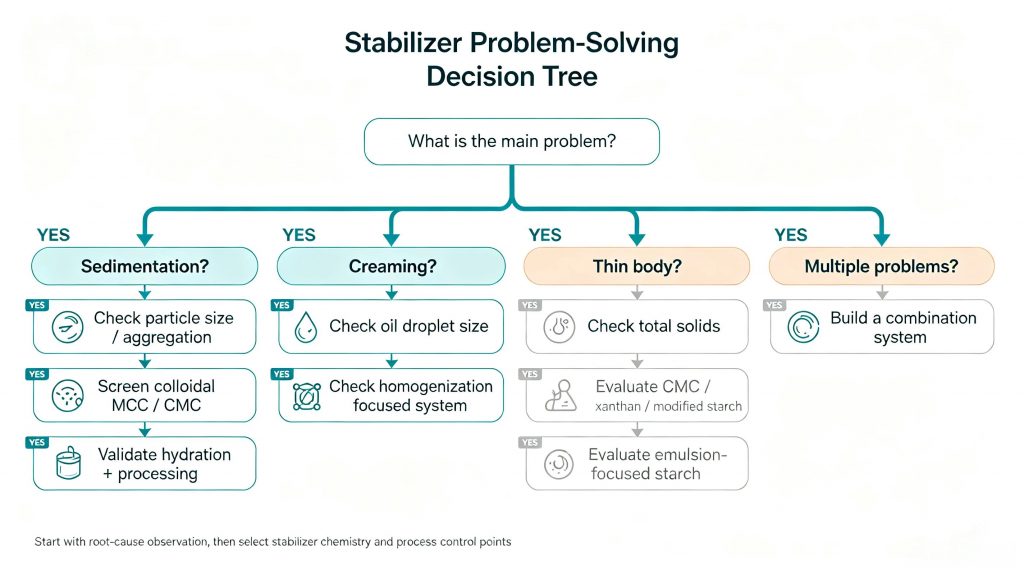
What is the main problem?
        ↓
Sedimentation?
  → Check particle size, aggregation and dispersion
  → Screen colloidal MCC / CMC

Creaming?
  → Check oil droplet size and homogenization
  → Evaluate an emulsion-focused system

Thin body?
  → Review total solids and rheology
  → Screen CMC / xanthan / modified starch

Grittiness?
  → Check protein aggregation and particle size
  → Review processing + suspension system

Multiple problems?
  → Separate suspension and emulsion diagnosis
  → Build a combination system
This flow is a starting point for screening, not a substitute for the diagnostic detail in Section 3 or the formulation trials in Sections 4 and 5.
| Ingredient | Main Role |
|---|---|
| Colloidal MCC | Suspension / structure |
| CMC | Viscosity / suspension support |
| Xanthan Gum | Viscosity / flow control |
| Modified Starch | Body / texture / stability |
A Practical Screening Sequence
MCC vs Colloidal MCC vs CMC vs Xanthan vs Modified Starch
| Stabilizer | Primary Role | Typical Formulation Question |
|---|---|---|
| Colloidal MCC | Suspension and structured stability | Can the beverage support particles without excessive bulk viscosity? |
| CMC | Viscosity, water binding, texture | Does the beverage need more body or water-phase control? |
| Xanthan gum | Viscosity and shear-thinning | Does the beverage need stronger rheology and flow control? |
| Modified starch | Body, texture, stability | Does the product need starch-based structure or mouthfeel? |
| Gellan gum | Suspension and network formation | Does the system need a low-level structured suspension? |
This table is a starting point; actual performance depends on the specific grade, dosage, formulation matrix and processing.
Problem: balancing suspension, body, smoothness and emulsion stability. Candidate: a suspension-focused system such as colloidal MCC, with or without CMC, for products with a higher insoluble-particle load; modified starch for a creamier position. What to test: validate suspension against body — low-viscosity products should avoid over-thickening in pursuit of suspension. For general background on suspension systems, see Plant-Based Milk Stabilizer.
Problem: protein-driven sedimentation and viscosity behavior. Candidate: colloidal MCC alone, CMC alone, or the combination. What to test: first, compare all three candidates under constant protein and processing conditions. This is important because protein dispersion can interact directly with stabilizer performance.
Problem: insoluble particulate matter combined with an oil phase. Candidate: a suspension system for the particles, along with a separate evaluation of emulsion stability for the oil phase. What to test: in this case, evaluate each mechanism independently. A single hydrocolloid rarely addresses both problems equally well.
Problem: an oil-phase-dominated system that is prone to creaming. Candidate: therefore, evaluate emulsification and homogenization first, with suspension considered as a secondary factor. What to test: before adding or increasing a stabilizer, measure droplet size after homogenization. This helps determine whether the primary issue is related to emulsion structure rather than insufficient suspension viscosity.
Problem: aggregation, grittiness, sedimentation, and heat sensitivity associated with the protein system. Candidate: a suspension-oriented stabilizer may be considered, but only after the protein system has been characterized. What to test: more importantly, evaluate protein quality and processing conditions first. Stabilizers should support the formulation rather than substitute for this step.
Problem: cocoa particle suspension must be balanced with acceptable mouthfeel. Candidate: therefore, consider a structured suspension system rather than simply increasing continuous-phase viscosity. What to test: at the same time, evaluate mouthfeel alongside sedimentation. Over-thickening may reduce visible sediment but can also compromise sensory acceptance.
Problem: a thin body combined with sedimentation and starch-related texture. Candidate: in this case, a body-building system such as CMC or modified starch can be paired with a suspension component where needed. What to test: evaluate body and suspension together because rice-based beverages may need both characteristics addressed at the same time.
Quick Selection Guide: Which Stabilizer Should You Screen First?
| Main Problem | First Candidates to Screen |
|---|---|
| Sedimentation | Colloidal MCC, CMC |
| Creaming | Emulsification + homogenization + compatible stabilizer |
| Thin body | CMC, xanthan, modified starch |
| Grittiness | Protein/process optimization + suspension system |
| Excessive viscosity | Lower-viscosity grade or lower total dosage |
| Multiple instability mechanisms | Combination system |
Need help matching a stabilizer to your beverage? To request a technical evaluation, send: beverage type + pH + protein level + fat/oil level + current stabilizer + current dosage + main stability problem + processing conditions + monthly volume — and we can help identify suitable grades for laboratory screening.
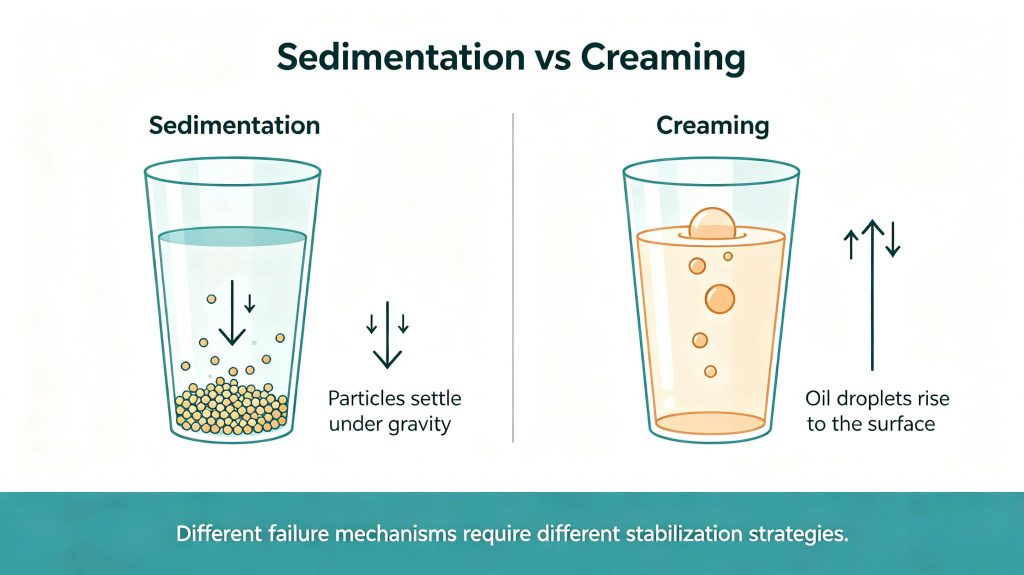
These problems can look similar to a consumer but come from different physical mechanisms, so the fix should match the mechanism, not the symptom.
| Observed Problem | First Variables to Check | Stabilizer Strategy to Evaluate |
|---|---|---|
| Bottom sediment | Particle size, dispersion, suspension structure | Colloidal MCC, CMC, or a combination |
| Top cream layer | Oil droplet size, homogenization | Emulsification + suitable stabilizer system |
| Clear serum layer | Protein, water phase, pH, salts | CMC or another compatible system |
| Excessive thickness | Dosage, grade, total solids | Lower dosage or an alternative grade |
| Thin body | Solids, viscosity contribution | CMC, xanthan gum, or modified starch |
| Gritty texture | Particle size, protein aggregation | Process optimization + formulation adjustment |
| Poor redispersion | Particle aggregation, structure | Suspension-system optimization |
| Instability develops during storage | Temperature, interactions, particle changes | Extended-storage validation |
Problem: insoluble particulate matter combined with an oil phase. Candidate: a suspension system for the particles, along with a separate evaluation of emulsion stability for the oil phase. What to test: in this case, evaluate each mechanism independently. A single hydrocolloid rarely addresses both problems equally well.
Problem: an oil-phase-dominated system that is prone to creaming. Candidate: therefore, evaluate emulsification and homogenization first, with suspension considered as a secondary factor. What to test: before adding or increasing a stabilizer, measure droplet size after homogenization. This helps determine whether the primary issue is related to emulsion structure rather than insufficient suspension viscosity.
Problem: aggregation, grittiness, sedimentation, and heat sensitivity associated with the protein system. Candidate: a suspension-oriented stabilizer may be considered, but only after the protein system has been characterized. What to test: more importantly, evaluate protein quality and processing conditions first. Stabilizers should support the formulation rather than substitute for this step.
Problem: cocoa particle suspension must be balanced with acceptable mouthfeel. Candidate: therefore, consider a structured suspension system rather than simply increasing continuous-phase viscosity. What to test: at the same time, evaluate mouthfeel alongside sedimentation. Over-thickening may reduce visible sediment but can also compromise sensory acceptance.
Problem: a thin body combined with sedimentation and starch-related texture. Candidate: in this case, a body-building system such as CMC or modified starch can be paired with a suspension component where needed. What to test: evaluate body and suspension together because rice-based beverages may need both characteristics addressed at the same time.
Many plant-based beverages need more than one functional mechanism — for example, controlling sedimentation while also maintaining body and emulsion stability. In these cases, manufacturers can build a combination stabilizer system, assigning a specific function to each ingredient rather than simply adding more of everything.
| Combination | Functional Logic | What to Watch For |
|---|---|---|
| Colloidal MCC + CMC | Suspension structure + water-phase/viscosity modification | No universal ratio — validate for each formulation |
| Colloidal MCC + Xanthan Gum | Suspension + controlled rheology | Total viscosity can rise faster than expected |
| Colloidal MCC + Modified Starch | Suspension + body/texture | Modified starch is sensitive to heat, shear and cooling — test under the real process |
| CMC + Xanthan Gum | Complementary rheology (water-phase + shear-thinning) | Can become gummy — validate with sensory testing, not viscosity alone |
Avoid stacking stabilizers just because each one “sounds right.” MCC + CMC + xanthan + modified starch together can create excessive viscosity, poor mouthfeel, higher cost, and formulations that are harder to troubleshoot. A simpler system with clearly defined functions is usually easier to control.
| Trial | Colloidal MCC | CMC | Xanthan Gum | Objective |
|---|---|---|---|---|
| A | Low | — | — | MCC baseline |
| B | Medium | — | — | MCC response |
| C | — | Low | — | CMC baseline |
| D | Low | Low | — | MCC + CMC combination |
| E | Low | — | Low | MCC + xanthan combination |
Before approving a system for production, confirm five areas:
Define the beverage and its dominant stability problem, select and screen candidate stabilizers and grades (see Section 5 for dosage screening), then evaluate single ingredients before selected combinations. The full step-by-step development logic — through processing, storage testing and cost-in-use validation — is laid out as a one-page reference in Section 10.
Key takeaway: colloidal MCC → suspension structure; CMC → water-phase/viscosity; xanthan gum → rheology; modified starch → body and texture. Optimize the combination against the beverage’s composition, sensory target, storage requirement and cost-in-use — not against viscosity alone.
Dosage is an optimization variable, not a default fix:
A common commercial objective is to identify the lowest practical dosage that consistently meets the required stability, sensory and processing targets — found through controlled trials with total stabilizer concentration tracked (e.g., 0.30% colloidal MCC + 0.10% CMC = 0.40% total), not by increasing one ingredient until the problem disappears.
Technical Note: Grade Before Dosage Two grades of the same stabilizer can produce different viscosity, hydration and processing behavior at the same dosage. Therefore, grade screening should normally precede final dosage optimization.
| Situation | What It May Mean | What to Test |
|---|---|---|
| Stability is weak at acceptable viscosity | Grade may not provide enough structure | Test another grade |
| Stability improves but viscosity becomes too high | Grade contributes too much continuous-phase viscosity | Test a lower-viscosity grade |
| Same dosage gives different results between suppliers | Product specifications/grade may differ | Compare TDS and test methods |
| Lab result differs from factory result | Dispersion/process may differ | Review process scale-up |
| Trial Result | Possible Interpretation | Next Variable to Check |
|---|---|---|
| Weak suspension | Dosage, grade or process may be insufficient | Grade, dispersion, dosage |
| Excessive viscosity | Total stabilizer contribution may be too high | Grade, dosage, combination |
| Good viscosity but sediment | Continuous-phase viscosity alone may not provide enough suspension | Suspension structure, particle characteristics |
| Good Day-0 stability but later sediment | Long-term structure may be insufficient | Storage stability, aggregation |
Many problems blamed on “the stabilizer” are actually dispersion, hydration or processing issues:
| Process Step | What to Control |
|---|---|
| Powder addition & dispersion | Sequence, lump prevention, mixing intensity |
| Hydration | Water temperature, hydration time |
| Homogenization | Pressure, number of passes, product temperature |
| Heat treatment | Pasteurization/UHT profile and its effect on viscosity/stability |
| Cooling & filling | Temperature control through to fill |
Homogenization is not a universal fix — if the underlying issue is poor hydration, protein aggregation, or an unsuitable grade, increasing homogenization intensity alone will not resolve it. Change one major process variable at a time so cause and effect stay traceable.
Need a sample for your formulation trial? To request a sample, send: beverage application + target texture + current formulation, and we can help you select suitable colloidal MCC / MCC Gel, CMC or modified starch grades for evaluation.
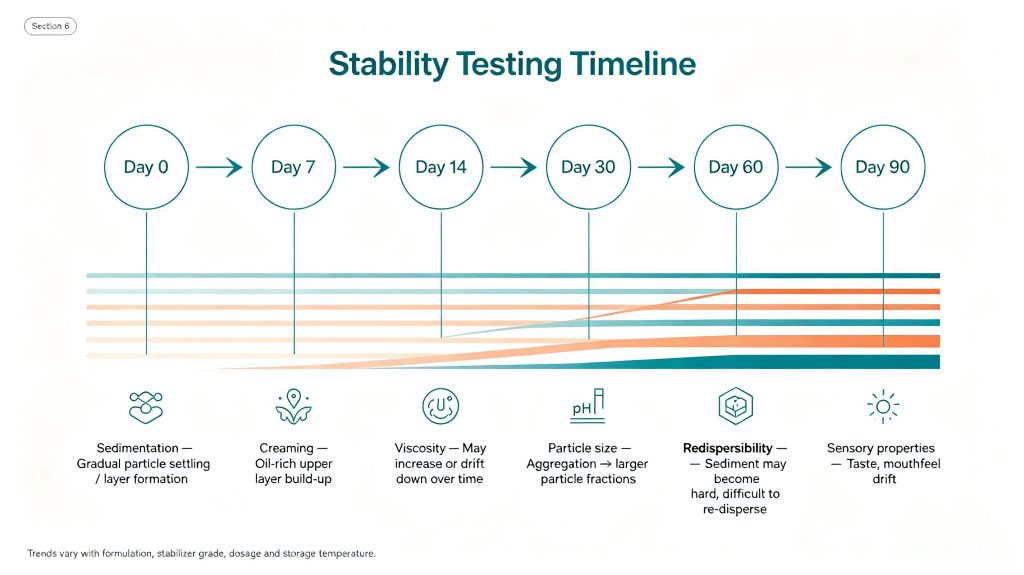
A beverage that looks stable on Day 0 has not demonstrated shelf-life stability. Sedimentation, creaming, viscosity drift and protein aggregation can all develop gradually.
| Test Area | What to Evaluate |
|---|---|
| Sedimentation | Sediment height, volume, appearance |
| Creaming | Upper-layer formation and thickness |
| Phase separation | Serum or distinct layers |
| Viscosity | Initial value and trend over storage |
| Redispersibility | Ease of returning particles to suspension |
| Sensory | Mouthfeel, thickness, smoothness, grittiness |
| pH | Initial value and drift over storage |
Track trends, not just pass/fail — a viscosity that is slowly dropping, or sediment that is slowly increasing, can signal a longer-term problem even if the current sample still looks acceptable. A practical schedule, adjusted to the intended shelf life:
| Time Point | What to Record |
|---|---|
| Day 0 | Appearance, viscosity, pH, sediment, creaming |
| Day 7 | Sedimentation trend, phase separation, viscosity |
| Day 14 | Redispersibility, appearance, viscosity |
| Day 30 | Stability trend, sensory, redispersion |
| Extended storage | Shelf-life trend and commercial acceptance |
Define target ranges for sedimentation, creaming, redispersion score, viscosity, appearance, mouthfeel, pH and storage stability before running the trial — as internal development targets specific to the product category, not universal industry limits.
A lab sample with no visible separation for a few days is not the same as demonstrated commercial shelf-life stability, which also has to account for packaging, distribution temperature swings, production-scale processing and batch-to-batch consistency. Keep a stability report (batch info, stabilizer grade and dosage, processing conditions, results at each time point) — it carries the formulation from R&D into pilot and commercial production.
Key principle: don’t just ask whether a stabilizer works — ask how well it works, at what dosage, under which process, for how long, and at what cost.
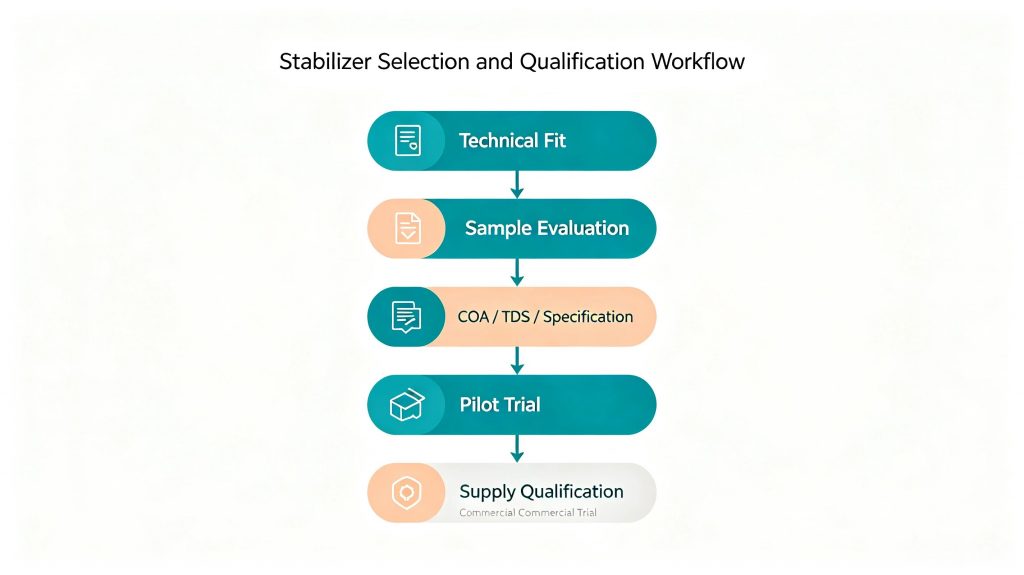
Once a stabilizer system and grade look technically suitable, the next question shifts from formulation to sourcing: can the supplier provide that exact grade consistently, with the documentation and commercial terms a production line needs? At minimum, buyers should confirm the exact grade (not just the ingredient name), request TDS, COA and SDS for that grade, clarify MOQ and lead time, calculate cost-in-use rather than price per kilogram, and check batch consistency and change-control practices. The subsections below walk through each of these in detail.
“We need CMC” is less useful than defining the actual beverage problem (sedimentation, creaming, thin body, excessive viscosity, poor redispersion) — the functional requirement determines the ingredient, not the reverse. Request the exact grade, not just the ingredient — “Colloidal MCC — Grade X” is meaningful, “MCC” alone is not — and confirm whether the sample is the same grade that would be supplied commercially.
| Information | Why It Matters |
|---|---|
| Beverage type | Determines application context |
| Protein source and level | Helps assess protein interactions |
| Fat/oil level | Indicates emulsion requirements |
| pH | Affects formulation compatibility |
| Current stabilizer | Provides a formulation baseline |
| Current dosage | Helps assess cost-in-use |
| Main instability | Defines the technical target |
| Processing conditions | Helps select a relevant grade |
| Monthly volume | Supports commercial quotation |
| Destination market | Determines logistics and documentation |
Cost-in-use per ton of beverage = Σ (ingredient price per kg × ingredient dosage in kg per ton of beverage)
Illustrative example: Supplier A quotes $4/kg at a 1.0% dosage → $40/ton of beverage. Supplier B quotes $7/kg at a 0.4% dosage → $28/ton of beverage. The higher-priced material is the lower cost-in-use once dosage is accounted for. Include freight, duty, packaging and QC cost for a complete comparison.
Define the beverage and its functional requirement, select candidate stabilizers and exact grades, then request samples and technical documents (TDS, COA, SDS) to run controlled laboratory trials. From there, optimize dosage and processing, validate through shelf-life testing and a pilot batch, and compare cost-in-use and supply conditions across suppliers before approving one and establishing change control. The sample-to-commercial progression and final approval criteria are detailed below.
Not every quotation comes from the same type of source, and the distinction affects what should be verified before committing.
| Factor | Manufacturer | Distributor |
|---|---|---|
| Production control | Direct | Depends on the producer relationship |
| Technical support | Often closer to production knowledge | May depend on the supplier network |
| MOQ | May be higher, but can vary by grade | May offer smaller lots |
| Customization | Potentially available (grade, particle size, packaging) | Depends on what the manufacturer allows |
| Batch consistency | Verify directly with production records | Verify the original production source |
| Lead time | Tied to production schedule | Often tied to stock availability |
| Documentation (TDS/COA/SDS) | Original source | Confirm traceability to the actual batch |
Neither structure is automatically the better choice — a distributor with strong local service and stock can outperform a distant manufacturer on responsiveness, while a manufacturer typically offers deeper technical involvement and more consistent long-term supply. The right fit depends on order volume, technical complexity and how much direct formulation support the project needs.
A useful Beverage Stabilizer RFQ Template includes:
Beverage type:
Protein source:
Protein content:
Fat/oil content:
pH:
Total solids:
Main stability problem:
Current stabilizer:
Current dosage:
Processing conditions:
Target shelf life:
Required sample quantity:
Estimated monthly volume:
Destination market:
Send this information to our technical team to start a formulation discussion. This produces far more relevant quotations than “please quote MCC.”
| Category | What to Compare |
|---|---|
| Exact grade & sample result | Technical fit |
| Price/kg & cost-in-use | Full economic comparison |
| MOQ, lead time, packaging | Commercial fit |
| TDS / COA / SDS availability | Documentation |
| Batch consistency, technical support | Reliability |
| Change-control process | Long-term risk |
For a critical, high-volume ingredient, a validated second-source supplier can reduce supply-chain risk — but a second source should be technically qualified before it is needed for emergency substitution, since two products with the same generic name are not automatically interchangeable.Regulatory requirements may vary by market, so manufacturers should verify food additive status and permitted use before commercialization.
Technical: problem defined · functional requirement defined · exact grade approved · dosage and processing optimized · shelf-life and sensory performance acceptable Quality: specification approved · COA reviewed · batch traceability established · commercial batch validated Regulatory: target-market requirements reviewed · TDS/SDS/food-grade documents received Commercial: price, cost-in-use, MOQ, packaging, lead time and payment terms confirmed Supply: production capacity reviewed · change-control process understood · second-source strategy considered where relevant
Send your beverage type, pH, protein and oil levels, current stabilizer, dosage, processing conditions, monthly volume and destination market. This information allows a more relevant technical and commercial discussion.
ACTA supplies colloidal MCC / MCC Gel, CMC and modified starch for beverage applications. Final grade and dosage should be confirmed through formulation and process trials.
Stabilizer performance is a property of the complete beverage system, not the powder alone. The same ingredient can behave differently depending on the surrounding formulation.
Compatibility Matrix
| Beverage Factor | Potential Risk | What to Check | Development Response |
|---|---|---|---|
| Low pH | Protein instability | pH and protein behavior | Evaluate the complete protein/stabilizer system |
| High protein | Aggregation or sediment | Protein concentration, heat history | Screen suspension and rheology systems together |
| High fat/oil | Creaming | Oil droplet size, homogenization | Evaluate emulsion stability separately from suspension |
| High mineral fortification | Changed formulation behavior | Mineral/ionic level | Compare fortified vs. non-fortified versions |
| High soluble solids | Excessive body | Total solids and viscosity | Optimize grade and dosage together |
| High fiber / insoluble particles | Sedimentation, grittiness | Particle size | Evaluate suspension and mouthfeel together |
| UHT / retort processing | Post-process instability | Full heat profile | Validate after the actual commercial heat treatment |
| Strong homogenization | Texture change | Pressure and temperature | Compare pre- and post-homogenization samples |
Suspension vs. Emulsion — a Key Distinction
A suspension problem (solids settling) and an emulsion problem (oil rising or separating) do not necessarily respond to the same stabilizer. A beverage can show both at once — for example, oil rising while plant particles settle — in which case the oil phase and the particle phase typically need separate evaluation rather than one blanket fix.
Compatibility Trial Sequence
| Document | Purpose | Typical Question It Answers |
|---|---|---|
| TDS | Technical product information | What is this product designed to be? |
| COA | Batch-specific quality confirmation | Does this lot meet the agreed specification? |
| SDS | Safety and handling information | How should the material be handled safely? |
| Specification | Acceptance criteria | What limits define acceptable material? |
A TDS helps R&D select a candidate but doesn’t guarantee every commercial batch matches it exactly — that’s what a batch-specific COA is for.
Appearance, moisture, viscosity (and its test conditions — concentration, temperature, instrument, spindle), particle size/mesh, pH (and its test conditions), microbiological limits, heavy-metal/contaminant controls, recommended applications, storage conditions and shelf life. Always compare test methods before comparing numbers — a viscosity reported at one concentration cannot be directly compared with another supplier’s value at a different concentration.
Confirm: product identity and grade match the approved material; batch number is traceable; test results meet the agreed specification with consistent units; test methods are identified; the material is released under the supplier’s quality system.
Clarify whether a reported range (e.g., “viscosity: 5,000–10,000 mPa·s”) is the formal acceptance specification or a typical/target value — these are not the same thing for commercial qualification purposes.
One successful sample does not prove long-term consistency. A stronger qualification compares the original sample against at least two subsequent commercial batches. Establish with the supplier which changes (manufacturing site, raw-material source, process, packaging, specification) require notification and whether they trigger requalification — an unexpected change can affect the finished beverage even when the product name stays the same.
Supplier Qualification Questions
One-Page Development Logic
1. Beverage        → What are we making?
2. Problem         → What is unstable?
3. Mechanism       → Why is it unstable?
4. Function        → What does the formulation need?
5. Candidate       → Which stabilizer system should be screened?
6. Grade           → Which exact grade?
7. Dosage          → At what practical level?
8. Process         → How should it be dispersed, hydrated, homogenized, heated?
9. Stability       → Does it remain stable through storage?
10. Sensory        → Does it still taste and pour correctly?
11. Cost           → Is the cost-in-use commercially acceptable?
12. Scale-up       → Does it work beyond the laboratory?
13. Supplier       → Can the material be supplied consistently?
Formulation Worksheet — Key Fields
Commercial Approval Checklist
Product: exact grade identified · specification approved · application trial completed Quality: TDS/COA/SDS available · batch traceability confirmed Application: stability, viscosity, sensory, redispersibility and processing all acceptable Commercial: cost-in-use, MOQ, lead time, packaging and supply continuity acceptable Change management: change-control process understood and requalification requirements defined
The strongest plant-based beverage stabilizer strategy starts with the beverage, not the ingredient: define the formulation, identify the actual instability, understand its mechanism, select the functional system and exact grade, optimize dosage and processing, validate stability and sensory performance, calculate cost-in-use, and qualify the supplier through specifications, batch documentation and consistent supply. This applies across oat, soy, almond, pea, rice, coconut, chocolate and high-fiber beverages — the goal is not the single most powerful stabilizer, but the right system, at the right grade and dosage, supplied consistently for commercial production.
There is no single best stabilizer. Instead, the right choice depends on the beverage’s dominant failure mode (sedimentation, creaming, thin body, or excessive viscosity) as well as its protein, fat, and processing conditions. Therefore, Section 2 covers how to match a stabilizer system to specific beverage types, such as oat, soy, almond, or pea milk.
Oat beverages typically need a balance of suspension, body, and smoothness. For this reason, a suspension-focused system such as colloidal MCC, with or without CMC, is often a reasonable starting point for products with a higher insoluble-particle load, subject to formulation and process validation. Meanwhile, modified starch is a common candidate where a creamier, fuller body is the priority.
Protein drinks (soy, pea, and other plant proteins) can show aggregation, grittiness, and sedimentation. Therefore, stabilizer selection should follow protein characterization rather than replace it. Colloidal MCC is often screened for suspension support and may sometimes be combined with a rheology modifier. However, the protein source, concentration, pH, and heat treatment all need to be evaluated alongside the stabilizer.
Dosage varies by ingredient, grade, and beverage matrix. As a result, the appropriate level should be established through controlled formulation trials rather than assumed from a generic range.
First, identify whether the sediment comes from particle settling, aggregation, or both. Then, evaluate particle size, dispersion, and a suspension-oriented system such as colloidal MCC (alone or combined with CMC), together with processing conditions such as hydration and homogenization. Finally, confirm the result through multi-week storage testing rather than relying on a Day-0 check alone.
Standard MCC does not automatically provide the same suspension functionality as a colloidal MCC system. In contrast, colloidal MCC is engineered to form a structured network that can help support suspended particles in suitable formulations.
CMC primarily modifies viscosity and water-phase behavior, which can indirectly slow settling. However, it is not typically the first choice for structured particle suspension. Instead, that role is more often evaluated with colloidal MCC.
First, identify whether the separation is sedimentation (particles settling), creaming (oil rising), or both. Then, evaluate a suspension system (e.g., colloidal MCC), an emulsion-focused approach (homogenization, emulsifier), or a combination. In either case, confirm the result through shelf-life testing rather than relying only on a Day-0 check.
Creaming typically comes from oil droplet size, insufficient emulsification, or homogenization conditions rather than from insufficient suspension stabilizer. Therefore, it should be diagnosed and addressed separately from bottom sedimentation.
First, evaluate the exact grade rather than just the ingredient name, and request TDS/COA/SDS. Next, run controlled lab trials and validate the leading candidates through pilot and commercial batches. At the same time, compare cost-in-use rather than price per kilogram alone, while also considering lead time, MOQ, and change-control practices.
First, build a side-by-side table covering exact grade, sample trial results, price and cost-in-use, MOQ, lead time, packaging, document availability (TDS/COA/SDS), batch consistency, and technical support. Then, validate the leading candidates through pilot and commercial-batch trials before final approval.
