

Xanthan Gum vs MCC is a common comparison for food and beverage formulators deciding how to control viscosity, particle suspension, texture, and long-term physical stability. Although both ingredients can contribute to stabilization, they do not perform the same function. Food and beverage manufacturers widely use xanthan gum to modify viscosity and create shear-thinning behavior, while formulators can use colloidal microcrystalline cellulose (MCC) to provide structural support for suspended particles in suitable food and beverage systems.
The key question is not which ingredient is “better,” but which stabilization mechanism matches the actual failure mode of the product.
The important question is therefore not simply which ingredient is “better.” The more useful formulation question is: Which stabilization mechanism matches the actual failure mode of your product?
If your main problem is insufficient viscosity, xanthan gum may be a logical ingredient to evaluate first. If the main problem is sedimentation of cocoa, minerals, protein particles, or insoluble fibers, colloidal MCC may deserve evaluation. In some formulations, a combination of xanthan gum and colloidal MCC may provide both viscosity control and suspension structure.
This guide compares xanthan gum and MCC from a formulation and purchasing perspective, including suspension mechanism, viscosity, mouthfeel, beverage applications, processing, dosage, cost-in-use, grade selection, troubleshooting, and supplier qualification..
When food and beverage manufacturers search for Xanthan Gum vs MCC, they are rarely looking for a textbook definition. They are usually trying to solve a specific problem: cocoa that settles to the bottom of the bottle, a beverage that has become too thick, a lab sample that performs perfectly but fails on the production line, or a search for a xanthan gum alternative that keeps the product pourable. This guide answers those questions directly, because the formulation needs to match the stabilization mechanism to the actual failure mode — not the other way around.
Both xanthan gum and microcrystalline cellulose (MCC) can improve the physical stability of a food or beverage system, but they do not work the same way. Xanthan gum primarily builds viscosity through hydration and polymer-chain interactions in the continuous phase. Colloidal MCC, on the other hand, can build a structured particle network that supports insoluble solids without relying entirely on bulk viscosity. A formulator who simply increases xanthan gum to fix sedimentation may also make the beverage too thick or slippery — and a formulator who reaches for MCC without understanding the mechanism may under-dose or over-dose the system.
This guide walks through the stabilization mechanism, suspension performance, viscosity and mouthfeel, beverage and dairy applications, replacement and combination strategies, processing, dosage, scale-up, cost-in-use, troubleshooting, common mistakes, and supplier qualification — so a formulation or purchasing team can decide based on function, not just a name on a spec sheet.
| If your formulation needs | Evaluate first | What to test |
|---|---|---|
| Strong viscosity and shear-thinning flow | Xanthan gum | Viscosity curve and shear-thinning behavior |
| Particle suspension without excess thickness | Colloidal MCC | Sedimentation and appearance over time |
| A less “gummy” or slippery mouthfeel | Colloidal MCC | Suspension performance and pourability |
| A xanthan gum alternative | Colloidal MCC | Suspension performance at reduced or zero xanthan gum |
| Lower xanthan gum usage | Colloidal MCC + reduced xanthan gum | Performance of a partial-reduction system vs. the original |
| Both viscosity and suspension | Xanthan gum + MCC | Viscosity, suspension, and mouthfeel together |
When comparing Xanthan Gum vs MCC, the right choice depends on whether the formulation needs primarily viscosity control, particle suspension, or a combination of both.
Xanthan gum is a microbial polysaccharide that Xanthomonas campestris produces by fermenting a carbohydrate source. After purification and drying, xanthan gum disperses in water and hydrates to form a viscous, pseudoplastic solution. As its polymer chains entangle within the continuous phase, xanthan gum increases viscosity at low shear and thins rapidly under agitation, pouring, or chewing, creating shear-thinning behavior.
This rheological profile explains why formulators continue to use xanthan gum in sauces, dressings, dairy beverages, and many suspension applications. A relatively small dosage can meaningfully change a product’s rheology, and the resulting viscosity can help slow the movement of suspended particles. However, viscosity does not fully determine stabilization performance. When formulators increase xanthan gum to improve suspension, they may also increase beverage thickness and create an unwanted sensory trade-off.
Food formulators widely use xanthan gum to modify viscosity and create shear-thinning behavior. As shear increases, xanthan gum can reduce apparent viscosity, allowing formulators to control flow behavior and texture. Scientific and regulatory evaluations of xanthan gum have documented this rheological behavior.
For additional technical background, see the EFSA evaluation of xanthan gum (E 415).
Microcrystalline cellulose (MCC) is a purified, partially depolymerized form of cellulose. In its standard powdered form, MCC is widely used as a bulking agent, tableting excipient, and texturizing ingredient. Standard MCC does not automatically deliver beverage-grade suspension performance on its own.
Colloidal MCC is a different product category. Through co-processing with a hydrophilic carrier and controlled particle-size reduction, it can be engineered to disperse as fine, insoluble cellulose particles that interact with each other and with the carrier system. Once properly activated through hydration and shear, colloidal MCC can form a structured network that helps immobilize suspended particles at rest while still allowing the system to flow under shear during pouring, pumping, or drinking. Whenever this guide discusses “MCC” for beverage or suspension applications, it means colloidal MCC — standard MCC and colloidal MCC do not necessarily deliver the same functionality in a beverage.
MCC has been investigated for a range of food applications, including beverages, dairy products, emulsions, bakery products, and other formulated foods. Its functional performance can depend on particle characteristics, grade, concentration, formulation composition, and processing conditions.
A review of the functionality and nutritional aspects of microcrystalline cellulose in food provides additional background on these applications.
This distinction is one of the most overlooked issues in ingredient sourcing, and it directly affects both performance and price comparisons.
| Feature | Standard MCC | Colloidal MCC |
|---|---|---|
| Primary form | Insoluble cellulose powder | Structured colloidal system |
| Beverage suspension | Limited without a suitable carrier system | Commonly used for suspension-focused systems |
| Network formation | Limited on its own | Forms a structured network once activated |
| Typical role | Bulking, texture, tablet applications | Suspension and beverage stabilization |
| Processing sensitivity | Application dependent | Activation and dispersion are critical |
| Buyer question to ask | “What is the MCC grade?” | “What colloidal system and activation method?” |
For buyers, this table has a practical purpose: it prevents comparing the price of a general-purpose MCC powder against the price of a purpose-built MCC Gel system. The two are not interchangeable line items, and treating them as such almost always leads to a disappointing lab trial.
A note on terminology: “colloidal MCC” refers generally to MCC-based systems engineered for dispersion and suspension applications. “MCC Gel” may be used as a commercial product term for specific colloidal MCC systems, depending on supplier terminology — the two terms are not automatically interchangeable across every supplier’s catalog. Confirm the exact composition and specification of any product called “MCC Gel” or “colloidal MCC” directly with the supplier.
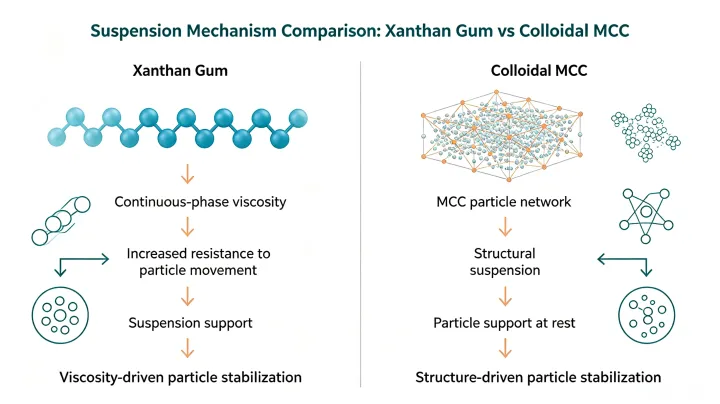
Xanthan gum stabilizes primarily by making the continuous phase more viscous: hydrated polymer chains entangle and resist the downward movement of suspended particles, while the shear-thinning profile keeps the product pourable despite high viscosity at rest.
Colloidal MCC can contribute to physical structure within the continuous phase. In suitable formulations, the dispersed cellulose particles and carrier system can form a structured network that helps resist particle movement at rest while allowing flow under shear.
As a simplified model: xanthan gum mainly increases resistance to particle movement through the continuous phase, while colloidal MCC can provide a structured network that supports suspended particles. The actual mechanisms in both systems are more complex and depend on grade, dosage, and formulation conditions, so treat this as a starting mental model, not a fixed rule. Neither mechanism is universally superior — the better one depends on what the finished product needs.
| Attribute | Xanthan Gum | Colloidal MCC |
|---|---|---|
| Primary mechanism | Viscosity via hydrated polymer chains | Structural network via particle interaction |
| Shear response | Strong and well-established | Grade and formulation dependent |
| Suspension mechanism | Mainly viscosity-driven | Mainly structure-driven |
| Contribution to mouthfeel | Can add body and, at higher dosage, a slippery texture | Can add body with a cleaner, less gummy mouthfeel |
| Typical dosage range | Low, but effective dose rises with particle load | Moderate, application and grade dependent |
| Sensitivity to processing | Hydration and shear during mixing | Activation, dispersion, and homogenization |
| Best-fit applications | Sauces, dressings, viscosity-driven suspension | Cloudy beverages, cocoa drinks, protein and plant-based beverages |
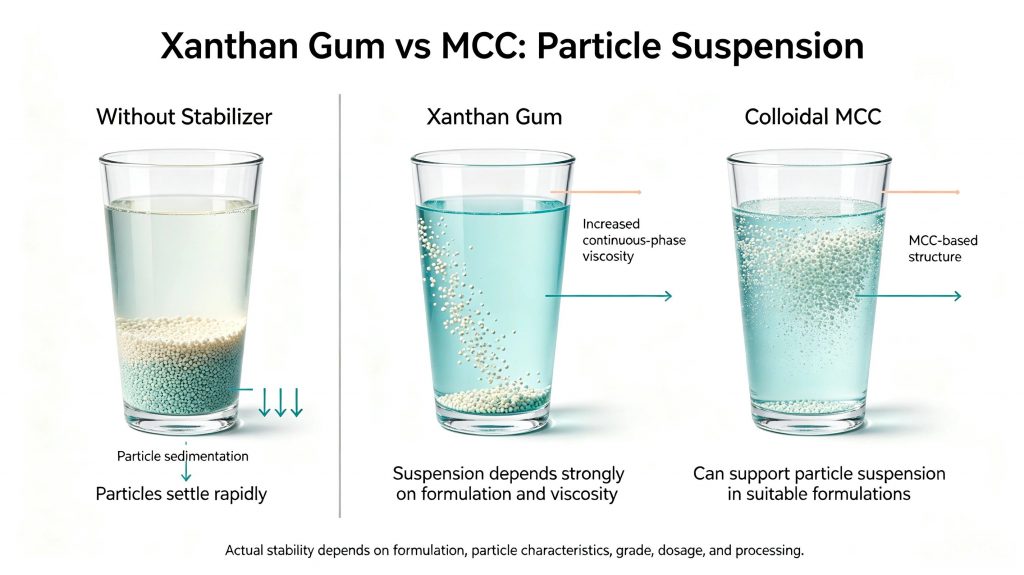
Caption:Particle suspension can respond differently to xanthan gum and colloidal MCC depending on formulation and processing conditions.
Consider two beverages with the same concentration of insoluble particles, such as cocoa, fruit fiber, or protein fragments. If a formulator increases xanthan gum to slow sedimentation, the approach works — but only up to a point, since achieving strong suspension with xanthan gum alone typically requires enough polymer to noticeably thicken the beverage.
Colloidal MCC approaches suspension differently: because the mechanism relies on a structured particle network rather than bulk viscosity alone, a well-selected grade may help suspend insoluble particles while keeping the beverage more pourable than a heavily thickened system. This is why colloidal MCC is particularly relevant whenever manufacturers need to control sedimentation, floating particles, creaming, or serum separation without pushing viscosity higher than the product should tolerate.
In practical Xanthan Gum vs MCC formulation work, suspension performance should be evaluated separately from bulk viscosity. A beverage can have relatively high viscosity and still experience particle sedimentation, so formulators should match the stabilizer mechanism to the actual stability problem.
When sedimentation is the primary formulation problem, it can also be useful to evaluate different food suspension agents according to particle type, product viscosity, and processing conditions.
Xanthan gum’s shear-thinning profile means the product can feel thinner in the mouth than a viscometer reading might suggest, because chewing and swallowing apply shear. At higher dosages, however, many tasters describe xanthan gum systems as “gummy” or “slippery,” an effect that becomes more noticeable as dosage increases to compensate for suspension needs.
In some beverage systems, colloidal MCC can provide body and suspension with less of the sticky or slippery sensation associated with higher levels of xanthan gum. However, sensory response is formulation-specific and should be evaluated at comparable suspension performance rather than at equal dosage.
Beverage formulators face a genuine trade-off: enough stabilization to prevent sedimentation, floating particles, phase separation, and inconsistent texture during shelf life, without excessive viscosity, gumminess, poor pourability, or unnecessary stabilizer cost.
For cloudy fruit beverages, cocoa drinks, protein beverages, plant-based milk, flavored milk, and beverage concentrates, colloidal MCC is worth evaluating early when particle suspension is the primary failure mode and viscosity must stay controlled. Xanthan gum becomes the stronger candidate when the beverage also needs meaningful thickening, or when the shear-thinning pour profile is part of the desired product identity — a thicker fruit concentrate or a syrup-style drink, for example.For a broader discussion of stabilization systems used in beverage formulations, see our guide to beverage stabilizers.
Dairy and protein beverages add complexity because proteins themselves interact with pH, minerals, and heat treatment. Before selecting a stabilizer, confirm whether the instability comes from insufficient viscosity or suspension, or from protein behavior during processing.
Once the failure mode is confirmed as a suspension or texture issue, colloidal MCC may be evaluated in protein beverages and plant-based milk when the formulation requires additional physical structure for suspended particles or dispersed components while maintaining the desired texture and flow profile. Xanthan gum remains useful in dairy and protein systems that need additional body or a creamier, thicker mouthfeel.
Sauces, dressings, gravies, and dips behave differently from beverages, because viscosity itself is often part of the desired finished-product texture rather than a side effect to minimize. Here, xanthan gum’s strong shear-thinning behavior is a genuine advantage: the product clings to food at rest but pours or spreads easily under shear.
Colloidal MCC may also be evaluated in formulations containing oil droplets, spice particles, or other insoluble materials where additional physical structure is needed alongside rheological control. Sauces and dressings are one of the more common categories where combination systems provide a useful balance of viscosity, suspension, and mouthfeel when a single ingredient cannot meet all three targets efficiently.
Sometimes — but treat replacement as a functional substitution project, not a simple ingredient swap. The first question isn’t “how much MCC equals how much xanthan gum,” but: what is the xanthan gum actually contributing to this formulation?
If xanthan gum is mainly providing viscosity and shear-thinning flow, MCC alone may not reproduce that rheological profile, since the two ingredients build stability through different mechanisms. If xanthan gum is mainly holding particles in suspension, colloidal MCC deserves direct evaluation — a suitable grade may achieve the required suspension target with a different viscosity profile, though whether it can actually reduce total xanthan gum use must be confirmed through formulation trials. The objective is never to match the exact dosage of the original ingredient; it’s to match the required finished-product performance under the same processing and storage conditions.
If you’re considering a xanthan gum replacement, the most useful first step is not requesting a generic MCC sample. Instead, ask the supplier to recommend a colloidal MCC grade based on your particle type, target viscosity, pH, solids content, and processing equipment.
In some formulations, yes — but the most realistic goal is usually not a complete replacement. Manufacturers generally have three practical paths:
The right path depends on what the existing xanthan gum is actually contributing, confirmed through a side-by-side trial rather than assumed from a general rule.
Example: partial xanthan gum reduction (illustrative only). Suppose a beverage currently uses 0.20% xanthan gum for suspension. A formulation trial might screen a reduced system of 0.08% xanthan gum plus 0.20% colloidal MCC against the original 0.20% xanthan gum control, comparing sedimentation, viscosity, mouthfeel, and cost-in-use side by side. Actual dosage always depends on the formulation, particle load, and the specific MCC grade selected — this example illustrates the comparison method, not a recommended ratio.
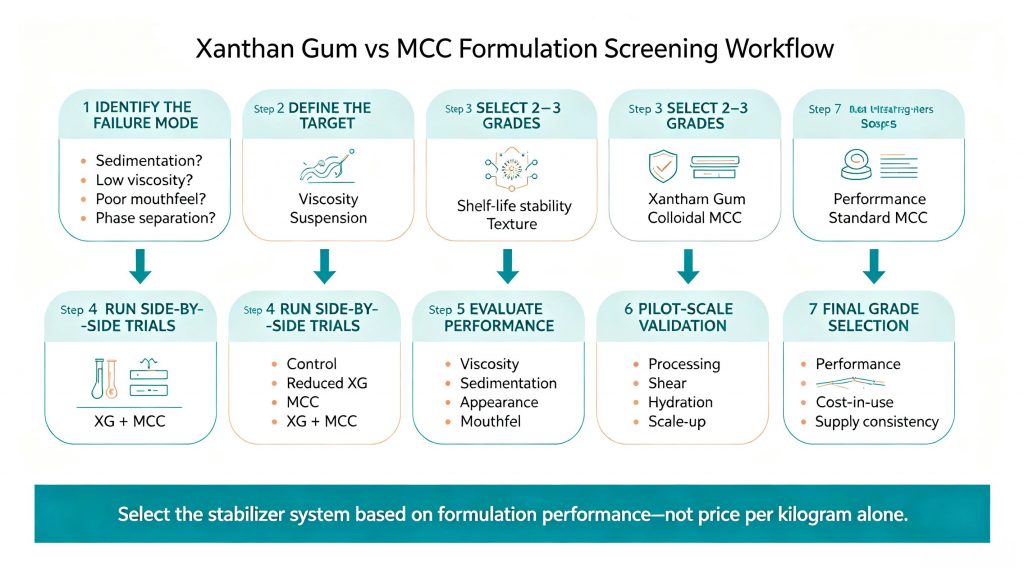
Xanthan Gum vs MCC Formulation Screening
Caption:A practical screening workflow for comparing xanthan gum, standard MCC, colloidal MCC, and combination systems.
This turns the comparison into an actionable R&D protocol, whether the goal is replacement, cost reduction, or better performance.
Yes, and in some formulations a combination can provide a balance that’s difficult to achieve with either ingredient alone. Xanthan gum contributes viscosity, shear-thinning behavior, and rheological control, while colloidal MCC contributes structural suspension, particle support, and body. Because the two mechanisms are complementary rather than redundant, a smaller amount of each ingredient can sometimes deliver better overall stability than a larger amount of either used alone — though this needs to be confirmed for each specific formulation.
A 2023 study published in LWT (Wang et al., Vol. 184, Article 114966) reported synergistic effects between MCC and xanthan gum in a UHT milk-fat whipping cream system, including improved stability and reduced fat coalescence under the tested conditions. That result should not be assumed to transfer directly to beverages, dairy drinks, sauces, or other food systems; each formulation still needs its own trial.
| Sample | Formulation |
|---|---|
| A — Control | Current formulation as-is |
| B — Reduced xanthan gum | Lower xanthan gum, no MCC |
| C — Low colloidal MCC | Colloidal MCC only, low dosage |
| D — Medium colloidal MCC | Colloidal MCC only, medium dosage |
| E — Combination, low MCC | Reduced xanthan gum + low colloidal MCC |
| F — Combination, medium MCC | Reduced xanthan gum + medium colloidal MCC |
Evaluate each sample against a consistent set of criteria:
| Parameter | What to record |
|---|---|
| Initial viscosity | Day 0 measurement |
| 24-hour sedimentation | Visual assessment or measured layer |
| 7-day stability | Ambient storage |
| Accelerated stability | Defined elevated-temperature condition |
| Pourability | Sensory or flow-rate assessment |
| Mouthfeel | Sensory panel |
| Appearance | Clarity and cloud uniformity |
| Processing time | Minutes required to hydrate and disperse |
| Stabilizer cost | Cost per kilogram of finished product |
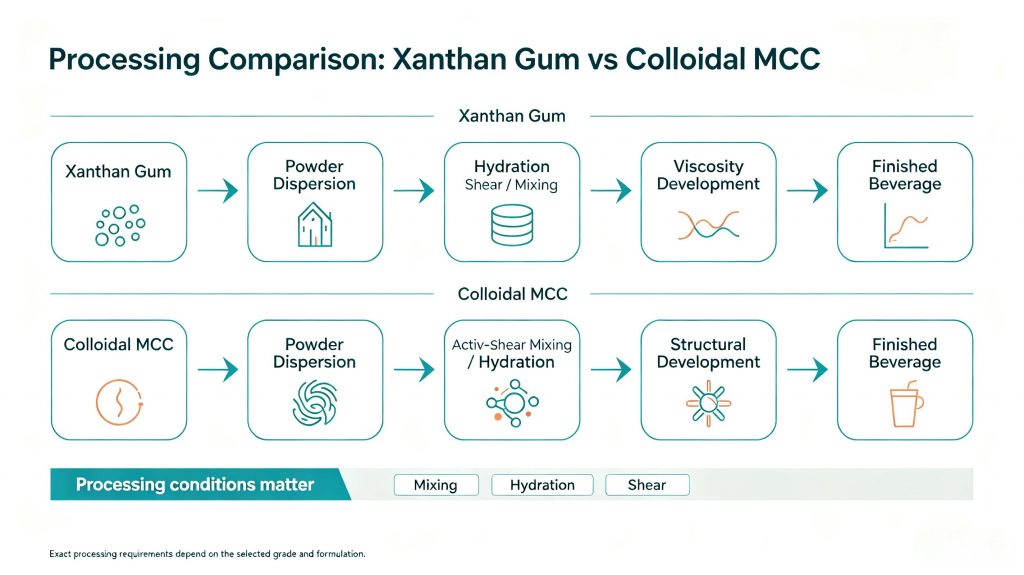
Caption:Proper dispersion, hydration, and processing conditions can influence the final performance of xanthan gum and colloidal MCC.
Xanthan Gum and Colloidal MCC Processing Workflow
Both ingredients are sensitive to how they’re added and processed, and poor dispersion is one of the most common reasons a stabilizer underperforms in production despite working well in the lab.
Xanthan gum should be dispersed thoroughly to avoid lumping and generally benefits from adequate shear during mixing to fully hydrate before the product moves downstream. Colloidal MCC requires proper activation — sufficient hydration time, adequate shear, and, in many systems, homogenization to fully develop the particle network. If colloidal MCC is under-processed, it may fail to build the suspension network at all, which can lead a formulator to wrongly conclude that “MCC doesn’t work” when the real issue was inadequate activation.
Dosage decisions should follow function, not habit. For xanthan gum, formulators typically start with the lowest dosage that achieves the required viscosity and shear-thinning profile, then adjust based on suspension and mouthfeel results. For colloidal MCC, dosage should be set according to particle load, target suspension window, and the specific grade’s activation characteristics, since different grades are engineered for different combinations of suspension, viscosity, and texture.
Never select a colloidal MCC grade based only on the highest viscosity figure on a data sheet. The grade should match the product’s actual particle type, particle size, and target mouthfeel — which is why the screening matrix above evaluates two or three grades side by side rather than a single option.
A stabilizer that works in a beaker is not automatically one that will work on a commercial production line, and skipping this step is one of the most expensive mistakes in stabilizer selection.
1 — Lab screening. Keep water source, solids content, pH, processing sequence, and shear condition constant across all samples so the comparison is fair.
Stage 2 — Pilot trial. Evaluate mixing time, hydration behavior, homogenization pressure, temperature, and pump shear, because these variables rarely match lab-scale conditions exactly.
3 — Commercial production. Confirm batch-to-batch consistency, equipment differences, shear history, holding time, and storage stability under real warehouse and distribution conditions.
Because shear, temperature, and holding time all change between these stages, a formulation that suspends particles perfectly on the bench can still fail after scale-up if the pilot and production steps are skipped.
Raw material price per kilogram is the wrong starting point for this comparison. The more useful calculation is cost-in-use:
Cost-in-use = ingredient price × actual dosage required to achieve stability.
For a combination system, total stabilizer cost equals xanthan gum cost plus MCC cost at their respective effective dosages. Even cost-in-use isn’t the full picture, though, because total formulation cost also includes processing cost, rework cost, and the quality-loss risk from an unstable finished product. A cheaper ingredient per kilogram is not necessarily a cheaper stabilizer system once processing time, batch failures, and shelf-life complaints are factored in.
Illustrative calculation only. These figures are not ACTA quotations — they exist only to demonstrate the cost-in-use method with hypothetical numbers.
| Stabilizer system | Illustrative price/kg | Use level | Cost per 1,000 kg finished beverage |
|---|---|---|---|
| Xanthan gum only | $6.00 | 0.15% | $9.00 |
| Colloidal MCC only | $3.50 | 0.35% | $12.25 |
| Xanthan gum + MCC | $6.00 + $3.50 | 0.08% + 0.20% | $4.80 + $7.00 = $11.80 |
These figures are illustrative only. Actual economics depend on supplier pricing, grade, dosage, processing conditions, and the stability target. Buyers should not assume that the lower-priced ingredient per kilogram will reduce the total stabilizer cost. They should multiply each ingredient’s price by its actual required dosage for the production batch rather than assume an equal dosage for both ingredients. This is exactly why cost conversations should start with a side-by-side trial rather than a price list.
The cost comparison in Xanthan Gum vs MCC should focus on cost-in-use rather than simply comparing the price per kilogram. Different grades can require different use levels, processing conditions, and combinations with other stabilizers.
When a stabilizer underperforms, the cause is usually one of these:
Start with the product, not the ingredient. Identify whether the dominant failure mode is low viscosity, particle sedimentation, phase separation, or poor mouthfeel. If the formulation primarily needs viscosity and shear-thinning flow, evaluate xanthan gum first. When it primarily needs structural particle suspension without excessive thickness, evaluate colloidal MCC first. If the product needs both, test a combination system rather than forcing a single ingredient to perform every function.
| Your situation | Recommended first evaluation |
|---|---|
| Sauce or dressing needing cling and shear-thinning flow | Xanthan gum |
| Cloudy beverage with visible sedimentation | Colloidal MCC |
| Protein or plant-based drink needing a lighter texture | Colloidal MCC |
| Product needing both thickness and suspension | Xanthan gum + colloidal MCC combination |
| Current xanthan gum dosage too high for target viscosity | Colloidal MCC, evaluated as a partial replacement |
| Lab sample works, production line fails | Re-run the trial at pilot scale with matched shear and hold time |
Xanthan Gum vs MCC Stabilizer Selection Decision Tree
What is your main problem?
            │
   ┌────────┼─────────────┐
   ▼        ▼              ▼
Viscosity  Sedimentation   Both
   │        │              │
   ▼        ▼              ▼
Xanthan   Colloidal      Xanthan Gum
Gum       MCC            + MCC
              │
              ▼
   Is mouthfeel/pourability acceptable?
              │
      ┌───────┴───────┐
      ▼                ▼
     Yes              No
      │                │
      ▼                ▼
  Move to pilot   Adjust grade or dosage,
  trial           retest
This flow mirrors the screening matrix above: identify the failure mode first, select the mechanism that matches it, and confirm sensory acceptability before moving to pilot-scale validation.
Published research on food rheology, suspension, and cellulose functionality supports the differences between xanthan gum and MCC. However, formulators should interpret these research findings in the context of their specific formulations because stabilizer performance changes with concentration, particle characteristics, pH, ionic strength, solids content, processing conditions, and storage conditions.
These studies support a mechanism-based approach to stabilizer selection. They do not establish a universal dosage, replacement ratio, or “best” stabilizer for every formulation. The final decision should still come from application-specific testing under the intended processing and storage conditions.
You do not need to disclose your complete formula to get useful grade guidance. You can start with a basic application profile without disclosing your complete formula or proprietary ingredient ratios — this is usually enough for a supplier to narrow the initial grade selection.
Before requesting a sample, buyers can speed up grade selection by providing:
The more formulation information a buyer provides upfront, the more accurately a supplier can recommend a suitable MCC or colloidal MCC grade — and the fewer trial-and-error rounds the project needs.
Choosing between xanthan gum and MCC doesn’t end with a successful lab trial; the supplier behind the ingredient affects consistency, lead time, documentation, and long-term supply security. Before committing to commercial volume, confirm the following:
The checklist above covers how to judge whether a supplier is qualified on paper. This section covers something different: how a genuinely technical supplier should be able to talk about your specific application, not just hand you a document.
Before committing to a grade, expect clear answers to:
A supplier that can explain why a specific grade fits your particle type, target viscosity, processing conditions, and stability objective can provide much more useful technical support than a supplier that simply quotes one standard grade. These points are worth clarifying before commercial approval, especially when qualifying a new MCC or colloidal MCC supplier.
If you are qualifying a new MCC or colloidal MCC supplier, ACTA can provide the technical and commercial information needed for an initial evaluation, including grade selection, application guidance, documentation, sample support, MOQ, and commercial supply conditions.
Xanthan gum stabilizes mainly by increasing the viscosity of the continuous phase, while colloidal MCC stabilizes mainly by forming a structural particle network that supports suspended solids.
Sometimes, but only after confirming what function xanthan gum was actually providing — viscosity, suspension, or both — and validating the replacement under the same processing and storage conditions.
In some formulations, yes, usually through partial reduction rather than full replacement. See the section above on full replacement, partial reduction, and combination systems for the three practical paths.
Yes. Combination systems can divide the functional load between rheology and structural suspension, and published research has reported synergistic effects in a specific whipped-cream system.
No. Standard MCC is a general-purpose cellulose powder, while colloidal MCC is engineered specifically for suspension and beverage stabilization applications.
Because xanthan gum stabilizes primarily through viscosity, achieving strong suspension with xanthan gum alone often requires enough polymer to noticeably thicken the product.
Match the grade to your particle type, particle size, target viscosity, and processing equipment, and always screen two to three grades side by side rather than testing only one.
No. Suspension performance depends on mechanism, not viscosity alone; a lower-viscosity colloidal MCC system can, in suitable formulations, achieve comparable or better particle suspension than a higher-viscosity xanthan gum system.
Shear, homogenization, temperature, and holding time typically differ between lab, pilot, and production scale — always validate through a pilot trial before finalizing a formulation.
Not necessarily. Ingredient price per kilogram is not a reliable comparison, because xanthan gum and colloidal MCC may be used at different dosages and provide different functional contributions. Compare cost-in-use based on the dosage required to reach the same finished-product target.
Product type, pH, total solids, particle type and size, current stabilizer and dosage, target viscosity, and your current failure mode — this speeds up accurate grade selection.
Yes. A technical supplier can often narrow the initial grade selection based on product type, particle characteristics, pH, solids content, target viscosity, processing conditions, and the main stability problem. Buyers do not necessarily need to disclose their complete formulation for an initial technical discussion.
Yes. For a new application, buyers should normally evaluate a representative sample before committing to commercial volume. A useful sample program should include the exact product identity, TDS, representative COA, recommended dispersion conditions, and sufficient material for side-by-side testing. Buyers should also confirm that the commercial product will match the qualified sample in specification and functional grade.
There is no universal answer to Xanthan Gum vs MCC because the two ingredients can address different formulation requirements. Xanthan gum is often evaluated when viscosity and shear-thinning behavior are important, while colloidal MCC is often evaluated when the primary challenge is suspension of insoluble particles. The final choice depends on the beverage matrix, particle load, target texture, processing conditions, and required shelf life.
There is no universal winner between xanthan gum and colloidal MCC — only the mechanism that matches your product’s actual failure mode. Use xanthan gum when the product primarily needs rheological control. Evaluate colloidal MCC when it primarily needs structural suspension, body, or controlled texture. Test both together when the formulation genuinely needs both functions.
When commercializing the formulation, evaluate not only lab performance but also processing behavior, sensory results, storage stability, total cost-in-use, and supplier consistency. A successful stabilizer is never simply the ingredient with the highest viscosity or the lowest price per kilogram — it’s the system that delivers the required finished-product performance at a commercially acceptable cost, backed by a reliable supply chain.
Choosing a stabilizer based only on a product name or a price quote often leads to unnecessary formulation trials. If xanthan gum already works in your formulation, our technical team can also help evaluate whether an MCC combination makes sense rather than replacing it completely — you do not need to abandon a working system to improve it.
Qingdao ACTA Biotechnology supplies MCC, colloidal MCC, and MCC Gel for food and beverage applications, including suspension stabilization, beverage stabilization, and texture modification. Our team can help you evaluate:
You do not need to send a complete formulation to start the conversation. You can start with a basic application profile — your product type, current stabilizer and dosage, suspended particles, pH, target viscosity, and main stability problem — without disclosing your complete formula or proprietary ingredient ratios.
1. Application review
Product type + pH + solids + particle problem
↓
2. Grade shortlist
Recommend 1–3 MCC/colloidal MCC grades
↓
3. Sample comparison
Control vs MCC vs XG/MCC combination
Contact Qingdao ACTA Biotechnology. Send us your product profile and current stabilization problem, and our team can recommend an initial grade shortlist for evaluation.
Send us these 6 details:
We can use these details to suggest an initial 1–3 grade screening plan.
Richard Wang — Qingdao ACTA Biotechnology Co., Ltd.
Richard Wang works with food and pharmaceutical ingredient sourcing, application development, and international B2B supply of cellulose-based ingredients, including MCC, colloidal MCC, CMC, HPMC, and modified starch.
Last Updated: September 2026
